Australia and Oceania / WQ
Wake Island

ⓘ
2021 Factbook flag mirror; image identity has not been individually audited. Source.
Last updated: October 29, 2026
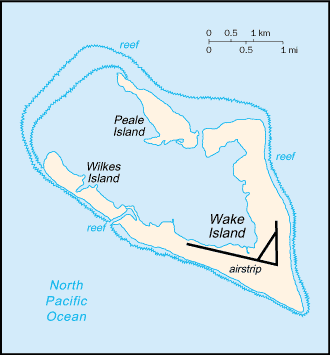
Map image could not be loaded. Open source image.
ⓘ
CIA World Factbook map, February 2021 media edition. Identity reviewed; current boundaries have not been audited. visual contact sheet or original identity check; does not verify current boundaries Boundaries, place names and designations may be dated or disputed; original annotations retained. SHA-256: b0e60d1ac12a3dd5bd220c3f9f5493d1b971181acb0fbeb1f6deef28b0b61f0a. Provenance and inspection record.Introduction
Background:1
Early Micronesian and Polynesian settlers probably visited Wake Island, and oral legends tell of periodic voyages to the islands by people from the Marshall Islands. Wake Island was uninhabited when Spanish explorer Alvaro de Mendana de NEYRA became the first European to see it in 1568 and still had no inhabitants when English captain Samuel WAKE sailed by it in 1796. The United States Exploring Expedition visited the island in 1841, and the US annexed it in 1899 to use as a cable and refueling station for its newly acquired Pacific territories of Hawaii, the Philippines, and Guam. In the 1930s, Pan American Airways built facilities on Wake Island so that it could be used as a stopover for flights from the US to China. In 1941, the US began to install military assets on Wake Island, and Japan then captured the island and held it until the end of World War II. In 1946, commercial airlines resumed using Wake Island as a refueling stop.
In 1973, the Marshall Islands claimed Wake Island, based on the oral legends, although the US has not recognized these claims. In 1974, the US military took exclusive control of the island’s airstrip and restricted visitors. In 1978, Bikini Islanders from the Marshall Islands, who were evacuated in the 1950s and 1960s because of US nuclear tests, considered rehoming on Wake Island, but the US military rejected that plan. Since the 1970s, the island has been important for missile defense testing. In 2009, Wake Island was included in the Pacific Remote Islands Marine National Monument.
Geography
Location:2
Oceania, atoll in the North Pacific Ocean, about two-thirds of the way from Hawaii to the Northern Mariana Islands
Geographic coordinates:3
19 17 N, 166 39 E
Map references:4
Oceania
Area:5
Area - comparative:6
about 11 times the size of the National Mall in Washington, D.C.
Land boundaries:7
Coastline:8
19.3 km
Maritime claims:9
Climate:10
tropical
Terrain:11
atoll of three low coral islands, Peale, Wake, and Wilkes, built up on an underwater volcano; central lagoon is former crater, islands are part of the rim
Elevation:12
Natural resources:13
none
Land use:14
Irrigated land:15
0 sq km (2022)
Natural hazards:16
subject to occasional typhoons
Geography - note:17
strategic location in the North Pacific Ocean
People and Society
Population:18
Environment
Environmental issues:19
limited potable water; hazardous waste disposal
Climate:20
tropical
Land use:21
Carbon dioxide emissions:22
Government
Country name:23
Dependency status:24
unincorporated, unorganized territory of the US; administered by the Department of the Interior; the 11th US Air Force currently conducts activities on the atoll, and it is managed from Pacific Air Force Support Center
Legal system:25
US common law
Citizenship:26
see United States
Independence:27
none (territory of the US)
Flag:28
the US flag is used
Energy
Electricity access:29
Petroleum:30
Communications
Broadcast media:31
US Armed Forces Radio and Television Service (AFRTS) provides satellite radio/TV broadcasts (2018)
Transportation
Military and Security
Military - note:34
defense is the responsibility of the US; the island serves as a trans-Pacific refueling stop for military aircraft and supports US Missile Defense Agency (MDA) testing activities; Wake is managed by the US Air Force (2025)
Notes & sources
- Background. Reference edition; observation: dates as stated in text. Field last updated: not supplied; profile fallback: 2025-08-28 05:45:47 -0400 (not a field revision date); needs review. Reference source. Edition last checked 2026-10-29 (retrieval only). ↩
- Location. Reference edition; observation: dates as stated in text. Field last updated: not supplied; profile fallback: 2025-08-28 05:45:47 -0400 (not a field revision date); needs review. Reference source. Edition last checked 2026-10-29 (retrieval only). ↩
- Geographic coordinates. Reference edition; observation: dates as stated in text. Field last updated: not supplied; profile fallback: 2025-08-28 05:45:47 -0400 (not a field revision date); needs review. Reference source. Edition last checked 2026-10-29 (retrieval only). ↩
- Map references. Reference edition; observation: dates as stated in text. Field last updated: not supplied; profile fallback: 2025-08-28 05:45:47 -0400 (not a field revision date); needs review. Reference source. Edition last checked 2026-10-29 (retrieval only). ↩
- Area. Reference edition; observation: dates as stated in text. Field last updated: not supplied; profile fallback: 2025-08-28 05:45:47 -0400 (not a field revision date); needs review. Reference source. Edition last checked 2026-10-29 (retrieval only). ↩
- Area - comparative. Reference edition; observation: dates as stated in text. Field last updated: not supplied; profile fallback: 2025-08-28 05:45:47 -0400 (not a field revision date); needs review. Reference source. Edition last checked 2026-10-29 (retrieval only). ↩
- Land boundaries. Reference edition; observation: dates as stated in text. Field last updated: not supplied; profile fallback: 2025-08-28 05:45:47 -0400 (not a field revision date); needs review. Reference source. Edition last checked 2026-10-29 (retrieval only). ↩
- Coastline. Reference edition; observation: dates as stated in text. Field last updated: not supplied; profile fallback: 2025-08-28 05:45:47 -0400 (not a field revision date); needs review. Reference source. Edition last checked 2026-10-29 (retrieval only). ↩
- Maritime claims. Reference edition; observation: dates as stated in text. Field last updated: not supplied; profile fallback: 2025-08-28 05:45:47 -0400 (not a field revision date); needs review. Reference source. Edition last checked 2026-10-29 (retrieval only). ↩
- Climate. Reference edition; observation: dates as stated in text. Field last updated: not supplied; profile fallback: 2025-08-28 05:45:47 -0400 (not a field revision date); needs review. Reference source. Edition last checked 2026-10-29 (retrieval only). ↩
- Terrain. Reference edition; observation: dates as stated in text. Field last updated: not supplied; profile fallback: 2025-08-28 05:45:47 -0400 (not a field revision date); needs review. Reference source. Edition last checked 2026-10-29 (retrieval only). ↩
- Elevation. Reference edition; observation: dates as stated in text. Field last updated: not supplied; profile fallback: 2025-08-28 05:45:47 -0400 (not a field revision date); needs review. Reference source. Edition last checked 2026-10-29 (retrieval only). ↩
- Natural resources. Reference edition; observation: dates as stated in text. Field last updated: not supplied; profile fallback: 2025-08-28 05:45:47 -0400 (not a field revision date); needs review. Reference source. Edition last checked 2026-10-29 (retrieval only). ↩
- Land use. Reference edition; observation: dates as stated in text. Field last updated: not supplied; profile fallback: 2025-08-28 05:45:47 -0400 (not a field revision date); needs review. Reference source. Edition last checked 2026-10-29 (retrieval only). ↩
- Irrigated land. Reference edition; observation: 2022. Field last updated: not supplied; profile fallback: 2025-08-28 05:45:47 -0400 (not a field revision date); needs review. Reference source. Edition last checked 2026-10-29 (retrieval only). ↩
- Natural hazards. Reference edition; observation: dates as stated in text. Field last updated: not supplied; profile fallback: 2025-08-28 05:45:47 -0400 (not a field revision date); needs review. Reference source. Edition last checked 2026-10-29 (retrieval only). ↩
- Geography - note. Reference edition; observation: dates as stated in text. Field last updated: not supplied; profile fallback: 2025-08-28 05:45:47 -0400 (not a field revision date); needs review. Reference source. Edition last checked 2026-10-29 (retrieval only). ↩
- Population. Reference edition; observation: dates as stated in text. Field last updated: not supplied; profile fallback: 2025-08-28 05:45:47 -0400 (not a field revision date); needs review. Reference source. Edition last checked 2026-10-29 (retrieval only). ↩
- Environmental issues. Reference edition; observation: dates as stated in text. Field last updated: not supplied; profile fallback: 2025-08-28 05:45:47 -0400 (not a field revision date); needs review. Reference source. Edition last checked 2026-10-29 (retrieval only). ↩
- Climate. Reference edition; observation: dates as stated in text. Field last updated: not supplied; profile fallback: 2025-08-28 05:45:47 -0400 (not a field revision date); needs review. Reference source. Edition last checked 2026-10-29 (retrieval only). ↩
- Land use. Reference edition; observation: dates as stated in text. Field last updated: not supplied; profile fallback: 2025-08-28 05:45:47 -0400 (not a field revision date); needs review. Reference source. Edition last checked 2026-10-29 (retrieval only). ↩
- Carbon dioxide emissions. Reference edition; observation: dates as stated in text. Field last updated: not supplied; profile fallback: 2025-08-28 05:45:47 -0400 (not a field revision date); needs review. Reference source. Edition last checked 2026-10-29 (retrieval only). ↩
- Country name. Reference edition; observation: dates as stated in text. Field last updated: not supplied; profile fallback: 2025-08-28 05:45:47 -0400 (not a field revision date); needs review. Reference source. Edition last checked 2026-10-29 (retrieval only). ↩
- Dependency status. Reference edition; observation: dates as stated in text. Field last updated: not supplied; profile fallback: 2025-08-28 05:45:47 -0400 (not a field revision date); needs review. Reference source. Edition last checked 2026-10-29 (retrieval only). ↩
- Legal system. Reference edition; observation: dates as stated in text. Field last updated: not supplied; profile fallback: 2025-08-28 05:45:47 -0400 (not a field revision date); needs review. Reference source. Edition last checked 2026-10-29 (retrieval only). ↩
- Citizenship. Reference edition; observation: dates as stated in text. Field last updated: not supplied; profile fallback: 2025-08-28 05:45:47 -0400 (not a field revision date); needs review. Reference source. Edition last checked 2026-10-29 (retrieval only). ↩
- Independence. Reference edition; observation: dates as stated in text. Field last updated: not supplied; profile fallback: 2025-08-28 05:45:47 -0400 (not a field revision date); needs review. Reference source. Edition last checked 2026-10-29 (retrieval only). ↩
- Flag. Reference edition; observation: dates as stated in text. Field last updated: not supplied; profile fallback: 2025-08-28 05:45:47 -0400 (not a field revision date); needs review. Reference source. Edition last checked 2026-10-29 (retrieval only). ↩
- Electricity access. Reference edition; observation: dates as stated in text. Field last updated: not supplied; profile fallback: 2025-08-28 05:45:47 -0400 (not a field revision date); needs review. Reference source. Edition last checked 2026-10-29 (retrieval only). ↩
- Petroleum. Reference edition; observation: dates as stated in text. Field last updated: not supplied; profile fallback: 2025-08-28 05:45:47 -0400 (not a field revision date); needs review. Reference source. Edition last checked 2026-10-29 (retrieval only). ↩
- Broadcast media. Reference edition; observation: 2018. Field last updated: not supplied; profile fallback: 2025-08-28 05:45:47 -0400 (not a field revision date); needs review. Reference source. Edition last checked 2026-10-29 (retrieval only). ↩
- Airports. Reference edition; observation: 2025. Field last updated: not supplied; profile fallback: 2025-08-28 05:45:47 -0400 (not a field revision date); needs review. Reference source. Edition last checked 2026-10-29 (retrieval only). ↩
- Ports. Reference edition; observation: dates as stated in text. Field last updated: not supplied; profile fallback: 2025-08-28 05:45:47 -0400 (not a field revision date); needs review. Reference source. Edition last checked 2026-10-29 (retrieval only). ↩
- Military - note. Reference edition; observation: 2025. Field last updated: not supplied; profile fallback: 2025-08-28 05:45:47 -0400 (not a field revision date); needs review. Reference source. Edition last checked 2026-10-29 (retrieval only). ↩