Latin America & Caribbean / VEN
Venezuela, RB

ⓘ
2021 Factbook flag mirror; image identity has not been individually audited. Source.
Last updated: October 29, 2026
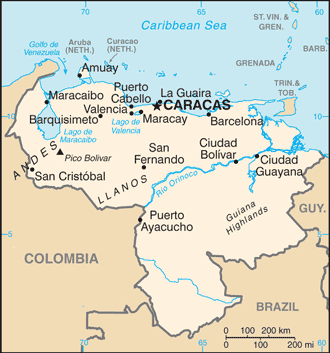
Map image could not be loaded. Open source image.
ⓘ
CIA World Factbook map, February 2021 media edition. Identity reviewed; current boundaries have not been audited. visual contact sheet or original identity check; does not verify current boundaries Boundaries, place names and designations may be dated or disputed; original annotations retained. SHA-256: e05dd1d64df6a537e98b22c398b48d792884ea38cdf0e768cd281c57b5820fb5. Provenance and inspection record.ⓘ
World Bank directory coordinates; approximate location, not a country center. Coordinate reference date is not supplied by the directory. Natural Earth 1:110m land (2022 source); simplified coastline, no political borders. Map source. Land SVG SHA-256: CF26056A39DC0A5B02F65704E279DFA86E77539A8387D0B2C92F907A67739E5E.Introduction
Background:1
Venezuela was one of three countries that emerged from the collapse of Gran Colombia in 1830, the others being Ecuador and New Granada (Colombia). For most of the first half of the 20th century, military strongmen ruled Venezuela and promoted the oil industry while allowing some social reforms. Democratically elected governments largely held sway until 1999, but Hugo CHAVEZ, who was president from 1999 to 2013, exercised authoritarian control over other branches of government. This trend continued in 2018 when Nicolas MADURO claimed the presidency for his second term in an election boycotted by most opposition parties and widely viewed as fraudulent. The legislative elections in 2020 were also seen as fraudulent, and most opposition parties and many international actors consider the resulting National Assembly illegitimate. In 2021, many opposition parties broke a three-year election boycott and participated in mayoral and gubernatorial elections, despite flawed conditions. As a result, the opposition more than doubled its representation at the mayoral level and retained four of 23 governorships. The 2021 regional elections marked the first time since 2006 that the EU was allowed to send an electoral observation mission to Venezuela.
MADURO has placed strong restrictions on free speech and the press. Since CHAVEZ, the ruling party has expanded the state's role in the economy through expropriations of major enterprises, strict currency exchange and price controls, and over-dependence on the petroleum industry for revenues. Years of economic mismanagement left Venezuela ill-prepared to weather the global drop in oil prices in 2014, sparking an economic decline that has resulted in reduced government social spending, shortages of basic goods, and high inflation. Worsened living conditions have prompted nearly 8 million Venezuelans to emigrate, mainly settling in nearby countries. The US imposed financial sanctions on MADURO and his representatives in 2017 and on sectors of the Venezuelan economy in 2018. Limited sanctions relief followed when the MADURO administration began making democratic and electoral concessions.
The government's mismanagement and lack of investment in infrastructure has also weakened the country's energy sector. Caracas has relaxed some controls to mitigate the impact of its sustained economic crisis, such as allowing increased import flexibility for the private sector and the informal use of US dollars and other international currencies. Ongoing concerns include human rights abuses, rampant violent crime, political manipulation of the judicial and electoral systems, and corruption.
Geography
Location:2
Northern South America, bordering the Caribbean Sea and the North Atlantic Ocean, between Colombia and Guyana
Geographic coordinates:3
8 00 N, 66 00 W
Map references:4
South America
Area:5
Surface area: 912,050 square kilometers (2024)
Area - comparative:7
almost six times the size of Georgia; slightly more than twice the size of California
Land boundaries:8
Coastline:9
2,800 km
Maritime claims:10
Climate:11
tropical; hot, humid; more moderate in highlands
Terrain:12
Andes Mountains and Maracaibo Lowlands in northwest; central plains (llanos); Guiana Highlands in southeast
Elevation:13
Natural resources:14
petroleum, natural gas, iron ore, gold, bauxite, other minerals, hydropower, diamonds
Land use:15
Irrigated land:16
10,550 sq km (2012)
Major lakes (area sq km):17
Major rivers (by length in km):18
Rio Negro (shared with Colombia [s] and Brazil [m]) - 2,250 km; Orinoco river source and mouth (shared with Colombia) - 2,101 km
Major watersheds (area sq km):19
Population distribution:20
most of the population is concentrated in the northern and western highlands along an eastern spur at the northern end of the Andes, an area that includes the capital of Caracas
Natural hazards:21
subject to floods, rockslides, mudslides; periodic droughts
Geography - note:22
People and Society
Population:23
Population: 28,516,896 people (2025)
Nationality:25
Ethnic groups:26
unspecified Spanish, Italian, Portuguese, Arab, German, African, Indigenous
Languages:27
Spanish (official) 98.2%, indigenous 1.3%, Portuguese 0.1%, other 0.4% (2023 est.)
Religions:28
Roman Catholic 48.1%, Protestant 31.6% (Evangelical 31.4%, Adventist 0.2%), Jehovah's Witness 1.4%, African American/umbanda 0.7%, other 0.1%, believer 3.5%, agnostic 0.1%, atheist, 0.4%, none 13.6%, unspecified 0.6% (2023 est.)
Age structure:29
Dependency ratios:30
Median age:31
Population growth rate:32
Population growth rate: 0.39 % annually (2025)
2.34% (2024 est.)
Birth rate:34
Crude birth rate: 15.23 births per 1,000 people (2024)
16.7 births/1,000 population (2024 est.)
Death rate:36
Crude death rate: 7.68 deaths per 1,000 people (2024)
6.5 deaths/1,000 population (2024 est.)
Net migration rate:38
13.2 migrant(s)/1,000 population (2024 est.)
Population distribution:39
most of the population is concentrated in the northern and western highlands along an eastern spur at the northern end of the Andes, an area that includes the capital of Caracas
Urbanization:40
Urban population: 89.32 % of population (2025)
Major urban areas - population:42
2.972 million CARACAS (capital), 2.368 million Maracaibo, 1.983 million Valencia, 1.254 million Barquisimeto, 1.243 million Maracay, 964,000 Ciudad Guayana (2023)
Sex ratio:43
Maternal mortality ratio:44
Maternal mortality ratio: 227 deaths per 100,000 live births (2023)
227 deaths/100,000 live births (2023 est.)
Infant mortality rate:46
Infant mortality rate: 21.2 deaths per 1,000 live births (2024)
Life expectancy at birth:48
Life expectancy at birth: 72.67 years (2024)
Total fertility rate:50
Total fertility rate: 2.08 births per woman (2024)
2.18 children born/woman (2024 est.)
Gross reproduction rate:52
1.06 (2024 est.)
Drinking water source:53
At least basic drinking water services: 93.33 % of population (2024)
Health expenditure:55
Current health expenditure: 3.78 % of GDP (2023)
Physician density:57
1.66 physicians/1,000 population (2017)
Hospital bed density:58
1 beds/1,000 population (2020 est.)
Sanitation facility access:59
At least basic sanitation services: 98.4 % of population (2024)
Obesity - adult prevalence rate:61
25.6% (2016)
Alcohol consumption per capita:62
Currently married women (ages 15-49):63
51.5% (2023 est.)
Education expenditure:64
Literacy:65
Environment
Environmental issues:66
sewage pollution of Lago de Valencia; oil and urban pollution of Lago de Maracaibo; deforestation; soil degradation; urban and industrial pollution, especially along the Caribbean coast; threat to the rainforest ecosystem from mining operations
International environmental agreements:67
Climate:68
tropical; hot, humid; more moderate in highlands
Land use:69
Urbanization:70
Carbon dioxide emissions:71
Particulate matter emissions:72
16.1 micrograms per cubic meter (2019 est.)
Methane emissions:73
Waste and recycling:74
Total water withdrawal:75
Total renewable water resources:76
1.325 trillion cubic meters (2022 est.)
Government
Country name:77
Government type:78
federal presidential republic
Capital:79
Administrative divisions:80
23 states ( estados , singular - estado ), 1 capital district* ( distrito capital ), and 1 federal dependency** ( dependencia federal ); Amazonas, Anzoátegui, Apure, Aragua, Barinas, Bolivar, Carabobo, Cojedes, Delta Amacuro, Dependencias Federales (Federal Dependencies)**, Distrito Capital (Capital District)*, Falcon, Guárico, La Guairá, Lara, Merida, Miranda, Monagas, Nueva Esparta, Portuguesa, Sucre, Táchira, Trujillo, Yaracuy, Zulia
Legal system:81
civil law system based on the Spanish civil code
Constitution:82
International law organization participation:83
has not submitted an ICJ jurisdiction declaration; accepts ICCt jurisdiction
Citizenship:84
Suffrage:85
18 years of age; universal
Executive branch:86
Legislative branch:87
Judicial branch:88
Political parties:89
A New Era (Un Nuevo Tiempo) or UNT
Cambiemos Movimiento Ciudadano or CMC
Christian Democrats or COPEI (also known as the Social Christian Party)
Citizens Encounter or EC
Clear Accounts or CC
Coalition of parties loyal to Nicolas MADURO - Great Patriotic Pole or GPP
Coalition of opposition parties - Democratic Alliance (Alianza Democratica) (includes AD, EL CAMBIO, COPEI, CMC, and AP)
Come Venezuela (Vente Venezuela) or VV
Communist Party of Venezuela or PCV
Consenso en la Zona or Conenzo
Convergencia
Democratic Action or AD
Fatherland for All (Patria para Todos) or PPT
Fearless People's Alliance or ABP
Fuerza Vecinal or FV
Hope for Change (Esperanza por el Cambio) or EL CAMBIO
Justice First (Primero Justicia) or PJ
LAPIZ
Movement to Socialism (Movimiento al Socialismo) or MAS
Popular Will (Voluntad Popular) or VP
Progressive Advance (Avanzada Progresista) or AP
The Radical Cause or La Causa R
United Socialist Party of Venezuela or PSUV
Venezuela First (Primero Venezuela) or PV
Venezuelan Progressive Movement or MPV
Venezuela Project or PV
Diplomatic representation in the US:90
none
note : the embassy, which had been run by the Venezuelan political opposition, announced on 5 January 2023, that it had ended all embassy functions
Diplomatic representation from the US:91
International organization participation:92
ACS, Caricom (observer), CD, CDB, CELAC, FAO, G-15, G-24, G-77, IADB, IAEA, IBRD, ICAO, ICC (national committees), ICCt (signatory), ICRM, IDA, IFAD, IFC, IFRCS, IHO, ILO, IMF, IMO, IMSO, Interpol, IOC, IOM, IPU, ITSO, ITU, ITUC (NGOs), LAES, LAIA, LAS (observer), MIGA, NAM, OAS, OPANAL, OPCW, OPEC, PCA, Petrocaribe, UN, UNASUR, UNCTAD, UNESCO, UNHCR, UNHRC, UNIDO, Union Latina, UNOOSA, UNWTO, UPU, WCO, WFTU (NGOs), WHO, WIPO, WMO, WTO
Independence:93
5 July 1811 (from Spain)
National holiday:94
Independence Day, 5 July (1811)
Flag:95
National symbol(s):96
troupial (bird)
National color(s):97
yellow, blue, red
National anthem(s):98
National heritage:99
Economy
Economic overview:100
South American economy; ongoing hyperinflation since mid-2010s; chaotic economy due to political corruption, infrastructure cuts, and human rights abuses; in debt default; oil exporter; hydropower consumer; rising Chinese relations
Real GDP (purchasing power parity):101
$110.943 billion (2023 est.)
$106.672 billion (2022 est.)
$98.768 billion (2021 est.)
Real GDP growth rate:102
-19.67% (2018 est.)
-14% (2017 est.)
-15.76% (2017 est.)
Real GDP per capita:103
GDP (official exchange rate):104
GDP: 99,661,244,155.63 current US dollars (2025)
$139.395 billion (2023 est.)
Inflation rate (consumer prices):106
200.9% (2022 est.)
1,588.5% (2021 est.)
2,355.1% (2020 est.)
Agricultural products:107
milk, sugarcane, maize, rice, plantains, oil palm fruit, bananas, chicken, pineapples, potatoes (2023)
Industries:108
agricultural products, livestock, raw materials, machinery and equipment, transport equipment, construction materials, medical equipment, pharmaceuticals, chemicals, iron and steel products, crude oil and petroleum products
Labor force:109
11.136 million (2024 est.)
Unemployment rate:110
Youth unemployment rate (ages 15-24):111
Population below poverty line:112
33.1% (2015 est.)
Average household expenditures:113
Budget:114
Public debt:115
38.9% of GDP (2017 est.)
Current account balance:116
-$3.87 billion (2016 est.)
-$16.051 billion (2015 est.)
Exports:117
$83.401 billion (2018 est.)
$93.485 billion (2017 est.)
$28.684 billion (2016 est.)
Exports - partners:118
USA 50%, China 10%, Spain 9%, Brazil 6%, Turkey 5% (2023)
Exports - commodities:119
crude petroleum, petroleum coke, scrap iron, alcohols, fertilizers (2023)
Imports:120
$18.432 billion (2018 est.)
$18.376 billion (2017 est.)
$25.81 billion (2016 est.)
Imports - partners:121
China 35%, USA 24%, Brazil 12%, Colombia 7%, Turkey 4% (2023)
Imports - commodities:122
refined petroleum, soybean meal, corn, plastic products, vehicle parts/accessories (2023)
Reserves of foreign exchange and gold:123
$9.794 billion (2017 est.)
$10.15 billion (2016 est.)
$15.625 billion (2015 est.)
Exchange rates:124
9.975 (2017 est.)
9.257 (2016 est.)
6.284 (2015 est.)
6.284 (2014 est.)
6.048 (2013 est.)
Energy
Electricity access:125
Electricity:126
Electricity generation sources:127
Coal:128
Petroleum:129
Natural gas:130
Energy consumption per capita:131
Communications
Telephones - fixed lines:132
Telephones - mobile cellular:133
Broadcast media:134
mix of state-run and private broadcast media subject to high levels of control; 13 public service networks, 61 privately owned TV networks, 1 privately owned news channel with limited national coverage, and a Maduro-backed Pan-American channel; 3 Maduro-aligned radio networks control about 65 news stations and another 30 stations targeted at specific audiences; Maduro-sponsored community broadcasters include 235 radio stations and 44 TV stations; the number of private broadcast radio stations declining, but many remain (2021)
Internet country code:135
.ve
Internet users:136
Broadband - fixed subscriptions:137
Transportation
Civil aircraft registration country code prefix:138
YV
Airports:139
509 (2025)
Heliports:140
88 (2025)
Railways:141
Merchant marine:142
Ports:143
Military and Security
Military and security forces:144
Bolivarian National Armed Forces (Fuerza Armada Nacional Bolivariana, FANB): Bolivarian Army (Ejercito Bolivariano, EB), Bolivarian Navy (Armada Bolivariana, AB; includes marines, Coast Guard), Bolivarian Military Aviation (Aviacion Militar Bolivariana, AMB), Bolivarian Militia (Milicia Bolivariana), Bolivarian National Guard (Guardia Nacional Bolivaria, GNB), Presidential Honor Guard
Ministry of Interior, Justice, and Peace: Bolivarian National Police (Policía Nacional Bolivariana, PNB) (2025)
note 3: the PNB is a federal force created by Hugo CHAVEZ in 2008 as a “preventative police force,” separate from state and local ones; the PNB largely focuses on policing Caracas’ Libertador municipality, patrolling Caracas-area highways, railways, and metro system, and protecting diplomatic missions; the PNB includes the Special Action Forces (Fuerzas de Acciones Especiales, FAES), a paramilitary unit created by President MADURO to bolster internal security after the 2017 anti-government protests
Military expenditures:145
0.6% of GDP (2024 est.)
0.5% of GDP (2023 est.)
0.6% of GDP (2022 est.)
0.3% of GDP (2021 est.)
1.6% of GDP (2020 est.)
Military and security service personnel strengths:146
information varies; approximately 125-150,000 active Armed Forces; estimated 200,000 Bolivarian Militia (2025)
Military equipment inventories and acquisitions:147
the FANB inventory is comprised mostly of Russian/Soviet-era weapons and equipment; in recent years, it has acquired some material from China and Iran; it also has smaller quantities of older equipment from France, Germany, Spain, the UK, and the US (2024)
Military service age and obligation:148
18-30 (25 for women) for voluntary service; the minimum service obligation is 24-30 months; 17-39 for Militia service; all citizens of military service age (18-50) are obligated to register for military service and subject to military training (2025)
Military - note:149
the armed forces (FANB) are responsible for ensuring Venezuela’s independence, sovereignty, and territorial integrity; they also have a domestic role, including assisting with maintaining internal security, conducting counter-narcotics missions, contributing to national socio-economic development, and providing disaster relief/humanitarian assistance; the military conducts internal security operations in large parts of the country and has been deployed against illegal armed groups operating in the Colombian border region and other areas to combat organized crime gangs involved in narcotics trafficking and illegal mining; it has ties with the militaries of China, Cuba, Iran, and Russia
the FANB has a role in the country’s economy and political sectors; military officers hold key positions in state-owned companies, government ministries, and funding agencies; the FANB runs corporation involved in agriculture, banking, communications, energy, insurance, mining, and transportation (2025)
Space
Space agency/agencies:150
Bolivarian Agency for Space Activities (Agencia Bolivariana para Actividades Espaciales, ABAE; formed 2007) (2025)
Space program overview:151
has a small national program primarily focused on acquiring satellites and expanding the country’s science and technological capabilities; operates satellites and maintains two satellite ground control stations; participates in multinational space organizations such as the Latin American and Caribbean Space Agency; closest bilateral partners are China and Russia; also has bilateral framework agreements for space cooperation with Argentina, Bolivia, Brazil, and Uruguay (2025)
Key space-program milestones:152
2005 - signed space cooperation partnership with China
2008- first communications satellite (Venesat-1 or Bolivar) financed, built, and launched by China
2012 - first remote sensing (RS) satellite (VRSS-1 or Miranda) built and launched by China
2017 - second RS satellite (VRSS-2 or Sucre) built and launched by China
2021 - signed agreement to establish the Latin American and Caribbean Space Agency (formally established in 2022)
2023 - joined China-Russia project to construct a permanent base on the Moon by the 2030s
2025 - announced intent to participate in planned Mars sample-return mission (Tianwen-3) led by China
Terrorism
Terrorist group(s):153
National Liberation Army (ELN); Revolutionary Armed Forces of Colombia-People's Army (FARC-EP); Segundo Marquetalia (SM); Tren de Aragua (TdA)
Transnational Issues
Refugees and internally displaced persons:154
Trafficking in persons:155
Illicit drugs:156
Additional observations
- Real GDP growth157
- 1.57 % annual change (2025)
- Consumer price inflation158
- 254.95 % annual change (2016)
- Unemployment (modeled ILO estimate)159
- 5.31 % of labor force (2025)
- Access to electricity160
- 100 % of population (2024)
- Renewable energy share of total final energy consumption161
- 33.7 % (2021)
- Individuals using the internet162
- 76.68 % of population (2024)
- Physicians163
- 1.66 per 1,000 people (2017)
- Adult literacy rate164
- 97.18 % of people aged 15 and over (2017)
- Government education expenditure165
- 6.87 % of GDP (2009)
Notes & sources
- Background. Reference edition; observation: dates as stated in text. Field last updated: not supplied; profile fallback: 2025-12-04 11:23:49 -0500 (not a field revision date); needs review. Reference source. Edition last checked 2026-10-29 (retrieval only). ↩
- Location. Reference edition; observation: dates as stated in text. Field last updated: not supplied; profile fallback: 2025-12-04 11:23:49 -0500 (not a field revision date); needs review. Reference source. Edition last checked 2026-10-29 (retrieval only). ↩
- Geographic coordinates. Reference edition; observation: dates as stated in text. Field last updated: not supplied; profile fallback: 2025-12-04 11:23:49 -0500 (not a field revision date); needs review. Reference source. Edition last checked 2026-10-29 (retrieval only). ↩
- Map references. Reference edition; observation: dates as stated in text. Field last updated: not supplied; profile fallback: 2025-12-04 11:23:49 -0500 (not a field revision date); needs review. Reference source. Edition last checked 2026-10-29 (retrieval only). ↩
- Area. Reference edition; observation: dates as stated in text. Field last updated: not supplied; profile fallback: 2025-12-04 11:23:49 -0500 (not a field revision date); needs review. Reference source. The archived total area has no reference year and territorial coverage may differ from World Bank surface area. World Bank: 912,050 square kilometers (2024). Reference: 912,050 square kilometers. Edition last checked 2026-10-29 (retrieval only). ↩
- Surface area. Surface area: observation 2024; checked 2026-10-29; single source. World Bank World Development Indicators. The archived total area has no reference year and territorial coverage may differ from World Bank surface area. World Bank: 912,050 square kilometers (2024). Reference: 912,050 square kilometers. ↩
- Area - comparative. Reference edition; observation: dates as stated in text. Field last updated: not supplied; profile fallback: 2025-12-04 11:23:49 -0500 (not a field revision date); needs review. Reference source. Edition last checked 2026-10-29 (retrieval only). ↩
- Land boundaries. Reference edition; observation: dates as stated in text. Field last updated: not supplied; profile fallback: 2025-12-04 11:23:49 -0500 (not a field revision date); needs review. Reference source. Edition last checked 2026-10-29 (retrieval only). ↩
- Coastline. Reference edition; observation: dates as stated in text. Field last updated: not supplied; profile fallback: 2025-12-04 11:23:49 -0500 (not a field revision date); needs review. Reference source. Edition last checked 2026-10-29 (retrieval only). ↩
- Maritime claims. Reference edition; observation: dates as stated in text. Field last updated: not supplied; profile fallback: 2025-12-04 11:23:49 -0500 (not a field revision date); needs review. Reference source. Edition last checked 2026-10-29 (retrieval only). ↩
- Climate. Reference edition; observation: dates as stated in text. Field last updated: not supplied; profile fallback: 2025-12-04 11:23:49 -0500 (not a field revision date); needs review. Reference source. Edition last checked 2026-10-29 (retrieval only). ↩
- Terrain. Reference edition; observation: dates as stated in text. Field last updated: not supplied; profile fallback: 2025-12-04 11:23:49 -0500 (not a field revision date); needs review. Reference source. Edition last checked 2026-10-29 (retrieval only). ↩
- Elevation. Reference edition; observation: dates as stated in text. Field last updated: not supplied; profile fallback: 2025-12-04 11:23:49 -0500 (not a field revision date); needs review. Reference source. Edition last checked 2026-10-29 (retrieval only). ↩
- Natural resources. Reference edition; observation: dates as stated in text. Field last updated: not supplied; profile fallback: 2025-12-04 11:23:49 -0500 (not a field revision date); needs review. Reference source. Edition last checked 2026-10-29 (retrieval only). ↩
- Land use. Reference edition; observation: dates as stated in text. Field last updated: not supplied; profile fallback: 2025-12-04 11:23:49 -0500 (not a field revision date); needs review. Reference source. Edition last checked 2026-10-29 (retrieval only). ↩
- Irrigated land. Reference edition; observation: 2012. Field last updated: not supplied; profile fallback: 2025-12-04 11:23:49 -0500 (not a field revision date); needs review. Reference source. Edition last checked 2026-10-29 (retrieval only). ↩
- Major lakes (area sq km). Reference edition; observation: dates as stated in text. Field last updated: not supplied; profile fallback: 2025-12-04 11:23:49 -0500 (not a field revision date); needs review. Reference source. Edition last checked 2026-10-29 (retrieval only). ↩
- Major rivers (by length in km). Reference edition; observation: dates as stated in text. Field last updated: not supplied; profile fallback: 2025-12-04 11:23:49 -0500 (not a field revision date); needs review. Reference source. Edition last checked 2026-10-29 (retrieval only). ↩
- Major watersheds (area sq km). Reference edition; observation: dates as stated in text. Field last updated: not supplied; profile fallback: 2025-12-04 11:23:49 -0500 (not a field revision date); needs review. Reference source. Edition last checked 2026-10-29 (retrieval only). ↩
- Population distribution. Reference edition; observation: dates as stated in text. Field last updated: not supplied; profile fallback: 2025-12-04 11:23:49 -0500 (not a field revision date); needs review. Reference source. Edition last checked 2026-10-29 (retrieval only). ↩
- Natural hazards. Reference edition; observation: dates as stated in text. Field last updated: not supplied; profile fallback: 2025-12-04 11:23:49 -0500 (not a field revision date); needs review. Reference source. Edition last checked 2026-10-29 (retrieval only). ↩
- Geography - note. Reference edition; observation: dates as stated in text. Field last updated: not supplied; profile fallback: 2025-12-04 11:23:49 -0500 (not a field revision date); needs review. Reference source. Edition last checked 2026-10-29 (retrieval only). ↩
- Population. Reference edition; observation: dates as stated in text. Field last updated: not supplied; profile fallback: 2025-12-04 11:23:49 -0500 (not a field revision date); needs review. Reference source. Different reference years; no numerical agreement is asserted. World Bank: 28,516,896 people (2025). Reference: 31,250,306 people (2024). Edition last checked 2026-10-29 (retrieval only). ↩
- Population. Population: observation 2025; checked 2026-10-29; single source. World Bank World Development Indicators. Different reference years; no numerical agreement is asserted. World Bank: 28,516,896 people (2025). Reference: 31,250,306 people (2024). ↩
- Nationality. Reference edition; observation: dates as stated in text. Field last updated: not supplied; profile fallback: 2025-12-04 11:23:49 -0500 (not a field revision date); needs review. Reference source. Edition last checked 2026-10-29 (retrieval only). ↩
- Ethnic groups. Reference edition; observation: dates as stated in text. Field last updated: not supplied; profile fallback: 2025-12-04 11:23:49 -0500 (not a field revision date); needs review. Reference source. Edition last checked 2026-10-29 (retrieval only). ↩
- Languages. Reference edition; observation: dates as stated in text. Field last updated: not supplied; profile fallback: 2025-12-04 11:23:49 -0500 (not a field revision date); needs review. Reference source. Edition last checked 2026-10-29 (retrieval only). ↩
- Religions. Reference edition; observation: 2023 est.. Field last updated: not supplied; profile fallback: 2025-12-04 11:23:49 -0500 (not a field revision date); needs review. Reference source. Edition last checked 2026-10-29 (retrieval only). ↩
- Age structure. Reference edition; observation: dates as stated in text. Field last updated: not supplied; profile fallback: 2025-12-04 11:23:49 -0500 (not a field revision date); needs review. Reference source. Edition last checked 2026-10-29 (retrieval only). ↩
- Dependency ratios. Reference edition; observation: dates as stated in text. Field last updated: not supplied; profile fallback: 2025-12-04 11:23:49 -0500 (not a field revision date); needs review. Reference source. Edition last checked 2026-10-29 (retrieval only). ↩
- Median age. Reference edition; observation: dates as stated in text. Field last updated: not supplied; profile fallback: 2025-12-04 11:23:49 -0500 (not a field revision date); needs review. Reference source. Edition last checked 2026-10-29 (retrieval only). ↩
- Population growth rate. Reference edition; observation: 2024. Field last updated: not supplied; profile fallback: 2025-12-04 11:23:49 -0500 (not a field revision date); needs review. Reference source. Edition last checked 2026-10-29 (retrieval only). ↩
- Population growth rate. Population growth rate: observation 2025; checked 2026-10-29; single source. World Bank World Development Indicators. Latest available World Bank series in 2020–2026; reference year is not retrieval year. May be modeled or revised; differing definitions and geography require review. No independent crosscheck; do not silently replace archived Factbook. ↩
- Birth rate. Reference edition; observation: 2024. Field last updated: not supplied; profile fallback: 2025-12-04 11:23:49 -0500 (not a field revision date); needs review. Reference source. Edition last checked 2026-10-29 (retrieval only). ↩
- Crude birth rate. Crude birth rate: observation 2024; checked 2026-10-29; single source. World Bank World Development Indicators. Latest available World Bank series in 2020–2026; reference year is not retrieval year. May be modeled or revised; differing definitions and geography require review. No independent crosscheck; do not silently replace archived Factbook. ↩
- Death rate. Reference edition; observation: 2024. Field last updated: not supplied; profile fallback: 2025-12-04 11:23:49 -0500 (not a field revision date); needs review. Reference source. Edition last checked 2026-10-29 (retrieval only). ↩
- Crude death rate. Crude death rate: observation 2024; checked 2026-10-29; single source. World Bank World Development Indicators. Latest available World Bank series in 2020–2026; reference year is not retrieval year. May be modeled or revised; differing definitions and geography require review. No independent crosscheck; do not silently replace archived Factbook. ↩
- Net migration rate. Reference edition; observation: 2024. Field last updated: not supplied; profile fallback: 2025-12-04 11:23:49 -0500 (not a field revision date); needs review. Reference source. Edition last checked 2026-10-29 (retrieval only). ↩
- Population distribution. Reference edition; observation: dates as stated in text. Field last updated: not supplied; profile fallback: 2025-12-04 11:23:49 -0500 (not a field revision date); needs review. Reference source. Edition last checked 2026-10-29 (retrieval only). ↩
- Urbanization. Reference edition; observation: dates as stated in text. Field last updated: not supplied; profile fallback: 2025-12-04 11:23:49 -0500 (not a field revision date); needs review. Reference source. Edition last checked 2026-10-29 (retrieval only). ↩
- Urban population. Urban population: observation 2025; checked 2026-10-29; single source. World Bank World Development Indicators. Latest available World Bank series in 2020–2026; reference year is not retrieval year. May be modeled or revised; differing definitions and geography require review. No independent crosscheck; do not silently replace archived Factbook. ↩
- Major urban areas - population. Reference edition; observation: 2023. Field last updated: not supplied; profile fallback: 2025-12-04 11:23:49 -0500 (not a field revision date); needs review. Reference source. Edition last checked 2026-10-29 (retrieval only). ↩
- Sex ratio. Reference edition; observation: dates as stated in text. Field last updated: not supplied; profile fallback: 2025-12-04 11:23:49 -0500 (not a field revision date); needs review. Reference source. Edition last checked 2026-10-29 (retrieval only). ↩
- Maternal mortality ratio. Reference edition; observation: 2023. Field last updated: not supplied; profile fallback: 2025-12-04 11:23:49 -0500 (not a field revision date); needs review. Reference source. Edition last checked 2026-10-29 (retrieval only). ↩
- Maternal mortality ratio. Maternal mortality ratio: observation 2023; checked 2026-10-29; single source. World Bank World Development Indicators. Latest available World Bank series in 2020–2026; reference year is not retrieval year. May be modeled or revised; differing definitions and geography require review. No independent crosscheck; do not silently replace archived Factbook. ↩
- Infant mortality rate. Reference edition; observation: dates as stated in text. Field last updated: not supplied; profile fallback: 2025-12-04 11:23:49 -0500 (not a field revision date); needs review. Reference source. Edition last checked 2026-10-29 (retrieval only). ↩
- Infant mortality rate. Infant mortality rate: observation 2024; checked 2026-10-29; single source. World Bank World Development Indicators. Latest available World Bank series in 2020–2026; reference year is not retrieval year. May be modeled or revised; differing definitions and geography require review. No independent crosscheck; do not silently replace archived Factbook. ↩
- Life expectancy at birth. Reference edition; observation: dates as stated in text. Field last updated: not supplied; profile fallback: 2025-12-04 11:23:49 -0500 (not a field revision date); needs review. Reference source. Edition last checked 2026-10-29 (retrieval only). ↩
- Life expectancy at birth. Life expectancy at birth: observation 2024; checked 2026-10-29; single source. World Bank World Development Indicators. Latest available World Bank series in 2020–2026; reference year is not retrieval year. May be modeled or revised; differing definitions and geography require review. No independent crosscheck; do not silently replace archived Factbook. ↩
- Total fertility rate. Reference edition; observation: 2024. Field last updated: not supplied; profile fallback: 2025-12-04 11:23:49 -0500 (not a field revision date); needs review. Reference source. Edition last checked 2026-10-29 (retrieval only). ↩
- Total fertility rate. Total fertility rate: observation 2024; checked 2026-10-29; single source. World Bank World Development Indicators. Latest available World Bank series in 2020–2026; reference year is not retrieval year. May be modeled or revised; differing definitions and geography require review. No independent crosscheck; do not silently replace archived Factbook. ↩
- Gross reproduction rate. Reference edition; observation: 2024. Field last updated: not supplied; profile fallback: 2025-12-04 11:23:49 -0500 (not a field revision date); needs review. Reference source. Edition last checked 2026-10-29 (retrieval only). ↩
- Drinking water source. Reference edition; observation: dates as stated in text. Field last updated: not supplied; profile fallback: 2025-12-04 11:23:49 -0500 (not a field revision date); needs review. Reference source. Edition last checked 2026-10-29 (retrieval only). ↩
- At least basic drinking water services. At least basic drinking water services: observation 2024; checked 2026-10-29; single source. World Bank World Development Indicators. Latest available World Bank series in 2020–2026; reference year is not retrieval year. May be modeled or revised; differing definitions and geography require review. No independent crosscheck; do not silently replace archived Factbook. This separately sourced basic-service observation is shown alongside the reference edition’s improved/unimproved categories. It does not replace those category totals. ↩
- Health expenditure. Reference edition; observation: dates as stated in text. Field last updated: not supplied; profile fallback: 2025-12-04 11:23:49 -0500 (not a field revision date); needs review. Reference source. Edition last checked 2026-10-29 (retrieval only). ↩
- Current health expenditure. Current health expenditure: observation 2023; checked 2026-10-29; single source. World Bank World Development Indicators. Latest available World Bank series in 2020–2026; reference year is not retrieval year. May be modeled or revised; differing definitions and geography require review. No independent crosscheck; do not silently replace archived Factbook. ↩
- Physician density. Reference edition; observation: 2017. Field last updated: not supplied; profile fallback: 2025-12-04 11:23:49 -0500 (not a field revision date); needs review. Reference source. Edition last checked 2026-10-29 (retrieval only). ↩
- Hospital bed density. Reference edition; observation: 2020. Field last updated: not supplied; profile fallback: 2025-12-04 11:23:49 -0500 (not a field revision date); needs review. Reference source. Edition last checked 2026-10-29 (retrieval only). ↩
- Sanitation facility access. Reference edition; observation: dates as stated in text. Field last updated: not supplied; profile fallback: 2025-12-04 11:23:49 -0500 (not a field revision date); needs review. Reference source. Edition last checked 2026-10-29 (retrieval only). ↩
- At least basic sanitation services. At least basic sanitation services: observation 2024; checked 2026-10-29; single source. World Bank World Development Indicators. Latest available World Bank series in 2020–2026; reference year is not retrieval year. May be modeled or revised; differing definitions and geography require review. No independent crosscheck; do not silently replace archived Factbook. This separately sourced basic-service observation is shown alongside the reference edition’s improved/unimproved categories. It does not replace those category totals. ↩
- Obesity - adult prevalence rate. Reference edition; observation: 2016. Field last updated: not supplied; profile fallback: 2025-12-04 11:23:49 -0500 (not a field revision date); needs review. Reference source. Edition last checked 2026-10-29 (retrieval only). ↩
- Alcohol consumption per capita. Reference edition; observation: dates as stated in text. Field last updated: not supplied; profile fallback: 2025-12-04 11:23:49 -0500 (not a field revision date); needs review. Reference source. Edition last checked 2026-10-29 (retrieval only). ↩
- Currently married women (ages 15-49). Reference edition; observation: 2023. Field last updated: not supplied; profile fallback: 2025-12-04 11:23:49 -0500 (not a field revision date); needs review. Reference source. Edition last checked 2026-10-29 (retrieval only). ↩
- Education expenditure. Reference edition; observation: dates as stated in text. Field last updated: not supplied; profile fallback: 2025-12-04 11:23:49 -0500 (not a field revision date); needs review. Reference source. Edition last checked 2026-10-29 (retrieval only). ↩
- Literacy. Reference edition; observation: dates as stated in text. Field last updated: not supplied; profile fallback: 2025-12-04 11:23:49 -0500 (not a field revision date); needs review. Reference source. Edition last checked 2026-10-29 (retrieval only). ↩
- Environmental issues. Reference edition; observation: dates as stated in text. Field last updated: not supplied; profile fallback: 2025-12-04 11:23:49 -0500 (not a field revision date); needs review. Reference source. Edition last checked 2026-10-29 (retrieval only). ↩
- International environmental agreements. Reference edition; observation: dates as stated in text. Field last updated: not supplied; profile fallback: 2025-12-04 11:23:49 -0500 (not a field revision date); needs review. Reference source. Edition last checked 2026-10-29 (retrieval only). ↩
- Climate. Reference edition; observation: dates as stated in text. Field last updated: not supplied; profile fallback: 2025-12-04 11:23:49 -0500 (not a field revision date); needs review. Reference source. Edition last checked 2026-10-29 (retrieval only). ↩
- Land use. Reference edition; observation: dates as stated in text. Field last updated: not supplied; profile fallback: 2025-12-04 11:23:49 -0500 (not a field revision date); needs review. Reference source. Edition last checked 2026-10-29 (retrieval only). ↩
- Urbanization. Reference edition; observation: dates as stated in text. Field last updated: not supplied; profile fallback: 2025-12-04 11:23:49 -0500 (not a field revision date); needs review. Reference source. Edition last checked 2026-10-29 (retrieval only). ↩
- Carbon dioxide emissions. Reference edition; observation: dates as stated in text. Field last updated: not supplied; profile fallback: 2025-12-04 11:23:49 -0500 (not a field revision date); needs review. Reference source. Edition last checked 2026-10-29 (retrieval only). ↩
- Particulate matter emissions. Reference edition; observation: 2019. Field last updated: not supplied; profile fallback: 2025-12-04 11:23:49 -0500 (not a field revision date); needs review. Reference source. Edition last checked 2026-10-29 (retrieval only). ↩
- Methane emissions. Reference edition; observation: dates as stated in text. Field last updated: not supplied; profile fallback: 2025-12-04 11:23:49 -0500 (not a field revision date); needs review. Reference source. Edition last checked 2026-10-29 (retrieval only). ↩
- Waste and recycling. Reference edition; observation: dates as stated in text. Field last updated: not supplied; profile fallback: 2025-12-04 11:23:49 -0500 (not a field revision date); needs review. Reference source. Edition last checked 2026-10-29 (retrieval only). ↩
- Total water withdrawal. Reference edition; observation: dates as stated in text. Field last updated: not supplied; profile fallback: 2025-12-04 11:23:49 -0500 (not a field revision date); needs review. Reference source. Edition last checked 2026-10-29 (retrieval only). ↩
- Total renewable water resources. Reference edition; observation: 2022. Field last updated: not supplied; profile fallback: 2025-12-04 11:23:49 -0500 (not a field revision date); needs review. Reference source. Edition last checked 2026-10-29 (retrieval only). ↩
- Country name. Reference edition; observation: dates as stated in text. Field last updated: not supplied; profile fallback: 2025-12-04 11:23:49 -0500 (not a field revision date); needs review. Reference source. Edition last checked 2026-10-29 (retrieval only). ↩
- Government type. Reference edition; observation: dates as stated in text. Field last updated: not supplied; profile fallback: 2025-12-04 11:23:49 -0500 (not a field revision date); needs review. Reference source. Edition last checked 2026-10-29 (retrieval only). ↩
- Capital. Reference edition; observation: dates as stated in text. Field last updated: not supplied; profile fallback: 2025-12-04 11:23:49 -0500 (not a field revision date); needs review. Reference source. Edition last checked 2026-10-29 (retrieval only). ↩
- Administrative divisions. Reference edition; observation: dates as stated in text. Field last updated: not supplied; profile fallback: 2025-12-04 11:23:49 -0500 (not a field revision date); needs review. Reference source. Edition last checked 2026-10-29 (retrieval only). ↩
- Legal system. Reference edition; observation: dates as stated in text. Field last updated: not supplied; profile fallback: 2025-12-04 11:23:49 -0500 (not a field revision date); needs review. Reference source. Edition last checked 2026-10-29 (retrieval only). ↩
- Constitution. Reference edition; observation: dates as stated in text. Field last updated: not supplied; profile fallback: 2025-12-04 11:23:49 -0500 (not a field revision date); needs review. Reference source. Edition last checked 2026-10-29 (retrieval only). ↩
- International law organization participation. Reference edition; observation: dates as stated in text. Field last updated: not supplied; profile fallback: 2025-12-04 11:23:49 -0500 (not a field revision date); needs review. Reference source. Edition last checked 2026-10-29 (retrieval only). ↩
- Citizenship. Reference edition; observation: dates as stated in text. Field last updated: not supplied; profile fallback: 2025-12-04 11:23:49 -0500 (not a field revision date); needs review. Reference source. Edition last checked 2026-10-29 (retrieval only). ↩
- Suffrage. Reference edition; observation: dates as stated in text. Field last updated: not supplied; profile fallback: 2025-12-04 11:23:49 -0500 (not a field revision date); needs review. Reference source. Edition last checked 2026-10-29 (retrieval only). ↩
- Executive branch. Reference edition; observation: dates as stated in text. Field last updated: not supplied; profile fallback: 2025-12-04 11:23:49 -0500 (not a field revision date); needs review. Reference source. Edition last checked 2026-10-29 (retrieval only). ↩
- Legislative branch. Reference edition; observation: dates as stated in text. Field last updated: not supplied; profile fallback: 2025-12-04 11:23:49 -0500 (not a field revision date); needs review. Reference source. Edition last checked 2026-10-29 (retrieval only). ↩
- Judicial branch. Reference edition; observation: dates as stated in text. Field last updated: not supplied; profile fallback: 2025-12-04 11:23:49 -0500 (not a field revision date); needs review. Reference source. Edition last checked 2026-10-29 (retrieval only). ↩
- Political parties. Reference edition; observation: dates as stated in text. Field last updated: not supplied; profile fallback: 2025-12-04 11:23:49 -0500 (not a field revision date); needs review. Reference source. Edition last checked 2026-10-29 (retrieval only). ↩
- Diplomatic representation in the US. Reference edition; observation: dates as stated in text. Field last updated: not supplied; profile fallback: 2025-12-04 11:23:49 -0500 (not a field revision date); needs review. Reference source. Edition last checked 2026-10-29 (retrieval only). ↩
- Diplomatic representation from the US. Reference edition; observation: dates as stated in text. Field last updated: not supplied; profile fallback: 2025-12-04 11:23:49 -0500 (not a field revision date); needs review. Reference source. Edition last checked 2026-10-29 (retrieval only). ↩
- International organization participation. Reference edition; observation: dates as stated in text. Field last updated: not supplied; profile fallback: 2025-12-04 11:23:49 -0500 (not a field revision date); needs review. Reference source. Edition last checked 2026-10-29 (retrieval only). ↩
- Independence. Reference edition; observation: dates as stated in text. Field last updated: not supplied; profile fallback: 2025-12-04 11:23:49 -0500 (not a field revision date); needs review. Reference source. Edition last checked 2026-10-29 (retrieval only). ↩
- National holiday. Reference edition; observation: dates as stated in text. Field last updated: not supplied; profile fallback: 2025-12-04 11:23:49 -0500 (not a field revision date); needs review. Reference source. Edition last checked 2026-10-29 (retrieval only). ↩
- Flag. Reference edition; observation: dates as stated in text. Field last updated: not supplied; profile fallback: 2025-12-04 11:23:49 -0500 (not a field revision date); needs review. Reference source. Edition last checked 2026-10-29 (retrieval only). ↩
- National symbol(s). Reference edition; observation: dates as stated in text. Field last updated: not supplied; profile fallback: 2025-12-04 11:23:49 -0500 (not a field revision date); needs review. Reference source. Edition last checked 2026-10-29 (retrieval only). ↩
- National color(s). Reference edition; observation: dates as stated in text. Field last updated: not supplied; profile fallback: 2025-12-04 11:23:49 -0500 (not a field revision date); needs review. Reference source. Edition last checked 2026-10-29 (retrieval only). ↩
- National anthem(s). Reference edition; observation: dates as stated in text. Field last updated: not supplied; profile fallback: 2025-12-04 11:23:49 -0500 (not a field revision date); needs review. Reference source. Edition last checked 2026-10-29 (retrieval only). ↩
- National heritage. Reference edition; observation: dates as stated in text. Field last updated: not supplied; profile fallback: 2025-12-04 11:23:49 -0500 (not a field revision date); needs review. Reference source. Edition last checked 2026-10-29 (retrieval only). ↩
- Economic overview. Reference edition; observation: dates as stated in text. Field last updated: not supplied; profile fallback: 2025-12-04 11:23:49 -0500 (not a field revision date); needs review. Reference source. Edition last checked 2026-10-29 (retrieval only). ↩
- Real GDP (purchasing power parity). Reference edition; observation: dates as stated in text. Field last updated: not supplied; profile fallback: 2025-12-04 11:23:49 -0500 (not a field revision date); needs review. Reference source. Edition last checked 2026-10-29 (retrieval only). ↩
- Real GDP growth rate. Reference edition; observation: dates as stated in text. Field last updated: not supplied; profile fallback: 2025-12-04 11:23:49 -0500 (not a field revision date); needs review. Reference source. Edition last checked 2026-10-29 (retrieval only). ↩
- Real GDP per capita. Reference edition; observation: dates as stated in text. Field last updated: not supplied; profile fallback: 2025-12-04 11:23:49 -0500 (not a field revision date); needs review. Reference source. Edition last checked 2026-10-29 (retrieval only). ↩
- GDP (official exchange rate). Reference edition; observation: 2023. Field last updated: not supplied; profile fallback: 2025-12-04 11:23:49 -0500 (not a field revision date); needs review. Reference source. Different reference years; no numerical agreement is asserted. World Bank: 99,661,244,155.63 current US dollars (2025). Reference: 139,395,000,000 current US dollars (2023). Edition last checked 2026-10-29 (retrieval only). ↩
- GDP. GDP: observation 2025; checked 2026-10-29; single source. World Bank World Development Indicators. Different reference years; no numerical agreement is asserted. World Bank: 99,661,244,155.63 current US dollars (2025). Reference: 139,395,000,000 current US dollars (2023). ↩
- Inflation rate (consumer prices). Reference edition; observation: dates as stated in text. Field last updated: not supplied; profile fallback: 2025-12-04 11:23:49 -0500 (not a field revision date); needs review. Reference source. Edition last checked 2026-10-29 (retrieval only). ↩
- Agricultural products. Reference edition; observation: 2023. Field last updated: not supplied; profile fallback: 2025-12-04 11:23:49 -0500 (not a field revision date); needs review. Reference source. Edition last checked 2026-10-29 (retrieval only). ↩
- Industries. Reference edition; observation: dates as stated in text. Field last updated: not supplied; profile fallback: 2025-12-04 11:23:49 -0500 (not a field revision date); needs review. Reference source. Edition last checked 2026-10-29 (retrieval only). ↩
- Labor force. Reference edition; observation: 2024. Field last updated: not supplied; profile fallback: 2025-12-04 11:23:49 -0500 (not a field revision date); needs review. Reference source. Edition last checked 2026-10-29 (retrieval only). ↩
- Unemployment rate. Reference edition; observation: dates as stated in text. Field last updated: not supplied; profile fallback: 2025-12-04 11:23:49 -0500 (not a field revision date); needs review. Reference source. Edition last checked 2026-10-29 (retrieval only). ↩
- Youth unemployment rate (ages 15-24). Reference edition; observation: dates as stated in text. Field last updated: not supplied; profile fallback: 2025-12-04 11:23:49 -0500 (not a field revision date); needs review. Reference source. Edition last checked 2026-10-29 (retrieval only). ↩
- Population below poverty line. Reference edition; observation: 2015. Field last updated: not supplied; profile fallback: 2025-12-04 11:23:49 -0500 (not a field revision date); needs review. Reference source. Edition last checked 2026-10-29 (retrieval only). ↩
- Average household expenditures. Reference edition; observation: dates as stated in text. Field last updated: not supplied; profile fallback: 2025-12-04 11:23:49 -0500 (not a field revision date); needs review. Reference source. Edition last checked 2026-10-29 (retrieval only). ↩
- Budget. Reference edition; observation: dates as stated in text. Field last updated: not supplied; profile fallback: 2025-12-04 11:23:49 -0500 (not a field revision date); needs review. Reference source. Edition last checked 2026-10-29 (retrieval only). ↩
- Public debt. Reference edition; observation: dates as stated in text. Field last updated: not supplied; profile fallback: 2025-12-04 11:23:49 -0500 (not a field revision date); needs review. Reference source. Edition last checked 2026-10-29 (retrieval only). ↩
- Current account balance. Reference edition; observation: dates as stated in text. Field last updated: not supplied; profile fallback: 2025-12-04 11:23:49 -0500 (not a field revision date); needs review. Reference source. Edition last checked 2026-10-29 (retrieval only). ↩
- Exports. Reference edition; observation: dates as stated in text. Field last updated: not supplied; profile fallback: 2025-12-04 11:23:49 -0500 (not a field revision date); needs review. Reference source. Edition last checked 2026-10-29 (retrieval only). ↩
- Exports - partners. Reference edition; observation: 2023. Field last updated: not supplied; profile fallback: 2025-12-04 11:23:49 -0500 (not a field revision date); needs review. Reference source. Edition last checked 2026-10-29 (retrieval only). ↩
- Exports - commodities. Reference edition; observation: 2023. Field last updated: not supplied; profile fallback: 2025-12-04 11:23:49 -0500 (not a field revision date); needs review. Reference source. Edition last checked 2026-10-29 (retrieval only). ↩
- Imports. Reference edition; observation: dates as stated in text. Field last updated: not supplied; profile fallback: 2025-12-04 11:23:49 -0500 (not a field revision date); needs review. Reference source. Edition last checked 2026-10-29 (retrieval only). ↩
- Imports - partners. Reference edition; observation: 2023. Field last updated: not supplied; profile fallback: 2025-12-04 11:23:49 -0500 (not a field revision date); needs review. Reference source. Edition last checked 2026-10-29 (retrieval only). ↩
- Imports - commodities. Reference edition; observation: 2023. Field last updated: not supplied; profile fallback: 2025-12-04 11:23:49 -0500 (not a field revision date); needs review. Reference source. Edition last checked 2026-10-29 (retrieval only). ↩
- Reserves of foreign exchange and gold. Reference edition; observation: dates as stated in text. Field last updated: not supplied; profile fallback: 2025-12-04 11:23:49 -0500 (not a field revision date); needs review. Reference source. Edition last checked 2026-10-29 (retrieval only). ↩
- Exchange rates. Reference edition; observation: dates as stated in text. Field last updated: not supplied; profile fallback: 2025-12-04 11:23:49 -0500 (not a field revision date); needs review. Reference source. Edition last checked 2026-10-29 (retrieval only). ↩
- Electricity access. Reference edition; observation: dates as stated in text. Field last updated: not supplied; profile fallback: 2025-12-04 11:23:49 -0500 (not a field revision date); needs review. Reference source. Edition last checked 2026-10-29 (retrieval only). ↩
- Electricity. Reference edition; observation: dates as stated in text. Field last updated: not supplied; profile fallback: 2025-12-04 11:23:49 -0500 (not a field revision date); needs review. Reference source. Edition last checked 2026-10-29 (retrieval only). ↩
- Electricity generation sources. Reference edition; observation: dates as stated in text. Field last updated: not supplied; profile fallback: 2025-12-04 11:23:49 -0500 (not a field revision date); needs review. Reference source. Edition last checked 2026-10-29 (retrieval only). ↩
- Coal. Reference edition; observation: dates as stated in text. Field last updated: not supplied; profile fallback: 2025-12-04 11:23:49 -0500 (not a field revision date); needs review. Reference source. Edition last checked 2026-10-29 (retrieval only). ↩
- Petroleum. Reference edition; observation: dates as stated in text. Field last updated: not supplied; profile fallback: 2025-12-04 11:23:49 -0500 (not a field revision date); needs review. Reference source. Edition last checked 2026-10-29 (retrieval only). ↩
- Natural gas. Reference edition; observation: dates as stated in text. Field last updated: not supplied; profile fallback: 2025-12-04 11:23:49 -0500 (not a field revision date); needs review. Reference source. Edition last checked 2026-10-29 (retrieval only). ↩
- Energy consumption per capita. Reference edition; observation: dates as stated in text. Field last updated: not supplied; profile fallback: 2025-12-04 11:23:49 -0500 (not a field revision date); needs review. Reference source. Edition last checked 2026-10-29 (retrieval only). ↩
- Telephones - fixed lines. Reference edition; observation: dates as stated in text. Field last updated: not supplied; profile fallback: 2025-12-04 11:23:49 -0500 (not a field revision date); needs review. Reference source. Edition last checked 2026-10-29 (retrieval only). ↩
- Telephones - mobile cellular. Reference edition; observation: dates as stated in text. Field last updated: not supplied; profile fallback: 2025-12-04 11:23:49 -0500 (not a field revision date); needs review. Reference source. Edition last checked 2026-10-29 (retrieval only). ↩
- Broadcast media. Reference edition; observation: 2021. Field last updated: not supplied; profile fallback: 2025-12-04 11:23:49 -0500 (not a field revision date); needs review. Reference source. Edition last checked 2026-10-29 (retrieval only). ↩
- Internet country code. Reference edition; observation: dates as stated in text. Field last updated: not supplied; profile fallback: 2025-12-04 11:23:49 -0500 (not a field revision date); needs review. Reference source. Edition last checked 2026-10-29 (retrieval only). ↩
- Internet users. Reference edition; observation: dates as stated in text. Field last updated: not supplied; profile fallback: 2025-12-04 11:23:49 -0500 (not a field revision date); needs review. Reference source. Edition last checked 2026-10-29 (retrieval only). ↩
- Broadband - fixed subscriptions. Reference edition; observation: dates as stated in text. Field last updated: not supplied; profile fallback: 2025-12-04 11:23:49 -0500 (not a field revision date); needs review. Reference source. Edition last checked 2026-10-29 (retrieval only). ↩
- Civil aircraft registration country code prefix. Reference edition; observation: dates as stated in text. Field last updated: not supplied; profile fallback: 2025-12-04 11:23:49 -0500 (not a field revision date); needs review. Reference source. Edition last checked 2026-10-29 (retrieval only). ↩
- Airports. Reference edition; observation: 2025. Field last updated: not supplied; profile fallback: 2025-12-04 11:23:49 -0500 (not a field revision date); needs review. Reference source. Edition last checked 2026-10-29 (retrieval only). ↩
- Heliports. Reference edition; observation: 2025. Field last updated: not supplied; profile fallback: 2025-12-04 11:23:49 -0500 (not a field revision date); needs review. Reference source. Edition last checked 2026-10-29 (retrieval only). ↩
- Railways. Reference edition; observation: dates as stated in text. Field last updated: not supplied; profile fallback: 2025-12-04 11:23:49 -0500 (not a field revision date); needs review. Reference source. Edition last checked 2026-10-29 (retrieval only). ↩
- Merchant marine. Reference edition; observation: dates as stated in text. Field last updated: not supplied; profile fallback: 2025-12-04 11:23:49 -0500 (not a field revision date); needs review. Reference source. Edition last checked 2026-10-29 (retrieval only). ↩
- Ports. Reference edition; observation: dates as stated in text. Field last updated: not supplied; profile fallback: 2025-12-04 11:23:49 -0500 (not a field revision date); needs review. Reference source. Edition last checked 2026-10-29 (retrieval only). ↩
- Military and security forces. Reference edition; observation: 2025. Field last updated: not supplied; profile fallback: 2025-12-04 11:23:49 -0500 (not a field revision date); needs review. Reference source. Edition last checked 2026-10-29 (retrieval only). ↩
- Military expenditures. Reference edition; observation: dates as stated in text. Field last updated: not supplied; profile fallback: 2025-12-04 11:23:49 -0500 (not a field revision date); needs review. Reference source. Edition last checked 2026-10-29 (retrieval only). ↩
- Military and security service personnel strengths. Reference edition; observation: 2025. Field last updated: not supplied; profile fallback: 2025-12-04 11:23:49 -0500 (not a field revision date); needs review. Reference source. Edition last checked 2026-10-29 (retrieval only). ↩
- Military equipment inventories and acquisitions. Reference edition; observation: 2024. Field last updated: not supplied; profile fallback: 2025-12-04 11:23:49 -0500 (not a field revision date); needs review. Reference source. Edition last checked 2026-10-29 (retrieval only). ↩
- Military service age and obligation. Reference edition; observation: 2025. Field last updated: not supplied; profile fallback: 2025-12-04 11:23:49 -0500 (not a field revision date); needs review. Reference source. Edition last checked 2026-10-29 (retrieval only). ↩
- Military - note. Reference edition; observation: 2025. Field last updated: not supplied; profile fallback: 2025-12-04 11:23:49 -0500 (not a field revision date); needs review. Reference source. Edition last checked 2026-10-29 (retrieval only). ↩
- Space agency/agencies. Reference edition; observation: 2025. Field last updated: not supplied; profile fallback: 2025-12-04 11:23:49 -0500 (not a field revision date); needs review. Reference source. Edition last checked 2026-10-29 (retrieval only). ↩
- Space program overview. Reference edition; observation: 2025. Field last updated: not supplied; profile fallback: 2025-12-04 11:23:49 -0500 (not a field revision date); needs review. Reference source. Edition last checked 2026-10-29 (retrieval only). ↩
- Key space-program milestones. Reference edition; observation: dates as stated in text. Field last updated: not supplied; profile fallback: 2025-12-04 11:23:49 -0500 (not a field revision date); needs review. Reference source. Edition last checked 2026-10-29 (retrieval only). ↩
- Terrorist group(s). Reference edition; observation: dates as stated in text. Field last updated: not supplied; profile fallback: 2025-12-04 11:23:49 -0500 (not a field revision date); needs review. Reference source. Edition last checked 2026-10-29 (retrieval only). ↩
- Refugees and internally displaced persons. Reference edition; observation: dates as stated in text. Field last updated: not supplied; profile fallback: 2025-12-04 11:23:49 -0500 (not a field revision date); needs review. Reference source. Edition last checked 2026-10-29 (retrieval only). ↩
- Trafficking in persons. Reference edition; observation: dates as stated in text. Field last updated: not supplied; profile fallback: 2025-12-04 11:23:49 -0500 (not a field revision date); needs review. Reference source. Edition last checked 2026-10-29 (retrieval only). ↩
- Illicit drugs. Reference edition; observation: dates as stated in text. Field last updated: not supplied; profile fallback: 2025-12-04 11:23:49 -0500 (not a field revision date); needs review. Reference source. Edition last checked 2026-10-29 (retrieval only). ↩
- Real GDP growth. Real GDP growth: observation 2025; checked 2026-10-29; single source. World Bank World Development Indicators. Gross domestic product is the total income earned through the production of goods and services in an economic territory during an accounting period. It can be measured in three different ways: using either the expenditure approach, the income approach, or the production approach. This indicator denotes the percentage change over each previous year of the constant price (base year 2015) series in United States dollars. Source metadata: https://api.worldbank.org/v2/indicator/NY.GDP.MKTP.KD.ZG?format=json ↩
- Consumer price inflation. Consumer price inflation: observation 2016; checked 2026-10-29; single source. World Bank World Development Indicators. Inflation as measured by the consumer price index reflects the annual percentage change in the cost to the average consumer of acquiring a basket of goods and services that may be fixed or changed at specified intervals, such as yearly. Source metadata: https://api.worldbank.org/v2/indicator/FP.CPI.TOTL.ZG?format=json ↩
- Unemployment (modeled ILO estimate). Unemployment (modeled ILO estimate): observation 2025; checked 2026-10-29; single source. World Bank World Development Indicators. Unemployment refers to the share of the labor force that is without work but available for and seeking employment. The ILO modeled estimate is not necessarily directly comparable with national unemployment measures. Source metadata: https://api.worldbank.org/v2/indicator/SL.UEM.TOTL.ZS?format=json ↩
- Access to electricity. Access to electricity: observation 2024; checked 2026-10-29; single source. World Bank World Development Indicators. Access to electricity is the percentage of population with access to electricity. Electrification data are collected from industry, national surveys and international sources. Source metadata: https://api.worldbank.org/v2/indicator/EG.ELC.ACCS.ZS?format=json ↩
- Renewable energy share of total final energy consumption. Renewable energy share of total final energy consumption: observation 2021; checked 2026-10-29; single source. World Bank World Development Indicators. Renewable energy consumption is the share of renewable energy in total final energy consumption. Source metadata: https://api.worldbank.org/v2/indicator/EG.FEC.RNEW.ZS?format=json ↩
- Individuals using the internet. Individuals using the internet: observation 2024; checked 2026-10-29; single source. World Bank World Development Indicators. Internet users are individuals who have used the Internet (from any location) in the last 3 months. The Internet can be used via a computer, mobile phone, personal digital assistant, games machine, digital TV etc. Source metadata: https://api.worldbank.org/v2/indicator/IT.NET.USER.ZS?format=json ↩
- Physicians. Physicians: observation 2017; checked 2026-10-29; primary source checked. World Bank World Development Indicators. Primary source checked 2026-10-29T20:32:53.258Z. provider release 2026-10-08. source organization Global Health Workforce Statistics, World Health Organization (WHO); Organisation for Economic Co-operation and Development (OECD); Country data. definition Physicians (per 1,000 people). Original provider-reported country/economy series; unchanged historical boundaries are not asserted. Checked original WDI publication and metadata, not independent corroboration. ↩
- Adult literacy rate. Adult literacy rate: observation 2017; checked 2026-10-29; primary source checked. World Bank World Development Indicators. Primary source checked 2026-10-29T20:32:46.105Z. provider release 2026-10-08. source organization Data API, UN Educational, Scientific and Cultural Organization (UNESCO), uri: https://databrowser.uis.unesco.org/resources, note: The data are obtained through the UIS API. Detailed documentation is available at: https://api.uis.unesco.org/api/public/documentation/, publisher: UNESCO Institute for Statistics (UIS), type: Excel (bulk file), date accessed: 2026-03-19, date published: 2026-02. definition Literacy rate, adult total (% of people ages 15 and above). Original provider-reported country/economy series; unchanged historical boundaries are not asserted. Checked original WDI publication and metadata, not independent corroboration. ↩
- Government education expenditure. Government education expenditure: observation 2009; checked 2026-10-29; primary source checked. World Bank World Development Indicators. Primary source checked 2026-10-29T20:32:39.111Z. provider release 2026-10-08. source organization Data API, UN Educational, Scientific and Cultural Organization (UNESCO), uri: https://databrowser.uis.unesco.org/resources, note: The data are obtained through the UIS API. Detailed documentation is available at: https://api.uis.unesco.org/api/public/documentation/, publisher: UNESCO Institute for Statistics (UIS), date accessed: 2026-03-19, date published: 2026-02. definition Government expenditure on education, total (% of GDP). Original provider-reported country/economy series; unchanged historical boundaries are not asserted. Checked original WDI publication and metadata, not independent corroboration. ↩