Sub-Saharan Africa / RWA
Rwanda

ⓘ
2021 Factbook flag mirror; image identity has not been individually audited. Source.
Last updated: October 29, 2026
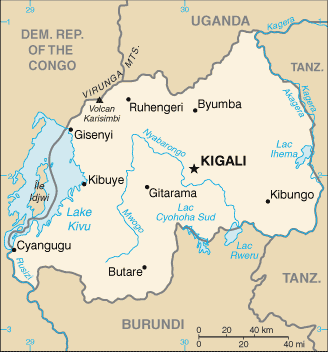
Map image could not be loaded. Open source image.
ⓘ
CIA World Factbook map, February 2021 media edition. Identity reviewed; current boundaries have not been audited. visual contact sheet or original identity check; does not verify current boundaries Boundaries, place names and designations may be dated or disputed; original annotations retained. SHA-256: 0d4438fabcdd2cfdaf999124ed2600b138dc3ec9fdce2aee5e33376b19e9a6c0. Provenance and inspection record.ⓘ
World Bank directory coordinates; approximate location, not a country center. Coordinate reference date is not supplied by the directory. Natural Earth 1:110m land (2022 source); simplified coastline, no political borders. Map source. Land SVG SHA-256: CF26056A39DC0A5B02F65704E279DFA86E77539A8387D0B2C92F907A67739E5E.Introduction
Background:1
Rwanda -- a small and centralized country dominated by rugged hills and fertile volcanic soil -- has exerted disproportionate influence over the African Great Lakes region for centuries. A Rwandan kingdom increasingly dominated the region from the mid-18th century onward, with the Tutsi monarchs gradually extending the power of the royal court into peripheral areas and expanding their borders through military conquest. While the current ethnic labels Hutu and Tutsi predate colonial rule, their flexibility and importance have varied significantly over time and often manifested more as a hierarchical class distinction than an ethnic or cultural distinction. The majority Hutu and minority Tutsi have long shared a common language and culture, and intermarriage was frequent.
The Rwandan royal court centered on the Tutsi king ( mwami ), who relied on an extensive network of political, cultural, and economic relationships. Social categories became more rigid during the reign of RWABUGIRI (1860-1895), who focused on aggressive expansion and solidifying Rwanda’s bureaucratic structures. German colonial conquest began in the late 1890s, but the territory was ceded to Belgian forces in 1916 during World War I. Both European nations quickly realized the benefits of ruling through the already centralized Rwandan Tutsi kingdom. Colonial rule reinforced existing trends toward autocratic and exclusionary rule, leading to the elimination of traditional positions of authority for Hutus. Belgian administrators significantly increased requirements for communal labor and instituted harsh taxes, which fed the population's frustration. Changing political attitudes in Belgium contributed to colonial and Catholic officials shifting their support from Tutsi to Hutu leaders in the years leading up to independence.
Simmering resentment of minority rule exploded in 1959, three years before independence from Belgium, when Hutus overthrew the Tutsi king. Thousands of Tutsis were killed over the next several years, and some 150,000 were driven into exile in neighboring countries. Army Chief of Staff Juvenal HABYARIMANA seized power in a coup in 1973 and ruled Rwanda as a single-party state for two decades. HABYARIMANA increasingly discriminated against Tutsis, and extremist Hutu factions gained prominence after multiple parties were introduced in the early 1990s. The children of Tutsi exiles later formed a rebel group, the Rwandan Patriotic Front (RPF) and began a civil war in 1990. The civil war exacerbated ethnic tensions and culminated in the shooting down of HABYARIMANA’s private jet in 1994. The event sparked a state-orchestrated genocide in which Rwandans killed more than 800,000 of their fellow citizens, including approximately three-quarters of the Tutsi population. The genocide ended later the same year when the predominantly Tutsi RPF, operating out of Uganda and northern Rwanda, defeated the national army and Hutu militias and established an RPF-led government of national unity. Rwanda held its first local elections in 1999 and its first post-genocide presidential and legislative elections in 2003, formalizing President Paul KAGAME’s de facto role as head of government. KAGAME was formally elected in 2010, and again in 2017 after changing the constitution to allow him to run for a third term.
Geography
Location:2
Central Africa, east of the Democratic Republic of the Congo, north of Burundi
Geographic coordinates:3
2 00 S, 30 00 E
Map references:4
Africa
Area:5
Surface area: 26,340 square kilometers (2024)
Area - comparative:7
slightly smaller than Maryland
Land boundaries:8
Coastline:9
0 km (landlocked)
Maritime claims:10
none (landlocked)
Climate:11
temperate; two rainy seasons (February to April, November to January); mild in mountains with frost and snow possible
Terrain:12
mostly grassy uplands and hills; relief is mountainous with altitude declining from west to east
Elevation:13
Natural resources:14
gold, cassiterite (tin ore), wolframite (tungsten ore), methane, hydropower, arable land
Land use:15
Irrigated land:16
96 sq km (2012)
Major lakes (area sq km):17
Major rivers (by length in km):18
Nile river source (shared with Tanzania, Uganda, South Sudan, Sudan, and Egypt [m]) - 6,650 km
Major watersheds (area sq km):19
Population distribution:20
one of Africa's most densely populated countries; large concentrations tend to be in the central regions and along the shore of Lake Kivu in the west, as shown in this population distribution map
Natural hazards:21
periodic droughts; the volcanic Virunga Mountains are in the northwest along the border with Democratic Republic of the Congo
Geography - note:22
landlocked; most of the country is intensively cultivated and rugged, with the population predominantly rural
People and Society
Population:23
Population: 14,569,341 people (2025)
Nationality:25
Ethnic groups:26
Hutu, Tutsi, Twa
Languages:27
Kinyarwanda (official, universal Bantu vernacular) 93.2%, French (official) <0.1%, English (official) <0.1%, Swahili/Kiswahili (official, used in commercial centers) <0.1%, more than one language, other 6.3%, unspecified 0.3% (2002 est.)
Religions:28
Christian 95.9% (Protestant 57.7% [includes Adventist 12.6%], Roman Catholic 38.2%), Muslim 2.1%, other 1% (includes traditional, Jehovah's Witness), none 1.1% (2019-20 est.)
Age structure:29
Dependency ratios:30
Median age:31
Population growth rate:32
Population growth rate: 2.17 % annually (2025)
1.62% (2024 est.)
Birth rate:34
Crude birth rate: 28.06 births per 1,000 people (2024)
25 births/1,000 population (2024 est.)
Death rate:36
Crude death rate: 5.9 deaths per 1,000 people (2024)
5.7 deaths/1,000 population (2024 est.)
Net migration rate:38
-3.1 migrant(s)/1,000 population (2024 est.)
Population distribution:39
one of Africa's most densely populated countries; large concentrations tend to be in the central regions and along the shore of Lake Kivu in the west, as shown in this population distribution map
Urbanization:40
Urban population: 30.91 % of population (2025)
Major urban areas - population:42
1.248 million KIGALI (capital) (2023)
Sex ratio:43
Mother's mean age at first birth:44
23 years (2019/20 est.)
Maternal mortality ratio:45
Maternal mortality ratio: 229 deaths per 100,000 live births (2023)
229 deaths/100,000 live births (2023 est.)
Infant mortality rate:47
Infant mortality rate: 29.4 deaths per 1,000 live births (2024)
Life expectancy at birth:49
Life expectancy at birth: 68.02 years (2024)
Total fertility rate:51
Total fertility rate: 3.65 births per woman (2024)
3.14 children born/woman (2024 est.)
Gross reproduction rate:53
1.54 (2024 est.)
Drinking water source:54
At least basic drinking water services: 61.39 % of population (2024)
Health expenditure:56
Current health expenditure: 5.13 % of GDP (2023)
Physician density:58
Physicians: 0.09 per 1,000 people (2022)
0.09 physicians/1,000 population (2022)
Hospital bed density:60
0.7 beds/1,000 population (2020 est.)
Sanitation facility access:61
At least basic sanitation services: 81.33 % of population (2024)
Obesity - adult prevalence rate:63
5.8% (2016)
Alcohol consumption per capita:64
Tobacco use:65
Children under the age of 5 years underweight:66
7.7% (2020 est.)
Currently married women (ages 15-49):67
50.4% (2023 est.)
Child marriage:68
Education expenditure:69
Government education expenditure: 4.61 % of GDP (2024)
Literacy:71
Adult literacy rate: 78.76 % of people aged 15 and over (2022)
School life expectancy (primary to tertiary education):73
Environment
Environmental issues:74
deforestation; overgrazing; land degradation; soil erosion; a decline in soil fertility (soil exhaustion); wetland degradation and loss of biodiversity; widespread poaching
International environmental agreements:75
Climate:76
temperate; two rainy seasons (February to April, November to January); mild in mountains with frost and snow possible
Land use:77
Urbanization:78
Carbon dioxide emissions:79
Particulate matter emissions:80
35.7 micrograms per cubic meter (2019 est.)
Waste and recycling:81
Total water withdrawal:82
Total renewable water resources:83
13.3 billion cubic meters (2022 est.)
Government
Country name:84
Government type:85
presidential republic
Capital:86
Administrative divisions:87
4 provinces ( provinces , singular - province (French); intara for singular and plural (Kinyarwanda)) and 1 city* ( ville (French); umujyi (Kinyarwanda)); Est (Eastern), Kigali*, Nord (Northern), Ouest (Western), Sud (Southern)
Legal system:88
mixed system of civil law, based on German and Belgian models, and customary law; Supreme Court reviews legislative acts
Constitution:89
International law organization participation:90
has not submitted an ICJ jurisdiction declaration; non-party state to the ICCt
Citizenship:91
Suffrage:92
18 years of age; universal
Executive branch:93
Legislative branch:94
Legislative branch - lower chamber:95
Legislative branch - upper chamber:96
Judicial branch:97
Political parties:98
Democratic Green Party of Rwanda or DGPR
Liberal Party or PL
Party for Progress and Concord or PPC
Rwandan Patriotic Front or RPF
Rwandan Patriotic Front Coalition (includes RPF, PPC, PSP, UDPR, PDI, PSR, PDC)
Social Democratic Party or PSD
Social Party Imberakuri or PS-Imberakuri
Diplomatic representation in the US:99
Diplomatic representation from the US:100
International organization participation:101
ACP, AfDB, AU, CEPGL, COMESA, EAC, EADB, FAO, G-77, IAEA, IBRD, ICAO, ICRM, IDA, IFAD, IFC, IFRCS, ILO, IMF, Interpol, IOC, IOM, IPU, ISO, ITSO, ITU, ITUC (NGOs), MIGA, MINUSMA, NAM, OIF, OPCW, PCA, UN, UNCTAD, UNESCO, UNHCR, UNIDO, UNISFA, UNMISS, UNOOSA, UNWTO, UPU, WCO, WHO, WIPO, WMO, WTO
Independence:102
1 July 1962 (from Belgium-administered UN trusteeship)
National holiday:103
Independence Day, 1 July (1962)
Flag:104
National symbol(s):105
traditional woven basket with peaked lid
National color(s):106
blue, yellow, green
National anthem(s):107
National heritage:108
Economy
Economic overview:109
fast-growing Sub-Saharan economy; major public investments; trade and tourism hit hard by COVID-19; increasing poverty after 2 decades of declines; Ugandan competition for regional influence; major coffee exporter; contested GDP figures
Real GDP (purchasing power parity):110
$46.543 billion (2024 est.)
$42.743 billion (2023 est.)
$39.485 billion (2022 est.)
Real GDP growth rate:111
8.9% (2024 est.)
8.2% (2023 est.)
8.2% (2022 est.)
Real GDP per capita:112
GDP (official exchange rate):113
GDP: 16,372,132,990.23 current US dollars (2025)
$14.252 billion (2024 est.)
Inflation rate (consumer prices):115
GDP - composition, by sector of origin:116
GDP - composition, by end use:117
Agricultural products:118
bananas, cassava, sweet potatoes, plantains, potatoes, maize, beans, pumpkins/squash, taro, sorghum (2023)
Industries:119
cement, agricultural products, small-scale beverages, soap, furniture, shoes, plastic goods, textiles, cigarettes
Industrial production growth rate:120
10% (2024 est.)
Labor force:121
5.671 million (2024 est.)
Unemployment rate:122
Youth unemployment rate (ages 15-24):123
Population below poverty line:124
38.2% (2016 est.)
Gini Index coefficient - distribution of family income:125
43.7 (2016 est.)
Household income or consumption by percentage share:126
Remittances:127
3.6% of GDP (2023 est.)
3.6% of GDP (2022 est.)
3.5% of GDP (2021 est.)
Budget:128
Public debt:129
37.3% of GDP (2016 est.)
Taxes and other revenues:130
13.5% (of GDP) (2023 est.)
Current account balance:131
-$1.654 billion (2023 est.)
-$1.246 billion (2022 est.)
-$1.209 billion (2021 est.)
Exports:132
$3.509 billion (2023 est.)
$2.993 billion (2022 est.)
$2.11 billion (2021 est.)
Exports - partners:133
UAE 66%, China 10%, USA 3%, Kenya 3%, Thailand 2% (2023)
Exports - commodities:134
gold, rare earth ores, coffee, tea, tin ores (2023)
Imports:135
$5.783 billion (2023 est.)
$4.978 billion (2022 est.)
$3.856 billion (2021 est.)
Imports - partners:136
China 19%, Kenya 14%, Uganda 13%, Tanzania 9%, UAE 7% (2023)
Imports - commodities:137
broadcasting equipment, fish, corn, packaged medicine, plastic products (2023)
Reserves of foreign exchange and gold:138
$2.406 billion (2024 est.)
$1.834 billion (2023 est.)
$1.726 billion (2022 est.)
Debt - external:139
$5.531 billion (2023 est.)
Exchange rates:140
1,318.128 (2024 est.)
1,160.099 (2023 est.)
1,030.308 (2022 est.)
988.625 (2021 est.)
943.278 (2020 est.)
Energy
Electricity access:141
Electricity:142
Electricity generation sources:143
Coal:144
Petroleum:145
Natural gas:146
Energy consumption per capita:147
Communications
Telephones - fixed lines:148
Telephones - mobile cellular:149
Broadcast media:150
13 TV stations; 35 radio stations, including international broadcasters; government owns most popular TV and radio stations; regional satellite-based TV available
Internet country code:151
.rw
Internet users:152
Broadband - fixed subscriptions:153
Transportation
Military and Security
Military and security forces:156
Rwanda Defense Force (RDF; Ingabo z’u Rwanda): Rwanda Army (Rwanda Land Force), Rwanda Air Force (Force Aerienne Rwandaise, FAR), Rwanda Reserve Force, Special Units
Ministry of Internal Security: Rwanda National Police (2025)
Military expenditures:157
1.3% of GDP (2024 est.)
1.3% of GDP (2023 est.)
1.4% of GDP (2022 est.)
1.4% of GDP (2021 est.)
1.3% of GDP (2020 est.)
Military and security service personnel strengths:158
approximately 30-35,000 active Rwanda Defense Forces (2025)
Military equipment inventories and acquisitions:159
the RDF's inventory includes a mix of older and some modern equipment from suppliers such as China, France, Israel, Russia and the former Soviet Union, South Africa, and Turkey (2024)
Military service age and obligation:160
18 years of age for men and women for voluntary military service; no conscription; Rwandan citizenship is required; enlistment is either as contract (5-years, renewable twice) or career professional (2024)
Military deployments:161
approximately 3,200 Central African Republic (about 2,200 under MINUSCA, plus some 700 police; approximately 1,000 under a bi-lateral agreement); estimated 3-4,000 Democratic Republic of the Congo; estimated 3,000 Mozambique (bilateral agreement to assist with combating an insurgency; includes both military and police forces); 2,600 (plus about 450 police) South Sudan (UNMISS) (2025)
Military - note:162
the principle responsibilities of the Rwanda Defense Force (RDF) are ensuring territorial integrity and national sovereignty and preventing infiltrations of illegal armed groups from neighboring countries, particularly the Democratic Republic of the Congo (DRC); since 2021, Rwanda has deployed RDF troops to the border region with the DRC to combat the rebel Democratic Forces for the Liberation of Rwanda (FDLR), which it has accused the DRC of backing; Rwanda has been accused by the DRC, the UN, and the US of deploying RDF troops in the DRC and providing material support to the March 23 Movement (M23, aka Congolese Revolutionary Army) rebel group; the RDF also participates in UN and regional military operations, as well as multinational exercises; it has deployed several thousand RDF troops and police personnel to Mozambique to assist in combating an insurgency since 2021; Rwanda has mutual defense treaties with Kenya and Uganda
the Rwandan Armed Forces (FAR) were established following independence in 1962; after the 1990-1994 civil war and genocide, the victorious Tutsi-dominated Rwandan Patriotic Front's military wing, the Rwandan Patriotic Army (RPA), became the country's military force; the RPA participated in the First (1996-1997) and Second (1998-2003) Congolese Wars; the RPA was renamed the Rwanda Defense Force (RDF) in 2003, by which time it had assumed a more national character with the inclusion of many former Hutu officers as well as newly recruited soldiers (2025)
Space
Space agency/agencies:163
Rwanda Space Agency (L’Agence Spatiale Rwandaise; RSA; established 2020 and approved by legislature in 2021) (2025)
Space program overview:164
has a small program focused on developing space technologies, such as satellite communications and imagery for connectivity, disaster management, security, and socioeconomic development; operates communications and remote sensing (RS) satellites; has established ties with the space agencies or industries of several countries, including France, Israel, Japan, Poland, the UAE, and the US, as well as members of the African Space Agency; seeks to establish itself as an African hub for satellite production and has encouraged development of a domestic commercial space sector (2025)
Key space-program milestones:165
2018 - signed cooperation agreement with Japan for training in designing and producing mini-satellites
2019 - first remote sensing (RS) nanosatellite (RWASAT-1) built with assistance from and launched by Japan; first commercial communications satellite (Icyerekezo) built and launched by France
2022 - signed US-led Artemis Accords for space exploration
2025 - joined newly formed African Space Agency
Transnational Issues
Refugees and internally displaced persons:166
Trafficking in persons:167
Additional observations
- Real GDP growth168
- 9.38 % annual change (2025)
- Consumer price inflation169
- 5.91 % annual change (2025)
- Unemployment (modeled ILO estimate)170
- 11.36 % of labor force (2025)
- Access to electricity171
- 72 % of population (2024)
- Renewable energy share of total final energy consumption172
- 79.9 % (2022)
- Individuals using the internet173
- 31.7 % of population (2024)
Notes & sources
- Background. Reference edition; observation: dates as stated in text. Field last updated: not supplied; profile fallback: 2025-12-04 13:07:34 -0500 (not a field revision date); needs review. Reference source. Edition last checked 2026-10-29 (retrieval only). ↩
- Location. Reference edition; observation: dates as stated in text. Field last updated: not supplied; profile fallback: 2025-12-04 13:07:34 -0500 (not a field revision date); needs review. Reference source. Edition last checked 2026-10-29 (retrieval only). ↩
- Geographic coordinates. Reference edition; observation: dates as stated in text. Field last updated: not supplied; profile fallback: 2025-12-04 13:07:34 -0500 (not a field revision date); needs review. Reference source. Edition last checked 2026-10-29 (retrieval only). ↩
- Map references. Reference edition; observation: dates as stated in text. Field last updated: not supplied; profile fallback: 2025-12-04 13:07:34 -0500 (not a field revision date); needs review. Reference source. Edition last checked 2026-10-29 (retrieval only). ↩
- Area. Reference edition; observation: dates as stated in text. Field last updated: not supplied; profile fallback: 2025-12-04 13:07:34 -0500 (not a field revision date); needs review. Reference source. The archived total area has no reference year and territorial coverage may differ from World Bank surface area. World Bank: 26,340 square kilometers (2024). Reference: 26,338 square kilometers. Edition last checked 2026-10-29 (retrieval only). ↩
- Surface area. Surface area: observation 2024; checked 2026-10-29; single source. World Bank World Development Indicators. The archived total area has no reference year and territorial coverage may differ from World Bank surface area. World Bank: 26,340 square kilometers (2024). Reference: 26,338 square kilometers. ↩
- Area - comparative. Reference edition; observation: dates as stated in text. Field last updated: not supplied; profile fallback: 2025-12-04 13:07:34 -0500 (not a field revision date); needs review. Reference source. Edition last checked 2026-10-29 (retrieval only). ↩
- Land boundaries. Reference edition; observation: dates as stated in text. Field last updated: not supplied; profile fallback: 2025-12-04 13:07:34 -0500 (not a field revision date); needs review. Reference source. Edition last checked 2026-10-29 (retrieval only). ↩
- Coastline. Reference edition; observation: dates as stated in text. Field last updated: not supplied; profile fallback: 2025-12-04 13:07:34 -0500 (not a field revision date); needs review. Reference source. Edition last checked 2026-10-29 (retrieval only). ↩
- Maritime claims. Reference edition; observation: dates as stated in text. Field last updated: not supplied; profile fallback: 2025-12-04 13:07:34 -0500 (not a field revision date); needs review. Reference source. Edition last checked 2026-10-29 (retrieval only). ↩
- Climate. Reference edition; observation: dates as stated in text. Field last updated: not supplied; profile fallback: 2025-12-04 13:07:34 -0500 (not a field revision date); needs review. Reference source. Edition last checked 2026-10-29 (retrieval only). ↩
- Terrain. Reference edition; observation: dates as stated in text. Field last updated: not supplied; profile fallback: 2025-12-04 13:07:34 -0500 (not a field revision date); needs review. Reference source. Edition last checked 2026-10-29 (retrieval only). ↩
- Elevation. Reference edition; observation: dates as stated in text. Field last updated: not supplied; profile fallback: 2025-12-04 13:07:34 -0500 (not a field revision date); needs review. Reference source. Edition last checked 2026-10-29 (retrieval only). ↩
- Natural resources. Reference edition; observation: dates as stated in text. Field last updated: not supplied; profile fallback: 2025-12-04 13:07:34 -0500 (not a field revision date); needs review. Reference source. Edition last checked 2026-10-29 (retrieval only). ↩
- Land use. Reference edition; observation: dates as stated in text. Field last updated: not supplied; profile fallback: 2025-12-04 13:07:34 -0500 (not a field revision date); needs review. Reference source. Edition last checked 2026-10-29 (retrieval only). ↩
- Irrigated land. Reference edition; observation: 2012. Field last updated: not supplied; profile fallback: 2025-12-04 13:07:34 -0500 (not a field revision date); needs review. Reference source. Edition last checked 2026-10-29 (retrieval only). ↩
- Major lakes (area sq km). Reference edition; observation: dates as stated in text. Field last updated: not supplied; profile fallback: 2025-12-04 13:07:34 -0500 (not a field revision date); needs review. Reference source. Edition last checked 2026-10-29 (retrieval only). ↩
- Major rivers (by length in km). Reference edition; observation: dates as stated in text. Field last updated: not supplied; profile fallback: 2025-12-04 13:07:34 -0500 (not a field revision date); needs review. Reference source. Edition last checked 2026-10-29 (retrieval only). ↩
- Major watersheds (area sq km). Reference edition; observation: dates as stated in text. Field last updated: not supplied; profile fallback: 2025-12-04 13:07:34 -0500 (not a field revision date); needs review. Reference source. Edition last checked 2026-10-29 (retrieval only). ↩
- Population distribution. Reference edition; observation: dates as stated in text. Field last updated: not supplied; profile fallback: 2025-12-04 13:07:34 -0500 (not a field revision date); needs review. Reference source. Edition last checked 2026-10-29 (retrieval only). ↩
- Natural hazards. Reference edition; observation: dates as stated in text. Field last updated: not supplied; profile fallback: 2025-12-04 13:07:34 -0500 (not a field revision date); needs review. Reference source. Edition last checked 2026-10-29 (retrieval only). ↩
- Geography - note. Reference edition; observation: dates as stated in text. Field last updated: not supplied; profile fallback: 2025-12-04 13:07:34 -0500 (not a field revision date); needs review. Reference source. Edition last checked 2026-10-29 (retrieval only). ↩
- Population. Reference edition; observation: dates as stated in text. Field last updated: not supplied; profile fallback: 2025-12-04 13:07:34 -0500 (not a field revision date); needs review. Reference source. Different reference years; no numerical agreement is asserted. World Bank: 14,569,341 people (2025). Reference: 13,623,302 people (2024). Edition last checked 2026-10-29 (retrieval only). ↩
- Population. Population: observation 2025; checked 2026-10-29; single source. World Bank World Development Indicators. Different reference years; no numerical agreement is asserted. World Bank: 14,569,341 people (2025). Reference: 13,623,302 people (2024). ↩
- Nationality. Reference edition; observation: dates as stated in text. Field last updated: not supplied; profile fallback: 2025-12-04 13:07:34 -0500 (not a field revision date); needs review. Reference source. Edition last checked 2026-10-29 (retrieval only). ↩
- Ethnic groups. Reference edition; observation: dates as stated in text. Field last updated: not supplied; profile fallback: 2025-12-04 13:07:34 -0500 (not a field revision date); needs review. Reference source. Edition last checked 2026-10-29 (retrieval only). ↩
- Languages. Reference edition; observation: dates as stated in text. Field last updated: not supplied; profile fallback: 2025-12-04 13:07:34 -0500 (not a field revision date); needs review. Reference source. Edition last checked 2026-10-29 (retrieval only). ↩
- Religions. Reference edition; observation: 2019-20 est.. Field last updated: not supplied; profile fallback: 2025-12-04 13:07:34 -0500 (not a field revision date); needs review. Reference source. Edition last checked 2026-10-29 (retrieval only). ↩
- Age structure. Reference edition; observation: dates as stated in text. Field last updated: not supplied; profile fallback: 2025-12-04 13:07:34 -0500 (not a field revision date); needs review. Reference source. Edition last checked 2026-10-29 (retrieval only). ↩
- Dependency ratios. Reference edition; observation: dates as stated in text. Field last updated: not supplied; profile fallback: 2025-12-04 13:07:34 -0500 (not a field revision date); needs review. Reference source. Edition last checked 2026-10-29 (retrieval only). ↩
- Median age. Reference edition; observation: dates as stated in text. Field last updated: not supplied; profile fallback: 2025-12-04 13:07:34 -0500 (not a field revision date); needs review. Reference source. Edition last checked 2026-10-29 (retrieval only). ↩
- Population growth rate. Reference edition; observation: 2024. Field last updated: not supplied; profile fallback: 2025-12-04 13:07:34 -0500 (not a field revision date); needs review. Reference source. Edition last checked 2026-10-29 (retrieval only). ↩
- Population growth rate. Population growth rate: observation 2025; checked 2026-10-29; single source. World Bank World Development Indicators. Latest available World Bank series in 2020–2026; reference year is not retrieval year. May be modeled or revised; differing definitions and geography require review. No independent crosscheck; do not silently replace archived Factbook. ↩
- Birth rate. Reference edition; observation: 2024. Field last updated: not supplied; profile fallback: 2025-12-04 13:07:34 -0500 (not a field revision date); needs review. Reference source. Edition last checked 2026-10-29 (retrieval only). ↩
- Crude birth rate. Crude birth rate: observation 2024; checked 2026-10-29; single source. World Bank World Development Indicators. Latest available World Bank series in 2020–2026; reference year is not retrieval year. May be modeled or revised; differing definitions and geography require review. No independent crosscheck; do not silently replace archived Factbook. ↩
- Death rate. Reference edition; observation: 2024. Field last updated: not supplied; profile fallback: 2025-12-04 13:07:34 -0500 (not a field revision date); needs review. Reference source. Edition last checked 2026-10-29 (retrieval only). ↩
- Crude death rate. Crude death rate: observation 2024; checked 2026-10-29; single source. World Bank World Development Indicators. Latest available World Bank series in 2020–2026; reference year is not retrieval year. May be modeled or revised; differing definitions and geography require review. No independent crosscheck; do not silently replace archived Factbook. ↩
- Net migration rate. Reference edition; observation: 2024. Field last updated: not supplied; profile fallback: 2025-12-04 13:07:34 -0500 (not a field revision date); needs review. Reference source. Edition last checked 2026-10-29 (retrieval only). ↩
- Population distribution. Reference edition; observation: dates as stated in text. Field last updated: not supplied; profile fallback: 2025-12-04 13:07:34 -0500 (not a field revision date); needs review. Reference source. Edition last checked 2026-10-29 (retrieval only). ↩
- Urbanization. Reference edition; observation: dates as stated in text. Field last updated: not supplied; profile fallback: 2025-12-04 13:07:34 -0500 (not a field revision date); needs review. Reference source. Edition last checked 2026-10-29 (retrieval only). ↩
- Urban population. Urban population: observation 2025; checked 2026-10-29; single source. World Bank World Development Indicators. Latest available World Bank series in 2020–2026; reference year is not retrieval year. May be modeled or revised; differing definitions and geography require review. No independent crosscheck; do not silently replace archived Factbook. ↩
- Major urban areas - population. Reference edition; observation: 2023. Field last updated: not supplied; profile fallback: 2025-12-04 13:07:34 -0500 (not a field revision date); needs review. Reference source. Edition last checked 2026-10-29 (retrieval only). ↩
- Sex ratio. Reference edition; observation: dates as stated in text. Field last updated: not supplied; profile fallback: 2025-12-04 13:07:34 -0500 (not a field revision date); needs review. Reference source. Edition last checked 2026-10-29 (retrieval only). ↩
- Mother's mean age at first birth. Reference edition; observation: 2019/20. Field last updated: not supplied; profile fallback: 2025-12-04 13:07:34 -0500 (not a field revision date); needs review. Reference source. Edition last checked 2026-10-29 (retrieval only). ↩
- Maternal mortality ratio. Reference edition; observation: 2023. Field last updated: not supplied; profile fallback: 2025-12-04 13:07:34 -0500 (not a field revision date); needs review. Reference source. Edition last checked 2026-10-29 (retrieval only). ↩
- Maternal mortality ratio. Maternal mortality ratio: observation 2023; checked 2026-10-29; single source. World Bank World Development Indicators. Latest available World Bank series in 2020–2026; reference year is not retrieval year. May be modeled or revised; differing definitions and geography require review. No independent crosscheck; do not silently replace archived Factbook. ↩
- Infant mortality rate. Reference edition; observation: dates as stated in text. Field last updated: not supplied; profile fallback: 2025-12-04 13:07:34 -0500 (not a field revision date); needs review. Reference source. Edition last checked 2026-10-29 (retrieval only). ↩
- Infant mortality rate. Infant mortality rate: observation 2024; checked 2026-10-29; single source. World Bank World Development Indicators. Latest available World Bank series in 2020–2026; reference year is not retrieval year. May be modeled or revised; differing definitions and geography require review. No independent crosscheck; do not silently replace archived Factbook. ↩
- Life expectancy at birth. Reference edition; observation: dates as stated in text. Field last updated: not supplied; profile fallback: 2025-12-04 13:07:34 -0500 (not a field revision date); needs review. Reference source. Edition last checked 2026-10-29 (retrieval only). ↩
- Life expectancy at birth. Life expectancy at birth: observation 2024; checked 2026-10-29; single source. World Bank World Development Indicators. Latest available World Bank series in 2020–2026; reference year is not retrieval year. May be modeled or revised; differing definitions and geography require review. No independent crosscheck; do not silently replace archived Factbook. ↩
- Total fertility rate. Reference edition; observation: 2024. Field last updated: not supplied; profile fallback: 2025-12-04 13:07:34 -0500 (not a field revision date); needs review. Reference source. Edition last checked 2026-10-29 (retrieval only). ↩
- Total fertility rate. Total fertility rate: observation 2024; checked 2026-10-29; single source. World Bank World Development Indicators. Latest available World Bank series in 2020–2026; reference year is not retrieval year. May be modeled or revised; differing definitions and geography require review. No independent crosscheck; do not silently replace archived Factbook. ↩
- Gross reproduction rate. Reference edition; observation: 2024. Field last updated: not supplied; profile fallback: 2025-12-04 13:07:34 -0500 (not a field revision date); needs review. Reference source. Edition last checked 2026-10-29 (retrieval only). ↩
- Drinking water source. Reference edition; observation: dates as stated in text. Field last updated: not supplied; profile fallback: 2025-12-04 13:07:34 -0500 (not a field revision date); needs review. Reference source. Edition last checked 2026-10-29 (retrieval only). ↩
- At least basic drinking water services. At least basic drinking water services: observation 2024; checked 2026-10-29; single source. World Bank World Development Indicators. Latest available World Bank series in 2020–2026; reference year is not retrieval year. May be modeled or revised; differing definitions and geography require review. No independent crosscheck; do not silently replace archived Factbook. This separately sourced basic-service observation is shown alongside the reference edition’s improved/unimproved categories. It does not replace those category totals. ↩
- Health expenditure. Reference edition; observation: dates as stated in text. Field last updated: not supplied; profile fallback: 2025-12-04 13:07:34 -0500 (not a field revision date); needs review. Reference source. Edition last checked 2026-10-29 (retrieval only). ↩
- Current health expenditure. Current health expenditure: observation 2023; checked 2026-10-29; single source. World Bank World Development Indicators. Latest available World Bank series in 2020–2026; reference year is not retrieval year. May be modeled or revised; differing definitions and geography require review. No independent crosscheck; do not silently replace archived Factbook. ↩
- Physician density. Reference edition; observation: 2022. Field last updated: not supplied; profile fallback: 2025-12-04 13:07:34 -0500 (not a field revision date); needs review. Reference source. Edition last checked 2026-10-29 (retrieval only). ↩
- Physicians. Physicians: observation 2022; checked 2026-10-29; single source. World Bank World Development Indicators. Latest available World Bank series in 2020–2026; reference year is not retrieval year. May be modeled or revised; differing definitions and geography require review. No independent crosscheck; do not silently replace archived Factbook. ↩
- Hospital bed density. Reference edition; observation: 2020. Field last updated: not supplied; profile fallback: 2025-12-04 13:07:34 -0500 (not a field revision date); needs review. Reference source. Edition last checked 2026-10-29 (retrieval only). ↩
- Sanitation facility access. Reference edition; observation: dates as stated in text. Field last updated: not supplied; profile fallback: 2025-12-04 13:07:34 -0500 (not a field revision date); needs review. Reference source. Edition last checked 2026-10-29 (retrieval only). ↩
- At least basic sanitation services. At least basic sanitation services: observation 2024; checked 2026-10-29; single source. World Bank World Development Indicators. Latest available World Bank series in 2020–2026; reference year is not retrieval year. May be modeled or revised; differing definitions and geography require review. No independent crosscheck; do not silently replace archived Factbook. This separately sourced basic-service observation is shown alongside the reference edition’s improved/unimproved categories. It does not replace those category totals. ↩
- Obesity - adult prevalence rate. Reference edition; observation: 2016. Field last updated: not supplied; profile fallback: 2025-12-04 13:07:34 -0500 (not a field revision date); needs review. Reference source. Edition last checked 2026-10-29 (retrieval only). ↩
- Alcohol consumption per capita. Reference edition; observation: dates as stated in text. Field last updated: not supplied; profile fallback: 2025-12-04 13:07:34 -0500 (not a field revision date); needs review. Reference source. Edition last checked 2026-10-29 (retrieval only). ↩
- Tobacco use. Reference edition; observation: dates as stated in text. Field last updated: not supplied; profile fallback: 2025-12-04 13:07:34 -0500 (not a field revision date); needs review. Reference source. Edition last checked 2026-10-29 (retrieval only). ↩
- Children under the age of 5 years underweight. Reference edition; observation: 2020. Field last updated: not supplied; profile fallback: 2025-12-04 13:07:34 -0500 (not a field revision date); needs review. Reference source. Edition last checked 2026-10-29 (retrieval only). ↩
- Currently married women (ages 15-49). Reference edition; observation: 2023. Field last updated: not supplied; profile fallback: 2025-12-04 13:07:34 -0500 (not a field revision date); needs review. Reference source. Edition last checked 2026-10-29 (retrieval only). ↩
- Child marriage. Reference edition; observation: dates as stated in text. Field last updated: not supplied; profile fallback: 2025-12-04 13:07:34 -0500 (not a field revision date); needs review. Reference source. Edition last checked 2026-10-29 (retrieval only). ↩
- Education expenditure. Reference edition; observation: dates as stated in text. Field last updated: not supplied; profile fallback: 2025-12-04 13:07:34 -0500 (not a field revision date); needs review. Reference source. Edition last checked 2026-10-29 (retrieval only). ↩
- Government education expenditure. Government education expenditure: observation 2024; checked 2026-10-29; single source. World Bank World Development Indicators. Latest available World Bank series in 2020–2026; reference year is not retrieval year. May be modeled or revised; differing definitions and geography require review. No independent crosscheck; do not silently replace archived Factbook. ↩
- Literacy. Reference edition; observation: dates as stated in text. Field last updated: not supplied; profile fallback: 2025-12-04 13:07:34 -0500 (not a field revision date); needs review. Reference source. Edition last checked 2026-10-29 (retrieval only). ↩
- Adult literacy rate. Adult literacy rate: observation 2022; checked 2026-10-29; single source. World Bank World Development Indicators. Latest available World Bank series in 2020–2026; reference year is not retrieval year. May be modeled or revised; differing definitions and geography require review. No independent crosscheck; do not silently replace archived Factbook. ↩
- School life expectancy (primary to tertiary education). Reference edition; observation: dates as stated in text. Field last updated: not supplied; profile fallback: 2025-12-04 13:07:34 -0500 (not a field revision date); needs review. Reference source. Edition last checked 2026-10-29 (retrieval only). ↩
- Environmental issues. Reference edition; observation: dates as stated in text. Field last updated: not supplied; profile fallback: 2025-12-04 13:07:34 -0500 (not a field revision date); needs review. Reference source. Edition last checked 2026-10-29 (retrieval only). ↩
- International environmental agreements. Reference edition; observation: dates as stated in text. Field last updated: not supplied; profile fallback: 2025-12-04 13:07:34 -0500 (not a field revision date); needs review. Reference source. Edition last checked 2026-10-29 (retrieval only). ↩
- Climate. Reference edition; observation: dates as stated in text. Field last updated: not supplied; profile fallback: 2025-12-04 13:07:34 -0500 (not a field revision date); needs review. Reference source. Edition last checked 2026-10-29 (retrieval only). ↩
- Land use. Reference edition; observation: dates as stated in text. Field last updated: not supplied; profile fallback: 2025-12-04 13:07:34 -0500 (not a field revision date); needs review. Reference source. Edition last checked 2026-10-29 (retrieval only). ↩
- Urbanization. Reference edition; observation: dates as stated in text. Field last updated: not supplied; profile fallback: 2025-12-04 13:07:34 -0500 (not a field revision date); needs review. Reference source. Edition last checked 2026-10-29 (retrieval only). ↩
- Carbon dioxide emissions. Reference edition; observation: dates as stated in text. Field last updated: not supplied; profile fallback: 2025-12-04 13:07:34 -0500 (not a field revision date); needs review. Reference source. Edition last checked 2026-10-29 (retrieval only). ↩
- Particulate matter emissions. Reference edition; observation: 2019. Field last updated: not supplied; profile fallback: 2025-12-04 13:07:34 -0500 (not a field revision date); needs review. Reference source. Edition last checked 2026-10-29 (retrieval only). ↩
- Waste and recycling. Reference edition; observation: dates as stated in text. Field last updated: not supplied; profile fallback: 2025-12-04 13:07:34 -0500 (not a field revision date); needs review. Reference source. Edition last checked 2026-10-29 (retrieval only). ↩
- Total water withdrawal. Reference edition; observation: dates as stated in text. Field last updated: not supplied; profile fallback: 2025-12-04 13:07:34 -0500 (not a field revision date); needs review. Reference source. Edition last checked 2026-10-29 (retrieval only). ↩
- Total renewable water resources. Reference edition; observation: 2022. Field last updated: not supplied; profile fallback: 2025-12-04 13:07:34 -0500 (not a field revision date); needs review. Reference source. Edition last checked 2026-10-29 (retrieval only). ↩
- Country name. Reference edition; observation: dates as stated in text. Field last updated: not supplied; profile fallback: 2025-12-04 13:07:34 -0500 (not a field revision date); needs review. Reference source. Edition last checked 2026-10-29 (retrieval only). ↩
- Government type. Reference edition; observation: dates as stated in text. Field last updated: not supplied; profile fallback: 2025-12-04 13:07:34 -0500 (not a field revision date); needs review. Reference source. Edition last checked 2026-10-29 (retrieval only). ↩
- Capital. Reference edition; observation: dates as stated in text. Field last updated: not supplied; profile fallback: 2025-12-04 13:07:34 -0500 (not a field revision date); needs review. Reference source. Edition last checked 2026-10-29 (retrieval only). ↩
- Administrative divisions. Reference edition; observation: dates as stated in text. Field last updated: not supplied; profile fallback: 2025-12-04 13:07:34 -0500 (not a field revision date); needs review. Reference source. Edition last checked 2026-10-29 (retrieval only). ↩
- Legal system. Reference edition; observation: dates as stated in text. Field last updated: not supplied; profile fallback: 2025-12-04 13:07:34 -0500 (not a field revision date); needs review. Reference source. Edition last checked 2026-10-29 (retrieval only). ↩
- Constitution. Reference edition; observation: dates as stated in text. Field last updated: not supplied; profile fallback: 2025-12-04 13:07:34 -0500 (not a field revision date); needs review. Reference source. Edition last checked 2026-10-29 (retrieval only). ↩
- International law organization participation. Reference edition; observation: dates as stated in text. Field last updated: not supplied; profile fallback: 2025-12-04 13:07:34 -0500 (not a field revision date); needs review. Reference source. Edition last checked 2026-10-29 (retrieval only). ↩
- Citizenship. Reference edition; observation: dates as stated in text. Field last updated: not supplied; profile fallback: 2025-12-04 13:07:34 -0500 (not a field revision date); needs review. Reference source. Edition last checked 2026-10-29 (retrieval only). ↩
- Suffrage. Reference edition; observation: dates as stated in text. Field last updated: not supplied; profile fallback: 2025-12-04 13:07:34 -0500 (not a field revision date); needs review. Reference source. Edition last checked 2026-10-29 (retrieval only). ↩
- Executive branch. Reference edition; observation: dates as stated in text. Field last updated: not supplied; profile fallback: 2025-12-04 13:07:34 -0500 (not a field revision date); needs review. Reference source. Edition last checked 2026-10-29 (retrieval only). ↩
- Legislative branch. Reference edition; observation: dates as stated in text. Field last updated: not supplied; profile fallback: 2025-12-04 13:07:34 -0500 (not a field revision date); needs review. Reference source. Edition last checked 2026-10-29 (retrieval only). ↩
- Legislative branch - lower chamber. Reference edition; observation: dates as stated in text. Field last updated: not supplied; profile fallback: 2025-12-04 13:07:34 -0500 (not a field revision date); needs review. Reference source. Edition last checked 2026-10-29 (retrieval only). ↩
- Legislative branch - upper chamber. Reference edition; observation: dates as stated in text. Field last updated: not supplied; profile fallback: 2025-12-04 13:07:34 -0500 (not a field revision date); needs review. Reference source. Edition last checked 2026-10-29 (retrieval only). ↩
- Judicial branch. Reference edition; observation: dates as stated in text. Field last updated: not supplied; profile fallback: 2025-12-04 13:07:34 -0500 (not a field revision date); needs review. Reference source. Edition last checked 2026-10-29 (retrieval only). ↩
- Political parties. Reference edition; observation: dates as stated in text. Field last updated: not supplied; profile fallback: 2025-12-04 13:07:34 -0500 (not a field revision date); needs review. Reference source. Edition last checked 2026-10-29 (retrieval only). ↩
- Diplomatic representation in the US. Reference edition; observation: dates as stated in text. Field last updated: not supplied; profile fallback: 2025-12-04 13:07:34 -0500 (not a field revision date); needs review. Reference source. Edition last checked 2026-10-29 (retrieval only). ↩
- Diplomatic representation from the US. Reference edition; observation: dates as stated in text. Field last updated: not supplied; profile fallback: 2025-12-04 13:07:34 -0500 (not a field revision date); needs review. Reference source. Edition last checked 2026-10-29 (retrieval only). ↩
- International organization participation. Reference edition; observation: dates as stated in text. Field last updated: not supplied; profile fallback: 2025-12-04 13:07:34 -0500 (not a field revision date); needs review. Reference source. Edition last checked 2026-10-29 (retrieval only). ↩
- Independence. Reference edition; observation: dates as stated in text. Field last updated: not supplied; profile fallback: 2025-12-04 13:07:34 -0500 (not a field revision date); needs review. Reference source. Edition last checked 2026-10-29 (retrieval only). ↩
- National holiday. Reference edition; observation: dates as stated in text. Field last updated: not supplied; profile fallback: 2025-12-04 13:07:34 -0500 (not a field revision date); needs review. Reference source. Edition last checked 2026-10-29 (retrieval only). ↩
- Flag. Reference edition; observation: dates as stated in text. Field last updated: not supplied; profile fallback: 2025-12-04 13:07:34 -0500 (not a field revision date); needs review. Reference source. Edition last checked 2026-10-29 (retrieval only). ↩
- National symbol(s). Reference edition; observation: dates as stated in text. Field last updated: not supplied; profile fallback: 2025-12-04 13:07:34 -0500 (not a field revision date); needs review. Reference source. Edition last checked 2026-10-29 (retrieval only). ↩
- National color(s). Reference edition; observation: dates as stated in text. Field last updated: not supplied; profile fallback: 2025-12-04 13:07:34 -0500 (not a field revision date); needs review. Reference source. Edition last checked 2026-10-29 (retrieval only). ↩
- National anthem(s). Reference edition; observation: dates as stated in text. Field last updated: not supplied; profile fallback: 2025-12-04 13:07:34 -0500 (not a field revision date); needs review. Reference source. Edition last checked 2026-10-29 (retrieval only). ↩
- National heritage. Reference edition; observation: dates as stated in text. Field last updated: not supplied; profile fallback: 2025-12-04 13:07:34 -0500 (not a field revision date); needs review. Reference source. Edition last checked 2026-10-29 (retrieval only). ↩
- Economic overview. Reference edition; observation: dates as stated in text. Field last updated: not supplied; profile fallback: 2025-12-04 13:07:34 -0500 (not a field revision date); needs review. Reference source. Edition last checked 2026-10-29 (retrieval only). ↩
- Real GDP (purchasing power parity). Reference edition; observation: dates as stated in text. Field last updated: not supplied; profile fallback: 2025-12-04 13:07:34 -0500 (not a field revision date); needs review. Reference source. Edition last checked 2026-10-29 (retrieval only). ↩
- Real GDP growth rate. Reference edition; observation: dates as stated in text. Field last updated: not supplied; profile fallback: 2025-12-04 13:07:34 -0500 (not a field revision date); needs review. Reference source. Edition last checked 2026-10-29 (retrieval only). ↩
- Real GDP per capita. Reference edition; observation: dates as stated in text. Field last updated: not supplied; profile fallback: 2025-12-04 13:07:34 -0500 (not a field revision date); needs review. Reference source. Edition last checked 2026-10-29 (retrieval only). ↩
- GDP (official exchange rate). Reference edition; observation: 2024. Field last updated: not supplied; profile fallback: 2025-12-04 13:07:34 -0500 (not a field revision date); needs review. Reference source. Different reference years; no numerical agreement is asserted. World Bank: 16,372,132,990.23 current US dollars (2025). Reference: 14,252,000,000 current US dollars (2024). Edition last checked 2026-10-29 (retrieval only). ↩
- GDP. GDP: observation 2025; checked 2026-10-29; single source. World Bank World Development Indicators. Different reference years; no numerical agreement is asserted. World Bank: 16,372,132,990.23 current US dollars (2025). Reference: 14,252,000,000 current US dollars (2024). ↩
- Inflation rate (consumer prices). Reference edition; observation: dates as stated in text. Field last updated: not supplied; profile fallback: 2025-12-04 13:07:34 -0500 (not a field revision date); needs review. Reference source. Edition last checked 2026-10-29 (retrieval only). ↩
- GDP - composition, by sector of origin. Reference edition; observation: dates as stated in text. Field last updated: not supplied; profile fallback: 2025-12-04 13:07:34 -0500 (not a field revision date); needs review. Reference source. Edition last checked 2026-10-29 (retrieval only). ↩
- GDP - composition, by end use. Reference edition; observation: dates as stated in text. Field last updated: not supplied; profile fallback: 2025-12-04 13:07:34 -0500 (not a field revision date); needs review. Reference source. Edition last checked 2026-10-29 (retrieval only). ↩
- Agricultural products. Reference edition; observation: 2023. Field last updated: not supplied; profile fallback: 2025-12-04 13:07:34 -0500 (not a field revision date); needs review. Reference source. Edition last checked 2026-10-29 (retrieval only). ↩
- Industries. Reference edition; observation: dates as stated in text. Field last updated: not supplied; profile fallback: 2025-12-04 13:07:34 -0500 (not a field revision date); needs review. Reference source. Edition last checked 2026-10-29 (retrieval only). ↩
- Industrial production growth rate. Reference edition; observation: 2024. Field last updated: not supplied; profile fallback: 2025-12-04 13:07:34 -0500 (not a field revision date); needs review. Reference source. Edition last checked 2026-10-29 (retrieval only). ↩
- Labor force. Reference edition; observation: 2024. Field last updated: not supplied; profile fallback: 2025-12-04 13:07:34 -0500 (not a field revision date); needs review. Reference source. Edition last checked 2026-10-29 (retrieval only). ↩
- Unemployment rate. Reference edition; observation: dates as stated in text. Field last updated: not supplied; profile fallback: 2025-12-04 13:07:34 -0500 (not a field revision date); needs review. Reference source. Edition last checked 2026-10-29 (retrieval only). ↩
- Youth unemployment rate (ages 15-24). Reference edition; observation: dates as stated in text. Field last updated: not supplied; profile fallback: 2025-12-04 13:07:34 -0500 (not a field revision date); needs review. Reference source. Edition last checked 2026-10-29 (retrieval only). ↩
- Population below poverty line. Reference edition; observation: 2016. Field last updated: not supplied; profile fallback: 2025-12-04 13:07:34 -0500 (not a field revision date); needs review. Reference source. Edition last checked 2026-10-29 (retrieval only). ↩
- Gini Index coefficient - distribution of family income. Reference edition; observation: dates as stated in text. Field last updated: not supplied; profile fallback: 2025-12-04 13:07:34 -0500 (not a field revision date); needs review. Reference source. Edition last checked 2026-10-29 (retrieval only). ↩
- Household income or consumption by percentage share. Reference edition; observation: dates as stated in text. Field last updated: not supplied; profile fallback: 2025-12-04 13:07:34 -0500 (not a field revision date); needs review. Reference source. Edition last checked 2026-10-29 (retrieval only). ↩
- Remittances. Reference edition; observation: dates as stated in text. Field last updated: not supplied; profile fallback: 2025-12-04 13:07:34 -0500 (not a field revision date); needs review. Reference source. Edition last checked 2026-10-29 (retrieval only). ↩
- Budget. Reference edition; observation: dates as stated in text. Field last updated: not supplied; profile fallback: 2025-12-04 13:07:34 -0500 (not a field revision date); needs review. Reference source. Edition last checked 2026-10-29 (retrieval only). ↩
- Public debt. Reference edition; observation: dates as stated in text. Field last updated: not supplied; profile fallback: 2025-12-04 13:07:34 -0500 (not a field revision date); needs review. Reference source. Edition last checked 2026-10-29 (retrieval only). ↩
- Taxes and other revenues. Reference edition; observation: 2023. Field last updated: not supplied; profile fallback: 2025-12-04 13:07:34 -0500 (not a field revision date); needs review. Reference source. Edition last checked 2026-10-29 (retrieval only). ↩
- Current account balance. Reference edition; observation: dates as stated in text. Field last updated: not supplied; profile fallback: 2025-12-04 13:07:34 -0500 (not a field revision date); needs review. Reference source. Edition last checked 2026-10-29 (retrieval only). ↩
- Exports. Reference edition; observation: dates as stated in text. Field last updated: not supplied; profile fallback: 2025-12-04 13:07:34 -0500 (not a field revision date); needs review. Reference source. Edition last checked 2026-10-29 (retrieval only). ↩
- Exports - partners. Reference edition; observation: 2023. Field last updated: not supplied; profile fallback: 2025-12-04 13:07:34 -0500 (not a field revision date); needs review. Reference source. Edition last checked 2026-10-29 (retrieval only). ↩
- Exports - commodities. Reference edition; observation: 2023. Field last updated: not supplied; profile fallback: 2025-12-04 13:07:34 -0500 (not a field revision date); needs review. Reference source. Edition last checked 2026-10-29 (retrieval only). ↩
- Imports. Reference edition; observation: dates as stated in text. Field last updated: not supplied; profile fallback: 2025-12-04 13:07:34 -0500 (not a field revision date); needs review. Reference source. Edition last checked 2026-10-29 (retrieval only). ↩
- Imports - partners. Reference edition; observation: 2023. Field last updated: not supplied; profile fallback: 2025-12-04 13:07:34 -0500 (not a field revision date); needs review. Reference source. Edition last checked 2026-10-29 (retrieval only). ↩
- Imports - commodities. Reference edition; observation: 2023. Field last updated: not supplied; profile fallback: 2025-12-04 13:07:34 -0500 (not a field revision date); needs review. Reference source. Edition last checked 2026-10-29 (retrieval only). ↩
- Reserves of foreign exchange and gold. Reference edition; observation: dates as stated in text. Field last updated: not supplied; profile fallback: 2025-12-04 13:07:34 -0500 (not a field revision date); needs review. Reference source. Edition last checked 2026-10-29 (retrieval only). ↩
- Debt - external. Reference edition; observation: dates as stated in text. Field last updated: not supplied; profile fallback: 2025-12-04 13:07:34 -0500 (not a field revision date); needs review. Reference source. Edition last checked 2026-10-29 (retrieval only). ↩
- Exchange rates. Reference edition; observation: dates as stated in text. Field last updated: not supplied; profile fallback: 2025-12-04 13:07:34 -0500 (not a field revision date); needs review. Reference source. Edition last checked 2026-10-29 (retrieval only). ↩
- Electricity access. Reference edition; observation: dates as stated in text. Field last updated: not supplied; profile fallback: 2025-12-04 13:07:34 -0500 (not a field revision date); needs review. Reference source. Edition last checked 2026-10-29 (retrieval only). ↩
- Electricity. Reference edition; observation: dates as stated in text. Field last updated: not supplied; profile fallback: 2025-12-04 13:07:34 -0500 (not a field revision date); needs review. Reference source. Edition last checked 2026-10-29 (retrieval only). ↩
- Electricity generation sources. Reference edition; observation: dates as stated in text. Field last updated: not supplied; profile fallback: 2025-12-04 13:07:34 -0500 (not a field revision date); needs review. Reference source. Edition last checked 2026-10-29 (retrieval only). ↩
- Coal. Reference edition; observation: dates as stated in text. Field last updated: not supplied; profile fallback: 2025-12-04 13:07:34 -0500 (not a field revision date); needs review. Reference source. Edition last checked 2026-10-29 (retrieval only). ↩
- Petroleum. Reference edition; observation: dates as stated in text. Field last updated: not supplied; profile fallback: 2025-12-04 13:07:34 -0500 (not a field revision date); needs review. Reference source. Edition last checked 2026-10-29 (retrieval only). ↩
- Natural gas. Reference edition; observation: dates as stated in text. Field last updated: not supplied; profile fallback: 2025-12-04 13:07:34 -0500 (not a field revision date); needs review. Reference source. Edition last checked 2026-10-29 (retrieval only). ↩
- Energy consumption per capita. Reference edition; observation: dates as stated in text. Field last updated: not supplied; profile fallback: 2025-12-04 13:07:34 -0500 (not a field revision date); needs review. Reference source. Edition last checked 2026-10-29 (retrieval only). ↩
- Telephones - fixed lines. Reference edition; observation: dates as stated in text. Field last updated: not supplied; profile fallback: 2025-12-04 13:07:34 -0500 (not a field revision date); needs review. Reference source. Edition last checked 2026-10-29 (retrieval only). ↩
- Telephones - mobile cellular. Reference edition; observation: dates as stated in text. Field last updated: not supplied; profile fallback: 2025-12-04 13:07:34 -0500 (not a field revision date); needs review. Reference source. Edition last checked 2026-10-29 (retrieval only). ↩
- Broadcast media. Reference edition; observation: dates as stated in text. Field last updated: not supplied; profile fallback: 2025-12-04 13:07:34 -0500 (not a field revision date); needs review. Reference source. Edition last checked 2026-10-29 (retrieval only). ↩
- Internet country code. Reference edition; observation: dates as stated in text. Field last updated: not supplied; profile fallback: 2025-12-04 13:07:34 -0500 (not a field revision date); needs review. Reference source. Edition last checked 2026-10-29 (retrieval only). ↩
- Internet users. Reference edition; observation: dates as stated in text. Field last updated: not supplied; profile fallback: 2025-12-04 13:07:34 -0500 (not a field revision date); needs review. Reference source. Edition last checked 2026-10-29 (retrieval only). ↩
- Broadband - fixed subscriptions. Reference edition; observation: dates as stated in text. Field last updated: not supplied; profile fallback: 2025-12-04 13:07:34 -0500 (not a field revision date); needs review. Reference source. Edition last checked 2026-10-29 (retrieval only). ↩
- Civil aircraft registration country code prefix. Reference edition; observation: dates as stated in text. Field last updated: not supplied; profile fallback: 2025-12-04 13:07:34 -0500 (not a field revision date); needs review. Reference source. Edition last checked 2026-10-29 (retrieval only). ↩
- Airports. Reference edition; observation: 2025. Field last updated: not supplied; profile fallback: 2025-12-04 13:07:34 -0500 (not a field revision date); needs review. Reference source. Edition last checked 2026-10-29 (retrieval only). ↩
- Military and security forces. Reference edition; observation: 2025. Field last updated: not supplied; profile fallback: 2025-12-04 13:07:34 -0500 (not a field revision date); needs review. Reference source. Edition last checked 2026-10-29 (retrieval only). ↩
- Military expenditures. Reference edition; observation: dates as stated in text. Field last updated: not supplied; profile fallback: 2025-12-04 13:07:34 -0500 (not a field revision date); needs review. Reference source. Edition last checked 2026-10-29 (retrieval only). ↩
- Military and security service personnel strengths. Reference edition; observation: 2025. Field last updated: not supplied; profile fallback: 2025-12-04 13:07:34 -0500 (not a field revision date); needs review. Reference source. Edition last checked 2026-10-29 (retrieval only). ↩
- Military equipment inventories and acquisitions. Reference edition; observation: 2024. Field last updated: not supplied; profile fallback: 2025-12-04 13:07:34 -0500 (not a field revision date); needs review. Reference source. Edition last checked 2026-10-29 (retrieval only). ↩
- Military service age and obligation. Reference edition; observation: 2024. Field last updated: not supplied; profile fallback: 2025-12-04 13:07:34 -0500 (not a field revision date); needs review. Reference source. Edition last checked 2026-10-29 (retrieval only). ↩
- Military deployments. Reference edition; observation: 2025. Field last updated: not supplied; profile fallback: 2025-12-04 13:07:34 -0500 (not a field revision date); needs review. Reference source. Edition last checked 2026-10-29 (retrieval only). ↩
- Military - note. Reference edition; observation: 2025. Field last updated: not supplied; profile fallback: 2025-12-04 13:07:34 -0500 (not a field revision date); needs review. Reference source. Edition last checked 2026-10-29 (retrieval only). ↩
- Space agency/agencies. Reference edition; observation: 2025. Field last updated: not supplied; profile fallback: 2025-12-04 13:07:34 -0500 (not a field revision date); needs review. Reference source. Edition last checked 2026-10-29 (retrieval only). ↩
- Space program overview. Reference edition; observation: 2025. Field last updated: not supplied; profile fallback: 2025-12-04 13:07:34 -0500 (not a field revision date); needs review. Reference source. Edition last checked 2026-10-29 (retrieval only). ↩
- Key space-program milestones. Reference edition; observation: dates as stated in text. Field last updated: not supplied; profile fallback: 2025-12-04 13:07:34 -0500 (not a field revision date); needs review. Reference source. Edition last checked 2026-10-29 (retrieval only). ↩
- Refugees and internally displaced persons. Reference edition; observation: dates as stated in text. Field last updated: not supplied; profile fallback: 2025-12-04 13:07:34 -0500 (not a field revision date); needs review. Reference source. Edition last checked 2026-10-29 (retrieval only). ↩
- Trafficking in persons. Reference edition; observation: dates as stated in text. Field last updated: not supplied; profile fallback: 2025-12-04 13:07:34 -0500 (not a field revision date); needs review. Reference source. Edition last checked 2026-10-29 (retrieval only). ↩
- Real GDP growth. Real GDP growth: observation 2025; checked 2026-10-29; single source. World Bank World Development Indicators. Gross domestic product is the total income earned through the production of goods and services in an economic territory during an accounting period. It can be measured in three different ways: using either the expenditure approach, the income approach, or the production approach. This indicator denotes the percentage change over each previous year of the constant price (base year 2015) series in United States dollars. Source metadata: https://api.worldbank.org/v2/indicator/NY.GDP.MKTP.KD.ZG?format=json ↩
- Consumer price inflation. Consumer price inflation: observation 2025; checked 2026-10-29; single source. World Bank World Development Indicators. Inflation as measured by the consumer price index reflects the annual percentage change in the cost to the average consumer of acquiring a basket of goods and services that may be fixed or changed at specified intervals, such as yearly. Source metadata: https://api.worldbank.org/v2/indicator/FP.CPI.TOTL.ZG?format=json ↩
- Unemployment (modeled ILO estimate). Unemployment (modeled ILO estimate): observation 2025; checked 2026-10-29; single source. World Bank World Development Indicators. Unemployment refers to the share of the labor force that is without work but available for and seeking employment. The ILO modeled estimate is not necessarily directly comparable with national unemployment measures. Source metadata: https://api.worldbank.org/v2/indicator/SL.UEM.TOTL.ZS?format=json ↩
- Access to electricity. Access to electricity: observation 2024; checked 2026-10-29; single source. World Bank World Development Indicators. Access to electricity is the percentage of population with access to electricity. Electrification data are collected from industry, national surveys and international sources. Source metadata: https://api.worldbank.org/v2/indicator/EG.ELC.ACCS.ZS?format=json ↩
- Renewable energy share of total final energy consumption. Renewable energy share of total final energy consumption: observation 2022; checked 2026-10-29; single source. World Bank World Development Indicators. Renewable energy consumption is the share of renewable energy in total final energy consumption. Source metadata: https://api.worldbank.org/v2/indicator/EG.FEC.RNEW.ZS?format=json ↩
- Individuals using the internet. Individuals using the internet: observation 2024; checked 2026-10-29; single source. World Bank World Development Indicators. Internet users are individuals who have used the Internet (from any location) in the last 3 months. The Internet can be used via a computer, mobile phone, personal digital assistant, games machine, digital TV etc. Source metadata: https://api.worldbank.org/v2/indicator/IT.NET.USER.ZS?format=json ↩