East Asia & Pacific / PHL
Philippines

ⓘ
2021 Factbook flag mirror; image identity has not been individually audited. Source.
Last updated: October 29, 2026
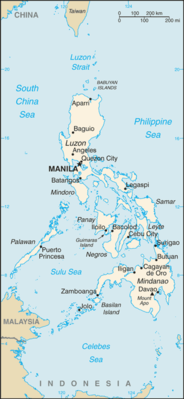
Map image could not be loaded. Open source image.
ⓘ
CIA World Factbook map, February 2021 media edition. Identity reviewed; current boundaries have not been audited. visual contact sheet or original identity check; does not verify current boundaries Boundaries, place names and designations may be dated or disputed; original annotations retained. SHA-256: 88392d28ecf25dabd4628fa8b476b9eced34a621b58becb0c7ceef58497747f3. Provenance and inspection record.ⓘ
World Bank directory coordinates; approximate location, not a country center. Coordinate reference date is not supplied by the directory. Natural Earth 1:110m land (2022 source); simplified coastline, no political borders. Map source. Land SVG SHA-256: CF26056A39DC0A5B02F65704E279DFA86E77539A8387D0B2C92F907A67739E5E.Introduction
Background:1
The Philippine Islands became a Spanish colony during the 16th century; they were ceded to the US in 1898 following the Spanish-American War. Led by Emilio AGUINALDO, the Filipinos conducted an insurgency against US rule from 1899-1902, although some fighting continued in outlying islands as late as 1913. In 1935, the Philippines became a self-governing commonwealth. Manuel QUEZON was elected president and was tasked with preparing the country for independence after a 10-year transition. The islands fell under Japanese occupation during World War II, and US forces and Filipinos fought together during 1944-45 to regain control. On 4 July 1946 the Republic of the Philippines attained its independence.
Twenty-one years of authoritarian rule under Ferdinand MARCOS ended in 1986, when a "people power" movement in Manila ("EDSA 1") forced him into exile and installed Corazon AQUINO as president. Several coup attempts hampered her presidency, and progress on political stability and economic development faltered until Fidel RAMOS was elected president in 1992. The US closed its last military bases on the islands the same year. Joseph ESTRADA was elected president in 1998. His vice-president, Gloria MACAPAGAL-ARROYO, succeded him in 2001 after ESTRADA's stormy impeachment trial on corruption charges broke down and another "people power" movement ("EDSA 2") demanded his resignation. MACAPAGAL-ARROYO was elected president in 2004. Corruption allegations marred her presidency, but the Philippine economy was one of the few to avoid contraction after the 2008 global financial crisis. Benigno AQUINO III was elected as president in 2010, followed by Rodrigo DUTERTE in 2016. During his term, DUTERTE pursued a controversial drug war that garnered international criticism for alleged human rights abuses. Ferdinand MARCOS, Jr. was elected president in 2022 with the largest popular vote in a presidential election since his father's ouster.
For decades, the country has been challenged by armed ethnic separatists, communist rebels, and Islamic terrorist groups, particularly in the southern islands and remote areas of Luzon.
Geography
Location:2
Southeastern Asia, archipelago between the Philippine Sea and the South China Sea, east of Vietnam
Geographic coordinates:3
13 00 N, 122 00 E
Map references:4
Southeast Asia
Area:5
Surface area: 300,000 square kilometers (2024)
Area - comparative:7
slightly less than twice the size of Georgia; slightly larger than Arizona
Land boundaries:8
Coastline:9
36,289 km
Maritime claims:10
Climate:11
tropical marine; northeast monsoon (November to April); southwest monsoon (May to October)
Terrain:12
mostly mountains with narrow to extensive coastal lowlands
Elevation:13
Natural resources:14
timber, petroleum, nickel, cobalt, silver, gold, salt, copper
Land use:15
Irrigated land:16
16,270 sq km (2012)
Major lakes (area sq km):17
Population distribution:18
population concentrated in areas with good farmland; highest concentrations are northwest and south-central Luzon, the southeastern extension of Luzon, and the islands of the Visayan Sea, particularly Cebu and Negros; Manila is home to one eighth of the national population
Natural hazards:19
astride typhoon belt, usually affected by several cyclonic storms each year; landslides; active volcanoes; destructive earthquakes; tsunamis
Geography - note:20
note 3: the Philippines sits on the Pacific typhoon belt, and an average of 9 typhoons make landfall on the islands each year, with about 5 being destructive; the country is the most exposed in the world to tropical storms
People and Society
Population:21
Population: 116,786,962 people (2025)
Nationality:23
Ethnic groups:24
Tagalog 26%, Bisaya/Binisaya 14.3%, Ilocano 8%, Cebuano 8%, Illonggo 7.9%, Bikol/Bicol 6.5%, Waray 3.8%, Kapampangan 3%, Maguindanao 1.9%, Pangasinan 1.9%, other local ethnicities 18.5%, foreign ethnicities 0.2% (2020 est.)
Languages:25
Tagalog 39.9%, Bisaya/Binisaya 16%, Hiligaynon/Ilonggo 7.3%, Ilocano 7.1%, Cebuano 6.5%, Bikol/Bicol 3.9%, Waray 2.6%, Kapampangan 2.4%, Maguindanao 1.4%, Pangasinan/Panggalato 1.3%, other languages/dialects 11.2%, unspecified 0.4% (2020 est.)
Religions:26
Roman Catholic 78.8%, Muslim 6.4%, Iglesia ni Cristo 2.6%, other Christian 3.9%, other 8.2%, none/unspecified <0.1 (2020 est.)
Age structure:27
Dependency ratios:28
Median age:29
Population growth rate:30
Population growth rate: 0.81 % annually (2025)
1.56% (2024 est.)
Birth rate:32
Crude birth rate: 15.89 births per 1,000 people (2024)
22.1 births/1,000 population (2024 est.)
Death rate:34
Crude death rate: 6.35 deaths per 1,000 people (2024)
6.2 deaths/1,000 population (2024 est.)
Net migration rate:36
-0.2 migrant(s)/1,000 population (2024 est.)
Population distribution:37
population concentrated in areas with good farmland; highest concentrations are northwest and south-central Luzon, the southeastern extension of Luzon, and the islands of the Visayan Sea, particularly Cebu and Negros; Manila is home to one eighth of the national population
Urbanization:38
Urban population: 55.77 % of population (2025)
Major urban areas - population:40
14.667 million MANILA (capital), 1.949 million Davao, 1.025 million Cebu City, 931,000 Zamboanga, 960,000 Antipolo, 803,000 Cagayan de Oro City, 803,000 Dasmarinas (2023)
Sex ratio:41
Mother's mean age at first birth:42
23.6 years (2022 est.)
Maternal mortality ratio:43
Maternal mortality ratio: 84 deaths per 100,000 live births (2023)
84 deaths/100,000 live births (2023 est.)
Infant mortality rate:45
Infant mortality rate: 21.7 deaths per 1,000 live births (2024)
Life expectancy at birth:47
Life expectancy at birth: 69.95 years (2024)
Total fertility rate:49
Total fertility rate: 1.89 births per woman (2024)
2.75 children born/woman (2024 est.)
Gross reproduction rate:51
1.34 (2024 est.)
Drinking water source:52
At least basic drinking water services: 95.86 % of population (2024)
Health expenditure:54
Current health expenditure: 5.1 % of GDP (2023)
Physician density:56
Physicians: 0.79 per 1,000 people (2021)
0.79 physicians/1,000 population (2021)
Hospital bed density:58
1 beds/1,000 population (2021 est.)
Sanitation facility access:59
At least basic sanitation services: 87.15 % of population (2024)
Obesity - adult prevalence rate:61
6.4% (2016)
Alcohol consumption per capita:62
Tobacco use:63
Children under the age of 5 years underweight:64
16.7% (2021 est.)
Currently married women (ages 15-49):65
59.3% (2023 est.)
Child marriage:66
Education expenditure:67
Government education expenditure: 3.97 % of GDP (2025)
Literacy:69
Adult literacy rate: 98.47 % of people aged 15 and over (2020)
School life expectancy (primary to tertiary education):71
People - note:72
one of only two predominantly Christian nations in Southeast Asia, the other being Timor-Leste
Environment
Environmental issues:73
deforestation, especially in watershed areas; illegal mining and logging; soil erosion; air and water pollution in major urban centers; coral reef degradation; increasing pollution of coastal mangrove swamps; coastal erosion; dynamite fishing; wildlife extinction
International environmental agreements:74
Climate:75
tropical marine; northeast monsoon (November to April); southwest monsoon (May to October)
Land use:76
Urbanization:77
Carbon dioxide emissions:78
Particulate matter emissions:79
25.4 micrograms per cubic meter (2019 est.)
Methane emissions:80
Waste and recycling:81
Total water withdrawal:82
Total renewable water resources:83
479 billion cubic meters (2022 est.)
Geoparks:84
Government
Country name:85
Government type:86
presidential republic
Capital:87
Administrative divisions:88
81 provinces and 38 chartered cities
Legal system:89
mixed system of civil, common, Islamic (sharia), and customary law
Constitution:90
International law organization participation:91
accepts compulsory ICJ jurisdiction with reservations; withdrew from the ICCt in March 2019
Citizenship:92
Suffrage:93
18 years of age; universal
Executive branch:94
Legislative branch:95
Legislative branch - lower chamber:96
Legislative branch - upper chamber:97
Judicial branch:98
Political parties:99
Democratic Action (Aksyon Demokratiko)
Alliance for Change (Hugpong ng Pagbabago or HNP)
Lakas ng EDSA-Christian Muslim Democrats or Lakas-CMD
Liberal Party or LP
Nacionalista Party or NP
Nationalist People's Coalition or NPC
National Unity Party or NUP
Partido Demokratiko Pilipino-Lakas ng Bayan or PDP-Laban
Partido Federal ng Pilipinas or PFP
Progressive Movement for the Devolution of Initiatives or PROMDI
Diplomatic representation in the US:100
Diplomatic representation from the US:101
International organization participation:102
ADB, APEC, ARF, ASEAN, BIS, CD, CICA (observer), CP, EAS, FAO, G-24, G-77, IAEA, IBRD, ICAO, ICRM, IDA, IFAD, IFC, IFRCS, IHO, ILO, IMF, IMO, IMSO, Interpol, IOC, IOM, IPU, ISO, ITSO, ITU, ITUC (NGOs), MIGA, MINUSTAH, NAM, OAS (observer), OPCW, PCA, PIF (partner), UN, UNCTAD, UNESCO, UNHCR, UNIDO, Union Latina, UNMIL, UNMOGIP, UNOCI, UNOOSA, UNWTO, UPU, WCO, WFTU (NGOs), WHO, WIPO, WMO, WTO
Independence:103
4 July 1946 (from the US)
National holiday:104
Independence Day, 12 June (1898)
Flag:105
National symbol(s):106
three stars and sun, Philippine eagle
National color(s):107
red, white, blue, yellow
National coat of arms:108
the coat of arms was adopted on 3 July 1946; the three gold stars represent the major island groups of Luzon, the Visayas, and Mindanao; the rays of the sun represent the provinces of the Philippines; the American eagle and lion of Spain represent the nation's colonial past
National anthem(s):109
National heritage:110
Economy
Economic overview:111
growing Southeast Asian economy; commercial rebound led by transportation, construction and financial services; electronics exports recovering from sector slowdown; significant remittances; interest rate rises following heightened inflation; uncertainties due to increased regional tensions with China
Real GDP (purchasing power parity):112
$1.202 trillion (2024 est.)
$1.137 trillion (2023 est.)
$1.078 trillion (2022 est.)
Real GDP growth rate:113
5.7% (2024 est.)
5.5% (2023 est.)
7.6% (2022 est.)
Real GDP per capita:114
GDP (official exchange rate):115
GDP: 487,086,123,720.42 current US dollars (2025)
$461.618 billion (2024 est.)
Inflation rate (consumer prices):117
GDP - composition, by sector of origin:118
GDP - composition, by end use:119
Agricultural products:120
sugarcane, rice, coconuts, maize, bananas, vegetables, tropical fruits, plantains, pineapples, cassava (2023)
Industries:121
semiconductors and electronics assembly, business process outsourcing, food and beverage manufacturing, construction, electric/gas/water supply, chemical products, radio/television/communications equipment and apparatus, petroleum and fuel, textile and garments, non-metallic minerals, basic metal industries, transport equipment
Industrial production growth rate:122
5.6% (2024 est.)
Labor force:123
50.979 million (2024 est.)
Unemployment rate:124
Youth unemployment rate (ages 15-24):125
Population below poverty line:126
15.5% (2023 est.)
Gini Index coefficient - distribution of family income:127
39.3 (2023 est.)
Average household expenditures:128
Household income or consumption by percentage share:129
Remittances:130
8.7% of GDP (2024 est.)
8.9% of GDP (2023 est.)
9.4% of GDP (2022 est.)
Budget:131
Public debt:132
39.9% of GDP (2017 est.)
Taxes and other revenues:133
14.1% (of GDP) (2023 est.)
Current account balance:134
-$17.514 billion (2024 est.)
-$12.387 billion (2023 est.)
-$18.261 billion (2022 est.)
Exports:135
$106.99 billion (2024 est.)
$103.588 billion (2023 est.)
$98.832 billion (2022 est.)
Exports - partners:136
China 19%, USA 13%, Hong Kong 12%, Japan 11%, Germany 5% (2023)
Exports - commodities:137
integrated circuits, machine parts, gold, insulated wire, semiconductors (2023)
Imports:138
$161.154 billion (2024 est.)
$151.441 billion (2023 est.)
$152.638 billion (2022 est.)
Imports - partners:139
China 25%, Indonesia 8%, Japan 8%, S. Korea 6%, USA 6% (2023)
Imports - commodities:140
integrated circuits, refined petroleum, cars, crude petroleum, coal (2023)
Reserves of foreign exchange and gold:141
$106.195 billion (2024 est.)
$103.742 billion (2023 est.)
$96.04 billion (2022 est.)
Debt - external:142
$63.241 billion (2023 est.)
Exchange rates:143
57.291 (2024 est.)
55.63 (2023 est.)
54.478 (2022 est.)
49.255 (2021 est.)
49.624 (2020 est.)
Energy
Electricity access:144
Electricity:145
Electricity generation sources:146
Coal:147
Petroleum:148
Natural gas:149
Energy consumption per capita:150
Communications
Telephones - fixed lines:151
Telephones - mobile cellular:152
Broadcast media:153
multiple national private TV and radio networks; multi-channel satellite and cable TV systems available; more than 400 TV stations; about 1,500 cable TV providers with more than 2 million subscribers; over 1,400 radio stations; was scheduled to move to digital by the end of 2023 (2019)
Internet country code:154
.ph
Internet users:155
Broadband - fixed subscriptions:156
Transportation
Civil aircraft registration country code prefix:157
RP
Airports:158
256 (2025)
Heliports:159
416 (2025)
Railways:160
Merchant marine:161
Ports:162
Military and Security
Military and security forces:163
Armed Forces of the Philippines (AFP): Army, Navy (includes Marine Corps), Air Force
Department of Transportation: Philippine Coast Guard (PCG); Department of the Interior: Philippine National Police Force (PNP) (2025)
Military expenditures:164
1.7% of GDP (2024 est.)
1.5% of GDP (2023 est.)
1.4% of GDP (2022 est.)
1.2% of GDP (2021 est.)
1.1% of GDP (2020 est.)
Military and security service personnel strengths:165
approximately 145,000 active Armed Forces (105,000 Army; 25,000 Navy, including about 8,000 Marine Corps; 15,000 Air Force) (2025)
Military equipment inventories and acquisitions:166
the AFP is equipped with a wide mix of imported weapons systems; in recent years, it has received equipment from more than a dozen countries, including Israel, South Korea, and the US (2024)
Military service age and obligation:167
some small variations in age based on the branch, but generally 18-27 years of age for voluntary military service for men and women; no conscription (2025)
Military - note:168
the Armed Forces of the Philippines (AFP) are responsible for territorial defense and assisting with internal security; much of the AFP's operational focus is on internal security alongside the Philippines National Police, particularly in the south, where several separatist insurgent, terrorist, and criminal groups operate and a considerable portion of the AFP is typically deployed; additional combat operations are conducted against the Communist People’s Party/New People’s Army, which is active mostly on Luzon, as well as the Visayas and areas of Mindanao; prior to a peace deal in 2014, the AFP fought a decades-long conflict against the Moro Islamic Liberation Front (MILF), a separatist organization based mostly on the island of Mindanao, which had up to 40,000 fighters under arms
maritime security is also a priority; the AFP's naval forces conduct naval interdiction missions in support of security operations on the southern islands, including joint maritime patrols with Indonesia and Malaysia; rising tensions with China over disputed waters and land features in the South China Sea since 2012 have spurred the AFP to place more emphasis on blue-water naval capabilities, including acquiring larger warships such as guided missile frigates, corvettes, offshore patrol vessels, and landing platform dock (LPD) amphibious assault ships
the Philippine military was formally organized during the American colonial period as the Philippine Army; they were established by the National Defense Act of 1935 and comprised of both Filipinos and Americans; the US and Philippines agreed to a mutual defense treaty in 1951; based on agreements signed in 2014 and 2023, the Philippine Government allows the rotational presence of US military forces, aircraft, and ships at up to nine bases in the Philippines; also in 2023, the US agreed to assist in modernizing Philippine defense capabilities, deepen interoperability, enhance bilateral planning and information-sharing, and combat transnational and nonconventional threats (2025)
Space
Space agency/agencies:169
Philippine Space Agency (PhilSA; established 2019) (2025)
Space program overview:170
has a small space program focused on acquiring satellites and related technologies, largely for climate studies, national security, and risk management; also prioritizing development of space expertise and industry; manufactures and operates satellites (mostly micro- and nano-sized), including remote sensing and scientific/experimental; has relations with a variety of foreign space agencies and industries, including those of China, the ESA (and some of its member states), India, Japan, Russia, and the US (2025)
Key space-program milestones:171
1994 - formed a consortium of companies to acquire and operate satellites
1996 - acquired first communications satellite (Agila-1) from Indonesia after it was already in orbit
2014 - initiated a scientific remote sensing (RS) microsatellite development program in collaboration with Japan, resulting in first RS microsatellite (Diwata-1) being deployed from the International Space Station (ISS) in 2016
2018 - first domestically designed and built scientific/technology-demonstrator cube satellite (Maya-1) deployed from ISS; second RS microsatellite (Diwata-2) developed with assistance from and launched by Japan
2023 - signed agreement with the ESA and EU to expand cooperation on Earth observation/RS data sharing
2025 - signed US-led Artemis Accords for space exploration
Terrorism
Terrorist group(s):172
Abu Sayyaf Group; Communist Party of the Philippines/New People's Army (CPP/NPA); Islamic State of Iraq and ash-Sham – East Asia (ISIS-EA) in the Philippines
note 2: details about the history, aims, leadership, organization, areas of operation, tactics, targets, weapons, size, and sources of support of the group(s) appear(s) in the Terrorism reference guide
Transnational Issues
Refugees and internally displaced persons:173
Additional observations
- Real GDP growth174
- 4.4 % annual change (2025)
- Consumer price inflation175
- 1.66 % annual change (2025)
- Unemployment (modeled ILO estimate)176
- 2.24 % of labor force (2025)
- Access to electricity177
- 94.8 % of population (2024)
- Renewable energy share of total final energy consumption178
- 28 % (2021)
- Individuals using the internet179
- 67.26 % of population (2024)
Notes & sources
- Background. Reference edition; observation: dates as stated in text. Field last updated: not supplied; profile fallback: 2025-12-09 10:10:25 -0500 (not a field revision date); needs review. Reference source. Edition last checked 2026-10-29 (retrieval only). ↩
- Location. Reference edition; observation: dates as stated in text. Field last updated: not supplied; profile fallback: 2025-12-09 10:10:25 -0500 (not a field revision date); needs review. Reference source. Edition last checked 2026-10-29 (retrieval only). ↩
- Geographic coordinates. Reference edition; observation: dates as stated in text. Field last updated: not supplied; profile fallback: 2025-12-09 10:10:25 -0500 (not a field revision date); needs review. Reference source. Edition last checked 2026-10-29 (retrieval only). ↩
- Map references. Reference edition; observation: dates as stated in text. Field last updated: not supplied; profile fallback: 2025-12-09 10:10:25 -0500 (not a field revision date); needs review. Reference source. Edition last checked 2026-10-29 (retrieval only). ↩
- Area. Reference edition; observation: dates as stated in text. Field last updated: not supplied; profile fallback: 2025-12-09 10:10:25 -0500 (not a field revision date); needs review. Reference source. The archived total area has no reference year and territorial coverage may differ from World Bank surface area. World Bank: 300,000 square kilometers (2024). Reference: 300,000 square kilometers. Edition last checked 2026-10-29 (retrieval only). ↩
- Surface area. Surface area: observation 2024; checked 2026-10-29; single source. World Bank World Development Indicators. The archived total area has no reference year and territorial coverage may differ from World Bank surface area. World Bank: 300,000 square kilometers (2024). Reference: 300,000 square kilometers. ↩
- Area - comparative. Reference edition; observation: dates as stated in text. Field last updated: not supplied; profile fallback: 2025-12-09 10:10:25 -0500 (not a field revision date); needs review. Reference source. Edition last checked 2026-10-29 (retrieval only). ↩
- Land boundaries. Reference edition; observation: dates as stated in text. Field last updated: not supplied; profile fallback: 2025-12-09 10:10:25 -0500 (not a field revision date); needs review. Reference source. Edition last checked 2026-10-29 (retrieval only). ↩
- Coastline. Reference edition; observation: dates as stated in text. Field last updated: not supplied; profile fallback: 2025-12-09 10:10:25 -0500 (not a field revision date); needs review. Reference source. Edition last checked 2026-10-29 (retrieval only). ↩
- Maritime claims. Reference edition; observation: dates as stated in text. Field last updated: not supplied; profile fallback: 2025-12-09 10:10:25 -0500 (not a field revision date); needs review. Reference source. Edition last checked 2026-10-29 (retrieval only). ↩
- Climate. Reference edition; observation: dates as stated in text. Field last updated: not supplied; profile fallback: 2025-12-09 10:10:25 -0500 (not a field revision date); needs review. Reference source. Edition last checked 2026-10-29 (retrieval only). ↩
- Terrain. Reference edition; observation: dates as stated in text. Field last updated: not supplied; profile fallback: 2025-12-09 10:10:25 -0500 (not a field revision date); needs review. Reference source. Edition last checked 2026-10-29 (retrieval only). ↩
- Elevation. Reference edition; observation: dates as stated in text. Field last updated: not supplied; profile fallback: 2025-12-09 10:10:25 -0500 (not a field revision date); needs review. Reference source. Edition last checked 2026-10-29 (retrieval only). ↩
- Natural resources. Reference edition; observation: dates as stated in text. Field last updated: not supplied; profile fallback: 2025-12-09 10:10:25 -0500 (not a field revision date); needs review. Reference source. Edition last checked 2026-10-29 (retrieval only). ↩
- Land use. Reference edition; observation: dates as stated in text. Field last updated: not supplied; profile fallback: 2025-12-09 10:10:25 -0500 (not a field revision date); needs review. Reference source. Edition last checked 2026-10-29 (retrieval only). ↩
- Irrigated land. Reference edition; observation: 2012. Field last updated: not supplied; profile fallback: 2025-12-09 10:10:25 -0500 (not a field revision date); needs review. Reference source. Edition last checked 2026-10-29 (retrieval only). ↩
- Major lakes (area sq km). Reference edition; observation: dates as stated in text. Field last updated: not supplied; profile fallback: 2025-12-09 10:10:25 -0500 (not a field revision date); needs review. Reference source. Edition last checked 2026-10-29 (retrieval only). ↩
- Population distribution. Reference edition; observation: dates as stated in text. Field last updated: not supplied; profile fallback: 2025-12-09 10:10:25 -0500 (not a field revision date); needs review. Reference source. Edition last checked 2026-10-29 (retrieval only). ↩
- Natural hazards. Reference edition; observation: dates as stated in text. Field last updated: not supplied; profile fallback: 2025-12-09 10:10:25 -0500 (not a field revision date); needs review. Reference source. Edition last checked 2026-10-29 (retrieval only). ↩
- Geography - note. Reference edition; observation: dates as stated in text. Field last updated: not supplied; profile fallback: 2025-12-09 10:10:25 -0500 (not a field revision date); needs review. Reference source. Edition last checked 2026-10-29 (retrieval only). ↩
- Population. Reference edition; observation: dates as stated in text. Field last updated: not supplied; profile fallback: 2025-12-09 10:10:25 -0500 (not a field revision date); needs review. Reference source. Different reference years; no numerical agreement is asserted. World Bank: 116,786,962 people (2025). Reference: 118,277,063 people (2024). Edition last checked 2026-10-29 (retrieval only). ↩
- Population. Population: observation 2025; checked 2026-10-29; single source. World Bank World Development Indicators. Different reference years; no numerical agreement is asserted. World Bank: 116,786,962 people (2025). Reference: 118,277,063 people (2024). ↩
- Nationality. Reference edition; observation: dates as stated in text. Field last updated: not supplied; profile fallback: 2025-12-09 10:10:25 -0500 (not a field revision date); needs review. Reference source. Edition last checked 2026-10-29 (retrieval only). ↩
- Ethnic groups. Reference edition; observation: 2020 est.. Field last updated: not supplied; profile fallback: 2025-12-09 10:10:25 -0500 (not a field revision date); needs review. Reference source. Edition last checked 2026-10-29 (retrieval only). ↩
- Languages. Reference edition; observation: dates as stated in text. Field last updated: not supplied; profile fallback: 2025-12-09 10:10:25 -0500 (not a field revision date); needs review. Reference source. Edition last checked 2026-10-29 (retrieval only). ↩
- Religions. Reference edition; observation: 2020 est.. Field last updated: not supplied; profile fallback: 2025-12-09 10:10:25 -0500 (not a field revision date); needs review. Reference source. Edition last checked 2026-10-29 (retrieval only). ↩
- Age structure. Reference edition; observation: dates as stated in text. Field last updated: not supplied; profile fallback: 2025-12-09 10:10:25 -0500 (not a field revision date); needs review. Reference source. Edition last checked 2026-10-29 (retrieval only). ↩
- Dependency ratios. Reference edition; observation: dates as stated in text. Field last updated: not supplied; profile fallback: 2025-12-09 10:10:25 -0500 (not a field revision date); needs review. Reference source. Edition last checked 2026-10-29 (retrieval only). ↩
- Median age. Reference edition; observation: dates as stated in text. Field last updated: not supplied; profile fallback: 2025-12-09 10:10:25 -0500 (not a field revision date); needs review. Reference source. Edition last checked 2026-10-29 (retrieval only). ↩
- Population growth rate. Reference edition; observation: 2024. Field last updated: not supplied; profile fallback: 2025-12-09 10:10:25 -0500 (not a field revision date); needs review. Reference source. Edition last checked 2026-10-29 (retrieval only). ↩
- Population growth rate. Population growth rate: observation 2025; checked 2026-10-29; single source. World Bank World Development Indicators. Latest available World Bank series in 2020–2026; reference year is not retrieval year. May be modeled or revised; differing definitions and geography require review. No independent crosscheck; do not silently replace archived Factbook. ↩
- Birth rate. Reference edition; observation: 2024. Field last updated: not supplied; profile fallback: 2025-12-09 10:10:25 -0500 (not a field revision date); needs review. Reference source. Edition last checked 2026-10-29 (retrieval only). ↩
- Crude birth rate. Crude birth rate: observation 2024; checked 2026-10-29; single source. World Bank World Development Indicators. Latest available World Bank series in 2020–2026; reference year is not retrieval year. May be modeled or revised; differing definitions and geography require review. No independent crosscheck; do not silently replace archived Factbook. ↩
- Death rate. Reference edition; observation: 2024. Field last updated: not supplied; profile fallback: 2025-12-09 10:10:25 -0500 (not a field revision date); needs review. Reference source. Edition last checked 2026-10-29 (retrieval only). ↩
- Crude death rate. Crude death rate: observation 2024; checked 2026-10-29; single source. World Bank World Development Indicators. Latest available World Bank series in 2020–2026; reference year is not retrieval year. May be modeled or revised; differing definitions and geography require review. No independent crosscheck; do not silently replace archived Factbook. ↩
- Net migration rate. Reference edition; observation: 2024. Field last updated: not supplied; profile fallback: 2025-12-09 10:10:25 -0500 (not a field revision date); needs review. Reference source. Edition last checked 2026-10-29 (retrieval only). ↩
- Population distribution. Reference edition; observation: dates as stated in text. Field last updated: not supplied; profile fallback: 2025-12-09 10:10:25 -0500 (not a field revision date); needs review. Reference source. Edition last checked 2026-10-29 (retrieval only). ↩
- Urbanization. Reference edition; observation: dates as stated in text. Field last updated: not supplied; profile fallback: 2025-12-09 10:10:25 -0500 (not a field revision date); needs review. Reference source. Edition last checked 2026-10-29 (retrieval only). ↩
- Urban population. Urban population: observation 2025; checked 2026-10-29; single source. World Bank World Development Indicators. Latest available World Bank series in 2020–2026; reference year is not retrieval year. May be modeled or revised; differing definitions and geography require review. No independent crosscheck; do not silently replace archived Factbook. ↩
- Major urban areas - population. Reference edition; observation: 2023. Field last updated: not supplied; profile fallback: 2025-12-09 10:10:25 -0500 (not a field revision date); needs review. Reference source. Edition last checked 2026-10-29 (retrieval only). ↩
- Sex ratio. Reference edition; observation: dates as stated in text. Field last updated: not supplied; profile fallback: 2025-12-09 10:10:25 -0500 (not a field revision date); needs review. Reference source. Edition last checked 2026-10-29 (retrieval only). ↩
- Mother's mean age at first birth. Reference edition; observation: 2022. Field last updated: not supplied; profile fallback: 2025-12-09 10:10:25 -0500 (not a field revision date); needs review. Reference source. Edition last checked 2026-10-29 (retrieval only). ↩
- Maternal mortality ratio. Reference edition; observation: 2023. Field last updated: not supplied; profile fallback: 2025-12-09 10:10:25 -0500 (not a field revision date); needs review. Reference source. Edition last checked 2026-10-29 (retrieval only). ↩
- Maternal mortality ratio. Maternal mortality ratio: observation 2023; checked 2026-10-29; single source. World Bank World Development Indicators. Latest available World Bank series in 2020–2026; reference year is not retrieval year. May be modeled or revised; differing definitions and geography require review. No independent crosscheck; do not silently replace archived Factbook. ↩
- Infant mortality rate. Reference edition; observation: dates as stated in text. Field last updated: not supplied; profile fallback: 2025-12-09 10:10:25 -0500 (not a field revision date); needs review. Reference source. Edition last checked 2026-10-29 (retrieval only). ↩
- Infant mortality rate. Infant mortality rate: observation 2024; checked 2026-10-29; single source. World Bank World Development Indicators. Latest available World Bank series in 2020–2026; reference year is not retrieval year. May be modeled or revised; differing definitions and geography require review. No independent crosscheck; do not silently replace archived Factbook. ↩
- Life expectancy at birth. Reference edition; observation: dates as stated in text. Field last updated: not supplied; profile fallback: 2025-12-09 10:10:25 -0500 (not a field revision date); needs review. Reference source. Edition last checked 2026-10-29 (retrieval only). ↩
- Life expectancy at birth. Life expectancy at birth: observation 2024; checked 2026-10-29; single source. World Bank World Development Indicators. Latest available World Bank series in 2020–2026; reference year is not retrieval year. May be modeled or revised; differing definitions and geography require review. No independent crosscheck; do not silently replace archived Factbook. ↩
- Total fertility rate. Reference edition; observation: 2024. Field last updated: not supplied; profile fallback: 2025-12-09 10:10:25 -0500 (not a field revision date); needs review. Reference source. Edition last checked 2026-10-29 (retrieval only). ↩
- Total fertility rate. Total fertility rate: observation 2024; checked 2026-10-29; single source. World Bank World Development Indicators. Latest available World Bank series in 2020–2026; reference year is not retrieval year. May be modeled or revised; differing definitions and geography require review. No independent crosscheck; do not silently replace archived Factbook. ↩
- Gross reproduction rate. Reference edition; observation: 2024. Field last updated: not supplied; profile fallback: 2025-12-09 10:10:25 -0500 (not a field revision date); needs review. Reference source. Edition last checked 2026-10-29 (retrieval only). ↩
- Drinking water source. Reference edition; observation: dates as stated in text. Field last updated: not supplied; profile fallback: 2025-12-09 10:10:25 -0500 (not a field revision date); needs review. Reference source. Edition last checked 2026-10-29 (retrieval only). ↩
- At least basic drinking water services. At least basic drinking water services: observation 2024; checked 2026-10-29; single source. World Bank World Development Indicators. Latest available World Bank series in 2020–2026; reference year is not retrieval year. May be modeled or revised; differing definitions and geography require review. No independent crosscheck; do not silently replace archived Factbook. This separately sourced basic-service observation is shown alongside the reference edition’s improved/unimproved categories. It does not replace those category totals. ↩
- Health expenditure. Reference edition; observation: dates as stated in text. Field last updated: not supplied; profile fallback: 2025-12-09 10:10:25 -0500 (not a field revision date); needs review. Reference source. Edition last checked 2026-10-29 (retrieval only). ↩
- Current health expenditure. Current health expenditure: observation 2023; checked 2026-10-29; single source. World Bank World Development Indicators. Latest available World Bank series in 2020–2026; reference year is not retrieval year. May be modeled or revised; differing definitions and geography require review. No independent crosscheck; do not silently replace archived Factbook. ↩
- Physician density. Reference edition; observation: 2021. Field last updated: not supplied; profile fallback: 2025-12-09 10:10:25 -0500 (not a field revision date); needs review. Reference source. Edition last checked 2026-10-29 (retrieval only). ↩
- Physicians. Physicians: observation 2021; checked 2026-10-29; single source. World Bank World Development Indicators. Latest available World Bank series in 2020–2026; reference year is not retrieval year. May be modeled or revised; differing definitions and geography require review. No independent crosscheck; do not silently replace archived Factbook. ↩
- Hospital bed density. Reference edition; observation: 2021. Field last updated: not supplied; profile fallback: 2025-12-09 10:10:25 -0500 (not a field revision date); needs review. Reference source. Edition last checked 2026-10-29 (retrieval only). ↩
- Sanitation facility access. Reference edition; observation: dates as stated in text. Field last updated: not supplied; profile fallback: 2025-12-09 10:10:25 -0500 (not a field revision date); needs review. Reference source. Edition last checked 2026-10-29 (retrieval only). ↩
- At least basic sanitation services. At least basic sanitation services: observation 2024; checked 2026-10-29; single source. World Bank World Development Indicators. Latest available World Bank series in 2020–2026; reference year is not retrieval year. May be modeled or revised; differing definitions and geography require review. No independent crosscheck; do not silently replace archived Factbook. This separately sourced basic-service observation is shown alongside the reference edition’s improved/unimproved categories. It does not replace those category totals. ↩
- Obesity - adult prevalence rate. Reference edition; observation: 2016. Field last updated: not supplied; profile fallback: 2025-12-09 10:10:25 -0500 (not a field revision date); needs review. Reference source. Edition last checked 2026-10-29 (retrieval only). ↩
- Alcohol consumption per capita. Reference edition; observation: dates as stated in text. Field last updated: not supplied; profile fallback: 2025-12-09 10:10:25 -0500 (not a field revision date); needs review. Reference source. Edition last checked 2026-10-29 (retrieval only). ↩
- Tobacco use. Reference edition; observation: dates as stated in text. Field last updated: not supplied; profile fallback: 2025-12-09 10:10:25 -0500 (not a field revision date); needs review. Reference source. Edition last checked 2026-10-29 (retrieval only). ↩
- Children under the age of 5 years underweight. Reference edition; observation: 2021. Field last updated: not supplied; profile fallback: 2025-12-09 10:10:25 -0500 (not a field revision date); needs review. Reference source. Edition last checked 2026-10-29 (retrieval only). ↩
- Currently married women (ages 15-49). Reference edition; observation: 2023. Field last updated: not supplied; profile fallback: 2025-12-09 10:10:25 -0500 (not a field revision date); needs review. Reference source. Edition last checked 2026-10-29 (retrieval only). ↩
- Child marriage. Reference edition; observation: dates as stated in text. Field last updated: not supplied; profile fallback: 2025-12-09 10:10:25 -0500 (not a field revision date); needs review. Reference source. Edition last checked 2026-10-29 (retrieval only). ↩
- Education expenditure. Reference edition; observation: dates as stated in text. Field last updated: not supplied; profile fallback: 2025-12-09 10:10:25 -0500 (not a field revision date); needs review. Reference source. Edition last checked 2026-10-29 (retrieval only). ↩
- Government education expenditure. Government education expenditure: observation 2025; checked 2026-10-29; single source. World Bank World Development Indicators. Latest available World Bank series in 2020–2026; reference year is not retrieval year. May be modeled or revised; differing definitions and geography require review. No independent crosscheck; do not silently replace archived Factbook. ↩
- Literacy. Reference edition; observation: dates as stated in text. Field last updated: not supplied; profile fallback: 2025-12-09 10:10:25 -0500 (not a field revision date); needs review. Reference source. Edition last checked 2026-10-29 (retrieval only). ↩
- Adult literacy rate. Adult literacy rate: observation 2020; checked 2026-10-29; single source. World Bank World Development Indicators. Latest available World Bank series in 2020–2026; reference year is not retrieval year. May be modeled or revised; differing definitions and geography require review. No independent crosscheck; do not silently replace archived Factbook. ↩
- School life expectancy (primary to tertiary education). Reference edition; observation: dates as stated in text. Field last updated: not supplied; profile fallback: 2025-12-09 10:10:25 -0500 (not a field revision date); needs review. Reference source. Edition last checked 2026-10-29 (retrieval only). ↩
- People - note. Reference edition; observation: dates as stated in text. Field last updated: not supplied; profile fallback: 2025-12-09 10:10:25 -0500 (not a field revision date); needs review. Reference source. Edition last checked 2026-10-29 (retrieval only). ↩
- Environmental issues. Reference edition; observation: dates as stated in text. Field last updated: not supplied; profile fallback: 2025-12-09 10:10:25 -0500 (not a field revision date); needs review. Reference source. Edition last checked 2026-10-29 (retrieval only). ↩
- International environmental agreements. Reference edition; observation: dates as stated in text. Field last updated: not supplied; profile fallback: 2025-12-09 10:10:25 -0500 (not a field revision date); needs review. Reference source. Edition last checked 2026-10-29 (retrieval only). ↩
- Climate. Reference edition; observation: dates as stated in text. Field last updated: not supplied; profile fallback: 2025-12-09 10:10:25 -0500 (not a field revision date); needs review. Reference source. Edition last checked 2026-10-29 (retrieval only). ↩
- Land use. Reference edition; observation: dates as stated in text. Field last updated: not supplied; profile fallback: 2025-12-09 10:10:25 -0500 (not a field revision date); needs review. Reference source. Edition last checked 2026-10-29 (retrieval only). ↩
- Urbanization. Reference edition; observation: dates as stated in text. Field last updated: not supplied; profile fallback: 2025-12-09 10:10:25 -0500 (not a field revision date); needs review. Reference source. Edition last checked 2026-10-29 (retrieval only). ↩
- Carbon dioxide emissions. Reference edition; observation: dates as stated in text. Field last updated: not supplied; profile fallback: 2025-12-09 10:10:25 -0500 (not a field revision date); needs review. Reference source. Edition last checked 2026-10-29 (retrieval only). ↩
- Particulate matter emissions. Reference edition; observation: 2019. Field last updated: not supplied; profile fallback: 2025-12-09 10:10:25 -0500 (not a field revision date); needs review. Reference source. Edition last checked 2026-10-29 (retrieval only). ↩
- Methane emissions. Reference edition; observation: dates as stated in text. Field last updated: not supplied; profile fallback: 2025-12-09 10:10:25 -0500 (not a field revision date); needs review. Reference source. Edition last checked 2026-10-29 (retrieval only). ↩
- Waste and recycling. Reference edition; observation: dates as stated in text. Field last updated: not supplied; profile fallback: 2025-12-09 10:10:25 -0500 (not a field revision date); needs review. Reference source. Edition last checked 2026-10-29 (retrieval only). ↩
- Total water withdrawal. Reference edition; observation: dates as stated in text. Field last updated: not supplied; profile fallback: 2025-12-09 10:10:25 -0500 (not a field revision date); needs review. Reference source. Edition last checked 2026-10-29 (retrieval only). ↩
- Total renewable water resources. Reference edition; observation: 2022. Field last updated: not supplied; profile fallback: 2025-12-09 10:10:25 -0500 (not a field revision date); needs review. Reference source. Edition last checked 2026-10-29 (retrieval only). ↩
- Geoparks. Reference edition; observation: dates as stated in text. Field last updated: not supplied; profile fallback: 2025-12-09 10:10:25 -0500 (not a field revision date); needs review. Reference source. Edition last checked 2026-10-29 (retrieval only). ↩
- Country name. Reference edition; observation: dates as stated in text. Field last updated: not supplied; profile fallback: 2025-12-09 10:10:25 -0500 (not a field revision date); needs review. Reference source. Edition last checked 2026-10-29 (retrieval only). ↩
- Government type. Reference edition; observation: dates as stated in text. Field last updated: not supplied; profile fallback: 2025-12-09 10:10:25 -0500 (not a field revision date); needs review. Reference source. Edition last checked 2026-10-29 (retrieval only). ↩
- Capital. Reference edition; observation: dates as stated in text. Field last updated: not supplied; profile fallback: 2025-12-09 10:10:25 -0500 (not a field revision date); needs review. Reference source. Edition last checked 2026-10-29 (retrieval only). ↩
- Administrative divisions. Reference edition; observation: dates as stated in text. Field last updated: not supplied; profile fallback: 2025-12-09 10:10:25 -0500 (not a field revision date); needs review. Reference source. Edition last checked 2026-10-29 (retrieval only). ↩
- Legal system. Reference edition; observation: dates as stated in text. Field last updated: not supplied; profile fallback: 2025-12-09 10:10:25 -0500 (not a field revision date); needs review. Reference source. Edition last checked 2026-10-29 (retrieval only). ↩
- Constitution. Reference edition; observation: dates as stated in text. Field last updated: not supplied; profile fallback: 2025-12-09 10:10:25 -0500 (not a field revision date); needs review. Reference source. Edition last checked 2026-10-29 (retrieval only). ↩
- International law organization participation. Reference edition; observation: dates as stated in text. Field last updated: not supplied; profile fallback: 2025-12-09 10:10:25 -0500 (not a field revision date); needs review. Reference source. Edition last checked 2026-10-29 (retrieval only). ↩
- Citizenship. Reference edition; observation: dates as stated in text. Field last updated: not supplied; profile fallback: 2025-12-09 10:10:25 -0500 (not a field revision date); needs review. Reference source. Edition last checked 2026-10-29 (retrieval only). ↩
- Suffrage. Reference edition; observation: dates as stated in text. Field last updated: not supplied; profile fallback: 2025-12-09 10:10:25 -0500 (not a field revision date); needs review. Reference source. Edition last checked 2026-10-29 (retrieval only). ↩
- Executive branch. Reference edition; observation: dates as stated in text. Field last updated: not supplied; profile fallback: 2025-12-09 10:10:25 -0500 (not a field revision date); needs review. Reference source. Edition last checked 2026-10-29 (retrieval only). ↩
- Legislative branch. Reference edition; observation: dates as stated in text. Field last updated: not supplied; profile fallback: 2025-12-09 10:10:25 -0500 (not a field revision date); needs review. Reference source. Edition last checked 2026-10-29 (retrieval only). ↩
- Legislative branch - lower chamber. Reference edition; observation: dates as stated in text. Field last updated: not supplied; profile fallback: 2025-12-09 10:10:25 -0500 (not a field revision date); needs review. Reference source. Edition last checked 2026-10-29 (retrieval only). ↩
- Legislative branch - upper chamber. Reference edition; observation: dates as stated in text. Field last updated: not supplied; profile fallback: 2025-12-09 10:10:25 -0500 (not a field revision date); needs review. Reference source. Edition last checked 2026-10-29 (retrieval only). ↩
- Judicial branch. Reference edition; observation: dates as stated in text. Field last updated: not supplied; profile fallback: 2025-12-09 10:10:25 -0500 (not a field revision date); needs review. Reference source. Edition last checked 2026-10-29 (retrieval only). ↩
- Political parties. Reference edition; observation: dates as stated in text. Field last updated: not supplied; profile fallback: 2025-12-09 10:10:25 -0500 (not a field revision date); needs review. Reference source. Edition last checked 2026-10-29 (retrieval only). ↩
- Diplomatic representation in the US. Reference edition; observation: dates as stated in text. Field last updated: not supplied; profile fallback: 2025-12-09 10:10:25 -0500 (not a field revision date); needs review. Reference source. Edition last checked 2026-10-29 (retrieval only). ↩
- Diplomatic representation from the US. Reference edition; observation: dates as stated in text. Field last updated: not supplied; profile fallback: 2025-12-09 10:10:25 -0500 (not a field revision date); needs review. Reference source. Edition last checked 2026-10-29 (retrieval only). ↩
- International organization participation. Reference edition; observation: dates as stated in text. Field last updated: not supplied; profile fallback: 2025-12-09 10:10:25 -0500 (not a field revision date); needs review. Reference source. Edition last checked 2026-10-29 (retrieval only). ↩
- Independence. Reference edition; observation: dates as stated in text. Field last updated: not supplied; profile fallback: 2025-12-09 10:10:25 -0500 (not a field revision date); needs review. Reference source. Edition last checked 2026-10-29 (retrieval only). ↩
- National holiday. Reference edition; observation: dates as stated in text. Field last updated: not supplied; profile fallback: 2025-12-09 10:10:25 -0500 (not a field revision date); needs review. Reference source. Edition last checked 2026-10-29 (retrieval only). ↩
- Flag. Reference edition; observation: dates as stated in text. Field last updated: not supplied; profile fallback: 2025-12-09 10:10:25 -0500 (not a field revision date); needs review. Reference source. Edition last checked 2026-10-29 (retrieval only). ↩
- National symbol(s). Reference edition; observation: dates as stated in text. Field last updated: not supplied; profile fallback: 2025-12-09 10:10:25 -0500 (not a field revision date); needs review. Reference source. Edition last checked 2026-10-29 (retrieval only). ↩
- National color(s). Reference edition; observation: dates as stated in text. Field last updated: not supplied; profile fallback: 2025-12-09 10:10:25 -0500 (not a field revision date); needs review. Reference source. Edition last checked 2026-10-29 (retrieval only). ↩
- National coat of arms. Reference edition; observation: dates as stated in text. Field last updated: not supplied; profile fallback: 2025-12-09 10:10:25 -0500 (not a field revision date); needs review. Reference source. Edition last checked 2026-10-29 (retrieval only). ↩
- National anthem(s). Reference edition; observation: dates as stated in text. Field last updated: not supplied; profile fallback: 2025-12-09 10:10:25 -0500 (not a field revision date); needs review. Reference source. Edition last checked 2026-10-29 (retrieval only). ↩
- National heritage. Reference edition; observation: dates as stated in text. Field last updated: not supplied; profile fallback: 2025-12-09 10:10:25 -0500 (not a field revision date); needs review. Reference source. Edition last checked 2026-10-29 (retrieval only). ↩
- Economic overview. Reference edition; observation: dates as stated in text. Field last updated: not supplied; profile fallback: 2025-12-09 10:10:25 -0500 (not a field revision date); needs review. Reference source. Edition last checked 2026-10-29 (retrieval only). ↩
- Real GDP (purchasing power parity). Reference edition; observation: dates as stated in text. Field last updated: not supplied; profile fallback: 2025-12-09 10:10:25 -0500 (not a field revision date); needs review. Reference source. Edition last checked 2026-10-29 (retrieval only). ↩
- Real GDP growth rate. Reference edition; observation: dates as stated in text. Field last updated: not supplied; profile fallback: 2025-12-09 10:10:25 -0500 (not a field revision date); needs review. Reference source. Edition last checked 2026-10-29 (retrieval only). ↩
- Real GDP per capita. Reference edition; observation: dates as stated in text. Field last updated: not supplied; profile fallback: 2025-12-09 10:10:25 -0500 (not a field revision date); needs review. Reference source. Edition last checked 2026-10-29 (retrieval only). ↩
- GDP (official exchange rate). Reference edition; observation: 2024. Field last updated: not supplied; profile fallback: 2025-12-09 10:10:25 -0500 (not a field revision date); needs review. Reference source. Different reference years; no numerical agreement is asserted. World Bank: 487,086,123,720.42 current US dollars (2025). Reference: 461,618,000,000 current US dollars (2024). Edition last checked 2026-10-29 (retrieval only). ↩
- GDP. GDP: observation 2025; checked 2026-10-29; single source. World Bank World Development Indicators. Different reference years; no numerical agreement is asserted. World Bank: 487,086,123,720.42 current US dollars (2025). Reference: 461,618,000,000 current US dollars (2024). ↩
- Inflation rate (consumer prices). Reference edition; observation: dates as stated in text. Field last updated: not supplied; profile fallback: 2025-12-09 10:10:25 -0500 (not a field revision date); needs review. Reference source. Edition last checked 2026-10-29 (retrieval only). ↩
- GDP - composition, by sector of origin. Reference edition; observation: dates as stated in text. Field last updated: not supplied; profile fallback: 2025-12-09 10:10:25 -0500 (not a field revision date); needs review. Reference source. Edition last checked 2026-10-29 (retrieval only). ↩
- GDP - composition, by end use. Reference edition; observation: dates as stated in text. Field last updated: not supplied; profile fallback: 2025-12-09 10:10:25 -0500 (not a field revision date); needs review. Reference source. Edition last checked 2026-10-29 (retrieval only). ↩
- Agricultural products. Reference edition; observation: 2023. Field last updated: not supplied; profile fallback: 2025-12-09 10:10:25 -0500 (not a field revision date); needs review. Reference source. Edition last checked 2026-10-29 (retrieval only). ↩
- Industries. Reference edition; observation: dates as stated in text. Field last updated: not supplied; profile fallback: 2025-12-09 10:10:25 -0500 (not a field revision date); needs review. Reference source. Edition last checked 2026-10-29 (retrieval only). ↩
- Industrial production growth rate. Reference edition; observation: 2024. Field last updated: not supplied; profile fallback: 2025-12-09 10:10:25 -0500 (not a field revision date); needs review. Reference source. Edition last checked 2026-10-29 (retrieval only). ↩
- Labor force. Reference edition; observation: 2024. Field last updated: not supplied; profile fallback: 2025-12-09 10:10:25 -0500 (not a field revision date); needs review. Reference source. Edition last checked 2026-10-29 (retrieval only). ↩
- Unemployment rate. Reference edition; observation: dates as stated in text. Field last updated: not supplied; profile fallback: 2025-12-09 10:10:25 -0500 (not a field revision date); needs review. Reference source. Edition last checked 2026-10-29 (retrieval only). ↩
- Youth unemployment rate (ages 15-24). Reference edition; observation: dates as stated in text. Field last updated: not supplied; profile fallback: 2025-12-09 10:10:25 -0500 (not a field revision date); needs review. Reference source. Edition last checked 2026-10-29 (retrieval only). ↩
- Population below poverty line. Reference edition; observation: 2023. Field last updated: not supplied; profile fallback: 2025-12-09 10:10:25 -0500 (not a field revision date); needs review. Reference source. Edition last checked 2026-10-29 (retrieval only). ↩
- Gini Index coefficient - distribution of family income. Reference edition; observation: dates as stated in text. Field last updated: not supplied; profile fallback: 2025-12-09 10:10:25 -0500 (not a field revision date); needs review. Reference source. Edition last checked 2026-10-29 (retrieval only). ↩
- Average household expenditures. Reference edition; observation: dates as stated in text. Field last updated: not supplied; profile fallback: 2025-12-09 10:10:25 -0500 (not a field revision date); needs review. Reference source. Edition last checked 2026-10-29 (retrieval only). ↩
- Household income or consumption by percentage share. Reference edition; observation: dates as stated in text. Field last updated: not supplied; profile fallback: 2025-12-09 10:10:25 -0500 (not a field revision date); needs review. Reference source. Edition last checked 2026-10-29 (retrieval only). ↩
- Remittances. Reference edition; observation: dates as stated in text. Field last updated: not supplied; profile fallback: 2025-12-09 10:10:25 -0500 (not a field revision date); needs review. Reference source. Edition last checked 2026-10-29 (retrieval only). ↩
- Budget. Reference edition; observation: dates as stated in text. Field last updated: not supplied; profile fallback: 2025-12-09 10:10:25 -0500 (not a field revision date); needs review. Reference source. Edition last checked 2026-10-29 (retrieval only). ↩
- Public debt. Reference edition; observation: dates as stated in text. Field last updated: not supplied; profile fallback: 2025-12-09 10:10:25 -0500 (not a field revision date); needs review. Reference source. Edition last checked 2026-10-29 (retrieval only). ↩
- Taxes and other revenues. Reference edition; observation: 2023. Field last updated: not supplied; profile fallback: 2025-12-09 10:10:25 -0500 (not a field revision date); needs review. Reference source. Edition last checked 2026-10-29 (retrieval only). ↩
- Current account balance. Reference edition; observation: dates as stated in text. Field last updated: not supplied; profile fallback: 2025-12-09 10:10:25 -0500 (not a field revision date); needs review. Reference source. Edition last checked 2026-10-29 (retrieval only). ↩
- Exports. Reference edition; observation: dates as stated in text. Field last updated: not supplied; profile fallback: 2025-12-09 10:10:25 -0500 (not a field revision date); needs review. Reference source. Edition last checked 2026-10-29 (retrieval only). ↩
- Exports - partners. Reference edition; observation: 2023. Field last updated: not supplied; profile fallback: 2025-12-09 10:10:25 -0500 (not a field revision date); needs review. Reference source. Edition last checked 2026-10-29 (retrieval only). ↩
- Exports - commodities. Reference edition; observation: 2023. Field last updated: not supplied; profile fallback: 2025-12-09 10:10:25 -0500 (not a field revision date); needs review. Reference source. Edition last checked 2026-10-29 (retrieval only). ↩
- Imports. Reference edition; observation: dates as stated in text. Field last updated: not supplied; profile fallback: 2025-12-09 10:10:25 -0500 (not a field revision date); needs review. Reference source. Edition last checked 2026-10-29 (retrieval only). ↩
- Imports - partners. Reference edition; observation: 2023. Field last updated: not supplied; profile fallback: 2025-12-09 10:10:25 -0500 (not a field revision date); needs review. Reference source. Edition last checked 2026-10-29 (retrieval only). ↩
- Imports - commodities. Reference edition; observation: 2023. Field last updated: not supplied; profile fallback: 2025-12-09 10:10:25 -0500 (not a field revision date); needs review. Reference source. Edition last checked 2026-10-29 (retrieval only). ↩
- Reserves of foreign exchange and gold. Reference edition; observation: dates as stated in text. Field last updated: not supplied; profile fallback: 2025-12-09 10:10:25 -0500 (not a field revision date); needs review. Reference source. Edition last checked 2026-10-29 (retrieval only). ↩
- Debt - external. Reference edition; observation: dates as stated in text. Field last updated: not supplied; profile fallback: 2025-12-09 10:10:25 -0500 (not a field revision date); needs review. Reference source. Edition last checked 2026-10-29 (retrieval only). ↩
- Exchange rates. Reference edition; observation: dates as stated in text. Field last updated: not supplied; profile fallback: 2025-12-09 10:10:25 -0500 (not a field revision date); needs review. Reference source. Edition last checked 2026-10-29 (retrieval only). ↩
- Electricity access. Reference edition; observation: dates as stated in text. Field last updated: not supplied; profile fallback: 2025-12-09 10:10:25 -0500 (not a field revision date); needs review. Reference source. Edition last checked 2026-10-29 (retrieval only). ↩
- Electricity. Reference edition; observation: dates as stated in text. Field last updated: not supplied; profile fallback: 2025-12-09 10:10:25 -0500 (not a field revision date); needs review. Reference source. Edition last checked 2026-10-29 (retrieval only). ↩
- Electricity generation sources. Reference edition; observation: dates as stated in text. Field last updated: not supplied; profile fallback: 2025-12-09 10:10:25 -0500 (not a field revision date); needs review. Reference source. Edition last checked 2026-10-29 (retrieval only). ↩
- Coal. Reference edition; observation: dates as stated in text. Field last updated: not supplied; profile fallback: 2025-12-09 10:10:25 -0500 (not a field revision date); needs review. Reference source. Edition last checked 2026-10-29 (retrieval only). ↩
- Petroleum. Reference edition; observation: dates as stated in text. Field last updated: not supplied; profile fallback: 2025-12-09 10:10:25 -0500 (not a field revision date); needs review. Reference source. Edition last checked 2026-10-29 (retrieval only). ↩
- Natural gas. Reference edition; observation: dates as stated in text. Field last updated: not supplied; profile fallback: 2025-12-09 10:10:25 -0500 (not a field revision date); needs review. Reference source. Edition last checked 2026-10-29 (retrieval only). ↩
- Energy consumption per capita. Reference edition; observation: dates as stated in text. Field last updated: not supplied; profile fallback: 2025-12-09 10:10:25 -0500 (not a field revision date); needs review. Reference source. Edition last checked 2026-10-29 (retrieval only). ↩
- Telephones - fixed lines. Reference edition; observation: dates as stated in text. Field last updated: not supplied; profile fallback: 2025-12-09 10:10:25 -0500 (not a field revision date); needs review. Reference source. Edition last checked 2026-10-29 (retrieval only). ↩
- Telephones - mobile cellular. Reference edition; observation: dates as stated in text. Field last updated: not supplied; profile fallback: 2025-12-09 10:10:25 -0500 (not a field revision date); needs review. Reference source. Edition last checked 2026-10-29 (retrieval only). ↩
- Broadcast media. Reference edition; observation: 2019. Field last updated: not supplied; profile fallback: 2025-12-09 10:10:25 -0500 (not a field revision date); needs review. Reference source. Edition last checked 2026-10-29 (retrieval only). ↩
- Internet country code. Reference edition; observation: dates as stated in text. Field last updated: not supplied; profile fallback: 2025-12-09 10:10:25 -0500 (not a field revision date); needs review. Reference source. Edition last checked 2026-10-29 (retrieval only). ↩
- Internet users. Reference edition; observation: dates as stated in text. Field last updated: not supplied; profile fallback: 2025-12-09 10:10:25 -0500 (not a field revision date); needs review. Reference source. Edition last checked 2026-10-29 (retrieval only). ↩
- Broadband - fixed subscriptions. Reference edition; observation: dates as stated in text. Field last updated: not supplied; profile fallback: 2025-12-09 10:10:25 -0500 (not a field revision date); needs review. Reference source. Edition last checked 2026-10-29 (retrieval only). ↩
- Civil aircraft registration country code prefix. Reference edition; observation: dates as stated in text. Field last updated: not supplied; profile fallback: 2025-12-09 10:10:25 -0500 (not a field revision date); needs review. Reference source. Edition last checked 2026-10-29 (retrieval only). ↩
- Airports. Reference edition; observation: 2025. Field last updated: not supplied; profile fallback: 2025-12-09 10:10:25 -0500 (not a field revision date); needs review. Reference source. Edition last checked 2026-10-29 (retrieval only). ↩
- Heliports. Reference edition; observation: 2025. Field last updated: not supplied; profile fallback: 2025-12-09 10:10:25 -0500 (not a field revision date); needs review. Reference source. Edition last checked 2026-10-29 (retrieval only). ↩
- Railways. Reference edition; observation: dates as stated in text. Field last updated: not supplied; profile fallback: 2025-12-09 10:10:25 -0500 (not a field revision date); needs review. Reference source. Edition last checked 2026-10-29 (retrieval only). ↩
- Merchant marine. Reference edition; observation: dates as stated in text. Field last updated: not supplied; profile fallback: 2025-12-09 10:10:25 -0500 (not a field revision date); needs review. Reference source. Edition last checked 2026-10-29 (retrieval only). ↩
- Ports. Reference edition; observation: dates as stated in text. Field last updated: not supplied; profile fallback: 2025-12-09 10:10:25 -0500 (not a field revision date); needs review. Reference source. Edition last checked 2026-10-29 (retrieval only). ↩
- Military and security forces. Reference edition; observation: 2025. Field last updated: not supplied; profile fallback: 2025-12-09 10:10:25 -0500 (not a field revision date); needs review. Reference source. Edition last checked 2026-10-29 (retrieval only). ↩
- Military expenditures. Reference edition; observation: dates as stated in text. Field last updated: not supplied; profile fallback: 2025-12-09 10:10:25 -0500 (not a field revision date); needs review. Reference source. Edition last checked 2026-10-29 (retrieval only). ↩
- Military and security service personnel strengths. Reference edition; observation: 2025. Field last updated: not supplied; profile fallback: 2025-12-09 10:10:25 -0500 (not a field revision date); needs review. Reference source. Edition last checked 2026-10-29 (retrieval only). ↩
- Military equipment inventories and acquisitions. Reference edition; observation: 2024. Field last updated: not supplied; profile fallback: 2025-12-09 10:10:25 -0500 (not a field revision date); needs review. Reference source. Edition last checked 2026-10-29 (retrieval only). ↩
- Military service age and obligation. Reference edition; observation: 2025. Field last updated: not supplied; profile fallback: 2025-12-09 10:10:25 -0500 (not a field revision date); needs review. Reference source. Edition last checked 2026-10-29 (retrieval only). ↩
- Military - note. Reference edition; observation: 2025. Field last updated: not supplied; profile fallback: 2025-12-09 10:10:25 -0500 (not a field revision date); needs review. Reference source. Edition last checked 2026-10-29 (retrieval only). ↩
- Space agency/agencies. Reference edition; observation: 2025. Field last updated: not supplied; profile fallback: 2025-12-09 10:10:25 -0500 (not a field revision date); needs review. Reference source. Edition last checked 2026-10-29 (retrieval only). ↩
- Space program overview. Reference edition; observation: 2025. Field last updated: not supplied; profile fallback: 2025-12-09 10:10:25 -0500 (not a field revision date); needs review. Reference source. Edition last checked 2026-10-29 (retrieval only). ↩
- Key space-program milestones. Reference edition; observation: dates as stated in text. Field last updated: not supplied; profile fallback: 2025-12-09 10:10:25 -0500 (not a field revision date); needs review. Reference source. Edition last checked 2026-10-29 (retrieval only). ↩
- Terrorist group(s). Reference edition; observation: dates as stated in text. Field last updated: not supplied; profile fallback: 2025-12-09 10:10:25 -0500 (not a field revision date); needs review. Reference source. Edition last checked 2026-10-29 (retrieval only). ↩
- Refugees and internally displaced persons. Reference edition; observation: dates as stated in text. Field last updated: not supplied; profile fallback: 2025-12-09 10:10:25 -0500 (not a field revision date); needs review. Reference source. Edition last checked 2026-10-29 (retrieval only). ↩
- Real GDP growth. Real GDP growth: observation 2025; checked 2026-10-29; single source. World Bank World Development Indicators. Gross domestic product is the total income earned through the production of goods and services in an economic territory during an accounting period. It can be measured in three different ways: using either the expenditure approach, the income approach, or the production approach. This indicator denotes the percentage change over each previous year of the constant price (base year 2015) series in United States dollars. Source metadata: https://api.worldbank.org/v2/indicator/NY.GDP.MKTP.KD.ZG?format=json ↩
- Consumer price inflation. Consumer price inflation: observation 2025; checked 2026-10-29; single source. World Bank World Development Indicators. Inflation as measured by the consumer price index reflects the annual percentage change in the cost to the average consumer of acquiring a basket of goods and services that may be fixed or changed at specified intervals, such as yearly. Source metadata: https://api.worldbank.org/v2/indicator/FP.CPI.TOTL.ZG?format=json ↩
- Unemployment (modeled ILO estimate). Unemployment (modeled ILO estimate): observation 2025; checked 2026-10-29; single source. World Bank World Development Indicators. Unemployment refers to the share of the labor force that is without work but available for and seeking employment. The ILO modeled estimate is not necessarily directly comparable with national unemployment measures. Source metadata: https://api.worldbank.org/v2/indicator/SL.UEM.TOTL.ZS?format=json ↩
- Access to electricity. Access to electricity: observation 2024; checked 2026-10-29; single source. World Bank World Development Indicators. Access to electricity is the percentage of population with access to electricity. Electrification data are collected from industry, national surveys and international sources. Source metadata: https://api.worldbank.org/v2/indicator/EG.ELC.ACCS.ZS?format=json ↩
- Renewable energy share of total final energy consumption. Renewable energy share of total final energy consumption: observation 2021; checked 2026-10-29; single source. World Bank World Development Indicators. Renewable energy consumption is the share of renewable energy in total final energy consumption. Source metadata: https://api.worldbank.org/v2/indicator/EG.FEC.RNEW.ZS?format=json ↩
- Individuals using the internet. Individuals using the internet: observation 2024; checked 2026-10-29; single source. World Bank World Development Indicators. Internet users are individuals who have used the Internet (from any location) in the last 3 months. The Internet can be used via a computer, mobile phone, personal digital assistant, games machine, digital TV etc. Source metadata: https://api.worldbank.org/v2/indicator/IT.NET.USER.ZS?format=json ↩