Middle East, North Africa, Afghanistan & Pakistan / PAK
Pakistan

ⓘ
2021 Factbook flag mirror; image identity has not been individually audited. Source.
Last updated: October 29, 2026
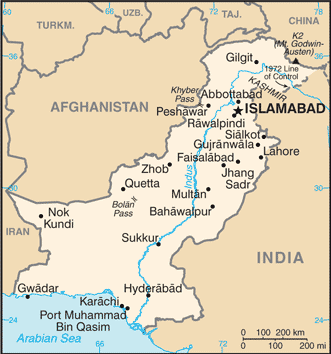
Map image could not be loaded. Open source image.
ⓘ
CIA World Factbook map, February 2021 media edition. Identity reviewed; current boundaries have not been audited. visual contact sheet or original identity check; does not verify current boundaries Boundaries, place names and designations may be dated or disputed; original annotations retained. SHA-256: f13bee7e4e8cb29187baaa2addc855688152476bd3d2ac7af7610b369bb8dacc. Provenance and inspection record.ⓘ
World Bank directory coordinates; approximate location, not a country center. Coordinate reference date is not supplied by the directory. Natural Earth 1:110m land (2022 source); simplified coastline, no political borders. Map source. Land SVG SHA-256: CF26056A39DC0A5B02F65704E279DFA86E77539A8387D0B2C92F907A67739E5E.Introduction
Background:1
The Indus Valley civilization, one of the oldest in the world and dating back at least 5,000 years, spread over much of modern-day Pakistan. During the second millennium B.C., remnants of this culture fused with the migrating Indo-Aryan peoples. The area underwent successive invasions in subsequent centuries from the Persians, Greeks, Scythians, Arabs (who brought Islam), Afghans, and Turks. The Mughal Empire flourished in the 16th and 17th centuries; the British came to dominate the region in the 18th century. The partition in 1947 of British India into the Muslim state of Pakistan (with West and East sections) and largely Hindu India created lasting tension between the two countries. They have fought two wars and a limited conflict -- in 1947-48, 1965, and 1999 respectively -- over the Kashmir territory, a dispute that continues to this day. A third war in 1971 -- in which India assisted an indigenous movement reacting to Bengali marginalization in Pakistani politics -- resulted in East Pakistan becoming the separate nation of Bangladesh.
In response to Indian nuclear weapons testing, Pakistan conducted its own tests in 1998. Pakistan has been engaged in a decades-long armed conflict with militant groups, including the Tehreek-e-Taliban Pakistan (TTP) and other militant networks that target government institutions and civilians.
Geography
Location:2
Southern Asia, bordering the Arabian Sea, between India on the east and Iran and Afghanistan on the west and China in the north
Geographic coordinates:3
30 00 N, 70 00 E
Map references:4
Asia
Area:5
Surface area: 796,100 square kilometers (2024)
Area - comparative:7
slightly more than five times the size of Georgia; slightly less than twice the size of California
Land boundaries:8
Coastline:9
1,046 km
Maritime claims:10
Climate:11
mostly hot, dry desert; temperate in northwest; arctic in north
Terrain:12
divided into three major geographic areas: the northern highlands, the Indus River plain in the center and east, and the Balochistan Plateau in the south and west
Elevation:13
Natural resources:14
arable land, extensive natural gas reserves, limited petroleum, poor quality coal, iron ore, copper, salt, limestone
Land use:15
Irrigated land:16
194,200 sq km (2022)
Major rivers (by length in km):17
Indus river mouth (shared with China [s] and India) - 3,610 km; Sutlej river mouth (shared with China [s] and India) - 1,372 km; Chenab river mouth (shared with India [s]) - 1,086 km
Major watersheds (area sq km):18
Major aquifers:19
Indus Basin
Population distribution:20
the Indus River and its tributaries attract most of the settlement, with Punjab province the most densely populated
Natural hazards:21
frequent earthquakes, occasionally severe especially in north and west; flooding along the Indus after heavy rains (July and August)
Geography - note:22
controls Khyber Pass and Bolan Pass, traditional invasion routes between Central Asia and India
People and Society
Population:23
Population: 255,219,554 people (2025)
Nationality:25
Ethnic groups:26
Punjabi 44.7%, Pashtun (Pathan) 15.4%, Sindhi 14.1%, Saraiki 8.4%, Muhajirs 7.6%, Baloch 3.6%, other 6.3%
Languages:27
Punjabi 38.8%, Pashto (alternate name, Pashtu) 18.2%, Sindhi 14.6%, Saraiki (a Punjabi variant) 12.2%, Urdu 7.1%, Balochi 3%, Hindko 2.4%, Brahui 1.2%, other 2.4%
Religions:28
Islam (official) 96.5% (Sunni 85-90%, Shia 10-15%), other (includes Christian and Hindu) 3.5% (2020 est.)
Age structure:29
Dependency ratios:30
Median age:31
Population growth rate:32
Population growth rate: 1.56 % annually (2025)
1.86% (2024 est.)
Birth rate:34
Crude birth rate: 27.41 births per 1,000 people (2024)
25.5 births/1,000 population (2024 est.)
Death rate:36
Crude death rate: 6.45 deaths per 1,000 people (2024)
5.9 deaths/1,000 population (2024 est.)
Net migration rate:38
-1.1 migrant(s)/1,000 population (2024 est.)
Population distribution:39
the Indus River and its tributaries attract most of the settlement, with Punjab province the most densely populated
Urbanization:40
Urban population: 39.53 % of population (2025)
Major urban areas - population:42
17.236 million Karachi, 13.979 million Lahore, 3.711 million Faisalabad, 2.415 million Gujranwala, 2.412 million Peshawar, 1.232 million ISLAMABAD (capital) (2023)
Sex ratio:43
Mother's mean age at first birth:44
22.8 years (2017/18 est.)
Maternal mortality ratio:45
Maternal mortality ratio: 155 deaths per 100,000 live births (2023)
155 deaths/100,000 live births (2023 est.)
Infant mortality rate:47
Infant mortality rate: 48.2 deaths per 1,000 live births (2024)
Life expectancy at birth:49
Life expectancy at birth: 67.8 years (2024)
Total fertility rate:51
Total fertility rate: 3.55 births per woman (2024)
3.32 children born/woman (2024 est.)
Gross reproduction rate:53
1.62 (2024 est.)
Drinking water source:54
At least basic drinking water services: 90.69 % of population (2024)
Health expenditure:56
Current health expenditure: 2.52 % of GDP (2023)
Physician density:58
Physicians: 1.16 per 1,000 people (2021)
1.16 physicians/1,000 population (2021)
Hospital bed density:60
0.5 beds/1,000 population (2019 est.)
Sanitation facility access:61
At least basic sanitation services: 71.88 % of population (2024)
Obesity - adult prevalence rate:63
8.6% (2016)
Alcohol consumption per capita:64
Tobacco use:65
Children under the age of 5 years underweight:66
23.1% (2018 est.)
Currently married women (ages 15-49):67
63.5% (2023 est.)
Child marriage:68
Education expenditure:69
Government education expenditure: 1.95 % of GDP (2023)
Literacy:71
Adult literacy rate: 58.86 % of people aged 15 and over (2021)
School life expectancy (primary to tertiary education):73
Environment
Environmental issues:74
water pollution from raw sewage, industrial wastes, and agricultural runoff; limited natural freshwater resources; most of the population does not have access to potable water; deforestation; soil erosion; desertification; air pollution and noise pollution in urban areas
International environmental agreements:75
Climate:76
mostly hot, dry desert; temperate in northwest; arctic in north
Land use:77
Urbanization:78
Carbon dioxide emissions:79
Particulate matter emissions:80
50.1 micrograms per cubic meter (2019 est.)
Methane emissions:81
Waste and recycling:82
Total water withdrawal:83
Total renewable water resources:84
246.8 billion cubic meters (2022 est.)
Government
Country name:85
Government type:86
federal parliamentary republic
Capital:87
Administrative divisions:88
4 provinces, 2 Pakistan-administered areas*, and 1 capital territory**; Azad Kashmir*, Balochistan, Gilgit-Baltistan*, Islamabad Capital Territory**, Khyber Pakhtunkhwa, Punjab, Sindh
Legal system:89
common law system with Islamic law influence
Constitution:90
International law organization participation:91
accepts compulsory ICJ jurisdiction with reservations; non-party state to the ICCt
Citizenship:92
Suffrage:93
18 years of age; universal
Executive branch:94
Legislative branch:95
note : in May 2018, the Parliament of Pakistan and the Khyber Pakhtunkhwa Assembly passed a constitutional amendment to merge the Federally Administrated Tribal Areas and Provincially Administered Tribal Areas with the province of Khyber Pakhtunkhwa; the amendment reduces the Senate from 104 to 96 members - 4 in the 2024 election and 4 in the 2027 election
Legislative branch - lower chamber:96
Legislative branch - upper chamber:97
Judicial branch:98
Political parties:99
Awami National Party or ANP
Awami Muslim League or AML
Balochistan Awami Party or BAP
Balochistan National Party-Awami or BNP-A
Balochistan National Party-Mengal or BNP-M
Grand Democratic Alliance or GDA (alliance of several parties)
Hazara Democratic Party or HDP
Istehkam-e-Pakistan Party
Jamaat-e-Islami or JI
Jamhoori Wattan Party or JWP
Jamiat Ulema-e-Islam-Fazl or JUI-F
Majlis Wahdat-e-Muslimeen Pakistan or MWM
Muttahida Majlis-e-Amal or MMA (alliance of several parties)
Muttahida Qaumi Movement-Pakistan or MQM-P
National Party or NP
Pakistan Muslim League or PML-Z
Pakistan Muslim League-Functional or PML-F
Pakistan Muslim League-Nawaz or PML-N
Pakistan Muslim League-Quaid-e-Azam or PML-Q
Pakistan Peoples Party or PPP
Pakistan Rah-e-Haq Party or PRHP
Pakistan Tehrik-e Insaaf or PTI (Pakistan Movement for Justice)
Pashtoonkhwa Milli Awami Party or PMAP or PKMAP
Tehreek-e-Labbaik Pakistan or TLP
Diplomatic representation in the US:100
Diplomatic representation from the US:101
International organization participation:102
ADB, AIIB, ARF, ASEAN (sectoral dialogue partner), C, CERN (associate member), CICA, CP, D-8, ECO, FAO, G-11, G-24, G-77, IAEA, IBRD, ICAO, ICC (national committees), ICRM, IDA, IDB, IFAD, IFC, IFRCS, IHO, ILO, IMF, IMO, IMSO, Interpol, IOC, IOM, IPU, ISO, ITSO, ITU, ITUC (NGOs), MIGA, MINURCAT, MINURSO, MINUSCA, MONUSCO, NAM, OAS (observer), OIC, OPCW, PCA, SAARC, SACEP, SCO, UN, UNAMID, UNCTAD, UNESCO, UNFICYP, UNHCR, UNIDO, UNISFA, UNISFA, UNMISS, UNOOSA, UNSOS, UNWTO, UPU, WCO, WFTU (NGOs), WHO, WIPO, WMO, WTO
Independence:103
14 August 1947 (from British India)
National holiday:104
Pakistan Day, 23 March, also referred to as Pakistan Resolution Day (1940) or Republic Day (1956)
Flag:105
National symbol(s):106
five-pointed star between the horns of a waxing crescent moon, jasmine
National color(s):107
green, white
National anthem(s):108
National heritage:109
Economy
Economic overview:110
lower middle-income South Asian economy; extremely high debt; endemic corruption; regional disputes with India and Afghanistan hinder investment; falling inflation, IMF relief programs, and strong agricultural output slowly contributing to economic recovery
Real GDP (purchasing power parity):111
$1.39 trillion (2024 est.)
$1.346 trillion (2023 est.)
$1.347 trillion (2022 est.)
Real GDP growth rate:112
3.2% (2024 est.)
0% (2023 est.)
4.8% (2022 est.)
Real GDP per capita:113
GDP (official exchange rate):114
GDP: 407,307,214,476.22 current US dollars (2025)
$373.072 billion (2024 est.)
Inflation rate (consumer prices):116
GDP - composition, by sector of origin:117
GDP - composition, by end use:118
Agricultural products:119
sugarcane, bison milk, wheat, milk, rice, maize, potatoes, cotton, mangoes/guavas, chicken (2023)
Industries:120
textiles and apparel, food processing, pharmaceuticals, surgical instruments, construction materials, paper products, fertilizer, shrimp
Industrial production growth rate:121
-1.7% (2024 est.)
Labor force:122
83.644 million (2024 est.)
Unemployment rate:123
Youth unemployment rate (ages 15-24):124
Population below poverty line:125
21.9% (2018 est.)
Gini Index coefficient - distribution of family income:126
29.6 (2018 est.)
Average household expenditures:127
Household income or consumption by percentage share:128
Remittances:129
9.4% of GDP (2024 est.)
7.9% of GDP (2023 est.)
8% of GDP (2022 est.)
Budget:130
Public debt:131
67.6% of GDP (2016 est.)
Current account balance:132
$699.22 million (2024 est.)
-$1.039 billion (2023 est.)
-$12.216 billion (2022 est.)
Exports:133
$40.219 billion (2024 est.)
$36.215 billion (2023 est.)
$38.967 billion (2022 est.)
Exports - partners:134
USA 14%, UAE 10%, China 9%, Germany 7%, UK 6% (2023)
Exports - commodities:135
garments, fabric, refined petroleum, rice, cotton fabric (2023)
Imports:136
$66.844 billion (2024 est.)
$58.069 billion (2023 est.)
$76.594 billion (2022 est.)
Imports - partners:137
China 25%, Qatar 11%, UAE 9%, Saudi Arabia 8%, Indonesia 6% (2023)
Imports - commodities:138
natural gas, refined petroleum, crude petroleum, palm oil, plastics (2023)
Reserves of foreign exchange and gold:139
$18.408 billion (2024 est.)
$13.73 billion (2023 est.)
$9.927 billion (2022 est.)
Debt - external:140
$89.148 billion (2023 est.)
Exchange rates:141
278.581 (2024 est.)
280.356 (2023 est.)
204.867 (2022 est.)
162.906 (2021 est.)
161.838 (2020 est.)
Energy
Electricity access:142
Electricity:143
Electricity generation sources:144
Nuclear energy:145
Coal:146
Petroleum:147
Natural gas:148
Energy consumption per capita:149
Communications
Telephones - fixed lines:150
Telephones - mobile cellular:151
Broadcast media:152
120 satellite TV stations; 42 media companies/channels; state-run Pakistan Television Corporation (PTV) is the largest TV network, serves over 85 percent of the population with 9 TV channels; over 100 private cable and satellite channels; state-owned Pakistan Broadcasting Corporation (PBC or Radio Pakistan) has the largest radio audience, particularly in rural areas, with AM/SW/FM stations covering most of the country (2022)
Internet country code:153
.pk
Internet users:154
Broadband - fixed subscriptions:155
Transportation
Civil aircraft registration country code prefix:156
AP
Airports:157
117 (2025)
Heliports:158
48 (2025)
Railways:159
Merchant marine:160
Ports:161
Military and Security
Military and security forces:162
Pakistan Armed Forces: Pakistan Army (includes National Guard), Pakistan Navy (includes Pakistan Marines, Pakistan Maritime Security Agency), Pakistan Air Force
Ministry of Interior: Frontier Constabulary, Frontier Corps, National Police, Pakistan Coast Guard, Punjab (Pakistan) Rangers, Sindh (Pakistan) Rangers (2025)
Military expenditures:163
2.5% of GDP (2024 est.)
3% of GDP (2023 est.)
4% of GDP (2022 est.)
4% of GDP (2021 est.)
4% of GDP (2020 est.)
Military and security service personnel strengths:164
information varies; approximately 650,000 active Armed Forces (550,000 Army; 30,000 Navy; 70,000 Air Force) (2025)
Military equipment inventories and acquisitions:165
the military's inventory is a broad mix of mostly imported and some domestically produced weapons and equipment; most of its imported weapons are from China; other suppliers include France, Russia, Turkey, Ukraine, the UK, and the US; Pakistan also has a large domestic defense industry, which produces or co-produces such items as armored vehicles, aircraft, missiles, naval vessels (2024)
Military service age and obligation:166
16 (or 17 depending on service) to 23 years of age for voluntary military service; soldiers cannot be deployed for combat until age 18; women serve in all three armed forces; reserve obligation to age 45 for enlisted men, age 50 for officers (2023)
Military deployments:167
1,300 Central African Republic (MINUSCA); 290 South Sudan (UNMISS); 590 Sudan (UNISFA) (2024)
Military - note:168
the Pakistan military is responsible for external defense but also has a domestic security role; its chief external focus is India; the military is the lead security agency in many areas of the former Federally Administered Tribal Areas (FATA) and has for decades conducted operations against various internal militant groups; it is also one of the longest serving and largest contributors to UN peacekeeping missions; China is its closest security partner
the military operates largely independently and without effective civilian oversight; it has ruled the country for more than 30 years since independence in 1947 and continues to play a significant role in Pakistan's political arena; it also has a large stake in the country’s economic sector and is involved in a diverse array of commercial activities, including banking, construction of public projects, employment services, energy and power generation, fertilizer, food, housing, real estate, and security services
Pakistan has fought four wars and several skirmishes with India; three of the wars have been over the disputed region of Jammu and Kashmir, the status of which has been unsettled since the UK's 1947 withdrawal and the partition and independence of India and Pakistan; a fragile cease-fire was reached in 2003, revised in 2018, and reaffirmed in 2021, although the militarized Line of Control which serves as the border remains contested, and India has accused Pakistan of backing armed separatists and terrorist organizations in the territory New Delhi controls; in the Spring of 2025, Indian held Pakistan responsible for a terrorist attack in India-controlled Kashmir and retaliated, sparking a brief cross-border conflict involving aircraft, artillery, drone, and missile strikes
the Kashmir dispute also includes the Siachen Glacier, located in the Karakoram Mountain Range, which was seized by India in 1984 with Pakistan attempting to retake the area several times between 1985 and 1995; despite the 2003 cease-fire, both sides continue to maintain a permanent military presence there with outposts at altitudes above 20,000 feet (over 6,000 meters) where most casualties are due to extreme weather and the hazards of operating in the high mountain terrain of the world’s highest conflict, including avalanches, exposure, and altitude sickness (2025)
Space
Space agency/agencies:169
Pakistan Space & Upper Atmosphere Research Commission (SUPARCO; established 1961) (2025)
Space launch site(s):170
none; missile test sites at Somiani (Balochistan) and Tilla Jogian (Punjab) (2025)
Space program overview:171
space program dates back to the early 1960s, but funding shortfalls and shifts in priority toward ballistic missile development in the 1980s and 1990s hampered the program’s development; now has a strengthened focus on acquiring satellites and reaching agreements with other space powers for additional capabilities; manufactures and operates satellites; researching and developing other space-related capabilities and technologies, such as satellite payloads; also conducts research in areas such as astronomy, astrophysics, environmental monitoring, and space sciences; works with China, Russia, and Turkey (cooperated with the UK and US prior to the 1990s) (2025)
Key space-program milestones:172
1962-1972 - launched about 200 sounding rockets with some US assistance
1990 - first domestically built experimental satellite (Badr-1) launched by China
2001 - first remote sensing (RS) satellite (Badr-2) built jointly with the UK and launched by Russia
2011 - first digital communications satellite (PakSat-1R) launched by China
2017 - successfully test-launched ballistic missile system (Shaheed-III)
2023 - joined China’s International Lunar Research Station program
2024 - first lunar orbiter/satellite (iCube Qamar) launched by China and deployed from China's Chang'e-6 spacecraft
2025 - first fully domestic RS satellite (PRSC-EO1) launched by China; selected country's first astronauts to be trained by China for mission to China's space station
Terrorism
Terrorist group(s):173
al-Qa’ida; al-Qa’ida in the Indian Subcontinent (AQIS); Balochistan Liberation Army (BLA); Haqqani Network (HQN); Harakat ul-Jihad-i-Islami (HUJI); Harakat ul-Mujahidin; Hizbul Mujahideen; Indian Mujahedeen; Islamic State of Iraq and ash-Sham-Khorasan (ISIS-K); Islamic State of Iraq and ash-Sham – India (ISI); Islamic State of ash-Sham – Pakistan (ISP); Islamic Movement of Uzbekistan (IMU); Jaish-e-Mohammed (JeM); Jaysh al Adl (Jundallah); Lashkar i Jhangvi (LJ); Lashkar-e Tayyiba (LeT); The Resistance Front (TRF); Tehrik-e-Taliban Pakistan (TTP)
Transnational Issues
Additional observations
- Real GDP growth176
- 3.7 % annual change (2025)
- Consumer price inflation177
- 3.55 % annual change (2025)
- Unemployment (modeled ILO estimate)178
- 5.42 % of labor force (2025)
- Access to electricity179
- 95.7 % of population (2024)
- Renewable energy share of total final energy consumption180
- 41.6 % (2021)
- Individuals using the internet181
- 57.25 % of population (2024)
Notes & sources
- Background. Reference edition; observation: dates as stated in text. Field last updated: not supplied; profile fallback: 2025-12-04 13:07:34 -0500 (not a field revision date); needs review. Reference source. Edition last checked 2026-10-29 (retrieval only). ↩
- Location. Reference edition; observation: dates as stated in text. Field last updated: not supplied; profile fallback: 2025-12-04 13:07:34 -0500 (not a field revision date); needs review. Reference source. Edition last checked 2026-10-29 (retrieval only). ↩
- Geographic coordinates. Reference edition; observation: dates as stated in text. Field last updated: not supplied; profile fallback: 2025-12-04 13:07:34 -0500 (not a field revision date); needs review. Reference source. Edition last checked 2026-10-29 (retrieval only). ↩
- Map references. Reference edition; observation: dates as stated in text. Field last updated: not supplied; profile fallback: 2025-12-04 13:07:34 -0500 (not a field revision date); needs review. Reference source. Edition last checked 2026-10-29 (retrieval only). ↩
- Area. Reference edition; observation: dates as stated in text. Field last updated: not supplied; profile fallback: 2025-12-04 13:07:34 -0500 (not a field revision date); needs review. Reference source. The archived total area has no reference year and territorial coverage may differ from World Bank surface area. World Bank: 796,100 square kilometers (2024). Reference: 796,095 square kilometers. Edition last checked 2026-10-29 (retrieval only). ↩
- Surface area. Surface area: observation 2024; checked 2026-10-29; single source. World Bank World Development Indicators. The archived total area has no reference year and territorial coverage may differ from World Bank surface area. World Bank: 796,100 square kilometers (2024). Reference: 796,095 square kilometers. ↩
- Area - comparative. Reference edition; observation: dates as stated in text. Field last updated: not supplied; profile fallback: 2025-12-04 13:07:34 -0500 (not a field revision date); needs review. Reference source. Edition last checked 2026-10-29 (retrieval only). ↩
- Land boundaries. Reference edition; observation: dates as stated in text. Field last updated: not supplied; profile fallback: 2025-12-04 13:07:34 -0500 (not a field revision date); needs review. Reference source. Edition last checked 2026-10-29 (retrieval only). ↩
- Coastline. Reference edition; observation: dates as stated in text. Field last updated: not supplied; profile fallback: 2025-12-04 13:07:34 -0500 (not a field revision date); needs review. Reference source. Edition last checked 2026-10-29 (retrieval only). ↩
- Maritime claims. Reference edition; observation: dates as stated in text. Field last updated: not supplied; profile fallback: 2025-12-04 13:07:34 -0500 (not a field revision date); needs review. Reference source. Edition last checked 2026-10-29 (retrieval only). ↩
- Climate. Reference edition; observation: dates as stated in text. Field last updated: not supplied; profile fallback: 2025-12-04 13:07:34 -0500 (not a field revision date); needs review. Reference source. Edition last checked 2026-10-29 (retrieval only). ↩
- Terrain. Reference edition; observation: dates as stated in text. Field last updated: not supplied; profile fallback: 2025-12-04 13:07:34 -0500 (not a field revision date); needs review. Reference source. Edition last checked 2026-10-29 (retrieval only). ↩
- Elevation. Reference edition; observation: dates as stated in text. Field last updated: not supplied; profile fallback: 2025-12-04 13:07:34 -0500 (not a field revision date); needs review. Reference source. Edition last checked 2026-10-29 (retrieval only). ↩
- Natural resources. Reference edition; observation: dates as stated in text. Field last updated: not supplied; profile fallback: 2025-12-04 13:07:34 -0500 (not a field revision date); needs review. Reference source. Edition last checked 2026-10-29 (retrieval only). ↩
- Land use. Reference edition; observation: dates as stated in text. Field last updated: not supplied; profile fallback: 2025-12-04 13:07:34 -0500 (not a field revision date); needs review. Reference source. Edition last checked 2026-10-29 (retrieval only). ↩
- Irrigated land. Reference edition; observation: 2022. Field last updated: not supplied; profile fallback: 2025-12-04 13:07:34 -0500 (not a field revision date); needs review. Reference source. Edition last checked 2026-10-29 (retrieval only). ↩
- Major rivers (by length in km). Reference edition; observation: dates as stated in text. Field last updated: not supplied; profile fallback: 2025-12-04 13:07:34 -0500 (not a field revision date); needs review. Reference source. Edition last checked 2026-10-29 (retrieval only). ↩
- Major watersheds (area sq km). Reference edition; observation: dates as stated in text. Field last updated: not supplied; profile fallback: 2025-12-04 13:07:34 -0500 (not a field revision date); needs review. Reference source. Edition last checked 2026-10-29 (retrieval only). ↩
- Major aquifers. Reference edition; observation: dates as stated in text. Field last updated: not supplied; profile fallback: 2025-12-04 13:07:34 -0500 (not a field revision date); needs review. Reference source. Edition last checked 2026-10-29 (retrieval only). ↩
- Population distribution. Reference edition; observation: dates as stated in text. Field last updated: not supplied; profile fallback: 2025-12-04 13:07:34 -0500 (not a field revision date); needs review. Reference source. Edition last checked 2026-10-29 (retrieval only). ↩
- Natural hazards. Reference edition; observation: dates as stated in text. Field last updated: not supplied; profile fallback: 2025-12-04 13:07:34 -0500 (not a field revision date); needs review. Reference source. Edition last checked 2026-10-29 (retrieval only). ↩
- Geography - note. Reference edition; observation: dates as stated in text. Field last updated: not supplied; profile fallback: 2025-12-04 13:07:34 -0500 (not a field revision date); needs review. Reference source. Edition last checked 2026-10-29 (retrieval only). ↩
- Population. Reference edition; observation: dates as stated in text. Field last updated: not supplied; profile fallback: 2025-12-04 13:07:34 -0500 (not a field revision date); needs review. Reference source. Different reference years; no numerical agreement is asserted. World Bank: 255,219,554 people (2025). Reference: 252,363,571 people (2024). Edition last checked 2026-10-29 (retrieval only). ↩
- Population. Population: observation 2025; checked 2026-10-29; single source. World Bank World Development Indicators. Different reference years; no numerical agreement is asserted. World Bank: 255,219,554 people (2025). Reference: 252,363,571 people (2024). ↩
- Nationality. Reference edition; observation: dates as stated in text. Field last updated: not supplied; profile fallback: 2025-12-04 13:07:34 -0500 (not a field revision date); needs review. Reference source. Edition last checked 2026-10-29 (retrieval only). ↩
- Ethnic groups. Reference edition; observation: dates as stated in text. Field last updated: not supplied; profile fallback: 2025-12-04 13:07:34 -0500 (not a field revision date); needs review. Reference source. Edition last checked 2026-10-29 (retrieval only). ↩
- Languages. Reference edition; observation: dates as stated in text. Field last updated: not supplied; profile fallback: 2025-12-04 13:07:34 -0500 (not a field revision date); needs review. Reference source. Edition last checked 2026-10-29 (retrieval only). ↩
- Religions. Reference edition; observation: 2020 est.. Field last updated: not supplied; profile fallback: 2025-12-04 13:07:34 -0500 (not a field revision date); needs review. Reference source. Edition last checked 2026-10-29 (retrieval only). ↩
- Age structure. Reference edition; observation: dates as stated in text. Field last updated: not supplied; profile fallback: 2025-12-04 13:07:34 -0500 (not a field revision date); needs review. Reference source. Edition last checked 2026-10-29 (retrieval only). ↩
- Dependency ratios. Reference edition; observation: dates as stated in text. Field last updated: not supplied; profile fallback: 2025-12-04 13:07:34 -0500 (not a field revision date); needs review. Reference source. Edition last checked 2026-10-29 (retrieval only). ↩
- Median age. Reference edition; observation: dates as stated in text. Field last updated: not supplied; profile fallback: 2025-12-04 13:07:34 -0500 (not a field revision date); needs review. Reference source. Edition last checked 2026-10-29 (retrieval only). ↩
- Population growth rate. Reference edition; observation: 2024. Field last updated: not supplied; profile fallback: 2025-12-04 13:07:34 -0500 (not a field revision date); needs review. Reference source. Edition last checked 2026-10-29 (retrieval only). ↩
- Population growth rate. Population growth rate: observation 2025; checked 2026-10-29; single source. World Bank World Development Indicators. Latest available World Bank series in 2020–2026; reference year is not retrieval year. May be modeled or revised; differing definitions and geography require review. No independent crosscheck; do not silently replace archived Factbook. ↩
- Birth rate. Reference edition; observation: 2024. Field last updated: not supplied; profile fallback: 2025-12-04 13:07:34 -0500 (not a field revision date); needs review. Reference source. Edition last checked 2026-10-29 (retrieval only). ↩
- Crude birth rate. Crude birth rate: observation 2024; checked 2026-10-29; single source. World Bank World Development Indicators. Latest available World Bank series in 2020–2026; reference year is not retrieval year. May be modeled or revised; differing definitions and geography require review. No independent crosscheck; do not silently replace archived Factbook. ↩
- Death rate. Reference edition; observation: 2024. Field last updated: not supplied; profile fallback: 2025-12-04 13:07:34 -0500 (not a field revision date); needs review. Reference source. Edition last checked 2026-10-29 (retrieval only). ↩
- Crude death rate. Crude death rate: observation 2024; checked 2026-10-29; single source. World Bank World Development Indicators. Latest available World Bank series in 2020–2026; reference year is not retrieval year. May be modeled or revised; differing definitions and geography require review. No independent crosscheck; do not silently replace archived Factbook. ↩
- Net migration rate. Reference edition; observation: 2024. Field last updated: not supplied; profile fallback: 2025-12-04 13:07:34 -0500 (not a field revision date); needs review. Reference source. Edition last checked 2026-10-29 (retrieval only). ↩
- Population distribution. Reference edition; observation: dates as stated in text. Field last updated: not supplied; profile fallback: 2025-12-04 13:07:34 -0500 (not a field revision date); needs review. Reference source. Edition last checked 2026-10-29 (retrieval only). ↩
- Urbanization. Reference edition; observation: dates as stated in text. Field last updated: not supplied; profile fallback: 2025-12-04 13:07:34 -0500 (not a field revision date); needs review. Reference source. Edition last checked 2026-10-29 (retrieval only). ↩
- Urban population. Urban population: observation 2025; checked 2026-10-29; single source. World Bank World Development Indicators. Latest available World Bank series in 2020–2026; reference year is not retrieval year. May be modeled or revised; differing definitions and geography require review. No independent crosscheck; do not silently replace archived Factbook. ↩
- Major urban areas - population. Reference edition; observation: 2023. Field last updated: not supplied; profile fallback: 2025-12-04 13:07:34 -0500 (not a field revision date); needs review. Reference source. Edition last checked 2026-10-29 (retrieval only). ↩
- Sex ratio. Reference edition; observation: dates as stated in text. Field last updated: not supplied; profile fallback: 2025-12-04 13:07:34 -0500 (not a field revision date); needs review. Reference source. Edition last checked 2026-10-29 (retrieval only). ↩
- Mother's mean age at first birth. Reference edition; observation: 2017/18. Field last updated: not supplied; profile fallback: 2025-12-04 13:07:34 -0500 (not a field revision date); needs review. Reference source. Edition last checked 2026-10-29 (retrieval only). ↩
- Maternal mortality ratio. Reference edition; observation: 2023. Field last updated: not supplied; profile fallback: 2025-12-04 13:07:34 -0500 (not a field revision date); needs review. Reference source. Edition last checked 2026-10-29 (retrieval only). ↩
- Maternal mortality ratio. Maternal mortality ratio: observation 2023; checked 2026-10-29; single source. World Bank World Development Indicators. Latest available World Bank series in 2020–2026; reference year is not retrieval year. May be modeled or revised; differing definitions and geography require review. No independent crosscheck; do not silently replace archived Factbook. ↩
- Infant mortality rate. Reference edition; observation: dates as stated in text. Field last updated: not supplied; profile fallback: 2025-12-04 13:07:34 -0500 (not a field revision date); needs review. Reference source. Edition last checked 2026-10-29 (retrieval only). ↩
- Infant mortality rate. Infant mortality rate: observation 2024; checked 2026-10-29; single source. World Bank World Development Indicators. Latest available World Bank series in 2020–2026; reference year is not retrieval year. May be modeled or revised; differing definitions and geography require review. No independent crosscheck; do not silently replace archived Factbook. ↩
- Life expectancy at birth. Reference edition; observation: dates as stated in text. Field last updated: not supplied; profile fallback: 2025-12-04 13:07:34 -0500 (not a field revision date); needs review. Reference source. Edition last checked 2026-10-29 (retrieval only). ↩
- Life expectancy at birth. Life expectancy at birth: observation 2024; checked 2026-10-29; single source. World Bank World Development Indicators. Latest available World Bank series in 2020–2026; reference year is not retrieval year. May be modeled or revised; differing definitions and geography require review. No independent crosscheck; do not silently replace archived Factbook. ↩
- Total fertility rate. Reference edition; observation: 2024. Field last updated: not supplied; profile fallback: 2025-12-04 13:07:34 -0500 (not a field revision date); needs review. Reference source. Edition last checked 2026-10-29 (retrieval only). ↩
- Total fertility rate. Total fertility rate: observation 2024; checked 2026-10-29; single source. World Bank World Development Indicators. Latest available World Bank series in 2020–2026; reference year is not retrieval year. May be modeled or revised; differing definitions and geography require review. No independent crosscheck; do not silently replace archived Factbook. ↩
- Gross reproduction rate. Reference edition; observation: 2024. Field last updated: not supplied; profile fallback: 2025-12-04 13:07:34 -0500 (not a field revision date); needs review. Reference source. Edition last checked 2026-10-29 (retrieval only). ↩
- Drinking water source. Reference edition; observation: dates as stated in text. Field last updated: not supplied; profile fallback: 2025-12-04 13:07:34 -0500 (not a field revision date); needs review. Reference source. Edition last checked 2026-10-29 (retrieval only). ↩
- At least basic drinking water services. At least basic drinking water services: observation 2024; checked 2026-10-29; single source. World Bank World Development Indicators. Latest available World Bank series in 2020–2026; reference year is not retrieval year. May be modeled or revised; differing definitions and geography require review. No independent crosscheck; do not silently replace archived Factbook. This separately sourced basic-service observation is shown alongside the reference edition’s improved/unimproved categories. It does not replace those category totals. ↩
- Health expenditure. Reference edition; observation: dates as stated in text. Field last updated: not supplied; profile fallback: 2025-12-04 13:07:34 -0500 (not a field revision date); needs review. Reference source. Edition last checked 2026-10-29 (retrieval only). ↩
- Current health expenditure. Current health expenditure: observation 2023; checked 2026-10-29; single source. World Bank World Development Indicators. Latest available World Bank series in 2020–2026; reference year is not retrieval year. May be modeled or revised; differing definitions and geography require review. No independent crosscheck; do not silently replace archived Factbook. ↩
- Physician density. Reference edition; observation: 2021. Field last updated: not supplied; profile fallback: 2025-12-04 13:07:34 -0500 (not a field revision date); needs review. Reference source. Edition last checked 2026-10-29 (retrieval only). ↩
- Physicians. Physicians: observation 2021; checked 2026-10-29; single source. World Bank World Development Indicators. Latest available World Bank series in 2020–2026; reference year is not retrieval year. May be modeled or revised; differing definitions and geography require review. No independent crosscheck; do not silently replace archived Factbook. ↩
- Hospital bed density. Reference edition; observation: 2019. Field last updated: not supplied; profile fallback: 2025-12-04 13:07:34 -0500 (not a field revision date); needs review. Reference source. Edition last checked 2026-10-29 (retrieval only). ↩
- Sanitation facility access. Reference edition; observation: dates as stated in text. Field last updated: not supplied; profile fallback: 2025-12-04 13:07:34 -0500 (not a field revision date); needs review. Reference source. Edition last checked 2026-10-29 (retrieval only). ↩
- At least basic sanitation services. At least basic sanitation services: observation 2024; checked 2026-10-29; single source. World Bank World Development Indicators. Latest available World Bank series in 2020–2026; reference year is not retrieval year. May be modeled or revised; differing definitions and geography require review. No independent crosscheck; do not silently replace archived Factbook. This separately sourced basic-service observation is shown alongside the reference edition’s improved/unimproved categories. It does not replace those category totals. ↩
- Obesity - adult prevalence rate. Reference edition; observation: 2016. Field last updated: not supplied; profile fallback: 2025-12-04 13:07:34 -0500 (not a field revision date); needs review. Reference source. Edition last checked 2026-10-29 (retrieval only). ↩
- Alcohol consumption per capita. Reference edition; observation: dates as stated in text. Field last updated: not supplied; profile fallback: 2025-12-04 13:07:34 -0500 (not a field revision date); needs review. Reference source. Edition last checked 2026-10-29 (retrieval only). ↩
- Tobacco use. Reference edition; observation: dates as stated in text. Field last updated: not supplied; profile fallback: 2025-12-04 13:07:34 -0500 (not a field revision date); needs review. Reference source. Edition last checked 2026-10-29 (retrieval only). ↩
- Children under the age of 5 years underweight. Reference edition; observation: 2018. Field last updated: not supplied; profile fallback: 2025-12-04 13:07:34 -0500 (not a field revision date); needs review. Reference source. Edition last checked 2026-10-29 (retrieval only). ↩
- Currently married women (ages 15-49). Reference edition; observation: 2023. Field last updated: not supplied; profile fallback: 2025-12-04 13:07:34 -0500 (not a field revision date); needs review. Reference source. Edition last checked 2026-10-29 (retrieval only). ↩
- Child marriage. Reference edition; observation: dates as stated in text. Field last updated: not supplied; profile fallback: 2025-12-04 13:07:34 -0500 (not a field revision date); needs review. Reference source. Edition last checked 2026-10-29 (retrieval only). ↩
- Education expenditure. Reference edition; observation: dates as stated in text. Field last updated: not supplied; profile fallback: 2025-12-04 13:07:34 -0500 (not a field revision date); needs review. Reference source. Edition last checked 2026-10-29 (retrieval only). ↩
- Government education expenditure. Government education expenditure: observation 2023; checked 2026-10-29; single source. World Bank World Development Indicators. Latest available World Bank series in 2020–2026; reference year is not retrieval year. May be modeled or revised; differing definitions and geography require review. No independent crosscheck; do not silently replace archived Factbook. ↩
- Literacy. Reference edition; observation: dates as stated in text. Field last updated: not supplied; profile fallback: 2025-12-04 13:07:34 -0500 (not a field revision date); needs review. Reference source. Edition last checked 2026-10-29 (retrieval only). ↩
- Adult literacy rate. Adult literacy rate: observation 2021; checked 2026-10-29; single source. World Bank World Development Indicators. Latest available World Bank series in 2020–2026; reference year is not retrieval year. May be modeled or revised; differing definitions and geography require review. No independent crosscheck; do not silently replace archived Factbook. ↩
- School life expectancy (primary to tertiary education). Reference edition; observation: dates as stated in text. Field last updated: not supplied; profile fallback: 2025-12-04 13:07:34 -0500 (not a field revision date); needs review. Reference source. Edition last checked 2026-10-29 (retrieval only). ↩
- Environmental issues. Reference edition; observation: dates as stated in text. Field last updated: not supplied; profile fallback: 2025-12-04 13:07:34 -0500 (not a field revision date); needs review. Reference source. Edition last checked 2026-10-29 (retrieval only). ↩
- International environmental agreements. Reference edition; observation: dates as stated in text. Field last updated: not supplied; profile fallback: 2025-12-04 13:07:34 -0500 (not a field revision date); needs review. Reference source. Edition last checked 2026-10-29 (retrieval only). ↩
- Climate. Reference edition; observation: dates as stated in text. Field last updated: not supplied; profile fallback: 2025-12-04 13:07:34 -0500 (not a field revision date); needs review. Reference source. Edition last checked 2026-10-29 (retrieval only). ↩
- Land use. Reference edition; observation: dates as stated in text. Field last updated: not supplied; profile fallback: 2025-12-04 13:07:34 -0500 (not a field revision date); needs review. Reference source. Edition last checked 2026-10-29 (retrieval only). ↩
- Urbanization. Reference edition; observation: dates as stated in text. Field last updated: not supplied; profile fallback: 2025-12-04 13:07:34 -0500 (not a field revision date); needs review. Reference source. Edition last checked 2026-10-29 (retrieval only). ↩
- Carbon dioxide emissions. Reference edition; observation: dates as stated in text. Field last updated: not supplied; profile fallback: 2025-12-04 13:07:34 -0500 (not a field revision date); needs review. Reference source. Edition last checked 2026-10-29 (retrieval only). ↩
- Particulate matter emissions. Reference edition; observation: 2019. Field last updated: not supplied; profile fallback: 2025-12-04 13:07:34 -0500 (not a field revision date); needs review. Reference source. Edition last checked 2026-10-29 (retrieval only). ↩
- Methane emissions. Reference edition; observation: dates as stated in text. Field last updated: not supplied; profile fallback: 2025-12-04 13:07:34 -0500 (not a field revision date); needs review. Reference source. Edition last checked 2026-10-29 (retrieval only). ↩
- Waste and recycling. Reference edition; observation: dates as stated in text. Field last updated: not supplied; profile fallback: 2025-12-04 13:07:34 -0500 (not a field revision date); needs review. Reference source. Edition last checked 2026-10-29 (retrieval only). ↩
- Total water withdrawal. Reference edition; observation: dates as stated in text. Field last updated: not supplied; profile fallback: 2025-12-04 13:07:34 -0500 (not a field revision date); needs review. Reference source. Edition last checked 2026-10-29 (retrieval only). ↩
- Total renewable water resources. Reference edition; observation: 2022. Field last updated: not supplied; profile fallback: 2025-12-04 13:07:34 -0500 (not a field revision date); needs review. Reference source. Edition last checked 2026-10-29 (retrieval only). ↩
- Country name. Reference edition; observation: dates as stated in text. Field last updated: not supplied; profile fallback: 2025-12-04 13:07:34 -0500 (not a field revision date); needs review. Reference source. Edition last checked 2026-10-29 (retrieval only). ↩
- Government type. Reference edition; observation: dates as stated in text. Field last updated: not supplied; profile fallback: 2025-12-04 13:07:34 -0500 (not a field revision date); needs review. Reference source. Edition last checked 2026-10-29 (retrieval only). ↩
- Capital. Reference edition; observation: dates as stated in text. Field last updated: not supplied; profile fallback: 2025-12-04 13:07:34 -0500 (not a field revision date); needs review. Reference source. Edition last checked 2026-10-29 (retrieval only). ↩
- Administrative divisions. Reference edition; observation: dates as stated in text. Field last updated: not supplied; profile fallback: 2025-12-04 13:07:34 -0500 (not a field revision date); needs review. Reference source. Edition last checked 2026-10-29 (retrieval only). ↩
- Legal system. Reference edition; observation: dates as stated in text. Field last updated: not supplied; profile fallback: 2025-12-04 13:07:34 -0500 (not a field revision date); needs review. Reference source. Edition last checked 2026-10-29 (retrieval only). ↩
- Constitution. Reference edition; observation: dates as stated in text. Field last updated: not supplied; profile fallback: 2025-12-04 13:07:34 -0500 (not a field revision date); needs review. Reference source. Edition last checked 2026-10-29 (retrieval only). ↩
- International law organization participation. Reference edition; observation: dates as stated in text. Field last updated: not supplied; profile fallback: 2025-12-04 13:07:34 -0500 (not a field revision date); needs review. Reference source. Edition last checked 2026-10-29 (retrieval only). ↩
- Citizenship. Reference edition; observation: dates as stated in text. Field last updated: not supplied; profile fallback: 2025-12-04 13:07:34 -0500 (not a field revision date); needs review. Reference source. Edition last checked 2026-10-29 (retrieval only). ↩
- Suffrage. Reference edition; observation: dates as stated in text. Field last updated: not supplied; profile fallback: 2025-12-04 13:07:34 -0500 (not a field revision date); needs review. Reference source. Edition last checked 2026-10-29 (retrieval only). ↩
- Executive branch. Reference edition; observation: dates as stated in text. Field last updated: not supplied; profile fallback: 2025-12-04 13:07:34 -0500 (not a field revision date); needs review. Reference source. Edition last checked 2026-10-29 (retrieval only). ↩
- Legislative branch. Reference edition; observation: dates as stated in text. Field last updated: not supplied; profile fallback: 2025-12-04 13:07:34 -0500 (not a field revision date); needs review. Reference source. Edition last checked 2026-10-29 (retrieval only). ↩
- Legislative branch - lower chamber. Reference edition; observation: dates as stated in text. Field last updated: not supplied; profile fallback: 2025-12-04 13:07:34 -0500 (not a field revision date); needs review. Reference source. Edition last checked 2026-10-29 (retrieval only). ↩
- Legislative branch - upper chamber. Reference edition; observation: dates as stated in text. Field last updated: not supplied; profile fallback: 2025-12-04 13:07:34 -0500 (not a field revision date); needs review. Reference source. Edition last checked 2026-10-29 (retrieval only). ↩
- Judicial branch. Reference edition; observation: dates as stated in text. Field last updated: not supplied; profile fallback: 2025-12-04 13:07:34 -0500 (not a field revision date); needs review. Reference source. Edition last checked 2026-10-29 (retrieval only). ↩
- Political parties. Reference edition; observation: dates as stated in text. Field last updated: not supplied; profile fallback: 2025-12-04 13:07:34 -0500 (not a field revision date); needs review. Reference source. Edition last checked 2026-10-29 (retrieval only). ↩
- Diplomatic representation in the US. Reference edition; observation: dates as stated in text. Field last updated: not supplied; profile fallback: 2025-12-04 13:07:34 -0500 (not a field revision date); needs review. Reference source. Edition last checked 2026-10-29 (retrieval only). ↩
- Diplomatic representation from the US. Reference edition; observation: dates as stated in text. Field last updated: not supplied; profile fallback: 2025-12-04 13:07:34 -0500 (not a field revision date); needs review. Reference source. Edition last checked 2026-10-29 (retrieval only). ↩
- International organization participation. Reference edition; observation: dates as stated in text. Field last updated: not supplied; profile fallback: 2025-12-04 13:07:34 -0500 (not a field revision date); needs review. Reference source. Edition last checked 2026-10-29 (retrieval only). ↩
- Independence. Reference edition; observation: dates as stated in text. Field last updated: not supplied; profile fallback: 2025-12-04 13:07:34 -0500 (not a field revision date); needs review. Reference source. Edition last checked 2026-10-29 (retrieval only). ↩
- National holiday. Reference edition; observation: dates as stated in text. Field last updated: not supplied; profile fallback: 2025-12-04 13:07:34 -0500 (not a field revision date); needs review. Reference source. Edition last checked 2026-10-29 (retrieval only). ↩
- Flag. Reference edition; observation: dates as stated in text. Field last updated: not supplied; profile fallback: 2025-12-04 13:07:34 -0500 (not a field revision date); needs review. Reference source. Edition last checked 2026-10-29 (retrieval only). ↩
- National symbol(s). Reference edition; observation: dates as stated in text. Field last updated: not supplied; profile fallback: 2025-12-04 13:07:34 -0500 (not a field revision date); needs review. Reference source. Edition last checked 2026-10-29 (retrieval only). ↩
- National color(s). Reference edition; observation: dates as stated in text. Field last updated: not supplied; profile fallback: 2025-12-04 13:07:34 -0500 (not a field revision date); needs review. Reference source. Edition last checked 2026-10-29 (retrieval only). ↩
- National anthem(s). Reference edition; observation: dates as stated in text. Field last updated: not supplied; profile fallback: 2025-12-04 13:07:34 -0500 (not a field revision date); needs review. Reference source. Edition last checked 2026-10-29 (retrieval only). ↩
- National heritage. Reference edition; observation: dates as stated in text. Field last updated: not supplied; profile fallback: 2025-12-04 13:07:34 -0500 (not a field revision date); needs review. Reference source. Edition last checked 2026-10-29 (retrieval only). ↩
- Economic overview. Reference edition; observation: dates as stated in text. Field last updated: not supplied; profile fallback: 2025-12-04 13:07:34 -0500 (not a field revision date); needs review. Reference source. Edition last checked 2026-10-29 (retrieval only). ↩
- Real GDP (purchasing power parity). Reference edition; observation: dates as stated in text. Field last updated: not supplied; profile fallback: 2025-12-04 13:07:34 -0500 (not a field revision date); needs review. Reference source. Edition last checked 2026-10-29 (retrieval only). ↩
- Real GDP growth rate. Reference edition; observation: dates as stated in text. Field last updated: not supplied; profile fallback: 2025-12-04 13:07:34 -0500 (not a field revision date); needs review. Reference source. Edition last checked 2026-10-29 (retrieval only). ↩
- Real GDP per capita. Reference edition; observation: dates as stated in text. Field last updated: not supplied; profile fallback: 2025-12-04 13:07:34 -0500 (not a field revision date); needs review. Reference source. Edition last checked 2026-10-29 (retrieval only). ↩
- GDP (official exchange rate). Reference edition; observation: 2024. Field last updated: not supplied; profile fallback: 2025-12-04 13:07:34 -0500 (not a field revision date); needs review. Reference source. Different reference years; no numerical agreement is asserted. World Bank: 407,307,214,476.22 current US dollars (2025). Reference: 373,072,000,000 current US dollars (2024). Edition last checked 2026-10-29 (retrieval only). ↩
- GDP. GDP: observation 2025; checked 2026-10-29; single source. World Bank World Development Indicators. Different reference years; no numerical agreement is asserted. World Bank: 407,307,214,476.22 current US dollars (2025). Reference: 373,072,000,000 current US dollars (2024). ↩
- Inflation rate (consumer prices). Reference edition; observation: dates as stated in text. Field last updated: not supplied; profile fallback: 2025-12-04 13:07:34 -0500 (not a field revision date); needs review. Reference source. Edition last checked 2026-10-29 (retrieval only). ↩
- GDP - composition, by sector of origin. Reference edition; observation: dates as stated in text. Field last updated: not supplied; profile fallback: 2025-12-04 13:07:34 -0500 (not a field revision date); needs review. Reference source. Edition last checked 2026-10-29 (retrieval only). ↩
- GDP - composition, by end use. Reference edition; observation: dates as stated in text. Field last updated: not supplied; profile fallback: 2025-12-04 13:07:34 -0500 (not a field revision date); needs review. Reference source. Edition last checked 2026-10-29 (retrieval only). ↩
- Agricultural products. Reference edition; observation: 2023. Field last updated: not supplied; profile fallback: 2025-12-04 13:07:34 -0500 (not a field revision date); needs review. Reference source. Edition last checked 2026-10-29 (retrieval only). ↩
- Industries. Reference edition; observation: dates as stated in text. Field last updated: not supplied; profile fallback: 2025-12-04 13:07:34 -0500 (not a field revision date); needs review. Reference source. Edition last checked 2026-10-29 (retrieval only). ↩
- Industrial production growth rate. Reference edition; observation: 2024. Field last updated: not supplied; profile fallback: 2025-12-04 13:07:34 -0500 (not a field revision date); needs review. Reference source. Edition last checked 2026-10-29 (retrieval only). ↩
- Labor force. Reference edition; observation: 2024. Field last updated: not supplied; profile fallback: 2025-12-04 13:07:34 -0500 (not a field revision date); needs review. Reference source. Edition last checked 2026-10-29 (retrieval only). ↩
- Unemployment rate. Reference edition; observation: dates as stated in text. Field last updated: not supplied; profile fallback: 2025-12-04 13:07:34 -0500 (not a field revision date); needs review. Reference source. Edition last checked 2026-10-29 (retrieval only). ↩
- Youth unemployment rate (ages 15-24). Reference edition; observation: dates as stated in text. Field last updated: not supplied; profile fallback: 2025-12-04 13:07:34 -0500 (not a field revision date); needs review. Reference source. Edition last checked 2026-10-29 (retrieval only). ↩
- Population below poverty line. Reference edition; observation: 2018. Field last updated: not supplied; profile fallback: 2025-12-04 13:07:34 -0500 (not a field revision date); needs review. Reference source. Edition last checked 2026-10-29 (retrieval only). ↩
- Gini Index coefficient - distribution of family income. Reference edition; observation: dates as stated in text. Field last updated: not supplied; profile fallback: 2025-12-04 13:07:34 -0500 (not a field revision date); needs review. Reference source. Edition last checked 2026-10-29 (retrieval only). ↩
- Average household expenditures. Reference edition; observation: dates as stated in text. Field last updated: not supplied; profile fallback: 2025-12-04 13:07:34 -0500 (not a field revision date); needs review. Reference source. Edition last checked 2026-10-29 (retrieval only). ↩
- Household income or consumption by percentage share. Reference edition; observation: dates as stated in text. Field last updated: not supplied; profile fallback: 2025-12-04 13:07:34 -0500 (not a field revision date); needs review. Reference source. Edition last checked 2026-10-29 (retrieval only). ↩
- Remittances. Reference edition; observation: dates as stated in text. Field last updated: not supplied; profile fallback: 2025-12-04 13:07:34 -0500 (not a field revision date); needs review. Reference source. Edition last checked 2026-10-29 (retrieval only). ↩
- Budget. Reference edition; observation: dates as stated in text. Field last updated: not supplied; profile fallback: 2025-12-04 13:07:34 -0500 (not a field revision date); needs review. Reference source. Edition last checked 2026-10-29 (retrieval only). ↩
- Public debt. Reference edition; observation: dates as stated in text. Field last updated: not supplied; profile fallback: 2025-12-04 13:07:34 -0500 (not a field revision date); needs review. Reference source. Edition last checked 2026-10-29 (retrieval only). ↩
- Current account balance. Reference edition; observation: dates as stated in text. Field last updated: not supplied; profile fallback: 2025-12-04 13:07:34 -0500 (not a field revision date); needs review. Reference source. Edition last checked 2026-10-29 (retrieval only). ↩
- Exports. Reference edition; observation: dates as stated in text. Field last updated: not supplied; profile fallback: 2025-12-04 13:07:34 -0500 (not a field revision date); needs review. Reference source. Edition last checked 2026-10-29 (retrieval only). ↩
- Exports - partners. Reference edition; observation: 2023. Field last updated: not supplied; profile fallback: 2025-12-04 13:07:34 -0500 (not a field revision date); needs review. Reference source. Edition last checked 2026-10-29 (retrieval only). ↩
- Exports - commodities. Reference edition; observation: 2023. Field last updated: not supplied; profile fallback: 2025-12-04 13:07:34 -0500 (not a field revision date); needs review. Reference source. Edition last checked 2026-10-29 (retrieval only). ↩
- Imports. Reference edition; observation: dates as stated in text. Field last updated: not supplied; profile fallback: 2025-12-04 13:07:34 -0500 (not a field revision date); needs review. Reference source. Edition last checked 2026-10-29 (retrieval only). ↩
- Imports - partners. Reference edition; observation: 2023. Field last updated: not supplied; profile fallback: 2025-12-04 13:07:34 -0500 (not a field revision date); needs review. Reference source. Edition last checked 2026-10-29 (retrieval only). ↩
- Imports - commodities. Reference edition; observation: 2023. Field last updated: not supplied; profile fallback: 2025-12-04 13:07:34 -0500 (not a field revision date); needs review. Reference source. Edition last checked 2026-10-29 (retrieval only). ↩
- Reserves of foreign exchange and gold. Reference edition; observation: dates as stated in text. Field last updated: not supplied; profile fallback: 2025-12-04 13:07:34 -0500 (not a field revision date); needs review. Reference source. Edition last checked 2026-10-29 (retrieval only). ↩
- Debt - external. Reference edition; observation: dates as stated in text. Field last updated: not supplied; profile fallback: 2025-12-04 13:07:34 -0500 (not a field revision date); needs review. Reference source. Edition last checked 2026-10-29 (retrieval only). ↩
- Exchange rates. Reference edition; observation: dates as stated in text. Field last updated: not supplied; profile fallback: 2025-12-04 13:07:34 -0500 (not a field revision date); needs review. Reference source. Edition last checked 2026-10-29 (retrieval only). ↩
- Electricity access. Reference edition; observation: dates as stated in text. Field last updated: not supplied; profile fallback: 2025-12-04 13:07:34 -0500 (not a field revision date); needs review. Reference source. Edition last checked 2026-10-29 (retrieval only). ↩
- Electricity. Reference edition; observation: dates as stated in text. Field last updated: not supplied; profile fallback: 2025-12-04 13:07:34 -0500 (not a field revision date); needs review. Reference source. Edition last checked 2026-10-29 (retrieval only). ↩
- Electricity generation sources. Reference edition; observation: dates as stated in text. Field last updated: not supplied; profile fallback: 2025-12-04 13:07:34 -0500 (not a field revision date); needs review. Reference source. Edition last checked 2026-10-29 (retrieval only). ↩
- Nuclear energy. Reference edition; observation: dates as stated in text. Field last updated: not supplied; profile fallback: 2025-12-04 13:07:34 -0500 (not a field revision date); needs review. Reference source. Edition last checked 2026-10-29 (retrieval only). ↩
- Coal. Reference edition; observation: dates as stated in text. Field last updated: not supplied; profile fallback: 2025-12-04 13:07:34 -0500 (not a field revision date); needs review. Reference source. Edition last checked 2026-10-29 (retrieval only). ↩
- Petroleum. Reference edition; observation: dates as stated in text. Field last updated: not supplied; profile fallback: 2025-12-04 13:07:34 -0500 (not a field revision date); needs review. Reference source. Edition last checked 2026-10-29 (retrieval only). ↩
- Natural gas. Reference edition; observation: dates as stated in text. Field last updated: not supplied; profile fallback: 2025-12-04 13:07:34 -0500 (not a field revision date); needs review. Reference source. Edition last checked 2026-10-29 (retrieval only). ↩
- Energy consumption per capita. Reference edition; observation: dates as stated in text. Field last updated: not supplied; profile fallback: 2025-12-04 13:07:34 -0500 (not a field revision date); needs review. Reference source. Edition last checked 2026-10-29 (retrieval only). ↩
- Telephones - fixed lines. Reference edition; observation: dates as stated in text. Field last updated: not supplied; profile fallback: 2025-12-04 13:07:34 -0500 (not a field revision date); needs review. Reference source. Edition last checked 2026-10-29 (retrieval only). ↩
- Telephones - mobile cellular. Reference edition; observation: dates as stated in text. Field last updated: not supplied; profile fallback: 2025-12-04 13:07:34 -0500 (not a field revision date); needs review. Reference source. Edition last checked 2026-10-29 (retrieval only). ↩
- Broadcast media. Reference edition; observation: 2022. Field last updated: not supplied; profile fallback: 2025-12-04 13:07:34 -0500 (not a field revision date); needs review. Reference source. Edition last checked 2026-10-29 (retrieval only). ↩
- Internet country code. Reference edition; observation: dates as stated in text. Field last updated: not supplied; profile fallback: 2025-12-04 13:07:34 -0500 (not a field revision date); needs review. Reference source. Edition last checked 2026-10-29 (retrieval only). ↩
- Internet users. Reference edition; observation: dates as stated in text. Field last updated: not supplied; profile fallback: 2025-12-04 13:07:34 -0500 (not a field revision date); needs review. Reference source. Edition last checked 2026-10-29 (retrieval only). ↩
- Broadband - fixed subscriptions. Reference edition; observation: dates as stated in text. Field last updated: not supplied; profile fallback: 2025-12-04 13:07:34 -0500 (not a field revision date); needs review. Reference source. Edition last checked 2026-10-29 (retrieval only). ↩
- Civil aircraft registration country code prefix. Reference edition; observation: dates as stated in text. Field last updated: not supplied; profile fallback: 2025-12-04 13:07:34 -0500 (not a field revision date); needs review. Reference source. Edition last checked 2026-10-29 (retrieval only). ↩
- Airports. Reference edition; observation: 2025. Field last updated: not supplied; profile fallback: 2025-12-04 13:07:34 -0500 (not a field revision date); needs review. Reference source. Edition last checked 2026-10-29 (retrieval only). ↩
- Heliports. Reference edition; observation: 2025. Field last updated: not supplied; profile fallback: 2025-12-04 13:07:34 -0500 (not a field revision date); needs review. Reference source. Edition last checked 2026-10-29 (retrieval only). ↩
- Railways. Reference edition; observation: dates as stated in text. Field last updated: not supplied; profile fallback: 2025-12-04 13:07:34 -0500 (not a field revision date); needs review. Reference source. Edition last checked 2026-10-29 (retrieval only). ↩
- Merchant marine. Reference edition; observation: dates as stated in text. Field last updated: not supplied; profile fallback: 2025-12-04 13:07:34 -0500 (not a field revision date); needs review. Reference source. Edition last checked 2026-10-29 (retrieval only). ↩
- Ports. Reference edition; observation: dates as stated in text. Field last updated: not supplied; profile fallback: 2025-12-04 13:07:34 -0500 (not a field revision date); needs review. Reference source. Edition last checked 2026-10-29 (retrieval only). ↩
- Military and security forces. Reference edition; observation: 2025. Field last updated: not supplied; profile fallback: 2025-12-04 13:07:34 -0500 (not a field revision date); needs review. Reference source. Edition last checked 2026-10-29 (retrieval only). ↩
- Military expenditures. Reference edition; observation: dates as stated in text. Field last updated: not supplied; profile fallback: 2025-12-04 13:07:34 -0500 (not a field revision date); needs review. Reference source. Edition last checked 2026-10-29 (retrieval only). ↩
- Military and security service personnel strengths. Reference edition; observation: 2025. Field last updated: not supplied; profile fallback: 2025-12-04 13:07:34 -0500 (not a field revision date); needs review. Reference source. Edition last checked 2026-10-29 (retrieval only). ↩
- Military equipment inventories and acquisitions. Reference edition; observation: 2024. Field last updated: not supplied; profile fallback: 2025-12-04 13:07:34 -0500 (not a field revision date); needs review. Reference source. Edition last checked 2026-10-29 (retrieval only). ↩
- Military service age and obligation. Reference edition; observation: 2023. Field last updated: not supplied; profile fallback: 2025-12-04 13:07:34 -0500 (not a field revision date); needs review. Reference source. Edition last checked 2026-10-29 (retrieval only). ↩
- Military deployments. Reference edition; observation: 2024. Field last updated: not supplied; profile fallback: 2025-12-04 13:07:34 -0500 (not a field revision date); needs review. Reference source. Edition last checked 2026-10-29 (retrieval only). ↩
- Military - note. Reference edition; observation: 2025. Field last updated: not supplied; profile fallback: 2025-12-04 13:07:34 -0500 (not a field revision date); needs review. Reference source. Edition last checked 2026-10-29 (retrieval only). ↩
- Space agency/agencies. Reference edition; observation: 2025. Field last updated: not supplied; profile fallback: 2025-12-04 13:07:34 -0500 (not a field revision date); needs review. Reference source. Edition last checked 2026-10-29 (retrieval only). ↩
- Space launch site(s). Reference edition; observation: 2025. Field last updated: not supplied; profile fallback: 2025-12-04 13:07:34 -0500 (not a field revision date); needs review. Reference source. Edition last checked 2026-10-29 (retrieval only). ↩
- Space program overview. Reference edition; observation: 2025. Field last updated: not supplied; profile fallback: 2025-12-04 13:07:34 -0500 (not a field revision date); needs review. Reference source. Edition last checked 2026-10-29 (retrieval only). ↩
- Key space-program milestones. Reference edition; observation: dates as stated in text. Field last updated: not supplied; profile fallback: 2025-12-04 13:07:34 -0500 (not a field revision date); needs review. Reference source. Edition last checked 2026-10-29 (retrieval only). ↩
- Terrorist group(s). Reference edition; observation: dates as stated in text. Field last updated: not supplied; profile fallback: 2025-12-04 13:07:34 -0500 (not a field revision date); needs review. Reference source. Edition last checked 2026-10-29 (retrieval only). ↩
- Refugees and internally displaced persons. Reference edition; observation: dates as stated in text. Field last updated: not supplied; profile fallback: 2025-12-04 13:07:34 -0500 (not a field revision date); needs review. Reference source. Edition last checked 2026-10-29 (retrieval only). ↩
- Illicit drugs. Reference edition; observation: dates as stated in text. Field last updated: not supplied; profile fallback: 2025-12-04 13:07:34 -0500 (not a field revision date); needs review. Reference source. Edition last checked 2026-10-29 (retrieval only). ↩
- Real GDP growth. Real GDP growth: observation 2025; checked 2026-10-29; single source. World Bank World Development Indicators. Gross domestic product is the total income earned through the production of goods and services in an economic territory during an accounting period. It can be measured in three different ways: using either the expenditure approach, the income approach, or the production approach. This indicator denotes the percentage change over each previous year of the constant price (base year 2015) series in United States dollars. Source metadata: https://api.worldbank.org/v2/indicator/NY.GDP.MKTP.KD.ZG?format=json ↩
- Consumer price inflation. Consumer price inflation: observation 2025; checked 2026-10-29; single source. World Bank World Development Indicators. Inflation as measured by the consumer price index reflects the annual percentage change in the cost to the average consumer of acquiring a basket of goods and services that may be fixed or changed at specified intervals, such as yearly. Source metadata: https://api.worldbank.org/v2/indicator/FP.CPI.TOTL.ZG?format=json ↩
- Unemployment (modeled ILO estimate). Unemployment (modeled ILO estimate): observation 2025; checked 2026-10-29; single source. World Bank World Development Indicators. Unemployment refers to the share of the labor force that is without work but available for and seeking employment. The ILO modeled estimate is not necessarily directly comparable with national unemployment measures. Source metadata: https://api.worldbank.org/v2/indicator/SL.UEM.TOTL.ZS?format=json ↩
- Access to electricity. Access to electricity: observation 2024; checked 2026-10-29; single source. World Bank World Development Indicators. Access to electricity is the percentage of population with access to electricity. Electrification data are collected from industry, national surveys and international sources. Source metadata: https://api.worldbank.org/v2/indicator/EG.ELC.ACCS.ZS?format=json ↩
- Renewable energy share of total final energy consumption. Renewable energy share of total final energy consumption: observation 2021; checked 2026-10-29; single source. World Bank World Development Indicators. Renewable energy consumption is the share of renewable energy in total final energy consumption. Source metadata: https://api.worldbank.org/v2/indicator/EG.FEC.RNEW.ZS?format=json ↩
- Individuals using the internet. Individuals using the internet: observation 2024; checked 2026-10-29; single source. World Bank World Development Indicators. Internet users are individuals who have used the Internet (from any location) in the last 3 months. The Internet can be used via a computer, mobile phone, personal digital assistant, games machine, digital TV etc. Source metadata: https://api.worldbank.org/v2/indicator/IT.NET.USER.ZS?format=json ↩