Sub-Saharan Africa / MRT
Mauritania

ⓘ
2021 Factbook flag mirror; image identity has not been individually audited. Source.
Last updated: October 29, 2026
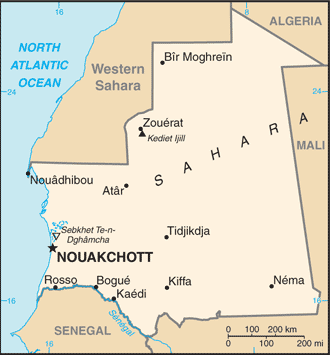
Map image could not be loaded. Open source image.
ⓘ
CIA World Factbook map, February 2021 media edition. Identity reviewed; current boundaries have not been audited. visual contact sheet or original identity check; does not verify current boundaries Boundaries, place names and designations may be dated or disputed; original annotations retained. SHA-256: d8845ba33f86e8908ded2514b3ed5105a899ee1924c86810cd90595609ecc34b. Provenance and inspection record.ⓘ
World Bank directory coordinates; approximate location, not a country center. Coordinate reference date is not supplied by the directory. Natural Earth 1:110m land (2022 source); simplified coastline, no political borders. Map source. Land SVG SHA-256: CF26056A39DC0A5B02F65704E279DFA86E77539A8387D0B2C92F907A67739E5E.Introduction
Background:1
The Amazigh and Bafour people were among the earliest settlers in what is now Mauritania and among the first in recorded history to convert from a nomadic to agricultural lifestyle. These groups account for roughly one third of Mauritania’s ethnic makeup. The remainder of Mauritania’s ethnic groups derive from Sub-Saharan ethnic groups originating mainly from the Senegal River Valley, including descendants of former enslaved peoples. These three groups are organized according to a strict caste system with deep ethnic divides that impact access to resources and power dynamics.
A former French colony, Mauritania achieved independence from France in 1960. Mauritania initially began as a single-party, authoritarian regime and experienced 49 years of dictatorships, flawed elections, failed attempts at democracy, and military coups. Ould Abdel AZIZ led the last coup in 2008, was elected president in 2009, and was reelected in 2014. Mohamed Ould Cheikh GHAZOUANI was elected president in 2019, and his inauguration marked the first peaceful transition of power from one democratically elected president to another, solidifying the country's status as an emerging democracy. International observers recognized the elections as relatively free and fair. GHAZOUANI is seeking re-election in June 2024 for a second, and final, five-year term.
The country is working to address vestigial practices of slavery and its hereditary impacts. Mauritania officially abolished slavery in 1981, but the practice was not criminalized until 2007. Between 2005 and 2011, Al-Qaeda in the Islamic Maghreb (AQIM) launched a series of attacks killing western tourists and aid workers, attacking diplomatic and government facilities, and ambushing Mauritanian soldiers and gendarmes. Although Mauritania has not seen an attack since 2011, AQIM and similar groups remain active in the Sahel region.
Geography
Location:2
Western Africa, bordering the North Atlantic Ocean, between Senegal and Western Sahara
Geographic coordinates:3
20 00 N, 12 00 W
Map references:4
Africa
Area:5
Surface area: 1,030,700 square kilometers (2024)
Area - comparative:7
slightly larger than three times the size of New Mexico; about six times the size of Florida
Land boundaries:8
Coastline:9
754 km
Maritime claims:10
Climate:11
desert; constantly hot, dry, dusty
Terrain:12
mostly barren, flat plains of the Sahara; some central hills
Elevation:13
Natural resources:14
iron ore, gypsum, copper, phosphate, diamonds, gold, oil, fish
Land use:15
Irrigated land:16
450 sq km (2012)
Major rivers (by length in km):17
Senegal river mouth (shared with Guinea [s], Senegal and Mali) - 1,641 km
Major watersheds (area sq km):18
Major aquifers:19
Senegalo-Mauritanian Basin, Taodeni-Tanzerouft Basin
Population distribution:20
vast areas of the country, particularly in the central, northern, and eastern areas, are desert and lack sizeable population clusters; half the population lives in or around the coastal capital of Nouakchott; smaller clusters are found near the southern border with Mali and Senegal, as shown in this population distribution map
Natural hazards:21
hot, dry, dust/sand-laden sirocco wind primarily in March and April; periodic droughts
Geography - note:22
Mauritania is considered part of both North Africa's Maghreb region and West Africa's Sahel region; most of the population is concentrated in the cities of Nouakchott and Nouadhibou and along the Senegal River in the southern part of the country
People and Society
Population:23
Population: 5,315,065 people (2025)
Nationality:25
Ethnic groups:26
Black Moors (Haratines - Arabic-speaking descendants of African origin who are or were enslaved by White Moors) 40%, White Moors (of Arab-Amazigh descent, known as Beydane) 30%, Sub-Saharan Mauritanians (non-Arabic speaking, largely resident in or originating from the Senegal River Valley, including Halpulaar, Fulani, Soninke, Wolof, and Bambara ethnic groups) 30%
Languages:27
Arabic (official and national), Pular, Soninke, Wolof (all national languages), French
كتاب حقائق العالم، المصدر الذي لا يمكن الاستغناء عنه للمعلومات الأساسية (Arabic)
The World Factbook, the indispensable source for basic information.
Religions:28
Muslim (official) 100%
Age structure:29
Dependency ratios:30
Median age:31
Population growth rate:32
Population growth rate: 2.78 % annually (2025)
1.92% (2024 est.)
Birth rate:34
Crude birth rate: 34.03 births per 1,000 people (2024)
27.2 births/1,000 population (2024 est.)
Death rate:36
Crude death rate: 5.41 deaths per 1,000 people (2024)
7.2 deaths/1,000 population (2024 est.)
Net migration rate:38
-0.7 migrant(s)/1,000 population (2024 est.)
Population distribution:39
vast areas of the country, particularly in the central, northern, and eastern areas, are desert and lack sizeable population clusters; half the population lives in or around the coastal capital of Nouakchott; smaller clusters are found near the southern border with Mali and Senegal, as shown in this population distribution map
Urbanization:40
Urban population: 61.49 % of population (2025)
Major urban areas - population:42
1.492 million NOUAKCHOTT (capital) (2023)
Sex ratio:43
Mother's mean age at first birth:44
21.8 years (2019/21)
Maternal mortality ratio:45
Maternal mortality ratio: 381 deaths per 100,000 live births (2023)
381 deaths/100,000 live births (2023 est.)
Infant mortality rate:47
Infant mortality rate: 30.2 deaths per 1,000 live births (2024)
Life expectancy at birth:49
Life expectancy at birth: 68.71 years (2024)
Total fertility rate:51
Total fertility rate: 4.63 births per woman (2024)
3.4 children born/woman (2024 est.)
Gross reproduction rate:53
1.68 (2024 est.)
Drinking water source:54
At least basic drinking water services: 77.28 % of population (2024)
Health expenditure:56
Current health expenditure: 4.34 % of GDP (2023)
Physician density:58
Physicians: 0.26 per 1,000 people (2022)
0.26 physicians/1,000 population (2022)
Sanitation facility access:60
At least basic sanitation services: 58.68 % of population (2024)
Obesity - adult prevalence rate:62
12.7% (2016)
Alcohol consumption per capita:63
Tobacco use:64
Children under the age of 5 years underweight:65
22.4% (2022 est.)
Currently married women (ages 15-49):66
66% (2023 est.)
Child marriage:67
Education expenditure:68
Government education expenditure: 7.61 % of GDP (2024)
Literacy:70
Adult literacy rate: 59.53 % of people aged 15 and over (2020)
School life expectancy (primary to tertiary education):72
Environment
Environmental issues:73
desertification caused in part by overgrazing, deforestation, and drought-aggravated soil erosion; limited natural freshwater resources; locust infestation
International environmental agreements:74
Climate:75
desert; constantly hot, dry, dusty
Land use:76
Urbanization:77
Carbon dioxide emissions:78
Particulate matter emissions:79
35.1 micrograms per cubic meter (2019 est.)
Waste and recycling:80
Total water withdrawal:81
Total renewable water resources:82
11.4 billion cubic meters (2022 est.)
Government
Country name:83
Government type:84
presidential republic
Capital:85
Administrative divisions:86
15 regions ( wilayas , singular - wilaya ); Adrar, Assaba, Brakna, Dakhlet Nouadhibou, Gorgol, Guidimaka, Hodh ech Chargui, Hodh El Gharbi, Inchiri, Nouakchott Nord, Nouakchott Ouest, Nouakchott Sud, Tagant, Tiris Zemmour, Trarza
Legal system:87
mixed system of Islamic and French civil law
Constitution:88
International law organization participation:89
has not submitted an ICJ jurisdiction declaration; non-party state to the ICCt
Citizenship:90
Suffrage:91
18 years of age; universal
Executive branch:92
Legislative branch:93
Judicial branch:94
Political parties:95
Alliance for Justice and Democracy/Movement for Renewal or AJD/MR
El Insaf or Equity Party
El Islah or Reform Party
El Karama or Dignity Party
El Vadila or Virtue Party
Mauritanian Party of Union and Change or HATEM
National Democratic Alliance or AND
National Rally for Reform and Development or RNRD or TAWASSOUL
Nida El-Watan
Party for Conciliation and Prosperity or HIWAR
Party of the Mauritanian Masses or Hakam
Republican Front for Unity and Democracy or FRUD
Sawab Party
Union for Democracy and Progress or UDP
Union of Planning and Construction or UPC
Diplomatic representation in the US:96
ambarimwashington@diplomatie.gov.mr
mauritaniaembassyus.org – Mauritania Embassy washington
Diplomatic representation from the US:97
consularnkc@state.gov
https://mr.usembassy.gov/
International organization participation:98
ABEDA, ACP, AfDB, AFESD, AIIB, AMF, AMU, AU, CAEU, EITI (compliant country), FAO, G-77, IAEA, IBRD, ICAO, ICC (NGOs), ICRM, IDA, IDB, IFAD, IFC, IFRCS, IHO (pending member), ILO, IMF, IMO, Interpol, IOC, IOM, IPU, ISO (correspondent), ITSO, ITU, ITUC (NGOs), LAS, MIGA, NAM, OIC, OIF, OPCW, UN, UNCTAD, UNESCO, UNHRC, UNIDO, UNWTO, UPU, WCO, WHO, WIPO, WMO, WTO
Independence:99
28 November 1960 (from France)
National holiday:100
Independence Day, 28 November (1960)
Flag:101
National symbol(s):102
five-pointed star between the horns of a horizontal crescent moon
National color(s):103
green, yellow
National anthem(s):104
National heritage:105
Economy
Economic overview:106
lower middle-income West African economy; primarily agrarian; rising urbanization; poor property rights; systemic corruption; endemic social and workforce tensions; wide-scale terrorism; foreign over-fishing; environmentally fragile
Real GDP (purchasing power parity):107
Real GDP growth rate:108
Real GDP per capita:109
GDP (official exchange rate):110
GDP: 11,679,910,946.44 current US dollars (2025)
$10.767 billion (2024 est.)
Inflation rate (consumer prices):112
GDP - composition, by sector of origin:113
GDP - composition, by end use:114
Agricultural products:115
rice, milk, goat milk, sorghum, sheep milk, lamb/mutton, beef, camel meat, camel milk, dates (2023)
Industries:116
fish processing, oil production, mining (iron ore, gold, copper)
Industrial production growth rate:117
2.8% (2024 est.)
Labor force:118
1.21 million (2024 est.)
Unemployment rate:119
Youth unemployment rate (ages 15-24):120
Population below poverty line:121
31.8% (2019 est.)
Gini Index coefficient - distribution of family income:122
Household income or consumption by percentage share:123
Remittances:124
Budget:125
Public debt:126
Current account balance:127
Exports:128
Exports - partners:129
China 25%, Switzerland 14%, Canada 12%, UAE 9%, Spain 7% (2023)
Exports - commodities:130
gold, iron ore, fish, processed crustaceans, copper ore (2023)
Imports:131
Imports - partners:132
China 19%, UAE 14%, Morocco 6%, Spain 6%, France 5% (2023)
Imports - commodities:133
refined petroleum, raw sugar, palm oil, wheat, soybean oil (2023)
Reserves of foreign exchange and gold:134
Debt - external:135
Exchange rates:136
Energy
Electricity access:137
Electricity:138
Electricity generation sources:139
Coal:140
Petroleum:141
Natural gas:142
Energy consumption per capita:143
Communications
Telephones - fixed lines:144
Telephones - mobile cellular:145
Broadcast media:146
12 TV stations, 6 state-owned and 6 private; 19 radio broadcasters, including 15 state-owned and 4 (Radio Nouakchott Libre, Radio Tenwir, Radio Kobeni and Mauritanid) private; of the 15 government stations, 4 broadcast from Nouakchott (Radio Mauritanie, Radio Jeunesse, Radio Koran and Mauritanid) and the other 12 broadcast from each of the 12 regions outside Nouakchott (2022)
Internet country code:147
.mr
Internet users:148
Broadband - fixed subscriptions:149
Transportation
Military and Security
Military and security forces:156
Mauritanian Armed Forces (aka Armée Nationale Mauritanienne): National Army, National Navy, Air Force; Gendarmerie
Ministry of Interior and Decentralization: National Police, National Guard (2025)
Military expenditures:157
Military and security service personnel strengths:158
estimated 17,000 active Mauritanian Armed Forces; estimated 3,000 Gendarmerie (2025)
Military equipment inventories and acquisitions:159
the military's inventory is limited and made up largely of older French and Soviet-era equipment; in recent years, Mauritania has received some secondhand and new military equipment, including unmanned aircraft (drones), from several suppliers, including China and the UAE (2024)
Military service age and obligation:160
18 is the legal minimum age for voluntary military service; has a compulsory two-year military service law, but the law has reportedly never been applied (2023)
Military deployments:161
450 (plus about 325 police) Central African Republic (MINUSCA) (2024)
Military - note:162
founded in 1960, the Mauritanian military is responsible for territorial defense and internal security; it also assists in economic development projects, humanitarian missions, and disaster response; border and maritime security, regional stability, and the threat of terrorist groups operating in the Sahel, particularly Mali, are key areas of focus; Mauritania has received security assistance from the EU, France, NATO, and the US (2025)
Terrorism
Terrorist group(s):163
Al-Qa'ida in the Islamic Maghreb (AQIM)
Transnational Issues
Refugees and internally displaced persons:164
Additional observations
- Real GDP growth165
- 4.03 % annual change (2025)
- Consumer price inflation166
- 1.55 % annual change (2025)
- Unemployment (modeled ILO estimate)167
- 10.32 % of labor force (2025)
- Access to electricity168
- 52.2 % of population (2024)
- Renewable energy share of total final energy consumption169
- 19.6 % (2022)
- Individuals using the internet170
- 45.78 % of population (2024)
Notes & sources
- Background. Reference edition; observation: dates as stated in text. Field last updated: not supplied; profile fallback: 2025-12-04 13:07:33 -0500 (not a field revision date); needs review. Reference source. Edition last checked 2026-10-29 (retrieval only). ↩
- Location. Reference edition; observation: dates as stated in text. Field last updated: not supplied; profile fallback: 2025-12-04 13:07:33 -0500 (not a field revision date); needs review. Reference source. Edition last checked 2026-10-29 (retrieval only). ↩
- Geographic coordinates. Reference edition; observation: dates as stated in text. Field last updated: not supplied; profile fallback: 2025-12-04 13:07:33 -0500 (not a field revision date); needs review. Reference source. Edition last checked 2026-10-29 (retrieval only). ↩
- Map references. Reference edition; observation: dates as stated in text. Field last updated: not supplied; profile fallback: 2025-12-04 13:07:33 -0500 (not a field revision date); needs review. Reference source. Edition last checked 2026-10-29 (retrieval only). ↩
- Area. Reference edition; observation: dates as stated in text. Field last updated: not supplied; profile fallback: 2025-12-04 13:07:33 -0500 (not a field revision date); needs review. Reference source. The archived total area has no reference year and territorial coverage may differ from World Bank surface area. World Bank: 1,030,700 square kilometers (2024). Reference: 1,030,700 square kilometers. Edition last checked 2026-10-29 (retrieval only). ↩
- Surface area. Surface area: observation 2024; checked 2026-10-29; single source. World Bank World Development Indicators. The archived total area has no reference year and territorial coverage may differ from World Bank surface area. World Bank: 1,030,700 square kilometers (2024). Reference: 1,030,700 square kilometers. ↩
- Area - comparative. Reference edition; observation: dates as stated in text. Field last updated: not supplied; profile fallback: 2025-12-04 13:07:33 -0500 (not a field revision date); needs review. Reference source. Edition last checked 2026-10-29 (retrieval only). ↩
- Land boundaries. Reference edition; observation: dates as stated in text. Field last updated: not supplied; profile fallback: 2025-12-04 13:07:33 -0500 (not a field revision date); needs review. Reference source. Edition last checked 2026-10-29 (retrieval only). ↩
- Coastline. Reference edition; observation: dates as stated in text. Field last updated: not supplied; profile fallback: 2025-12-04 13:07:33 -0500 (not a field revision date); needs review. Reference source. Edition last checked 2026-10-29 (retrieval only). ↩
- Maritime claims. Reference edition; observation: dates as stated in text. Field last updated: not supplied; profile fallback: 2025-12-04 13:07:33 -0500 (not a field revision date); needs review. Reference source. Edition last checked 2026-10-29 (retrieval only). ↩
- Climate. Reference edition; observation: dates as stated in text. Field last updated: not supplied; profile fallback: 2025-12-04 13:07:33 -0500 (not a field revision date); needs review. Reference source. Edition last checked 2026-10-29 (retrieval only). ↩
- Terrain. Reference edition; observation: dates as stated in text. Field last updated: not supplied; profile fallback: 2025-12-04 13:07:33 -0500 (not a field revision date); needs review. Reference source. Edition last checked 2026-10-29 (retrieval only). ↩
- Elevation. Reference edition; observation: dates as stated in text. Field last updated: not supplied; profile fallback: 2025-12-04 13:07:33 -0500 (not a field revision date); needs review. Reference source. Edition last checked 2026-10-29 (retrieval only). ↩
- Natural resources. Reference edition; observation: dates as stated in text. Field last updated: not supplied; profile fallback: 2025-12-04 13:07:33 -0500 (not a field revision date); needs review. Reference source. Edition last checked 2026-10-29 (retrieval only). ↩
- Land use. Reference edition; observation: dates as stated in text. Field last updated: not supplied; profile fallback: 2025-12-04 13:07:33 -0500 (not a field revision date); needs review. Reference source. Edition last checked 2026-10-29 (retrieval only). ↩
- Irrigated land. Reference edition; observation: 2012. Field last updated: not supplied; profile fallback: 2025-12-04 13:07:33 -0500 (not a field revision date); needs review. Reference source. Edition last checked 2026-10-29 (retrieval only). ↩
- Major rivers (by length in km). Reference edition; observation: dates as stated in text. Field last updated: not supplied; profile fallback: 2025-12-04 13:07:33 -0500 (not a field revision date); needs review. Reference source. Edition last checked 2026-10-29 (retrieval only). ↩
- Major watersheds (area sq km). Reference edition; observation: dates as stated in text. Field last updated: not supplied; profile fallback: 2025-12-04 13:07:33 -0500 (not a field revision date); needs review. Reference source. Edition last checked 2026-10-29 (retrieval only). ↩
- Major aquifers. Reference edition; observation: dates as stated in text. Field last updated: not supplied; profile fallback: 2025-12-04 13:07:33 -0500 (not a field revision date); needs review. Reference source. Edition last checked 2026-10-29 (retrieval only). ↩
- Population distribution. Reference edition; observation: dates as stated in text. Field last updated: not supplied; profile fallback: 2025-12-04 13:07:33 -0500 (not a field revision date); needs review. Reference source. Edition last checked 2026-10-29 (retrieval only). ↩
- Natural hazards. Reference edition; observation: dates as stated in text. Field last updated: not supplied; profile fallback: 2025-12-04 13:07:33 -0500 (not a field revision date); needs review. Reference source. Edition last checked 2026-10-29 (retrieval only). ↩
- Geography - note. Reference edition; observation: dates as stated in text. Field last updated: not supplied; profile fallback: 2025-12-04 13:07:33 -0500 (not a field revision date); needs review. Reference source. Edition last checked 2026-10-29 (retrieval only). ↩
- Population. Reference edition; observation: dates as stated in text. Field last updated: not supplied; profile fallback: 2025-12-04 13:07:33 -0500 (not a field revision date); needs review. Reference source. Different reference years; no numerical agreement is asserted. World Bank: 5,315,065 people (2025). Reference: 4,328,040 people (2024). Edition last checked 2026-10-29 (retrieval only). ↩
- Population. Population: observation 2025; checked 2026-10-29; single source. World Bank World Development Indicators. Different reference years; no numerical agreement is asserted. World Bank: 5,315,065 people (2025). Reference: 4,328,040 people (2024). ↩
- Nationality. Reference edition; observation: dates as stated in text. Field last updated: not supplied; profile fallback: 2025-12-04 13:07:33 -0500 (not a field revision date); needs review. Reference source. Edition last checked 2026-10-29 (retrieval only). ↩
- Ethnic groups. Reference edition; observation: dates as stated in text. Field last updated: not supplied; profile fallback: 2025-12-04 13:07:33 -0500 (not a field revision date); needs review. Reference source. Edition last checked 2026-10-29 (retrieval only). ↩
- Languages. Reference edition; observation: dates as stated in text. Field last updated: not supplied; profile fallback: 2025-12-04 13:07:33 -0500 (not a field revision date); needs review. Reference source. Edition last checked 2026-10-29 (retrieval only). ↩
- Religions. Reference edition; observation: dates as stated in text. Field last updated: not supplied; profile fallback: 2025-12-04 13:07:33 -0500 (not a field revision date); needs review. Reference source. Edition last checked 2026-10-29 (retrieval only). ↩
- Age structure. Reference edition; observation: dates as stated in text. Field last updated: not supplied; profile fallback: 2025-12-04 13:07:33 -0500 (not a field revision date); needs review. Reference source. Edition last checked 2026-10-29 (retrieval only). ↩
- Dependency ratios. Reference edition; observation: dates as stated in text. Field last updated: not supplied; profile fallback: 2025-12-04 13:07:33 -0500 (not a field revision date); needs review. Reference source. Edition last checked 2026-10-29 (retrieval only). ↩
- Median age. Reference edition; observation: dates as stated in text. Field last updated: not supplied; profile fallback: 2025-12-04 13:07:33 -0500 (not a field revision date); needs review. Reference source. Edition last checked 2026-10-29 (retrieval only). ↩
- Population growth rate. Reference edition; observation: 2024. Field last updated: not supplied; profile fallback: 2025-12-04 13:07:33 -0500 (not a field revision date); needs review. Reference source. Edition last checked 2026-10-29 (retrieval only). ↩
- Population growth rate. Population growth rate: observation 2025; checked 2026-10-29; single source. World Bank World Development Indicators. Latest available World Bank series in 2020–2026; reference year is not retrieval year. May be modeled or revised; differing definitions and geography require review. No independent crosscheck; do not silently replace archived Factbook. ↩
- Birth rate. Reference edition; observation: 2024. Field last updated: not supplied; profile fallback: 2025-12-04 13:07:33 -0500 (not a field revision date); needs review. Reference source. Edition last checked 2026-10-29 (retrieval only). ↩
- Crude birth rate. Crude birth rate: observation 2024; checked 2026-10-29; single source. World Bank World Development Indicators. Latest available World Bank series in 2020–2026; reference year is not retrieval year. May be modeled or revised; differing definitions and geography require review. No independent crosscheck; do not silently replace archived Factbook. ↩
- Death rate. Reference edition; observation: 2024. Field last updated: not supplied; profile fallback: 2025-12-04 13:07:33 -0500 (not a field revision date); needs review. Reference source. Edition last checked 2026-10-29 (retrieval only). ↩
- Crude death rate. Crude death rate: observation 2024; checked 2026-10-29; single source. World Bank World Development Indicators. Latest available World Bank series in 2020–2026; reference year is not retrieval year. May be modeled or revised; differing definitions and geography require review. No independent crosscheck; do not silently replace archived Factbook. ↩
- Net migration rate. Reference edition; observation: 2024. Field last updated: not supplied; profile fallback: 2025-12-04 13:07:33 -0500 (not a field revision date); needs review. Reference source. Edition last checked 2026-10-29 (retrieval only). ↩
- Population distribution. Reference edition; observation: dates as stated in text. Field last updated: not supplied; profile fallback: 2025-12-04 13:07:33 -0500 (not a field revision date); needs review. Reference source. Edition last checked 2026-10-29 (retrieval only). ↩
- Urbanization. Reference edition; observation: dates as stated in text. Field last updated: not supplied; profile fallback: 2025-12-04 13:07:33 -0500 (not a field revision date); needs review. Reference source. Edition last checked 2026-10-29 (retrieval only). ↩
- Urban population. Urban population: observation 2025; checked 2026-10-29; single source. World Bank World Development Indicators. Latest available World Bank series in 2020–2026; reference year is not retrieval year. May be modeled or revised; differing definitions and geography require review. No independent crosscheck; do not silently replace archived Factbook. ↩
- Major urban areas - population. Reference edition; observation: 2023. Field last updated: not supplied; profile fallback: 2025-12-04 13:07:33 -0500 (not a field revision date); needs review. Reference source. Edition last checked 2026-10-29 (retrieval only). ↩
- Sex ratio. Reference edition; observation: dates as stated in text. Field last updated: not supplied; profile fallback: 2025-12-04 13:07:33 -0500 (not a field revision date); needs review. Reference source. Edition last checked 2026-10-29 (retrieval only). ↩
- Mother's mean age at first birth. Reference edition; observation: 2019/21. Field last updated: not supplied; profile fallback: 2025-12-04 13:07:33 -0500 (not a field revision date); needs review. Reference source. Edition last checked 2026-10-29 (retrieval only). ↩
- Maternal mortality ratio. Reference edition; observation: 2023. Field last updated: not supplied; profile fallback: 2025-12-04 13:07:33 -0500 (not a field revision date); needs review. Reference source. Edition last checked 2026-10-29 (retrieval only). ↩
- Maternal mortality ratio. Maternal mortality ratio: observation 2023; checked 2026-10-29; single source. World Bank World Development Indicators. Latest available World Bank series in 2020–2026; reference year is not retrieval year. May be modeled or revised; differing definitions and geography require review. No independent crosscheck; do not silently replace archived Factbook. ↩
- Infant mortality rate. Reference edition; observation: dates as stated in text. Field last updated: not supplied; profile fallback: 2025-12-04 13:07:33 -0500 (not a field revision date); needs review. Reference source. Edition last checked 2026-10-29 (retrieval only). ↩
- Infant mortality rate. Infant mortality rate: observation 2024; checked 2026-10-29; single source. World Bank World Development Indicators. Latest available World Bank series in 2020–2026; reference year is not retrieval year. May be modeled or revised; differing definitions and geography require review. No independent crosscheck; do not silently replace archived Factbook. ↩
- Life expectancy at birth. Reference edition; observation: dates as stated in text. Field last updated: not supplied; profile fallback: 2025-12-04 13:07:33 -0500 (not a field revision date); needs review. Reference source. Edition last checked 2026-10-29 (retrieval only). ↩
- Life expectancy at birth. Life expectancy at birth: observation 2024; checked 2026-10-29; single source. World Bank World Development Indicators. Latest available World Bank series in 2020–2026; reference year is not retrieval year. May be modeled or revised; differing definitions and geography require review. No independent crosscheck; do not silently replace archived Factbook. ↩
- Total fertility rate. Reference edition; observation: 2024. Field last updated: not supplied; profile fallback: 2025-12-04 13:07:33 -0500 (not a field revision date); needs review. Reference source. Edition last checked 2026-10-29 (retrieval only). ↩
- Total fertility rate. Total fertility rate: observation 2024; checked 2026-10-29; single source. World Bank World Development Indicators. Latest available World Bank series in 2020–2026; reference year is not retrieval year. May be modeled or revised; differing definitions and geography require review. No independent crosscheck; do not silently replace archived Factbook. ↩
- Gross reproduction rate. Reference edition; observation: 2024. Field last updated: not supplied; profile fallback: 2025-12-04 13:07:33 -0500 (not a field revision date); needs review. Reference source. Edition last checked 2026-10-29 (retrieval only). ↩
- Drinking water source. Reference edition; observation: dates as stated in text. Field last updated: not supplied; profile fallback: 2025-12-04 13:07:33 -0500 (not a field revision date); needs review. Reference source. Edition last checked 2026-10-29 (retrieval only). ↩
- At least basic drinking water services. At least basic drinking water services: observation 2024; checked 2026-10-29; single source. World Bank World Development Indicators. Latest available World Bank series in 2020–2026; reference year is not retrieval year. May be modeled or revised; differing definitions and geography require review. No independent crosscheck; do not silently replace archived Factbook. This separately sourced basic-service observation is shown alongside the reference edition’s improved/unimproved categories. It does not replace those category totals. ↩
- Health expenditure. Reference edition; observation: dates as stated in text. Field last updated: not supplied; profile fallback: 2025-12-04 13:07:33 -0500 (not a field revision date); needs review. Reference source. Edition last checked 2026-10-29 (retrieval only). ↩
- Current health expenditure. Current health expenditure: observation 2023; checked 2026-10-29; single source. World Bank World Development Indicators. Latest available World Bank series in 2020–2026; reference year is not retrieval year. May be modeled or revised; differing definitions and geography require review. No independent crosscheck; do not silently replace archived Factbook. ↩
- Physician density. Reference edition; observation: 2022. Field last updated: not supplied; profile fallback: 2025-12-04 13:07:33 -0500 (not a field revision date); needs review. Reference source. Edition last checked 2026-10-29 (retrieval only). ↩
- Physicians. Physicians: observation 2022; checked 2026-10-29; single source. World Bank World Development Indicators. Latest available World Bank series in 2020–2026; reference year is not retrieval year. May be modeled or revised; differing definitions and geography require review. No independent crosscheck; do not silently replace archived Factbook. ↩
- Sanitation facility access. Reference edition; observation: dates as stated in text. Field last updated: not supplied; profile fallback: 2025-12-04 13:07:33 -0500 (not a field revision date); needs review. Reference source. Edition last checked 2026-10-29 (retrieval only). ↩
- At least basic sanitation services. At least basic sanitation services: observation 2024; checked 2026-10-29; single source. World Bank World Development Indicators. Latest available World Bank series in 2020–2026; reference year is not retrieval year. May be modeled or revised; differing definitions and geography require review. No independent crosscheck; do not silently replace archived Factbook. This separately sourced basic-service observation is shown alongside the reference edition’s improved/unimproved categories. It does not replace those category totals. ↩
- Obesity - adult prevalence rate. Reference edition; observation: 2016. Field last updated: not supplied; profile fallback: 2025-12-04 13:07:33 -0500 (not a field revision date); needs review. Reference source. Edition last checked 2026-10-29 (retrieval only). ↩
- Alcohol consumption per capita. Reference edition; observation: dates as stated in text. Field last updated: not supplied; profile fallback: 2025-12-04 13:07:33 -0500 (not a field revision date); needs review. Reference source. Edition last checked 2026-10-29 (retrieval only). ↩
- Tobacco use. Reference edition; observation: dates as stated in text. Field last updated: not supplied; profile fallback: 2025-12-04 13:07:33 -0500 (not a field revision date); needs review. Reference source. Edition last checked 2026-10-29 (retrieval only). ↩
- Children under the age of 5 years underweight. Reference edition; observation: 2022. Field last updated: not supplied; profile fallback: 2025-12-04 13:07:33 -0500 (not a field revision date); needs review. Reference source. Edition last checked 2026-10-29 (retrieval only). ↩
- Currently married women (ages 15-49). Reference edition; observation: 2023. Field last updated: not supplied; profile fallback: 2025-12-04 13:07:33 -0500 (not a field revision date); needs review. Reference source. Edition last checked 2026-10-29 (retrieval only). ↩
- Child marriage. Reference edition; observation: dates as stated in text. Field last updated: not supplied; profile fallback: 2025-12-04 13:07:33 -0500 (not a field revision date); needs review. Reference source. Edition last checked 2026-10-29 (retrieval only). ↩
- Education expenditure. Reference edition; observation: dates as stated in text. Field last updated: not supplied; profile fallback: 2025-12-04 13:07:33 -0500 (not a field revision date); needs review. Reference source. Edition last checked 2026-10-29 (retrieval only). ↩
- Government education expenditure. Government education expenditure: observation 2024; checked 2026-10-29; single source. World Bank World Development Indicators. Latest available World Bank series in 2020–2026; reference year is not retrieval year. May be modeled or revised; differing definitions and geography require review. No independent crosscheck; do not silently replace archived Factbook. ↩
- Literacy. Reference edition; observation: dates as stated in text. Field last updated: not supplied; profile fallback: 2025-12-04 13:07:33 -0500 (not a field revision date); needs review. Reference source. Edition last checked 2026-10-29 (retrieval only). ↩
- Adult literacy rate. Adult literacy rate: observation 2020; checked 2026-10-29; single source. World Bank World Development Indicators. Latest available World Bank series in 2020–2026; reference year is not retrieval year. May be modeled or revised; differing definitions and geography require review. No independent crosscheck; do not silently replace archived Factbook. ↩
- School life expectancy (primary to tertiary education). Reference edition; observation: dates as stated in text. Field last updated: not supplied; profile fallback: 2025-12-04 13:07:33 -0500 (not a field revision date); needs review. Reference source. Edition last checked 2026-10-29 (retrieval only). ↩
- Environmental issues. Reference edition; observation: dates as stated in text. Field last updated: not supplied; profile fallback: 2025-12-04 13:07:33 -0500 (not a field revision date); needs review. Reference source. Edition last checked 2026-10-29 (retrieval only). ↩
- International environmental agreements. Reference edition; observation: dates as stated in text. Field last updated: not supplied; profile fallback: 2025-12-04 13:07:33 -0500 (not a field revision date); needs review. Reference source. Edition last checked 2026-10-29 (retrieval only). ↩
- Climate. Reference edition; observation: dates as stated in text. Field last updated: not supplied; profile fallback: 2025-12-04 13:07:33 -0500 (not a field revision date); needs review. Reference source. Edition last checked 2026-10-29 (retrieval only). ↩
- Land use. Reference edition; observation: dates as stated in text. Field last updated: not supplied; profile fallback: 2025-12-04 13:07:33 -0500 (not a field revision date); needs review. Reference source. Edition last checked 2026-10-29 (retrieval only). ↩
- Urbanization. Reference edition; observation: dates as stated in text. Field last updated: not supplied; profile fallback: 2025-12-04 13:07:33 -0500 (not a field revision date); needs review. Reference source. Edition last checked 2026-10-29 (retrieval only). ↩
- Carbon dioxide emissions. Reference edition; observation: dates as stated in text. Field last updated: not supplied; profile fallback: 2025-12-04 13:07:33 -0500 (not a field revision date); needs review. Reference source. Edition last checked 2026-10-29 (retrieval only). ↩
- Particulate matter emissions. Reference edition; observation: 2019. Field last updated: not supplied; profile fallback: 2025-12-04 13:07:33 -0500 (not a field revision date); needs review. Reference source. Edition last checked 2026-10-29 (retrieval only). ↩
- Waste and recycling. Reference edition; observation: dates as stated in text. Field last updated: not supplied; profile fallback: 2025-12-04 13:07:33 -0500 (not a field revision date); needs review. Reference source. Edition last checked 2026-10-29 (retrieval only). ↩
- Total water withdrawal. Reference edition; observation: dates as stated in text. Field last updated: not supplied; profile fallback: 2025-12-04 13:07:33 -0500 (not a field revision date); needs review. Reference source. Edition last checked 2026-10-29 (retrieval only). ↩
- Total renewable water resources. Reference edition; observation: 2022. Field last updated: not supplied; profile fallback: 2025-12-04 13:07:33 -0500 (not a field revision date); needs review. Reference source. Edition last checked 2026-10-29 (retrieval only). ↩
- Country name. Reference edition; observation: dates as stated in text. Field last updated: not supplied; profile fallback: 2025-12-04 13:07:33 -0500 (not a field revision date); needs review. Reference source. Edition last checked 2026-10-29 (retrieval only). ↩
- Government type. Reference edition; observation: dates as stated in text. Field last updated: not supplied; profile fallback: 2025-12-04 13:07:33 -0500 (not a field revision date); needs review. Reference source. Edition last checked 2026-10-29 (retrieval only). ↩
- Capital. Reference edition; observation: dates as stated in text. Field last updated: not supplied; profile fallback: 2025-12-04 13:07:33 -0500 (not a field revision date); needs review. Reference source. Edition last checked 2026-10-29 (retrieval only). ↩
- Administrative divisions. Reference edition; observation: dates as stated in text. Field last updated: not supplied; profile fallback: 2025-12-04 13:07:33 -0500 (not a field revision date); needs review. Reference source. Edition last checked 2026-10-29 (retrieval only). ↩
- Legal system. Reference edition; observation: dates as stated in text. Field last updated: not supplied; profile fallback: 2025-12-04 13:07:33 -0500 (not a field revision date); needs review. Reference source. Edition last checked 2026-10-29 (retrieval only). ↩
- Constitution. Reference edition; observation: dates as stated in text. Field last updated: not supplied; profile fallback: 2025-12-04 13:07:33 -0500 (not a field revision date); needs review. Reference source. Edition last checked 2026-10-29 (retrieval only). ↩
- International law organization participation. Reference edition; observation: dates as stated in text. Field last updated: not supplied; profile fallback: 2025-12-04 13:07:33 -0500 (not a field revision date); needs review. Reference source. Edition last checked 2026-10-29 (retrieval only). ↩
- Citizenship. Reference edition; observation: dates as stated in text. Field last updated: not supplied; profile fallback: 2025-12-04 13:07:33 -0500 (not a field revision date); needs review. Reference source. Edition last checked 2026-10-29 (retrieval only). ↩
- Suffrage. Reference edition; observation: dates as stated in text. Field last updated: not supplied; profile fallback: 2025-12-04 13:07:33 -0500 (not a field revision date); needs review. Reference source. Edition last checked 2026-10-29 (retrieval only). ↩
- Executive branch. Reference edition; observation: dates as stated in text. Field last updated: not supplied; profile fallback: 2025-12-04 13:07:33 -0500 (not a field revision date); needs review. Reference source. Edition last checked 2026-10-29 (retrieval only). ↩
- Legislative branch. Reference edition; observation: dates as stated in text. Field last updated: not supplied; profile fallback: 2025-12-04 13:07:33 -0500 (not a field revision date); needs review. Reference source. Edition last checked 2026-10-29 (retrieval only). ↩
- Judicial branch. Reference edition; observation: dates as stated in text. Field last updated: not supplied; profile fallback: 2025-12-04 13:07:33 -0500 (not a field revision date); needs review. Reference source. Edition last checked 2026-10-29 (retrieval only). ↩
- Political parties. Reference edition; observation: dates as stated in text. Field last updated: not supplied; profile fallback: 2025-12-04 13:07:33 -0500 (not a field revision date); needs review. Reference source. Edition last checked 2026-10-29 (retrieval only). ↩
- Diplomatic representation in the US. Reference edition; observation: dates as stated in text. Field last updated: not supplied; profile fallback: 2025-12-04 13:07:33 -0500 (not a field revision date); needs review. Reference source. Edition last checked 2026-10-29 (retrieval only). ↩
- Diplomatic representation from the US. Reference edition; observation: dates as stated in text. Field last updated: not supplied; profile fallback: 2025-12-04 13:07:33 -0500 (not a field revision date); needs review. Reference source. Edition last checked 2026-10-29 (retrieval only). ↩
- International organization participation. Reference edition; observation: dates as stated in text. Field last updated: not supplied; profile fallback: 2025-12-04 13:07:33 -0500 (not a field revision date); needs review. Reference source. Edition last checked 2026-10-29 (retrieval only). ↩
- Independence. Reference edition; observation: dates as stated in text. Field last updated: not supplied; profile fallback: 2025-12-04 13:07:33 -0500 (not a field revision date); needs review. Reference source. Edition last checked 2026-10-29 (retrieval only). ↩
- National holiday. Reference edition; observation: dates as stated in text. Field last updated: not supplied; profile fallback: 2025-12-04 13:07:33 -0500 (not a field revision date); needs review. Reference source. Edition last checked 2026-10-29 (retrieval only). ↩
- Flag. Reference edition; observation: dates as stated in text. Field last updated: not supplied; profile fallback: 2025-12-04 13:07:33 -0500 (not a field revision date); needs review. Reference source. Edition last checked 2026-10-29 (retrieval only). ↩
- National symbol(s). Reference edition; observation: dates as stated in text. Field last updated: not supplied; profile fallback: 2025-12-04 13:07:33 -0500 (not a field revision date); needs review. Reference source. Edition last checked 2026-10-29 (retrieval only). ↩
- National color(s). Reference edition; observation: dates as stated in text. Field last updated: not supplied; profile fallback: 2025-12-04 13:07:33 -0500 (not a field revision date); needs review. Reference source. Edition last checked 2026-10-29 (retrieval only). ↩
- National anthem(s). Reference edition; observation: dates as stated in text. Field last updated: not supplied; profile fallback: 2025-12-04 13:07:33 -0500 (not a field revision date); needs review. Reference source. Edition last checked 2026-10-29 (retrieval only). ↩
- National heritage. Reference edition; observation: dates as stated in text. Field last updated: not supplied; profile fallback: 2025-12-04 13:07:33 -0500 (not a field revision date); needs review. Reference source. Edition last checked 2026-10-29 (retrieval only). ↩
- Economic overview. Reference edition; observation: dates as stated in text. Field last updated: not supplied; profile fallback: 2025-12-04 13:07:33 -0500 (not a field revision date); needs review. Reference source. Edition last checked 2026-10-29 (retrieval only). ↩
- Real GDP (purchasing power parity). Reference edition; observation: dates as stated in text. Field last updated: not supplied; profile fallback: 2025-12-04 13:07:33 -0500 (not a field revision date); needs review. Reference source. Edition last checked 2026-10-29 (retrieval only). ↩
- Real GDP growth rate. Reference edition; observation: dates as stated in text. Field last updated: not supplied; profile fallback: 2025-12-04 13:07:33 -0500 (not a field revision date); needs review. Reference source. Edition last checked 2026-10-29 (retrieval only). ↩
- Real GDP per capita. Reference edition; observation: dates as stated in text. Field last updated: not supplied; profile fallback: 2025-12-04 13:07:33 -0500 (not a field revision date); needs review. Reference source. Edition last checked 2026-10-29 (retrieval only). ↩
- GDP (official exchange rate). Reference edition; observation: 2024. Field last updated: not supplied; profile fallback: 2025-12-04 13:07:33 -0500 (not a field revision date); needs review. Reference source. Different reference years; no numerical agreement is asserted. World Bank: 11,679,910,946.44 current US dollars (2025). Reference: 10,767,000,000 current US dollars (2024). Edition last checked 2026-10-29 (retrieval only). ↩
- GDP. GDP: observation 2025; checked 2026-10-29; single source. World Bank World Development Indicators. Different reference years; no numerical agreement is asserted. World Bank: 11,679,910,946.44 current US dollars (2025). Reference: 10,767,000,000 current US dollars (2024). ↩
- Inflation rate (consumer prices). Reference edition; observation: dates as stated in text. Field last updated: not supplied; profile fallback: 2025-12-04 13:07:33 -0500 (not a field revision date); needs review. Reference source. Edition last checked 2026-10-29 (retrieval only). ↩
- GDP - composition, by sector of origin. Reference edition; observation: dates as stated in text. Field last updated: not supplied; profile fallback: 2025-12-04 13:07:33 -0500 (not a field revision date); needs review. Reference source. Edition last checked 2026-10-29 (retrieval only). ↩
- GDP - composition, by end use. Reference edition; observation: dates as stated in text. Field last updated: not supplied; profile fallback: 2025-12-04 13:07:33 -0500 (not a field revision date); needs review. Reference source. Edition last checked 2026-10-29 (retrieval only). ↩
- Agricultural products. Reference edition; observation: 2023. Field last updated: not supplied; profile fallback: 2025-12-04 13:07:33 -0500 (not a field revision date); needs review. Reference source. Edition last checked 2026-10-29 (retrieval only). ↩
- Industries. Reference edition; observation: dates as stated in text. Field last updated: not supplied; profile fallback: 2025-12-04 13:07:33 -0500 (not a field revision date); needs review. Reference source. Edition last checked 2026-10-29 (retrieval only). ↩
- Industrial production growth rate. Reference edition; observation: 2024. Field last updated: not supplied; profile fallback: 2025-12-04 13:07:33 -0500 (not a field revision date); needs review. Reference source. Edition last checked 2026-10-29 (retrieval only). ↩
- Labor force. Reference edition; observation: 2024. Field last updated: not supplied; profile fallback: 2025-12-04 13:07:33 -0500 (not a field revision date); needs review. Reference source. Edition last checked 2026-10-29 (retrieval only). ↩
- Unemployment rate. Reference edition; observation: dates as stated in text. Field last updated: not supplied; profile fallback: 2025-12-04 13:07:33 -0500 (not a field revision date); needs review. Reference source. Edition last checked 2026-10-29 (retrieval only). ↩
- Youth unemployment rate (ages 15-24). Reference edition; observation: dates as stated in text. Field last updated: not supplied; profile fallback: 2025-12-04 13:07:33 -0500 (not a field revision date); needs review. Reference source. Edition last checked 2026-10-29 (retrieval only). ↩
- Population below poverty line. Reference edition; observation: 2019. Field last updated: not supplied; profile fallback: 2025-12-04 13:07:33 -0500 (not a field revision date); needs review. Reference source. Edition last checked 2026-10-29 (retrieval only). ↩
- Gini Index coefficient - distribution of family income. Reference edition; observation: dates as stated in text. Field last updated: not supplied; profile fallback: 2025-12-04 13:07:33 -0500 (not a field revision date); needs review. Reference source. Edition last checked 2026-10-29 (retrieval only). ↩
- Household income or consumption by percentage share. Reference edition; observation: dates as stated in text. Field last updated: not supplied; profile fallback: 2025-12-04 13:07:33 -0500 (not a field revision date); needs review. Reference source. Edition last checked 2026-10-29 (retrieval only). ↩
- Remittances. Reference edition; observation: dates as stated in text. Field last updated: not supplied; profile fallback: 2025-12-04 13:07:33 -0500 (not a field revision date); needs review. Reference source. Edition last checked 2026-10-29 (retrieval only). ↩
- Budget. Reference edition; observation: dates as stated in text. Field last updated: not supplied; profile fallback: 2025-12-04 13:07:33 -0500 (not a field revision date); needs review. Reference source. Edition last checked 2026-10-29 (retrieval only). ↩
- Public debt. Reference edition; observation: dates as stated in text. Field last updated: not supplied; profile fallback: 2025-12-04 13:07:33 -0500 (not a field revision date); needs review. Reference source. Edition last checked 2026-10-29 (retrieval only). ↩
- Current account balance. Reference edition; observation: dates as stated in text. Field last updated: not supplied; profile fallback: 2025-12-04 13:07:33 -0500 (not a field revision date); needs review. Reference source. Edition last checked 2026-10-29 (retrieval only). ↩
- Exports. Reference edition; observation: dates as stated in text. Field last updated: not supplied; profile fallback: 2025-12-04 13:07:33 -0500 (not a field revision date); needs review. Reference source. Edition last checked 2026-10-29 (retrieval only). ↩
- Exports - partners. Reference edition; observation: 2023. Field last updated: not supplied; profile fallback: 2025-12-04 13:07:33 -0500 (not a field revision date); needs review. Reference source. Edition last checked 2026-10-29 (retrieval only). ↩
- Exports - commodities. Reference edition; observation: 2023. Field last updated: not supplied; profile fallback: 2025-12-04 13:07:33 -0500 (not a field revision date); needs review. Reference source. Edition last checked 2026-10-29 (retrieval only). ↩
- Imports. Reference edition; observation: dates as stated in text. Field last updated: not supplied; profile fallback: 2025-12-04 13:07:33 -0500 (not a field revision date); needs review. Reference source. Edition last checked 2026-10-29 (retrieval only). ↩
- Imports - partners. Reference edition; observation: 2023. Field last updated: not supplied; profile fallback: 2025-12-04 13:07:33 -0500 (not a field revision date); needs review. Reference source. Edition last checked 2026-10-29 (retrieval only). ↩
- Imports - commodities. Reference edition; observation: 2023. Field last updated: not supplied; profile fallback: 2025-12-04 13:07:33 -0500 (not a field revision date); needs review. Reference source. Edition last checked 2026-10-29 (retrieval only). ↩
- Reserves of foreign exchange and gold. Reference edition; observation: dates as stated in text. Field last updated: not supplied; profile fallback: 2025-12-04 13:07:33 -0500 (not a field revision date); needs review. Reference source. Edition last checked 2026-10-29 (retrieval only). ↩
- Debt - external. Reference edition; observation: dates as stated in text. Field last updated: not supplied; profile fallback: 2025-12-04 13:07:33 -0500 (not a field revision date); needs review. Reference source. Edition last checked 2026-10-29 (retrieval only). ↩
- Exchange rates. Reference edition; observation: dates as stated in text. Field last updated: not supplied; profile fallback: 2025-12-04 13:07:33 -0500 (not a field revision date); needs review. Reference source. Edition last checked 2026-10-29 (retrieval only). ↩
- Electricity access. Reference edition; observation: dates as stated in text. Field last updated: not supplied; profile fallback: 2025-12-04 13:07:33 -0500 (not a field revision date); needs review. Reference source. Edition last checked 2026-10-29 (retrieval only). ↩
- Electricity. Reference edition; observation: dates as stated in text. Field last updated: not supplied; profile fallback: 2025-12-04 13:07:33 -0500 (not a field revision date); needs review. Reference source. Edition last checked 2026-10-29 (retrieval only). ↩
- Electricity generation sources. Reference edition; observation: dates as stated in text. Field last updated: not supplied; profile fallback: 2025-12-04 13:07:33 -0500 (not a field revision date); needs review. Reference source. Edition last checked 2026-10-29 (retrieval only). ↩
- Coal. Reference edition; observation: dates as stated in text. Field last updated: not supplied; profile fallback: 2025-12-04 13:07:33 -0500 (not a field revision date); needs review. Reference source. Edition last checked 2026-10-29 (retrieval only). ↩
- Petroleum. Reference edition; observation: dates as stated in text. Field last updated: not supplied; profile fallback: 2025-12-04 13:07:33 -0500 (not a field revision date); needs review. Reference source. Edition last checked 2026-10-29 (retrieval only). ↩
- Natural gas. Reference edition; observation: dates as stated in text. Field last updated: not supplied; profile fallback: 2025-12-04 13:07:33 -0500 (not a field revision date); needs review. Reference source. Edition last checked 2026-10-29 (retrieval only). ↩
- Energy consumption per capita. Reference edition; observation: dates as stated in text. Field last updated: not supplied; profile fallback: 2025-12-04 13:07:33 -0500 (not a field revision date); needs review. Reference source. Edition last checked 2026-10-29 (retrieval only). ↩
- Telephones - fixed lines. Reference edition; observation: dates as stated in text. Field last updated: not supplied; profile fallback: 2025-12-04 13:07:33 -0500 (not a field revision date); needs review. Reference source. Edition last checked 2026-10-29 (retrieval only). ↩
- Telephones - mobile cellular. Reference edition; observation: dates as stated in text. Field last updated: not supplied; profile fallback: 2025-12-04 13:07:33 -0500 (not a field revision date); needs review. Reference source. Edition last checked 2026-10-29 (retrieval only). ↩
- Broadcast media. Reference edition; observation: 2022. Field last updated: not supplied; profile fallback: 2025-12-04 13:07:33 -0500 (not a field revision date); needs review. Reference source. Edition last checked 2026-10-29 (retrieval only). ↩
- Internet country code. Reference edition; observation: dates as stated in text. Field last updated: not supplied; profile fallback: 2025-12-04 13:07:33 -0500 (not a field revision date); needs review. Reference source. Edition last checked 2026-10-29 (retrieval only). ↩
- Internet users. Reference edition; observation: dates as stated in text. Field last updated: not supplied; profile fallback: 2025-12-04 13:07:33 -0500 (not a field revision date); needs review. Reference source. Edition last checked 2026-10-29 (retrieval only). ↩
- Broadband - fixed subscriptions. Reference edition; observation: dates as stated in text. Field last updated: not supplied; profile fallback: 2025-12-04 13:07:33 -0500 (not a field revision date); needs review. Reference source. Edition last checked 2026-10-29 (retrieval only). ↩
- Civil aircraft registration country code prefix. Reference edition; observation: dates as stated in text. Field last updated: not supplied; profile fallback: 2025-12-04 13:07:33 -0500 (not a field revision date); needs review. Reference source. Edition last checked 2026-10-29 (retrieval only). ↩
- Airports. Reference edition; observation: 2025. Field last updated: not supplied; profile fallback: 2025-12-04 13:07:33 -0500 (not a field revision date); needs review. Reference source. Edition last checked 2026-10-29 (retrieval only). ↩
- Heliports. Reference edition; observation: 2025. Field last updated: not supplied; profile fallback: 2025-12-04 13:07:33 -0500 (not a field revision date); needs review. Reference source. Edition last checked 2026-10-29 (retrieval only). ↩
- Railways. Reference edition; observation: dates as stated in text. Field last updated: not supplied; profile fallback: 2025-12-04 13:07:33 -0500 (not a field revision date); needs review. Reference source. Edition last checked 2026-10-29 (retrieval only). ↩
- Merchant marine. Reference edition; observation: dates as stated in text. Field last updated: not supplied; profile fallback: 2025-12-04 13:07:33 -0500 (not a field revision date); needs review. Reference source. Edition last checked 2026-10-29 (retrieval only). ↩
- Ports. Reference edition; observation: dates as stated in text. Field last updated: not supplied; profile fallback: 2025-12-04 13:07:33 -0500 (not a field revision date); needs review. Reference source. Edition last checked 2026-10-29 (retrieval only). ↩
- Military and security forces. Reference edition; observation: 2025. Field last updated: not supplied; profile fallback: 2025-12-04 13:07:33 -0500 (not a field revision date); needs review. Reference source. Edition last checked 2026-10-29 (retrieval only). ↩
- Military expenditures. Reference edition; observation: dates as stated in text. Field last updated: not supplied; profile fallback: 2025-12-04 13:07:33 -0500 (not a field revision date); needs review. Reference source. Edition last checked 2026-10-29 (retrieval only). ↩
- Military and security service personnel strengths. Reference edition; observation: 2025. Field last updated: not supplied; profile fallback: 2025-12-04 13:07:33 -0500 (not a field revision date); needs review. Reference source. Edition last checked 2026-10-29 (retrieval only). ↩
- Military equipment inventories and acquisitions. Reference edition; observation: 2024. Field last updated: not supplied; profile fallback: 2025-12-04 13:07:33 -0500 (not a field revision date); needs review. Reference source. Edition last checked 2026-10-29 (retrieval only). ↩
- Military service age and obligation. Reference edition; observation: 2023. Field last updated: not supplied; profile fallback: 2025-12-04 13:07:33 -0500 (not a field revision date); needs review. Reference source. Edition last checked 2026-10-29 (retrieval only). ↩
- Military deployments. Reference edition; observation: 2024. Field last updated: not supplied; profile fallback: 2025-12-04 13:07:33 -0500 (not a field revision date); needs review. Reference source. Edition last checked 2026-10-29 (retrieval only). ↩
- Military - note. Reference edition; observation: 2025. Field last updated: not supplied; profile fallback: 2025-12-04 13:07:33 -0500 (not a field revision date); needs review. Reference source. Edition last checked 2026-10-29 (retrieval only). ↩
- Terrorist group(s). Reference edition; observation: dates as stated in text. Field last updated: not supplied; profile fallback: 2025-12-04 13:07:33 -0500 (not a field revision date); needs review. Reference source. Edition last checked 2026-10-29 (retrieval only). ↩
- Refugees and internally displaced persons. Reference edition; observation: dates as stated in text. Field last updated: not supplied; profile fallback: 2025-12-04 13:07:33 -0500 (not a field revision date); needs review. Reference source. Edition last checked 2026-10-29 (retrieval only). ↩
- Real GDP growth. Real GDP growth: observation 2025; checked 2026-10-29; single source. World Bank World Development Indicators. Gross domestic product is the total income earned through the production of goods and services in an economic territory during an accounting period. It can be measured in three different ways: using either the expenditure approach, the income approach, or the production approach. This indicator denotes the percentage change over each previous year of the constant price (base year 2015) series in United States dollars. Source metadata: https://api.worldbank.org/v2/indicator/NY.GDP.MKTP.KD.ZG?format=json ↩
- Consumer price inflation. Consumer price inflation: observation 2025; checked 2026-10-29; single source. World Bank World Development Indicators. Inflation as measured by the consumer price index reflects the annual percentage change in the cost to the average consumer of acquiring a basket of goods and services that may be fixed or changed at specified intervals, such as yearly. Source metadata: https://api.worldbank.org/v2/indicator/FP.CPI.TOTL.ZG?format=json ↩
- Unemployment (modeled ILO estimate). Unemployment (modeled ILO estimate): observation 2025; checked 2026-10-29; single source. World Bank World Development Indicators. Unemployment refers to the share of the labor force that is without work but available for and seeking employment. The ILO modeled estimate is not necessarily directly comparable with national unemployment measures. Source metadata: https://api.worldbank.org/v2/indicator/SL.UEM.TOTL.ZS?format=json ↩
- Access to electricity. Access to electricity: observation 2024; checked 2026-10-29; single source. World Bank World Development Indicators. Access to electricity is the percentage of population with access to electricity. Electrification data are collected from industry, national surveys and international sources. Source metadata: https://api.worldbank.org/v2/indicator/EG.ELC.ACCS.ZS?format=json ↩
- Renewable energy share of total final energy consumption. Renewable energy share of total final energy consumption: observation 2022; checked 2026-10-29; single source. World Bank World Development Indicators. Renewable energy consumption is the share of renewable energy in total final energy consumption. Source metadata: https://api.worldbank.org/v2/indicator/EG.FEC.RNEW.ZS?format=json ↩
- Individuals using the internet. Individuals using the internet: observation 2024; checked 2026-10-29; single source. World Bank World Development Indicators. Internet users are individuals who have used the Internet (from any location) in the last 3 months. The Internet can be used via a computer, mobile phone, personal digital assistant, games machine, digital TV etc. Source metadata: https://api.worldbank.org/v2/indicator/IT.NET.USER.ZS?format=json ↩