East Asia & Pacific / MHL
Marshall Islands

ⓘ
2021 Factbook flag mirror; image identity has not been individually audited. Source.
Last updated: October 29, 2026
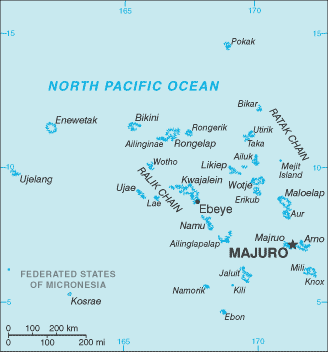
Map image could not be loaded. Open source image.
ⓘ
CIA World Factbook map, February 2021 media edition. Identity reviewed; current boundaries have not been audited. visual contact sheet or original identity check; does not verify current boundaries Boundaries, place names and designations may be dated or disputed; original annotations retained. SHA-256: bba27b1bc4f0890a71984dc9e4cb5f16206ee4b24c6957f0709f322346fb00b5. Provenance and inspection record.ⓘ
World Bank directory coordinates; approximate location, not a country center. Coordinate reference date is not supplied by the directory. Natural Earth 1:110m land (2022 source); simplified coastline, no political borders. Map source. Land SVG SHA-256: CF26056A39DC0A5B02F65704E279DFA86E77539A8387D0B2C92F907A67739E5E.Introduction
Background:1
Humans arrived in the Marshall Islands in the first millennium B.C. and gradually created permanent settlements on the various atolls. The early inhabitants were skilled navigators who frequently traveled between atolls using stick charts to map the islands. Society became organized under two paramount chiefs, one each for the Ratak (Sunrise) Chain and the Ralik (Sunset) Chain. Spain formally claimed the islands in 1592. Germany established a supply station on Jaluit Atoll and bought the islands from Spain in 1884, although paramount chiefs continued to rule.
Japan seized the Marshall Islands in 1914 and was granted a League of Nations Mandate to administer the islands in 1920. The US captured the islands in heavy fighting during World War II, and the islands came under US administration as part of the Trust Territory of the Pacific Islands (TTPI) in 1947. Between 1946 and 1958, the US resettled populations from Bikini and Enewetak Atolls and conducted 67 nuclear tests; people from Ailinginae, Rongelap, and Utrik Atolls were also evacuated because of nuclear fallout, and Bikini and Rongelap remain largely uninhabited. In 1979, the Marshall Islands drafted a constitution separate from the rest of the TTPI and declared independence under President Amata KABUA, a paramount chief. In 2000, Kessai NOTE became the first commoner elected president. In 2016, Hilda HEINE was the first woman elected president.
Geography
Location:2
Oceania, consists of 29 atolls and five isolated islands in the North Pacific Ocean, about halfway between Hawaii and Australia; the atolls and islands are situated in two, almost-parallel island chains - the Ratak (Sunrise) group and the Ralik (Sunset) group; the total number of islands and islets is about 1,225; 22 of the atolls and four of the islands are uninhabited
Geographic coordinates:3
9 00 N, 168 00 E
Map references:4
Oceania
Area:5
Surface area: 181 square kilometers (2024)
Area - comparative:7
about the size of Washington, D.C.
Land boundaries:8
Coastline:9
370.4 km
Maritime claims:10
Climate:11
tropical; hot and humid; wet season May to November; islands border typhoon belt
Terrain:12
low coral limestone and sand islands
Elevation:13
Natural resources:14
coconut products, marine products, deep seabed minerals
Land use:15
Irrigated land:16
0 sq km (2022)
Population distribution:17
most people live in urban clusters on many of the country's islands; more than two thirds of the population lives on the atolls of Majuro and Ebeye
Natural hazards:18
infrequent typhoons
Geography - note:19
Kwajalein atoll surrounds the world's largest lagoon; the island city of Ebeye is the second largest settlement in the Marshall Islands, after the capital of Majuro, and one of the most densely populated locations in the Pacific
People and Society
Population:20
Population: 36,282 people (2025)
Nationality:22
Ethnic groups:23
Marshallese 95.6%, Filipino 1.1%, other 3.3% (2021 est.)
Languages:24
Marshallese (official) 98.2%, other languages 1.8% (1999)
Religions:25
Protestant 79.3% (United Church of Christ 47.9%, Assembly of God 14.1%, Full Gospel 5%, Bukot Nan Jesus 3%, Salvation Army 2.3%, Reformed Congressional Church 2.2%, Seventh Day Adventist 1.7%, New Beginning Church 1.4%, other Protestant 1.6%), Roman Catholic 9.3%, Church of Jesus Christ 5.7%, Jehovah's Witness 1.3%, other 3.3%, none 1.1% (2021 est.)
Age structure:26
Dependency ratios:27
Median age:28
Population growth rate:29
Population growth rate: -3.43 % annually (2025)
1.26% (2024 est.)
Birth rate:31
Crude birth rate: 20.09 births per 1,000 people (2024)
21.2 births/1,000 population (2024 est.)
Death rate:33
Crude death rate: 7.13 deaths per 1,000 people (2024)
4.3 deaths/1,000 population (2024 est.)
Net migration rate:35
-4.3 migrant(s)/1,000 population (2024 est.)
Population distribution:36
most people live in urban clusters on many of the country's islands; more than two thirds of the population lives on the atolls of Majuro and Ebeye
Urbanization:37
Urban population: 79.11 % of population (2025)
Major urban areas - population:39
31,000 MAJURO (capital) (2018)
Sex ratio:40
Maternal mortality ratio:41
Maternal mortality ratio: 155 deaths per 100,000 live births (2023)
155 deaths/100,000 live births (2023 est.)
Infant mortality rate:43
Infant mortality rate: 22.7 deaths per 1,000 live births (2024)
Life expectancy at birth:45
Life expectancy at birth: 67.08 years (2024)
Total fertility rate:47
Total fertility rate: 2.86 births per woman (2024)
2.67 children born/woman (2024 est.)
Gross reproduction rate:49
1.3 (2024 est.)
Drinking water source:50
At least basic drinking water services: 87.44 % of population (2024)
Health expenditure:52
Current health expenditure: 13.41 % of GDP (2023)
Physician density:54
0.47 physicians/1,000 population (2012)
Sanitation facility access:55
At least basic sanitation services: 78.96 % of population (2024)
Obesity - adult prevalence rate:57
52.9% (2016)
Tobacco use:58
Children under the age of 5 years underweight:59
11.9% (2017 est.)
Currently married women (ages 15-49):60
68.3% (2022 est.)
Education expenditure:61
Government education expenditure: 7.7 % of GDP (2022)
Literacy:63
Adult literacy rate: 95.76 % of people aged 15 and over (2021)
School life expectancy (primary to tertiary education):65
Environment
Environmental issues:66
inadequate potable water; pollution of Majuro lagoon from household waste and discharges from fishing vessels; sea-level rise
International environmental agreements:67
Climate:68
tropical; hot and humid; wet season May to November; islands border typhoon belt
Land use:69
Urbanization:70
Carbon dioxide emissions:71
293,700 metric tonnes of CO2 (2017 est.)
Particulate matter emissions:72
7.2 micrograms per cubic meter (2019 est.)
Waste and recycling:73
Government
Country name:74
Government type:75
mixed presidential-parliamentary system in free association with the US
Capital:76
Administrative divisions:77
24 municipalities; Ailinglaplap, Ailuk, Arno, Aur, Bikini & Kili, Ebon, Enewetak & Ujelang, Jabat, Jaluit, Kwajalein, Lae, Lib, Likiep, Majuro, Maloelap, Mejit, Mili, Namorik, Namu, Rongelap, Ujae, Utrik, Wotho, Wotje
Legal system:78
mixed system of US and English common law, customary law, and local statutes
Constitution:79
International law organization participation:80
accepts compulsory ICJ jurisdiction with reservations; accepts ICCt jurisdiction
Citizenship:81
Suffrage:82
18 years of age; universal
Executive branch:83
Legislative branch:84
Judicial branch:85
Political parties:86
traditionally there have been no formally organized political parties; what has existed more closely resembles factions or interest groups because they do not have party headquarters, formal platforms, or party structures
Diplomatic representation in the US:87
Diplomatic representation from the US:88
International organization participation:89
ACP, ADB, AOSIS, FAO, G-77, IAEA, IBRD, ICAO, ICCt, IDA, IFAD, IFC, ILO, IMF, IMO, IMSO, Interpol, IOC, IOM, ITU, OPCW, PIF, Sparteca, SPC, UN, UNCTAD, UNESCO, UNHRC, WHO
Independence:90
21 October 1986 (from the US-administered UN trusteeship)
National holiday:91
Constitution Day, 1 May (1979)
Flag:92
National symbol(s):93
a 24-rayed star
National color(s):94
blue, white, orange
National anthem(s):95
National heritage:96
Economy
Economic overview:97
upper middle-income Pacific island economy; US aid reliance; large public sector; coconut oil production as diesel fuel substitute; growing offshore banking locale; fishing rights seller; import-dependent
Real GDP (purchasing power parity):98
$270.809 million (2024 est.)
$263.507 million (2023 est.)
$274.3 million (2022 est.)
Real GDP growth rate:99
2.8% (2024 est.)
-3.9% (2023 est.)
-1.1% (2022 est.)
Real GDP per capita:100
GDP (official exchange rate):101
GDP: 308,000,000 current US dollars (2025)
$280.358 million (2024 est.)
Inflation rate (consumer prices):103
GDP - composition, by sector of origin:104
GDP - composition, by end use:105
Agricultural products:106
coconuts (2023)
Industries:107
copra, tuna processing, tourism, craft items (from seashells, wood, and pearls)
Industrial production growth rate:108
-2.8% (2023 est.)
Population below poverty line:109
7.2% (2019 est.)
Gini Index coefficient - distribution of family income:110
35.5 (2019 est.)
Household income or consumption by percentage share:111
Remittances:112
13.3% of GDP (2023 est.)
13.6% of GDP (2022 est.)
13.3% of GDP (2021 est.)
Budget:113
Public debt:114
41.6% of GDP (2019 est.)
Taxes and other revenues:115
17.2% (of GDP) (2020 est.)
Current account balance:116
$76.263 million (2021 est.)
$90.281 million (2020 est.)
$86.133 million (2019 est.)
Exports:117
$130.016 million (2021 est.)
$88.042 million (2020 est.)
$91.394 million (2019 est.)
Exports - partners:118
UK 16%, Germany 13%, Denmark 10%, Ghana 9%, Cyprus 9% (2023)
Exports - commodities:119
ships, refined petroleum, fish, natural gas, stone processing machines (2023)
Imports:120
$206.025 million (2021 est.)
$132.845 million (2020 est.)
$129.682 million (2019 est.)
Imports - partners:121
China 47%, Japan 15%, Germany 5%, Brazil 4%, Cyprus 4% (2023)
Imports - commodities:122
ships, refined petroleum, additive manufacturing machines, iron structures, crude petroleum (2023)
Exchange rates:123
the US dollar is used
Energy
Electricity access:124
Communications
Telephones - fixed lines:125
Telephones - mobile cellular:126
Broadcast media:127
no TV broadcast station; a cable network is available on Majuro with programming via videotape replay and satellite relays; 4 radio broadcast stations; US Armed Forces Radio and Television Service (AFRTS) provides satellite radio and TV service to Kwajalein Atoll (2019)
Internet country code:128
.mh
Internet users:129
Broadband - fixed subscriptions:130
Transportation
Civil aircraft registration country code prefix:131
V7
Airports:132
33 (2025)
Merchant marine:133
Ports:134
Military and Security
Military and security forces:135
no regular military forces; Marshall Islands Police Department (includes a Sea Patrol Division) (2025)
Military - note:136
defense is the responsibility of the US; in 1982, the Marshall Islands signed a Compact of Free Association (COFA) with the US, which granted the Marshall Islands financial assistance and access to many US domestic programs in exchange for exclusive US military access and defense responsibilities; the COFA entered into force in 1986; the Marshall Islands hosts a US Army missile test site
the Marshall Islands has a "shiprider" agreement with the US, which allows local maritime law enforcement officers to embark on US Coast Guard (USCG) and US Navy (USN) vessels, including to board and search vessels suspected of violating laws or regulations within its designated exclusive economic zone (EEZ) or on the high seas; "shiprider" agreements also enable USCG personnel and USN vessels with embarked USCG law enforcement personnel to work with host nations to protect critical regional resources (2025)
Transnational Issues
Refugees and internally displaced persons:137
Additional observations
Notes & sources
- Background. Reference edition; observation: dates as stated in text. Field last updated: not supplied; profile fallback: 2025-12-04 13:07:34 -0500 (not a field revision date); needs review. Reference source. Edition last checked 2026-10-29 (retrieval only). ↩
- Location. Reference edition; observation: dates as stated in text. Field last updated: not supplied; profile fallback: 2025-12-04 13:07:34 -0500 (not a field revision date); needs review. Reference source. Edition last checked 2026-10-29 (retrieval only). ↩
- Geographic coordinates. Reference edition; observation: dates as stated in text. Field last updated: not supplied; profile fallback: 2025-12-04 13:07:34 -0500 (not a field revision date); needs review. Reference source. Edition last checked 2026-10-29 (retrieval only). ↩
- Map references. Reference edition; observation: dates as stated in text. Field last updated: not supplied; profile fallback: 2025-12-04 13:07:34 -0500 (not a field revision date); needs review. Reference source. Edition last checked 2026-10-29 (retrieval only). ↩
- Area. Reference edition; observation: dates as stated in text. Field last updated: not supplied; profile fallback: 2025-12-04 13:07:34 -0500 (not a field revision date); needs review. Reference source. The archived total area has no reference year and territorial coverage may differ from World Bank surface area. World Bank: 181 square kilometers (2024). Reference: 181 square kilometers. Edition last checked 2026-10-29 (retrieval only). ↩
- Surface area. Surface area: observation 2024; checked 2026-10-29; single source. World Bank World Development Indicators. The archived total area has no reference year and territorial coverage may differ from World Bank surface area. World Bank: 181 square kilometers (2024). Reference: 181 square kilometers. ↩
- Area - comparative. Reference edition; observation: dates as stated in text. Field last updated: not supplied; profile fallback: 2025-12-04 13:07:34 -0500 (not a field revision date); needs review. Reference source. Edition last checked 2026-10-29 (retrieval only). ↩
- Land boundaries. Reference edition; observation: dates as stated in text. Field last updated: not supplied; profile fallback: 2025-12-04 13:07:34 -0500 (not a field revision date); needs review. Reference source. Edition last checked 2026-10-29 (retrieval only). ↩
- Coastline. Reference edition; observation: dates as stated in text. Field last updated: not supplied; profile fallback: 2025-12-04 13:07:34 -0500 (not a field revision date); needs review. Reference source. Edition last checked 2026-10-29 (retrieval only). ↩
- Maritime claims. Reference edition; observation: dates as stated in text. Field last updated: not supplied; profile fallback: 2025-12-04 13:07:34 -0500 (not a field revision date); needs review. Reference source. Edition last checked 2026-10-29 (retrieval only). ↩
- Climate. Reference edition; observation: dates as stated in text. Field last updated: not supplied; profile fallback: 2025-12-04 13:07:34 -0500 (not a field revision date); needs review. Reference source. Edition last checked 2026-10-29 (retrieval only). ↩
- Terrain. Reference edition; observation: dates as stated in text. Field last updated: not supplied; profile fallback: 2025-12-04 13:07:34 -0500 (not a field revision date); needs review. Reference source. Edition last checked 2026-10-29 (retrieval only). ↩
- Elevation. Reference edition; observation: dates as stated in text. Field last updated: not supplied; profile fallback: 2025-12-04 13:07:34 -0500 (not a field revision date); needs review. Reference source. Edition last checked 2026-10-29 (retrieval only). ↩
- Natural resources. Reference edition; observation: dates as stated in text. Field last updated: not supplied; profile fallback: 2025-12-04 13:07:34 -0500 (not a field revision date); needs review. Reference source. Edition last checked 2026-10-29 (retrieval only). ↩
- Land use. Reference edition; observation: dates as stated in text. Field last updated: not supplied; profile fallback: 2025-12-04 13:07:34 -0500 (not a field revision date); needs review. Reference source. Edition last checked 2026-10-29 (retrieval only). ↩
- Irrigated land. Reference edition; observation: 2022. Field last updated: not supplied; profile fallback: 2025-12-04 13:07:34 -0500 (not a field revision date); needs review. Reference source. Edition last checked 2026-10-29 (retrieval only). ↩
- Population distribution. Reference edition; observation: dates as stated in text. Field last updated: not supplied; profile fallback: 2025-12-04 13:07:34 -0500 (not a field revision date); needs review. Reference source. Edition last checked 2026-10-29 (retrieval only). ↩
- Natural hazards. Reference edition; observation: dates as stated in text. Field last updated: not supplied; profile fallback: 2025-12-04 13:07:34 -0500 (not a field revision date); needs review. Reference source. Edition last checked 2026-10-29 (retrieval only). ↩
- Geography - note. Reference edition; observation: dates as stated in text. Field last updated: not supplied; profile fallback: 2025-12-04 13:07:34 -0500 (not a field revision date); needs review. Reference source. Edition last checked 2026-10-29 (retrieval only). ↩
- Population. Reference edition; observation: dates as stated in text. Field last updated: not supplied; profile fallback: 2025-12-04 13:07:34 -0500 (not a field revision date); needs review. Reference source. Different reference years; no numerical agreement is asserted. World Bank: 36,282 people (2025). Reference: 82,011 people (2024). Edition last checked 2026-10-29 (retrieval only). ↩
- Population. Population: observation 2025; checked 2026-10-29; single source. World Bank World Development Indicators. Different reference years; no numerical agreement is asserted. World Bank: 36,282 people (2025). Reference: 82,011 people (2024). ↩
- Nationality. Reference edition; observation: dates as stated in text. Field last updated: not supplied; profile fallback: 2025-12-04 13:07:34 -0500 (not a field revision date); needs review. Reference source. Edition last checked 2026-10-29 (retrieval only). ↩
- Ethnic groups. Reference edition; observation: 2021 est.. Field last updated: not supplied; profile fallback: 2025-12-04 13:07:34 -0500 (not a field revision date); needs review. Reference source. Edition last checked 2026-10-29 (retrieval only). ↩
- Languages. Reference edition; observation: dates as stated in text. Field last updated: not supplied; profile fallback: 2025-12-04 13:07:34 -0500 (not a field revision date); needs review. Reference source. Edition last checked 2026-10-29 (retrieval only). ↩
- Religions. Reference edition; observation: 2021 est.. Field last updated: not supplied; profile fallback: 2025-12-04 13:07:34 -0500 (not a field revision date); needs review. Reference source. Edition last checked 2026-10-29 (retrieval only). ↩
- Age structure. Reference edition; observation: dates as stated in text. Field last updated: not supplied; profile fallback: 2025-12-04 13:07:34 -0500 (not a field revision date); needs review. Reference source. Edition last checked 2026-10-29 (retrieval only). ↩
- Dependency ratios. Reference edition; observation: dates as stated in text. Field last updated: not supplied; profile fallback: 2025-12-04 13:07:34 -0500 (not a field revision date); needs review. Reference source. Edition last checked 2026-10-29 (retrieval only). ↩
- Median age. Reference edition; observation: dates as stated in text. Field last updated: not supplied; profile fallback: 2025-12-04 13:07:34 -0500 (not a field revision date); needs review. Reference source. Edition last checked 2026-10-29 (retrieval only). ↩
- Population growth rate. Reference edition; observation: 2024. Field last updated: not supplied; profile fallback: 2025-12-04 13:07:34 -0500 (not a field revision date); needs review. Reference source. Edition last checked 2026-10-29 (retrieval only). ↩
- Population growth rate. Population growth rate: observation 2025; checked 2026-10-29; single source. World Bank World Development Indicators. Latest available World Bank series in 2020–2026; reference year is not retrieval year. May be modeled or revised; differing definitions and geography require review. No independent crosscheck; do not silently replace archived Factbook. ↩
- Birth rate. Reference edition; observation: 2024. Field last updated: not supplied; profile fallback: 2025-12-04 13:07:34 -0500 (not a field revision date); needs review. Reference source. Edition last checked 2026-10-29 (retrieval only). ↩
- Crude birth rate. Crude birth rate: observation 2024; checked 2026-10-29; single source. World Bank World Development Indicators. Latest available World Bank series in 2020–2026; reference year is not retrieval year. May be modeled or revised; differing definitions and geography require review. No independent crosscheck; do not silently replace archived Factbook. ↩
- Death rate. Reference edition; observation: 2024. Field last updated: not supplied; profile fallback: 2025-12-04 13:07:34 -0500 (not a field revision date); needs review. Reference source. Edition last checked 2026-10-29 (retrieval only). ↩
- Crude death rate. Crude death rate: observation 2024; checked 2026-10-29; single source. World Bank World Development Indicators. Latest available World Bank series in 2020–2026; reference year is not retrieval year. May be modeled or revised; differing definitions and geography require review. No independent crosscheck; do not silently replace archived Factbook. ↩
- Net migration rate. Reference edition; observation: 2024. Field last updated: not supplied; profile fallback: 2025-12-04 13:07:34 -0500 (not a field revision date); needs review. Reference source. Edition last checked 2026-10-29 (retrieval only). ↩
- Population distribution. Reference edition; observation: dates as stated in text. Field last updated: not supplied; profile fallback: 2025-12-04 13:07:34 -0500 (not a field revision date); needs review. Reference source. Edition last checked 2026-10-29 (retrieval only). ↩
- Urbanization. Reference edition; observation: dates as stated in text. Field last updated: not supplied; profile fallback: 2025-12-04 13:07:34 -0500 (not a field revision date); needs review. Reference source. Edition last checked 2026-10-29 (retrieval only). ↩
- Urban population. Urban population: observation 2025; checked 2026-10-29; single source. World Bank World Development Indicators. Latest available World Bank series in 2020–2026; reference year is not retrieval year. May be modeled or revised; differing definitions and geography require review. No independent crosscheck; do not silently replace archived Factbook. ↩
- Major urban areas - population. Reference edition; observation: 2018. Field last updated: not supplied; profile fallback: 2025-12-04 13:07:34 -0500 (not a field revision date); needs review. Reference source. Edition last checked 2026-10-29 (retrieval only). ↩
- Sex ratio. Reference edition; observation: dates as stated in text. Field last updated: not supplied; profile fallback: 2025-12-04 13:07:34 -0500 (not a field revision date); needs review. Reference source. Edition last checked 2026-10-29 (retrieval only). ↩
- Maternal mortality ratio. Reference edition; observation: 2023. Field last updated: not supplied; profile fallback: 2025-12-04 13:07:34 -0500 (not a field revision date); needs review. Reference source. Edition last checked 2026-10-29 (retrieval only). ↩
- Maternal mortality ratio. Maternal mortality ratio: observation 2023; checked 2026-10-29; single source. World Bank World Development Indicators. Latest available World Bank series in 2020–2026; reference year is not retrieval year. May be modeled or revised; differing definitions and geography require review. No independent crosscheck; do not silently replace archived Factbook. ↩
- Infant mortality rate. Reference edition; observation: dates as stated in text. Field last updated: not supplied; profile fallback: 2025-12-04 13:07:34 -0500 (not a field revision date); needs review. Reference source. Edition last checked 2026-10-29 (retrieval only). ↩
- Infant mortality rate. Infant mortality rate: observation 2024; checked 2026-10-29; single source. World Bank World Development Indicators. Latest available World Bank series in 2020–2026; reference year is not retrieval year. May be modeled or revised; differing definitions and geography require review. No independent crosscheck; do not silently replace archived Factbook. ↩
- Life expectancy at birth. Reference edition; observation: dates as stated in text. Field last updated: not supplied; profile fallback: 2025-12-04 13:07:34 -0500 (not a field revision date); needs review. Reference source. Edition last checked 2026-10-29 (retrieval only). ↩
- Life expectancy at birth. Life expectancy at birth: observation 2024; checked 2026-10-29; single source. World Bank World Development Indicators. Latest available World Bank series in 2020–2026; reference year is not retrieval year. May be modeled or revised; differing definitions and geography require review. No independent crosscheck; do not silently replace archived Factbook. ↩
- Total fertility rate. Reference edition; observation: 2024. Field last updated: not supplied; profile fallback: 2025-12-04 13:07:34 -0500 (not a field revision date); needs review. Reference source. Edition last checked 2026-10-29 (retrieval only). ↩
- Total fertility rate. Total fertility rate: observation 2024; checked 2026-10-29; single source. World Bank World Development Indicators. Latest available World Bank series in 2020–2026; reference year is not retrieval year. May be modeled or revised; differing definitions and geography require review. No independent crosscheck; do not silently replace archived Factbook. ↩
- Gross reproduction rate. Reference edition; observation: 2024. Field last updated: not supplied; profile fallback: 2025-12-04 13:07:34 -0500 (not a field revision date); needs review. Reference source. Edition last checked 2026-10-29 (retrieval only). ↩
- Drinking water source. Reference edition; observation: dates as stated in text. Field last updated: not supplied; profile fallback: 2025-12-04 13:07:34 -0500 (not a field revision date); needs review. Reference source. Edition last checked 2026-10-29 (retrieval only). ↩
- At least basic drinking water services. At least basic drinking water services: observation 2024; checked 2026-10-29; single source. World Bank World Development Indicators. Latest available World Bank series in 2020–2026; reference year is not retrieval year. May be modeled or revised; differing definitions and geography require review. No independent crosscheck; do not silently replace archived Factbook. This separately sourced basic-service observation is shown alongside the reference edition’s improved/unimproved categories. It does not replace those category totals. ↩
- Health expenditure. Reference edition; observation: dates as stated in text. Field last updated: not supplied; profile fallback: 2025-12-04 13:07:34 -0500 (not a field revision date); needs review. Reference source. Edition last checked 2026-10-29 (retrieval only). ↩
- Current health expenditure. Current health expenditure: observation 2023; checked 2026-10-29; single source. World Bank World Development Indicators. Latest available World Bank series in 2020–2026; reference year is not retrieval year. May be modeled or revised; differing definitions and geography require review. No independent crosscheck; do not silently replace archived Factbook. ↩
- Physician density. Reference edition; observation: 2012. Field last updated: not supplied; profile fallback: 2025-12-04 13:07:34 -0500 (not a field revision date); needs review. Reference source. Edition last checked 2026-10-29 (retrieval only). ↩
- Sanitation facility access. Reference edition; observation: dates as stated in text. Field last updated: not supplied; profile fallback: 2025-12-04 13:07:34 -0500 (not a field revision date); needs review. Reference source. Edition last checked 2026-10-29 (retrieval only). ↩
- At least basic sanitation services. At least basic sanitation services: observation 2024; checked 2026-10-29; single source. World Bank World Development Indicators. Latest available World Bank series in 2020–2026; reference year is not retrieval year. May be modeled or revised; differing definitions and geography require review. No independent crosscheck; do not silently replace archived Factbook. This separately sourced basic-service observation is shown alongside the reference edition’s improved/unimproved categories. It does not replace those category totals. ↩
- Obesity - adult prevalence rate. Reference edition; observation: 2016. Field last updated: not supplied; profile fallback: 2025-12-04 13:07:34 -0500 (not a field revision date); needs review. Reference source. Edition last checked 2026-10-29 (retrieval only). ↩
- Tobacco use. Reference edition; observation: dates as stated in text. Field last updated: not supplied; profile fallback: 2025-12-04 13:07:34 -0500 (not a field revision date); needs review. Reference source. Edition last checked 2026-10-29 (retrieval only). ↩
- Children under the age of 5 years underweight. Reference edition; observation: 2017. Field last updated: not supplied; profile fallback: 2025-12-04 13:07:34 -0500 (not a field revision date); needs review. Reference source. Edition last checked 2026-10-29 (retrieval only). ↩
- Currently married women (ages 15-49). Reference edition; observation: 2022. Field last updated: not supplied; profile fallback: 2025-12-04 13:07:34 -0500 (not a field revision date); needs review. Reference source. Edition last checked 2026-10-29 (retrieval only). ↩
- Education expenditure. Reference edition; observation: dates as stated in text. Field last updated: not supplied; profile fallback: 2025-12-04 13:07:34 -0500 (not a field revision date); needs review. Reference source. Edition last checked 2026-10-29 (retrieval only). ↩
- Government education expenditure. Government education expenditure: observation 2022; checked 2026-10-29; single source. World Bank World Development Indicators. Latest available World Bank series in 2020–2026; reference year is not retrieval year. May be modeled or revised; differing definitions and geography require review. No independent crosscheck; do not silently replace archived Factbook. ↩
- Literacy. Reference edition; observation: dates as stated in text. Field last updated: not supplied; profile fallback: 2025-12-04 13:07:34 -0500 (not a field revision date); needs review. Reference source. Edition last checked 2026-10-29 (retrieval only). ↩
- Adult literacy rate. Adult literacy rate: observation 2021; checked 2026-10-29; single source. World Bank World Development Indicators. Latest available World Bank series in 2020–2026; reference year is not retrieval year. May be modeled or revised; differing definitions and geography require review. No independent crosscheck; do not silently replace archived Factbook. ↩
- School life expectancy (primary to tertiary education). Reference edition; observation: dates as stated in text. Field last updated: not supplied; profile fallback: 2025-12-04 13:07:34 -0500 (not a field revision date); needs review. Reference source. Edition last checked 2026-10-29 (retrieval only). ↩
- Environmental issues. Reference edition; observation: dates as stated in text. Field last updated: not supplied; profile fallback: 2025-12-04 13:07:34 -0500 (not a field revision date); needs review. Reference source. Edition last checked 2026-10-29 (retrieval only). ↩
- International environmental agreements. Reference edition; observation: dates as stated in text. Field last updated: not supplied; profile fallback: 2025-12-04 13:07:34 -0500 (not a field revision date); needs review. Reference source. Edition last checked 2026-10-29 (retrieval only). ↩
- Climate. Reference edition; observation: dates as stated in text. Field last updated: not supplied; profile fallback: 2025-12-04 13:07:34 -0500 (not a field revision date); needs review. Reference source. Edition last checked 2026-10-29 (retrieval only). ↩
- Land use. Reference edition; observation: dates as stated in text. Field last updated: not supplied; profile fallback: 2025-12-04 13:07:34 -0500 (not a field revision date); needs review. Reference source. Edition last checked 2026-10-29 (retrieval only). ↩
- Urbanization. Reference edition; observation: dates as stated in text. Field last updated: not supplied; profile fallback: 2025-12-04 13:07:34 -0500 (not a field revision date); needs review. Reference source. Edition last checked 2026-10-29 (retrieval only). ↩
- Carbon dioxide emissions. Reference edition; observation: 2017. Field last updated: not supplied; profile fallback: 2025-12-04 13:07:34 -0500 (not a field revision date); needs review. Reference source. Edition last checked 2026-10-29 (retrieval only). ↩
- Particulate matter emissions. Reference edition; observation: 2019. Field last updated: not supplied; profile fallback: 2025-12-04 13:07:34 -0500 (not a field revision date); needs review. Reference source. Edition last checked 2026-10-29 (retrieval only). ↩
- Waste and recycling. Reference edition; observation: dates as stated in text. Field last updated: not supplied; profile fallback: 2025-12-04 13:07:34 -0500 (not a field revision date); needs review. Reference source. Edition last checked 2026-10-29 (retrieval only). ↩
- Country name. Reference edition; observation: dates as stated in text. Field last updated: not supplied; profile fallback: 2025-12-04 13:07:34 -0500 (not a field revision date); needs review. Reference source. Edition last checked 2026-10-29 (retrieval only). ↩
- Government type. Reference edition; observation: dates as stated in text. Field last updated: not supplied; profile fallback: 2025-12-04 13:07:34 -0500 (not a field revision date); needs review. Reference source. Edition last checked 2026-10-29 (retrieval only). ↩
- Capital. Reference edition; observation: dates as stated in text. Field last updated: not supplied; profile fallback: 2025-12-04 13:07:34 -0500 (not a field revision date); needs review. Reference source. Edition last checked 2026-10-29 (retrieval only). ↩
- Administrative divisions. Reference edition; observation: dates as stated in text. Field last updated: not supplied; profile fallback: 2025-12-04 13:07:34 -0500 (not a field revision date); needs review. Reference source. Edition last checked 2026-10-29 (retrieval only). ↩
- Legal system. Reference edition; observation: dates as stated in text. Field last updated: not supplied; profile fallback: 2025-12-04 13:07:34 -0500 (not a field revision date); needs review. Reference source. Edition last checked 2026-10-29 (retrieval only). ↩
- Constitution. Reference edition; observation: dates as stated in text. Field last updated: not supplied; profile fallback: 2025-12-04 13:07:34 -0500 (not a field revision date); needs review. Reference source. Edition last checked 2026-10-29 (retrieval only). ↩
- International law organization participation. Reference edition; observation: dates as stated in text. Field last updated: not supplied; profile fallback: 2025-12-04 13:07:34 -0500 (not a field revision date); needs review. Reference source. Edition last checked 2026-10-29 (retrieval only). ↩
- Citizenship. Reference edition; observation: dates as stated in text. Field last updated: not supplied; profile fallback: 2025-12-04 13:07:34 -0500 (not a field revision date); needs review. Reference source. Edition last checked 2026-10-29 (retrieval only). ↩
- Suffrage. Reference edition; observation: dates as stated in text. Field last updated: not supplied; profile fallback: 2025-12-04 13:07:34 -0500 (not a field revision date); needs review. Reference source. Edition last checked 2026-10-29 (retrieval only). ↩
- Executive branch. Reference edition; observation: dates as stated in text. Field last updated: not supplied; profile fallback: 2025-12-04 13:07:34 -0500 (not a field revision date); needs review. Reference source. Edition last checked 2026-10-29 (retrieval only). ↩
- Legislative branch. Reference edition; observation: dates as stated in text. Field last updated: not supplied; profile fallback: 2025-12-04 13:07:34 -0500 (not a field revision date); needs review. Reference source. Edition last checked 2026-10-29 (retrieval only). ↩
- Judicial branch. Reference edition; observation: dates as stated in text. Field last updated: not supplied; profile fallback: 2025-12-04 13:07:34 -0500 (not a field revision date); needs review. Reference source. Edition last checked 2026-10-29 (retrieval only). ↩
- Political parties. Reference edition; observation: dates as stated in text. Field last updated: not supplied; profile fallback: 2025-12-04 13:07:34 -0500 (not a field revision date); needs review. Reference source. Edition last checked 2026-10-29 (retrieval only). ↩
- Diplomatic representation in the US. Reference edition; observation: dates as stated in text. Field last updated: not supplied; profile fallback: 2025-12-04 13:07:34 -0500 (not a field revision date); needs review. Reference source. Edition last checked 2026-10-29 (retrieval only). ↩
- Diplomatic representation from the US. Reference edition; observation: dates as stated in text. Field last updated: not supplied; profile fallback: 2025-12-04 13:07:34 -0500 (not a field revision date); needs review. Reference source. Edition last checked 2026-10-29 (retrieval only). ↩
- International organization participation. Reference edition; observation: dates as stated in text. Field last updated: not supplied; profile fallback: 2025-12-04 13:07:34 -0500 (not a field revision date); needs review. Reference source. Edition last checked 2026-10-29 (retrieval only). ↩
- Independence. Reference edition; observation: dates as stated in text. Field last updated: not supplied; profile fallback: 2025-12-04 13:07:34 -0500 (not a field revision date); needs review. Reference source. Edition last checked 2026-10-29 (retrieval only). ↩
- National holiday. Reference edition; observation: dates as stated in text. Field last updated: not supplied; profile fallback: 2025-12-04 13:07:34 -0500 (not a field revision date); needs review. Reference source. Edition last checked 2026-10-29 (retrieval only). ↩
- Flag. Reference edition; observation: dates as stated in text. Field last updated: not supplied; profile fallback: 2025-12-04 13:07:34 -0500 (not a field revision date); needs review. Reference source. Edition last checked 2026-10-29 (retrieval only). ↩
- National symbol(s). Reference edition; observation: dates as stated in text. Field last updated: not supplied; profile fallback: 2025-12-04 13:07:34 -0500 (not a field revision date); needs review. Reference source. Edition last checked 2026-10-29 (retrieval only). ↩
- National color(s). Reference edition; observation: dates as stated in text. Field last updated: not supplied; profile fallback: 2025-12-04 13:07:34 -0500 (not a field revision date); needs review. Reference source. Edition last checked 2026-10-29 (retrieval only). ↩
- National anthem(s). Reference edition; observation: dates as stated in text. Field last updated: not supplied; profile fallback: 2025-12-04 13:07:34 -0500 (not a field revision date); needs review. Reference source. Edition last checked 2026-10-29 (retrieval only). ↩
- National heritage. Reference edition; observation: dates as stated in text. Field last updated: not supplied; profile fallback: 2025-12-04 13:07:34 -0500 (not a field revision date); needs review. Reference source. Edition last checked 2026-10-29 (retrieval only). ↩
- Economic overview. Reference edition; observation: dates as stated in text. Field last updated: not supplied; profile fallback: 2025-12-04 13:07:34 -0500 (not a field revision date); needs review. Reference source. Edition last checked 2026-10-29 (retrieval only). ↩
- Real GDP (purchasing power parity). Reference edition; observation: dates as stated in text. Field last updated: not supplied; profile fallback: 2025-12-04 13:07:34 -0500 (not a field revision date); needs review. Reference source. Edition last checked 2026-10-29 (retrieval only). ↩
- Real GDP growth rate. Reference edition; observation: dates as stated in text. Field last updated: not supplied; profile fallback: 2025-12-04 13:07:34 -0500 (not a field revision date); needs review. Reference source. Edition last checked 2026-10-29 (retrieval only). ↩
- Real GDP per capita. Reference edition; observation: dates as stated in text. Field last updated: not supplied; profile fallback: 2025-12-04 13:07:34 -0500 (not a field revision date); needs review. Reference source. Edition last checked 2026-10-29 (retrieval only). ↩
- GDP (official exchange rate). Reference edition; observation: 2024. Field last updated: not supplied; profile fallback: 2025-12-04 13:07:34 -0500 (not a field revision date); needs review. Reference source. Different reference years; no numerical agreement is asserted. World Bank: 308,000,000 current US dollars (2025). Reference: 280,358,000 current US dollars (2024). Edition last checked 2026-10-29 (retrieval only). ↩
- GDP. GDP: observation 2025; checked 2026-10-29; single source. World Bank World Development Indicators. Different reference years; no numerical agreement is asserted. World Bank: 308,000,000 current US dollars (2025). Reference: 280,358,000 current US dollars (2024). ↩
- Inflation rate (consumer prices). Reference edition; observation: dates as stated in text. Field last updated: not supplied; profile fallback: 2025-12-04 13:07:34 -0500 (not a field revision date); needs review. Reference source. Edition last checked 2026-10-29 (retrieval only). ↩
- GDP - composition, by sector of origin. Reference edition; observation: dates as stated in text. Field last updated: not supplied; profile fallback: 2025-12-04 13:07:34 -0500 (not a field revision date); needs review. Reference source. Edition last checked 2026-10-29 (retrieval only). ↩
- GDP - composition, by end use. Reference edition; observation: dates as stated in text. Field last updated: not supplied; profile fallback: 2025-12-04 13:07:34 -0500 (not a field revision date); needs review. Reference source. Edition last checked 2026-10-29 (retrieval only). ↩
- Agricultural products. Reference edition; observation: 2023. Field last updated: not supplied; profile fallback: 2025-12-04 13:07:34 -0500 (not a field revision date); needs review. Reference source. Edition last checked 2026-10-29 (retrieval only). ↩
- Industries. Reference edition; observation: dates as stated in text. Field last updated: not supplied; profile fallback: 2025-12-04 13:07:34 -0500 (not a field revision date); needs review. Reference source. Edition last checked 2026-10-29 (retrieval only). ↩
- Industrial production growth rate. Reference edition; observation: 2023. Field last updated: not supplied; profile fallback: 2025-12-04 13:07:34 -0500 (not a field revision date); needs review. Reference source. Edition last checked 2026-10-29 (retrieval only). ↩
- Population below poverty line. Reference edition; observation: 2019. Field last updated: not supplied; profile fallback: 2025-12-04 13:07:34 -0500 (not a field revision date); needs review. Reference source. Edition last checked 2026-10-29 (retrieval only). ↩
- Gini Index coefficient - distribution of family income. Reference edition; observation: dates as stated in text. Field last updated: not supplied; profile fallback: 2025-12-04 13:07:34 -0500 (not a field revision date); needs review. Reference source. Edition last checked 2026-10-29 (retrieval only). ↩
- Household income or consumption by percentage share. Reference edition; observation: dates as stated in text. Field last updated: not supplied; profile fallback: 2025-12-04 13:07:34 -0500 (not a field revision date); needs review. Reference source. Edition last checked 2026-10-29 (retrieval only). ↩
- Remittances. Reference edition; observation: dates as stated in text. Field last updated: not supplied; profile fallback: 2025-12-04 13:07:34 -0500 (not a field revision date); needs review. Reference source. Edition last checked 2026-10-29 (retrieval only). ↩
- Budget. Reference edition; observation: dates as stated in text. Field last updated: not supplied; profile fallback: 2025-12-04 13:07:34 -0500 (not a field revision date); needs review. Reference source. Edition last checked 2026-10-29 (retrieval only). ↩
- Public debt. Reference edition; observation: dates as stated in text. Field last updated: not supplied; profile fallback: 2025-12-04 13:07:34 -0500 (not a field revision date); needs review. Reference source. Edition last checked 2026-10-29 (retrieval only). ↩
- Taxes and other revenues. Reference edition; observation: 2020. Field last updated: not supplied; profile fallback: 2025-12-04 13:07:34 -0500 (not a field revision date); needs review. Reference source. Edition last checked 2026-10-29 (retrieval only). ↩
- Current account balance. Reference edition; observation: dates as stated in text. Field last updated: not supplied; profile fallback: 2025-12-04 13:07:34 -0500 (not a field revision date); needs review. Reference source. Edition last checked 2026-10-29 (retrieval only). ↩
- Exports. Reference edition; observation: dates as stated in text. Field last updated: not supplied; profile fallback: 2025-12-04 13:07:34 -0500 (not a field revision date); needs review. Reference source. Edition last checked 2026-10-29 (retrieval only). ↩
- Exports - partners. Reference edition; observation: 2023. Field last updated: not supplied; profile fallback: 2025-12-04 13:07:34 -0500 (not a field revision date); needs review. Reference source. Edition last checked 2026-10-29 (retrieval only). ↩
- Exports - commodities. Reference edition; observation: 2023. Field last updated: not supplied; profile fallback: 2025-12-04 13:07:34 -0500 (not a field revision date); needs review. Reference source. Edition last checked 2026-10-29 (retrieval only). ↩
- Imports. Reference edition; observation: dates as stated in text. Field last updated: not supplied; profile fallback: 2025-12-04 13:07:34 -0500 (not a field revision date); needs review. Reference source. Edition last checked 2026-10-29 (retrieval only). ↩
- Imports - partners. Reference edition; observation: 2023. Field last updated: not supplied; profile fallback: 2025-12-04 13:07:34 -0500 (not a field revision date); needs review. Reference source. Edition last checked 2026-10-29 (retrieval only). ↩
- Imports - commodities. Reference edition; observation: 2023. Field last updated: not supplied; profile fallback: 2025-12-04 13:07:34 -0500 (not a field revision date); needs review. Reference source. Edition last checked 2026-10-29 (retrieval only). ↩
- Exchange rates. Reference edition; observation: dates as stated in text. Field last updated: not supplied; profile fallback: 2025-12-04 13:07:34 -0500 (not a field revision date); needs review. Reference source. Edition last checked 2026-10-29 (retrieval only). ↩
- Electricity access. Reference edition; observation: dates as stated in text. Field last updated: not supplied; profile fallback: 2025-12-04 13:07:34 -0500 (not a field revision date); needs review. Reference source. Edition last checked 2026-10-29 (retrieval only). ↩
- Telephones - fixed lines. Reference edition; observation: dates as stated in text. Field last updated: not supplied; profile fallback: 2025-12-04 13:07:34 -0500 (not a field revision date); needs review. Reference source. Edition last checked 2026-10-29 (retrieval only). ↩
- Telephones - mobile cellular. Reference edition; observation: dates as stated in text. Field last updated: not supplied; profile fallback: 2025-12-04 13:07:34 -0500 (not a field revision date); needs review. Reference source. Edition last checked 2026-10-29 (retrieval only). ↩
- Broadcast media. Reference edition; observation: 2019. Field last updated: not supplied; profile fallback: 2025-12-04 13:07:34 -0500 (not a field revision date); needs review. Reference source. Edition last checked 2026-10-29 (retrieval only). ↩
- Internet country code. Reference edition; observation: dates as stated in text. Field last updated: not supplied; profile fallback: 2025-12-04 13:07:34 -0500 (not a field revision date); needs review. Reference source. Edition last checked 2026-10-29 (retrieval only). ↩
- Internet users. Reference edition; observation: dates as stated in text. Field last updated: not supplied; profile fallback: 2025-12-04 13:07:34 -0500 (not a field revision date); needs review. Reference source. Edition last checked 2026-10-29 (retrieval only). ↩
- Broadband - fixed subscriptions. Reference edition; observation: dates as stated in text. Field last updated: not supplied; profile fallback: 2025-12-04 13:07:34 -0500 (not a field revision date); needs review. Reference source. Edition last checked 2026-10-29 (retrieval only). ↩
- Civil aircraft registration country code prefix. Reference edition; observation: dates as stated in text. Field last updated: not supplied; profile fallback: 2025-12-04 13:07:34 -0500 (not a field revision date); needs review. Reference source. Edition last checked 2026-10-29 (retrieval only). ↩
- Airports. Reference edition; observation: 2025. Field last updated: not supplied; profile fallback: 2025-12-04 13:07:34 -0500 (not a field revision date); needs review. Reference source. Edition last checked 2026-10-29 (retrieval only). ↩
- Merchant marine. Reference edition; observation: dates as stated in text. Field last updated: not supplied; profile fallback: 2025-12-04 13:07:34 -0500 (not a field revision date); needs review. Reference source. Edition last checked 2026-10-29 (retrieval only). ↩
- Ports. Reference edition; observation: dates as stated in text. Field last updated: not supplied; profile fallback: 2025-12-04 13:07:34 -0500 (not a field revision date); needs review. Reference source. Edition last checked 2026-10-29 (retrieval only). ↩
- Military and security forces. Reference edition; observation: 2025. Field last updated: not supplied; profile fallback: 2025-12-04 13:07:34 -0500 (not a field revision date); needs review. Reference source. Edition last checked 2026-10-29 (retrieval only). ↩
- Military - note. Reference edition; observation: 2025. Field last updated: not supplied; profile fallback: 2025-12-04 13:07:34 -0500 (not a field revision date); needs review. Reference source. Edition last checked 2026-10-29 (retrieval only). ↩
- Refugees and internally displaced persons. Reference edition; observation: dates as stated in text. Field last updated: not supplied; profile fallback: 2025-12-04 13:07:34 -0500 (not a field revision date); needs review. Reference source. Edition last checked 2026-10-29 (retrieval only). ↩
- Real GDP growth. Real GDP growth: observation 2025; checked 2026-10-29; single source. World Bank World Development Indicators. Gross domestic product is the total income earned through the production of goods and services in an economic territory during an accounting period. It can be measured in three different ways: using either the expenditure approach, the income approach, or the production approach. This indicator denotes the percentage change over each previous year of the constant price (base year 2015) series in United States dollars. Source metadata: https://api.worldbank.org/v2/indicator/NY.GDP.MKTP.KD.ZG?format=json ↩
- Access to electricity. Access to electricity: observation 2024; checked 2026-10-29; single source. World Bank World Development Indicators. Access to electricity is the percentage of population with access to electricity. Electrification data are collected from industry, national surveys and international sources. Source metadata: https://api.worldbank.org/v2/indicator/EG.ELC.ACCS.ZS?format=json ↩
- Renewable energy share of total final energy consumption. Renewable energy share of total final energy consumption: observation 2022; checked 2026-10-29; single source. World Bank World Development Indicators. Renewable energy consumption is the share of renewable energy in total final energy consumption. Source metadata: https://api.worldbank.org/v2/indicator/EG.FEC.RNEW.ZS?format=json ↩
- Individuals using the internet. Individuals using the internet: observation 2024; checked 2026-10-29; single source. World Bank World Development Indicators. Internet users are individuals who have used the Internet (from any location) in the last 3 months. The Internet can be used via a computer, mobile phone, personal digital assistant, games machine, digital TV etc. Source metadata: https://api.worldbank.org/v2/indicator/IT.NET.USER.ZS?format=json ↩
- Physicians. Physicians: observation 2012; checked 2026-10-29; primary source checked. World Bank World Development Indicators. Primary source checked 2026-10-29T20:01:54.801Z. provider release 2026-10-08. source organization Global Health Workforce Statistics, World Health Organization (WHO); Organisation for Economic Co-operation and Development (OECD); Country data. definition Physicians (per 1,000 people). Original provider-reported country/economy series; unchanged historical boundaries are not asserted. Checked original WDI publication and metadata, not independent corroboration. ↩