Sub-Saharan Africa / ERI
Eritrea

ⓘ
2021 Factbook flag mirror; image identity has not been individually audited. Source.
Last updated: October 29, 2026
Map image could not be loaded. Open source image.
ⓘ
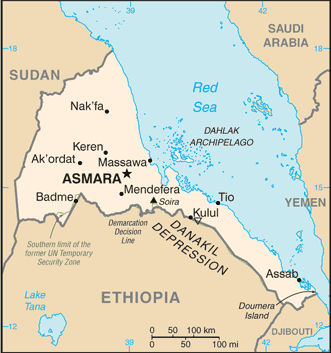
CIA World Factbook map, February 2021 media edition. Identity reviewed; current boundaries have not been audited. visual contact sheet or original identity check; does not verify current boundaries Boundaries, place names and designations may be dated or disputed; original annotations retained. SHA-256: d6c98ca935a77bcd9a7507f88542608f5dce5f69ba5b81a66a393fc375941d5f. Provenance and inspection record.ⓘ
World Bank directory coordinates; approximate location, not a country center. Coordinate reference date is not supplied by the directory. Natural Earth 1:110m land (2022 source); simplified coastline, no political borders. Map source. Land SVG SHA-256: CF26056A39DC0A5B02F65704E279DFA86E77539A8387D0B2C92F907A67739E5E.Introduction
Background:1
Eritrea won independence from Italian colonial control in 1941, but the UN only established it as an autonomous region within the Ethiopian federation in 1952, after a decade of British administrative control. Ethiopia's full annexation of Eritrea as a province 10 years later sparked a violent 30-year conflict for independence that ended in 1991 with Eritrean fighters defeating government forces. Eritreans overwhelmingly approved independence in a 1993 referendum. ISAIAS Afwerki has been Eritrea's only president since independence; his rule, particularly since 2001, has been characterized by highly autocratic and repressive actions. His government has created a highly militarized society by instituting an unpopular program of mandatory conscription into national service -- divided between military and civilian service -- of indefinite length.
A two-and-a-half-year border war with Ethiopia that erupted in 1998 ended under UN auspices in 2000. Ethiopia rejected a subsequent 2007 Eritrea-Ethiopia Boundary Commission (EEBC) demarcation. More than a decade of a tense “no peace, no war” stalemate ended in 2018 when the newly elected Ethiopian prime minister accepted the EEBC’s 2007 ruling, and the two countries signed declarations of peace and friendship. Eritrean leaders then engaged in intensive diplomacy around the Horn of Africa, bolstering regional peace, security, and cooperation, as well as brokering rapprochements between governments and opposition groups. In 2018, the UN Security Council lifted an arms embargo that had been imposed on Eritrea since 2009, after the UN Somalia-Eritrea Monitoring Group reported they had not found evidence of Eritrean support in recent years for al-Shabaab. The country’s rapprochement with Ethiopia led to a resumption of economic ties, but the level of air transport, trade, and tourism have remained roughly the same since late 2020.
The Eritrean economy remains agriculture-dependent, and the country is still one of Africa’s poorest nations. Eritrea faced new international condemnation and US sanctions in mid-2021 for its participation in the war in Ethiopia’s Tigray Regional State, where Eritrean forces were found to have committed war crimes and crimes against humanity. As most Eritrean troops were departing northern Ethiopia in January 2023, ISAIAS began a series of diplomatic engagements aimed at bolstering Eritrea’s foreign partnerships and regional influence. Despite the country's improved relations with its neighbors, ISAIAS has not let up on repression, and conscription and militarization continue.
Geography
Location:2
Eastern Africa, bordering the Red Sea, between Djibouti and Sudan
Geographic coordinates:3
15 00 N, 39 00 E
Map references:4
Africa
Area:5
Surface area: 121,630 square kilometers (2024)
Area - comparative:7
slightly smaller than Pennsylvania
Land boundaries:8
Coastline:9
2,234 km (mainland on Red Sea 1,151 km; islands in Red Sea 1,083 km)
Maritime claims:10
Climate:11
hot, dry desert strip along Red Sea coast; cooler and wetter in the central highlands (up to 61 cm of rainfall annually, heaviest June to September); semiarid in western hills and lowlands
Terrain:12
dominated by extension of Ethiopian north-south trending highlands, descending on the east to a coastal desert plain, on the northwest to hilly terrain and on the southwest to flat-to-rolling plains
Elevation:13
Natural resources:14
gold, potash, zinc, copper, salt, possibly oil and natural gas, fish
Land use:15
Irrigated land:16
210 sq km (2012)
Population distribution:17
density is highest in the center of the country, in and around the cities of Asmara (capital) and Keren; smaller settlements exist in the north and south, as shown in this population distribution map
Natural hazards:18
frequent droughts, rare earthquakes and volcanoes; locust swarms
Geography - note:19
strategic geopolitical position along world's busiest shipping lanes
People and Society
Population:20
Population: 3,607,003 people (2025)
Nationality:22
Ethnic groups:23
Tigrinya 50%, Tigre 30%, Saho 4%, Afar 4%, Kunama 4%, Bilen 3%, Hedareb/Beja 2%, Nara 2%, Rashaida 1% (2021 est.)
Languages:24
Tigrinya (official), Arabic (official), English (official), Tigre, Kunama, Afar, other Cushitic languages
Religions:25
Eritrean Orthodox, Roman Catholic, Evangelical Lutheran, Sunni Muslim
Age structure:26
Dependency ratios:27
Median age:28
Population growth rate:29
Population growth rate: 2 % annually (2025)
1.12% (2024 est.)
Birth rate:31
Crude birth rate: 28.72 births per 1,000 people (2024)
26.3 births/1,000 population (2024 est.)
Death rate:33
Crude death rate: 6 deaths per 1,000 people (2024)
6.5 deaths/1,000 population (2024 est.)
Net migration rate:35
-8.7 migrant(s)/1,000 population (2024 est.)
Population distribution:36
density is highest in the center of the country, in and around the cities of Asmara (capital) and Keren; smaller settlements exist in the north and south, as shown in this population distribution map
Urbanization:37
Urban population: 34.54 % of population (2025)
Major urban areas - population:39
1.073 million ASMARA (capital) (2023)
Sex ratio:40
Mother's mean age at first birth:41
21.3 years (2010 est.)
Maternal mortality ratio:42
Maternal mortality ratio: 291 deaths per 100,000 live births (2023)
291 deaths/100,000 live births (2023 est.)
Infant mortality rate:44
Infant mortality rate: 24.7 deaths per 1,000 live births (2024)
Life expectancy at birth:46
Life expectancy at birth: 68.89 years (2024)
Total fertility rate:48
Total fertility rate: 3.68 births per woman (2024)
3.43 children born/woman (2024 est.)
Gross reproduction rate:50
1.69 (2024 est.)
Health expenditure:51
Current health expenditure: 3.68 % of GDP (2023)
Physician density:53
Physicians: 0.09 per 1,000 people (2022)
0.09 physicians/1,000 population (2022)
Hospital bed density:55
1 beds/1,000 population (2020 est.)
Obesity - adult prevalence rate:56
5% (2016)
Alcohol consumption per capita:57
Tobacco use:58
Currently married women (ages 15-49):59
52.3% (2023 est.)
School life expectancy (primary to tertiary education):60
Environment
Environmental issues:61
deforestation; desertification; soil erosion; overgrazing
International environmental agreements:62
Climate:63
hot, dry desert strip along Red Sea coast; cooler and wetter in the central highlands (up to 61 cm of rainfall annually, heaviest June to September); semiarid in western hills and lowlands
Land use:64
Urbanization:65
Carbon dioxide emissions:66
Particulate matter emissions:67
22.7 micrograms per cubic meter (2019 est.)
Methane emissions:68
Waste and recycling:69
Total water withdrawal:70
Total renewable water resources:71
7.315 billion cubic meters (2022 est.)
Government
Country name:72
Government type:73
presidential republic
Capital:74
Administrative divisions:75
6 regions ( zobatat , singular - zoba ); 'Anseba, Debub (South), Debubawi K'eyyih Bahri (Southern Red Sea), Gash-Barka, Ma'ikel (Central), Semienawi K'eyyih Bahri (Northern Red Sea)
Legal system:76
mixed system of civil, customary, and Islamic religious law
Constitution:77
International law organization participation:78
has not submitted an ICJ jurisdiction declaration; non-party state to the ICCt
Citizenship:79
Suffrage:80
18 years of age; universal
Executive branch:81
Legislative branch:82
Judicial branch:83
Political parties:84
People's Front for Democracy and Justice or PFDJ (the only party recognized by the government)
Diplomatic representation in the US:85
Diplomatic representation from the US:86
International organization participation:87
ACP, AfDB, AU, COMESA, FAO, G-77, IAEA, IBRD, ICAO, ICC (NGOs), IDA, IFAD, IFC, IFRCS (observer), IGAD, ILO, IMF, IMO, Interpol, IOC, ISO (correspondent), ITU, ITUC (NGOs), LAS (observer), MIGA, NAM, OPCW, PCA, UN, UNCTAD, UNESCO, UNHRC, UNIDO, UNWTO, UPU, WCO, WFTU (NGOs), WHO, WIPO, WMO
Independence:88
24 May 1993 (from Ethiopia)
National holiday:89
Independence Day, 24 May (1991)
Flag:90
National symbol(s):91
camel
National color(s):92
green, red, blue
National coat of arms:93
Eritrea adopted its coat of arms on May 24, 1993, when it won independence from Ethiopia; the camel was used to transport supplies and goods during the war, and it became a symbol of the country’s success; the olive wreath represents peace, reconciliation, and harmony; under the camel is name of the country in its three official languages: Tigrinya, English, and Arabic
National anthem(s):94
National heritage:95
Economy
Economic overview:96
largely agrarian economy with a significant mining sector; substantial fiscal surplus due to tight controls; high and vulnerable debts; increased Ethiopian trade and shared port usage decreasing prices; financial and economic data integrity challenges
Real GDP (purchasing power parity):97
$2.534 billion (2024 est.)
$2.465 billion (2023 est.)
$2.398 billion (2022 est.)
Real GDP growth rate:98
Real GDP per capita:99
GDP (official exchange rate):100
GDP: 2,065,001,626.02 current US dollars (2011)
$2.535 billion (2024 est.)
Inflation rate (consumer prices):102
Agricultural products:103
sorghum, milk, barley, vegetables, root vegetables, cereals, pulses, wheat, beef, maize (2023)
Industries:104
food processing, beverages, clothing and textiles, light manufacturing, salt, cement
Labor force:105
1.71 million (2024 est.)
Unemployment rate:106
Youth unemployment rate (ages 15-24):107
Budget:108
Public debt:109
132.8% of GDP (2016 est.)
Exports:110
Exports - partners:111
China 67%, UAE 26%, Philippines 5%, Italy 1%, Croatia 1% (2023)
Exports - commodities:112
copper ore, zinc ore, gold, garments, liquor (2023)
Imports:113
$494.229 million (2010 est.)
$435.275 million (2009 est.)
Imports - partners:114
China 32%, UAE 27%, Turkey 9%, USA 7%, Italy 5% (2023)
Imports - commodities:115
trucks, sorghum, construction vehicles, wheat flours, other foods (2023)
Reserves of foreign exchange and gold:116
$191.694 million (2019 est.)
$163.034 million (2018 est.)
$143.412 million (2017 est.)
Debt - external:117
$461.376 million (2023 est.)
Exchange rates:118
15.075 (2024 est.)
15.075 (2023 est.)
15.075 (2022 est.)
15.075 (2021 est.)
15.075 (2020 est.)
Energy
Electricity access:119
Electricity:120
Electricity generation sources:121
Petroleum:122
Energy consumption per capita:123
Communications
Telephones - fixed lines:124
Telephones - mobile cellular:125
Broadcast media:126
government controls broadcast media, with private ownership prohibited; 1 state-owned TV station; 2 state-owned radio networks; purchases of satellite dishes and subscriptions to international broadcast media are permitted (2023)
Internet country code:127
.er
Internet users:128
Broadband - fixed subscriptions:129
Transportation
Military and Security
Military and security forces:135
Eritrean Defense Forces (EDF): Eritrean Ground Forces, Eritrean Navy, Eritrean Air Force; People's Militia (aka People's Army or Hizbawi Serawit) (2024)
Military expenditures:136
10% of GDP (2019 est.)
10.2% of GDP (2018 est.)
10.3% of GDP (2017 est.)
10.4% of GDP (2016 est.)
10.6% of GDP (2015 est.)
Military and security service personnel strengths:137
available information varies widely; estimated 150,000-200,000 active Defense Forces (2025)
Military equipment inventories and acquisitions:138
the EDF's inventory is comprised primarily of Soviet-era weapons and equipment (2024)
Military service age and obligation:139
Eritrea mandates military service for all citizens age 18-40; 18-month conscript service obligation, which reportedly includes 4-6 months of military training and 12 months of military or other national service (military service is most common); in practice, military and national service is often extended indefinitely; citizens up to the age of 59 eligible for recall during mobilization (2024)
Military - note:140
the military’s primary responsibilities are external defense, border security, and providing the regime a vehicle for national cohesion; the conscript-based Army is the dominant service
since the country's independence in 1991, the Eritrean military has participated in numerous conflicts, including the Hanish Island Crisis with Yemen (1995), the First Congo War (1996-1997), the Second Sudanese Civil War (1996-1998), the Eritrea-Ethiopia War (1998-2000), the Djiboutian-Eritrean border conflict (2008), and the Tigray conflict in Ethiopia (2020-2022); during the Tigray conflict, the Eritrean Defense Forces were accused of human rights abuses; in recent years, it has provided training support to the military of Somalia (2025)
Transnational Issues
Refugees and internally displaced persons:141
Trafficking in persons:142
Additional observations
- Unemployment (modeled ILO estimate)143
- 5.98 % of labor force (2025)
- Access to electricity144
- 55.3 % of population (2024)
- Renewable energy share of total final energy consumption145
- 80.7 % (2021)
- Individuals using the internet146
- 14.35 % of population (2020)
- At least basic sanitation services147
- 11.94 % of population (2016)
- Adult literacy rate148
- 64.66 % of people aged 15 and over (2008)
- Real GDP growth149
- 8.68 % annual change (2011)
- Government education expenditure150
- 2.13 % of GDP (2006)
- At least basic drinking water services151
- 51.85 % of population (2016)
Notes & sources
- Background. Reference edition; observation: dates as stated in text. Field last updated: not supplied; profile fallback: 2025-12-04 08:19:58 -0500 (not a field revision date); needs review. Reference source. Edition last checked 2026-10-29 (retrieval only). ↩
- Location. Reference edition; observation: dates as stated in text. Field last updated: not supplied; profile fallback: 2025-12-04 08:19:58 -0500 (not a field revision date); needs review. Reference source. Edition last checked 2026-10-29 (retrieval only). ↩
- Geographic coordinates. Reference edition; observation: dates as stated in text. Field last updated: not supplied; profile fallback: 2025-12-04 08:19:58 -0500 (not a field revision date); needs review. Reference source. Edition last checked 2026-10-29 (retrieval only). ↩
- Map references. Reference edition; observation: dates as stated in text. Field last updated: not supplied; profile fallback: 2025-12-04 08:19:58 -0500 (not a field revision date); needs review. Reference source. Edition last checked 2026-10-29 (retrieval only). ↩
- Area. Reference edition; observation: dates as stated in text. Field last updated: not supplied; profile fallback: 2025-12-04 08:19:58 -0500 (not a field revision date); needs review. Reference source. The archived total area has no reference year and territorial coverage may differ from World Bank surface area. World Bank: 121,630 square kilometers (2024). Reference: 117,600 square kilometers. Edition last checked 2026-10-29 (retrieval only). ↩
- Surface area. Surface area: observation 2024; checked 2026-10-29; single source. World Bank World Development Indicators. The archived total area has no reference year and territorial coverage may differ from World Bank surface area. World Bank: 121,630 square kilometers (2024). Reference: 117,600 square kilometers. ↩
- Area - comparative. Reference edition; observation: dates as stated in text. Field last updated: not supplied; profile fallback: 2025-12-04 08:19:58 -0500 (not a field revision date); needs review. Reference source. Edition last checked 2026-10-29 (retrieval only). ↩
- Land boundaries. Reference edition; observation: dates as stated in text. Field last updated: not supplied; profile fallback: 2025-12-04 08:19:58 -0500 (not a field revision date); needs review. Reference source. Edition last checked 2026-10-29 (retrieval only). ↩
- Coastline. Reference edition; observation: dates as stated in text. Field last updated: not supplied; profile fallback: 2025-12-04 08:19:58 -0500 (not a field revision date); needs review. Reference source. Edition last checked 2026-10-29 (retrieval only). ↩
- Maritime claims. Reference edition; observation: dates as stated in text. Field last updated: not supplied; profile fallback: 2025-12-04 08:19:58 -0500 (not a field revision date); needs review. Reference source. Edition last checked 2026-10-29 (retrieval only). ↩
- Climate. Reference edition; observation: dates as stated in text. Field last updated: not supplied; profile fallback: 2025-12-04 08:19:58 -0500 (not a field revision date); needs review. Reference source. Edition last checked 2026-10-29 (retrieval only). ↩
- Terrain. Reference edition; observation: dates as stated in text. Field last updated: not supplied; profile fallback: 2025-12-04 08:19:58 -0500 (not a field revision date); needs review. Reference source. Edition last checked 2026-10-29 (retrieval only). ↩
- Elevation. Reference edition; observation: dates as stated in text. Field last updated: not supplied; profile fallback: 2025-12-04 08:19:58 -0500 (not a field revision date); needs review. Reference source. Edition last checked 2026-10-29 (retrieval only). ↩
- Natural resources. Reference edition; observation: dates as stated in text. Field last updated: not supplied; profile fallback: 2025-12-04 08:19:58 -0500 (not a field revision date); needs review. Reference source. Edition last checked 2026-10-29 (retrieval only). ↩
- Land use. Reference edition; observation: dates as stated in text. Field last updated: not supplied; profile fallback: 2025-12-04 08:19:58 -0500 (not a field revision date); needs review. Reference source. Edition last checked 2026-10-29 (retrieval only). ↩
- Irrigated land. Reference edition; observation: 2012. Field last updated: not supplied; profile fallback: 2025-12-04 08:19:58 -0500 (not a field revision date); needs review. Reference source. Edition last checked 2026-10-29 (retrieval only). ↩
- Population distribution. Reference edition; observation: dates as stated in text. Field last updated: not supplied; profile fallback: 2025-12-04 08:19:58 -0500 (not a field revision date); needs review. Reference source. Edition last checked 2026-10-29 (retrieval only). ↩
- Natural hazards. Reference edition; observation: dates as stated in text. Field last updated: not supplied; profile fallback: 2025-12-04 08:19:58 -0500 (not a field revision date); needs review. Reference source. Edition last checked 2026-10-29 (retrieval only). ↩
- Geography - note. Reference edition; observation: dates as stated in text. Field last updated: not supplied; profile fallback: 2025-12-04 08:19:58 -0500 (not a field revision date); needs review. Reference source. Edition last checked 2026-10-29 (retrieval only). ↩
- Population. Reference edition; observation: dates as stated in text. Field last updated: not supplied; profile fallback: 2025-12-04 08:19:58 -0500 (not a field revision date); needs review. Reference source. Different reference years; no numerical agreement is asserted. World Bank: 3,607,003 people (2025). Reference: 6,343,956 people (2024). Edition last checked 2026-10-29 (retrieval only). ↩
- Population. Population: observation 2025; checked 2026-10-29; single source. World Bank World Development Indicators. Different reference years; no numerical agreement is asserted. World Bank: 3,607,003 people (2025). Reference: 6,343,956 people (2024). ↩
- Nationality. Reference edition; observation: dates as stated in text. Field last updated: not supplied; profile fallback: 2025-12-04 08:19:58 -0500 (not a field revision date); needs review. Reference source. Edition last checked 2026-10-29 (retrieval only). ↩
- Ethnic groups. Reference edition; observation: 2021 est.. Field last updated: not supplied; profile fallback: 2025-12-04 08:19:58 -0500 (not a field revision date); needs review. Reference source. Edition last checked 2026-10-29 (retrieval only). ↩
- Languages. Reference edition; observation: dates as stated in text. Field last updated: not supplied; profile fallback: 2025-12-04 08:19:58 -0500 (not a field revision date); needs review. Reference source. Edition last checked 2026-10-29 (retrieval only). ↩
- Religions. Reference edition; observation: dates as stated in text. Field last updated: not supplied; profile fallback: 2025-12-04 08:19:58 -0500 (not a field revision date); needs review. Reference source. Edition last checked 2026-10-29 (retrieval only). ↩
- Age structure. Reference edition; observation: dates as stated in text. Field last updated: not supplied; profile fallback: 2025-12-04 08:19:58 -0500 (not a field revision date); needs review. Reference source. Edition last checked 2026-10-29 (retrieval only). ↩
- Dependency ratios. Reference edition; observation: dates as stated in text. Field last updated: not supplied; profile fallback: 2025-12-04 08:19:58 -0500 (not a field revision date); needs review. Reference source. Edition last checked 2026-10-29 (retrieval only). ↩
- Median age. Reference edition; observation: dates as stated in text. Field last updated: not supplied; profile fallback: 2025-12-04 08:19:58 -0500 (not a field revision date); needs review. Reference source. Edition last checked 2026-10-29 (retrieval only). ↩
- Population growth rate. Reference edition; observation: 2024. Field last updated: not supplied; profile fallback: 2025-12-04 08:19:58 -0500 (not a field revision date); needs review. Reference source. Edition last checked 2026-10-29 (retrieval only). ↩
- Population growth rate. Population growth rate: observation 2025; checked 2026-10-29; single source. World Bank World Development Indicators. Latest available World Bank series in 2020–2026; reference year is not retrieval year. May be modeled or revised; differing definitions and geography require review. No independent crosscheck; do not silently replace archived Factbook. ↩
- Birth rate. Reference edition; observation: 2024. Field last updated: not supplied; profile fallback: 2025-12-04 08:19:58 -0500 (not a field revision date); needs review. Reference source. Edition last checked 2026-10-29 (retrieval only). ↩
- Crude birth rate. Crude birth rate: observation 2024; checked 2026-10-29; single source. World Bank World Development Indicators. Latest available World Bank series in 2020–2026; reference year is not retrieval year. May be modeled or revised; differing definitions and geography require review. No independent crosscheck; do not silently replace archived Factbook. ↩
- Death rate. Reference edition; observation: 2024. Field last updated: not supplied; profile fallback: 2025-12-04 08:19:58 -0500 (not a field revision date); needs review. Reference source. Edition last checked 2026-10-29 (retrieval only). ↩
- Crude death rate. Crude death rate: observation 2024; checked 2026-10-29; single source. World Bank World Development Indicators. Latest available World Bank series in 2020–2026; reference year is not retrieval year. May be modeled or revised; differing definitions and geography require review. No independent crosscheck; do not silently replace archived Factbook. ↩
- Net migration rate. Reference edition; observation: 2024. Field last updated: not supplied; profile fallback: 2025-12-04 08:19:58 -0500 (not a field revision date); needs review. Reference source. Edition last checked 2026-10-29 (retrieval only). ↩
- Population distribution. Reference edition; observation: dates as stated in text. Field last updated: not supplied; profile fallback: 2025-12-04 08:19:58 -0500 (not a field revision date); needs review. Reference source. Edition last checked 2026-10-29 (retrieval only). ↩
- Urbanization. Reference edition; observation: dates as stated in text. Field last updated: not supplied; profile fallback: 2025-12-04 08:19:58 -0500 (not a field revision date); needs review. Reference source. Edition last checked 2026-10-29 (retrieval only). ↩
- Urban population. Urban population: observation 2025; checked 2026-10-29; single source. World Bank World Development Indicators. Latest available World Bank series in 2020–2026; reference year is not retrieval year. May be modeled or revised; differing definitions and geography require review. No independent crosscheck; do not silently replace archived Factbook. ↩
- Major urban areas - population. Reference edition; observation: 2023. Field last updated: not supplied; profile fallback: 2025-12-04 08:19:58 -0500 (not a field revision date); needs review. Reference source. Edition last checked 2026-10-29 (retrieval only). ↩
- Sex ratio. Reference edition; observation: dates as stated in text. Field last updated: not supplied; profile fallback: 2025-12-04 08:19:58 -0500 (not a field revision date); needs review. Reference source. Edition last checked 2026-10-29 (retrieval only). ↩
- Mother's mean age at first birth. Reference edition; observation: 2010. Field last updated: not supplied; profile fallback: 2025-12-04 08:19:58 -0500 (not a field revision date); needs review. Reference source. Edition last checked 2026-10-29 (retrieval only). ↩
- Maternal mortality ratio. Reference edition; observation: 2023. Field last updated: not supplied; profile fallback: 2025-12-04 08:19:58 -0500 (not a field revision date); needs review. Reference source. Edition last checked 2026-10-29 (retrieval only). ↩
- Maternal mortality ratio. Maternal mortality ratio: observation 2023; checked 2026-10-29; single source. World Bank World Development Indicators. Latest available World Bank series in 2020–2026; reference year is not retrieval year. May be modeled or revised; differing definitions and geography require review. No independent crosscheck; do not silently replace archived Factbook. ↩
- Infant mortality rate. Reference edition; observation: dates as stated in text. Field last updated: not supplied; profile fallback: 2025-12-04 08:19:58 -0500 (not a field revision date); needs review. Reference source. Edition last checked 2026-10-29 (retrieval only). ↩
- Infant mortality rate. Infant mortality rate: observation 2024; checked 2026-10-29; single source. World Bank World Development Indicators. Latest available World Bank series in 2020–2026; reference year is not retrieval year. May be modeled or revised; differing definitions and geography require review. No independent crosscheck; do not silently replace archived Factbook. ↩
- Life expectancy at birth. Reference edition; observation: dates as stated in text. Field last updated: not supplied; profile fallback: 2025-12-04 08:19:58 -0500 (not a field revision date); needs review. Reference source. Edition last checked 2026-10-29 (retrieval only). ↩
- Life expectancy at birth. Life expectancy at birth: observation 2024; checked 2026-10-29; single source. World Bank World Development Indicators. Latest available World Bank series in 2020–2026; reference year is not retrieval year. May be modeled or revised; differing definitions and geography require review. No independent crosscheck; do not silently replace archived Factbook. ↩
- Total fertility rate. Reference edition; observation: 2024. Field last updated: not supplied; profile fallback: 2025-12-04 08:19:58 -0500 (not a field revision date); needs review. Reference source. Edition last checked 2026-10-29 (retrieval only). ↩
- Total fertility rate. Total fertility rate: observation 2024; checked 2026-10-29; single source. World Bank World Development Indicators. Latest available World Bank series in 2020–2026; reference year is not retrieval year. May be modeled or revised; differing definitions and geography require review. No independent crosscheck; do not silently replace archived Factbook. ↩
- Gross reproduction rate. Reference edition; observation: 2024. Field last updated: not supplied; profile fallback: 2025-12-04 08:19:58 -0500 (not a field revision date); needs review. Reference source. Edition last checked 2026-10-29 (retrieval only). ↩
- Health expenditure. Reference edition; observation: dates as stated in text. Field last updated: not supplied; profile fallback: 2025-12-04 08:19:58 -0500 (not a field revision date); needs review. Reference source. Edition last checked 2026-10-29 (retrieval only). ↩
- Current health expenditure. Current health expenditure: observation 2023; checked 2026-10-29; single source. World Bank World Development Indicators. Latest available World Bank series in 2020–2026; reference year is not retrieval year. May be modeled or revised; differing definitions and geography require review. No independent crosscheck; do not silently replace archived Factbook. ↩
- Physician density. Reference edition; observation: 2022. Field last updated: not supplied; profile fallback: 2025-12-04 08:19:58 -0500 (not a field revision date); needs review. Reference source. Edition last checked 2026-10-29 (retrieval only). ↩
- Physicians. Physicians: observation 2022; checked 2026-10-29; single source. World Bank World Development Indicators. Latest available World Bank series in 2020–2026; reference year is not retrieval year. May be modeled or revised; differing definitions and geography require review. No independent crosscheck; do not silently replace archived Factbook. ↩
- Hospital bed density. Reference edition; observation: 2020. Field last updated: not supplied; profile fallback: 2025-12-04 08:19:58 -0500 (not a field revision date); needs review. Reference source. Edition last checked 2026-10-29 (retrieval only). ↩
- Obesity - adult prevalence rate. Reference edition; observation: 2016. Field last updated: not supplied; profile fallback: 2025-12-04 08:19:58 -0500 (not a field revision date); needs review. Reference source. Edition last checked 2026-10-29 (retrieval only). ↩
- Alcohol consumption per capita. Reference edition; observation: dates as stated in text. Field last updated: not supplied; profile fallback: 2025-12-04 08:19:58 -0500 (not a field revision date); needs review. Reference source. Edition last checked 2026-10-29 (retrieval only). ↩
- Tobacco use. Reference edition; observation: dates as stated in text. Field last updated: not supplied; profile fallback: 2025-12-04 08:19:58 -0500 (not a field revision date); needs review. Reference source. Edition last checked 2026-10-29 (retrieval only). ↩
- Currently married women (ages 15-49). Reference edition; observation: 2023. Field last updated: not supplied; profile fallback: 2025-12-04 08:19:58 -0500 (not a field revision date); needs review. Reference source. Edition last checked 2026-10-29 (retrieval only). ↩
- School life expectancy (primary to tertiary education). Reference edition; observation: dates as stated in text. Field last updated: not supplied; profile fallback: 2025-12-04 08:19:58 -0500 (not a field revision date); needs review. Reference source. Edition last checked 2026-10-29 (retrieval only). ↩
- Environmental issues. Reference edition; observation: dates as stated in text. Field last updated: not supplied; profile fallback: 2025-12-04 08:19:58 -0500 (not a field revision date); needs review. Reference source. Edition last checked 2026-10-29 (retrieval only). ↩
- International environmental agreements. Reference edition; observation: dates as stated in text. Field last updated: not supplied; profile fallback: 2025-12-04 08:19:58 -0500 (not a field revision date); needs review. Reference source. Edition last checked 2026-10-29 (retrieval only). ↩
- Climate. Reference edition; observation: dates as stated in text. Field last updated: not supplied; profile fallback: 2025-12-04 08:19:58 -0500 (not a field revision date); needs review. Reference source. Edition last checked 2026-10-29 (retrieval only). ↩
- Land use. Reference edition; observation: dates as stated in text. Field last updated: not supplied; profile fallback: 2025-12-04 08:19:58 -0500 (not a field revision date); needs review. Reference source. Edition last checked 2026-10-29 (retrieval only). ↩
- Urbanization. Reference edition; observation: dates as stated in text. Field last updated: not supplied; profile fallback: 2025-12-04 08:19:58 -0500 (not a field revision date); needs review. Reference source. Edition last checked 2026-10-29 (retrieval only). ↩
- Carbon dioxide emissions. Reference edition; observation: dates as stated in text. Field last updated: not supplied; profile fallback: 2025-12-04 08:19:58 -0500 (not a field revision date); needs review. Reference source. Edition last checked 2026-10-29 (retrieval only). ↩
- Particulate matter emissions. Reference edition; observation: 2019. Field last updated: not supplied; profile fallback: 2025-12-04 08:19:58 -0500 (not a field revision date); needs review. Reference source. Edition last checked 2026-10-29 (retrieval only). ↩
- Methane emissions. Reference edition; observation: dates as stated in text. Field last updated: not supplied; profile fallback: 2025-12-04 08:19:58 -0500 (not a field revision date); needs review. Reference source. Edition last checked 2026-10-29 (retrieval only). ↩
- Waste and recycling. Reference edition; observation: dates as stated in text. Field last updated: not supplied; profile fallback: 2025-12-04 08:19:58 -0500 (not a field revision date); needs review. Reference source. Edition last checked 2026-10-29 (retrieval only). ↩
- Total water withdrawal. Reference edition; observation: dates as stated in text. Field last updated: not supplied; profile fallback: 2025-12-04 08:19:58 -0500 (not a field revision date); needs review. Reference source. Edition last checked 2026-10-29 (retrieval only). ↩
- Total renewable water resources. Reference edition; observation: 2022. Field last updated: not supplied; profile fallback: 2025-12-04 08:19:58 -0500 (not a field revision date); needs review. Reference source. Edition last checked 2026-10-29 (retrieval only). ↩
- Country name. Reference edition; observation: dates as stated in text. Field last updated: not supplied; profile fallback: 2025-12-04 08:19:58 -0500 (not a field revision date); needs review. Reference source. Edition last checked 2026-10-29 (retrieval only). ↩
- Government type. Reference edition; observation: dates as stated in text. Field last updated: not supplied; profile fallback: 2025-12-04 08:19:58 -0500 (not a field revision date); needs review. Reference source. Edition last checked 2026-10-29 (retrieval only). ↩
- Capital. Reference edition; observation: dates as stated in text. Field last updated: not supplied; profile fallback: 2025-12-04 08:19:58 -0500 (not a field revision date); needs review. Reference source. Edition last checked 2026-10-29 (retrieval only). ↩
- Administrative divisions. Reference edition; observation: dates as stated in text. Field last updated: not supplied; profile fallback: 2025-12-04 08:19:58 -0500 (not a field revision date); needs review. Reference source. Edition last checked 2026-10-29 (retrieval only). ↩
- Legal system. Reference edition; observation: dates as stated in text. Field last updated: not supplied; profile fallback: 2025-12-04 08:19:58 -0500 (not a field revision date); needs review. Reference source. Edition last checked 2026-10-29 (retrieval only). ↩
- Constitution. Reference edition; observation: dates as stated in text. Field last updated: not supplied; profile fallback: 2025-12-04 08:19:58 -0500 (not a field revision date); needs review. Reference source. Edition last checked 2026-10-29 (retrieval only). ↩
- International law organization participation. Reference edition; observation: dates as stated in text. Field last updated: not supplied; profile fallback: 2025-12-04 08:19:58 -0500 (not a field revision date); needs review. Reference source. Edition last checked 2026-10-29 (retrieval only). ↩
- Citizenship. Reference edition; observation: dates as stated in text. Field last updated: not supplied; profile fallback: 2025-12-04 08:19:58 -0500 (not a field revision date); needs review. Reference source. Edition last checked 2026-10-29 (retrieval only). ↩
- Suffrage. Reference edition; observation: dates as stated in text. Field last updated: not supplied; profile fallback: 2025-12-04 08:19:58 -0500 (not a field revision date); needs review. Reference source. Edition last checked 2026-10-29 (retrieval only). ↩
- Executive branch. Reference edition; observation: dates as stated in text. Field last updated: not supplied; profile fallback: 2025-12-04 08:19:58 -0500 (not a field revision date); needs review. Reference source. Edition last checked 2026-10-29 (retrieval only). ↩
- Legislative branch. Reference edition; observation: dates as stated in text. Field last updated: not supplied; profile fallback: 2025-12-04 08:19:58 -0500 (not a field revision date); needs review. Reference source. Edition last checked 2026-10-29 (retrieval only). ↩
- Judicial branch. Reference edition; observation: dates as stated in text. Field last updated: not supplied; profile fallback: 2025-12-04 08:19:58 -0500 (not a field revision date); needs review. Reference source. Edition last checked 2026-10-29 (retrieval only). ↩
- Political parties. Reference edition; observation: dates as stated in text. Field last updated: not supplied; profile fallback: 2025-12-04 08:19:58 -0500 (not a field revision date); needs review. Reference source. Edition last checked 2026-10-29 (retrieval only). ↩
- Diplomatic representation in the US. Reference edition; observation: dates as stated in text. Field last updated: not supplied; profile fallback: 2025-12-04 08:19:58 -0500 (not a field revision date); needs review. Reference source. Edition last checked 2026-10-29 (retrieval only). ↩
- Diplomatic representation from the US. Reference edition; observation: dates as stated in text. Field last updated: not supplied; profile fallback: 2025-12-04 08:19:58 -0500 (not a field revision date); needs review. Reference source. Edition last checked 2026-10-29 (retrieval only). ↩
- International organization participation. Reference edition; observation: dates as stated in text. Field last updated: not supplied; profile fallback: 2025-12-04 08:19:58 -0500 (not a field revision date); needs review. Reference source. Edition last checked 2026-10-29 (retrieval only). ↩
- Independence. Reference edition; observation: dates as stated in text. Field last updated: not supplied; profile fallback: 2025-12-04 08:19:58 -0500 (not a field revision date); needs review. Reference source. Edition last checked 2026-10-29 (retrieval only). ↩
- National holiday. Reference edition; observation: dates as stated in text. Field last updated: not supplied; profile fallback: 2025-12-04 08:19:58 -0500 (not a field revision date); needs review. Reference source. Edition last checked 2026-10-29 (retrieval only). ↩
- Flag. Reference edition; observation: dates as stated in text. Field last updated: not supplied; profile fallback: 2025-12-04 08:19:58 -0500 (not a field revision date); needs review. Reference source. Edition last checked 2026-10-29 (retrieval only). ↩
- National symbol(s). Reference edition; observation: dates as stated in text. Field last updated: not supplied; profile fallback: 2025-12-04 08:19:58 -0500 (not a field revision date); needs review. Reference source. Edition last checked 2026-10-29 (retrieval only). ↩
- National color(s). Reference edition; observation: dates as stated in text. Field last updated: not supplied; profile fallback: 2025-12-04 08:19:58 -0500 (not a field revision date); needs review. Reference source. Edition last checked 2026-10-29 (retrieval only). ↩
- National coat of arms. Reference edition; observation: dates as stated in text. Field last updated: not supplied; profile fallback: 2025-12-04 08:19:58 -0500 (not a field revision date); needs review. Reference source. Edition last checked 2026-10-29 (retrieval only). ↩
- National anthem(s). Reference edition; observation: dates as stated in text. Field last updated: not supplied; profile fallback: 2025-12-04 08:19:58 -0500 (not a field revision date); needs review. Reference source. Edition last checked 2026-10-29 (retrieval only). ↩
- National heritage. Reference edition; observation: dates as stated in text. Field last updated: not supplied; profile fallback: 2025-12-04 08:19:58 -0500 (not a field revision date); needs review. Reference source. Edition last checked 2026-10-29 (retrieval only). ↩
- Economic overview. Reference edition; observation: dates as stated in text. Field last updated: not supplied; profile fallback: 2025-12-04 08:19:58 -0500 (not a field revision date); needs review. Reference source. Edition last checked 2026-10-29 (retrieval only). ↩
- Real GDP (purchasing power parity). Reference edition; observation: dates as stated in text. Field last updated: not supplied; profile fallback: 2025-12-04 08:19:58 -0500 (not a field revision date); needs review. Reference source. Edition last checked 2026-10-29 (retrieval only). ↩
- Real GDP growth rate. Reference edition; observation: dates as stated in text. Field last updated: not supplied; profile fallback: 2025-12-04 08:19:58 -0500 (not a field revision date); needs review. Reference source. Edition last checked 2026-10-29 (retrieval only). ↩
- Real GDP per capita. Reference edition; observation: dates as stated in text. Field last updated: not supplied; profile fallback: 2025-12-04 08:19:58 -0500 (not a field revision date); needs review. Reference source. Edition last checked 2026-10-29 (retrieval only). ↩
- GDP (official exchange rate). Reference edition; observation: 2024. Field last updated: not supplied; profile fallback: 2025-12-04 08:19:58 -0500 (not a field revision date); needs review. Reference source. Different reference years; no numerical agreement is asserted. World Bank: 2,065,001,626.02 current US dollars (2011). Reference: 2,535,000,000 current US dollars (2024). Edition last checked 2026-10-29 (retrieval only). ↩
- GDP. GDP: observation 2011; checked 2026-10-29; single source. World Bank World Development Indicators. Different reference years; no numerical agreement is asserted. World Bank: 2,065,001,626.02 current US dollars (2011). Reference: 2,535,000,000 current US dollars (2024). ↩
- Inflation rate (consumer prices). Reference edition; observation: dates as stated in text. Field last updated: not supplied; profile fallback: 2025-12-04 08:19:58 -0500 (not a field revision date); needs review. Reference source. Edition last checked 2026-10-29 (retrieval only). ↩
- Agricultural products. Reference edition; observation: 2023. Field last updated: not supplied; profile fallback: 2025-12-04 08:19:58 -0500 (not a field revision date); needs review. Reference source. Edition last checked 2026-10-29 (retrieval only). ↩
- Industries. Reference edition; observation: dates as stated in text. Field last updated: not supplied; profile fallback: 2025-12-04 08:19:58 -0500 (not a field revision date); needs review. Reference source. Edition last checked 2026-10-29 (retrieval only). ↩
- Labor force. Reference edition; observation: 2024. Field last updated: not supplied; profile fallback: 2025-12-04 08:19:58 -0500 (not a field revision date); needs review. Reference source. Edition last checked 2026-10-29 (retrieval only). ↩
- Unemployment rate. Reference edition; observation: dates as stated in text. Field last updated: not supplied; profile fallback: 2025-12-04 08:19:58 -0500 (not a field revision date); needs review. Reference source. Edition last checked 2026-10-29 (retrieval only). ↩
- Youth unemployment rate (ages 15-24). Reference edition; observation: dates as stated in text. Field last updated: not supplied; profile fallback: 2025-12-04 08:19:58 -0500 (not a field revision date); needs review. Reference source. Edition last checked 2026-10-29 (retrieval only). ↩
- Budget. Reference edition; observation: dates as stated in text. Field last updated: not supplied; profile fallback: 2025-12-04 08:19:58 -0500 (not a field revision date); needs review. Reference source. Edition last checked 2026-10-29 (retrieval only). ↩
- Public debt. Reference edition; observation: dates as stated in text. Field last updated: not supplied; profile fallback: 2025-12-04 08:19:58 -0500 (not a field revision date); needs review. Reference source. Edition last checked 2026-10-29 (retrieval only). ↩
- Exports. Reference edition; observation: dates as stated in text. Field last updated: not supplied; profile fallback: 2025-12-04 08:19:58 -0500 (not a field revision date); needs review. Reference source. Edition last checked 2026-10-29 (retrieval only). ↩
- Exports - partners. Reference edition; observation: 2023. Field last updated: not supplied; profile fallback: 2025-12-04 08:19:58 -0500 (not a field revision date); needs review. Reference source. Edition last checked 2026-10-29 (retrieval only). ↩
- Exports - commodities. Reference edition; observation: 2023. Field last updated: not supplied; profile fallback: 2025-12-04 08:19:58 -0500 (not a field revision date); needs review. Reference source. Edition last checked 2026-10-29 (retrieval only). ↩
- Imports. Reference edition; observation: dates as stated in text. Field last updated: not supplied; profile fallback: 2025-12-04 08:19:58 -0500 (not a field revision date); needs review. Reference source. Edition last checked 2026-10-29 (retrieval only). ↩
- Imports - partners. Reference edition; observation: 2023. Field last updated: not supplied; profile fallback: 2025-12-04 08:19:58 -0500 (not a field revision date); needs review. Reference source. Edition last checked 2026-10-29 (retrieval only). ↩
- Imports - commodities. Reference edition; observation: 2023. Field last updated: not supplied; profile fallback: 2025-12-04 08:19:58 -0500 (not a field revision date); needs review. Reference source. Edition last checked 2026-10-29 (retrieval only). ↩
- Reserves of foreign exchange and gold. Reference edition; observation: dates as stated in text. Field last updated: not supplied; profile fallback: 2025-12-04 08:19:58 -0500 (not a field revision date); needs review. Reference source. Edition last checked 2026-10-29 (retrieval only). ↩
- Debt - external. Reference edition; observation: dates as stated in text. Field last updated: not supplied; profile fallback: 2025-12-04 08:19:58 -0500 (not a field revision date); needs review. Reference source. Edition last checked 2026-10-29 (retrieval only). ↩
- Exchange rates. Reference edition; observation: dates as stated in text. Field last updated: not supplied; profile fallback: 2025-12-04 08:19:58 -0500 (not a field revision date); needs review. Reference source. Edition last checked 2026-10-29 (retrieval only). ↩
- Electricity access. Reference edition; observation: dates as stated in text. Field last updated: not supplied; profile fallback: 2025-12-04 08:19:58 -0500 (not a field revision date); needs review. Reference source. Edition last checked 2026-10-29 (retrieval only). ↩
- Electricity. Reference edition; observation: dates as stated in text. Field last updated: not supplied; profile fallback: 2025-12-04 08:19:58 -0500 (not a field revision date); needs review. Reference source. Edition last checked 2026-10-29 (retrieval only). ↩
- Electricity generation sources. Reference edition; observation: dates as stated in text. Field last updated: not supplied; profile fallback: 2025-12-04 08:19:58 -0500 (not a field revision date); needs review. Reference source. Edition last checked 2026-10-29 (retrieval only). ↩
- Petroleum. Reference edition; observation: dates as stated in text. Field last updated: not supplied; profile fallback: 2025-12-04 08:19:58 -0500 (not a field revision date); needs review. Reference source. Edition last checked 2026-10-29 (retrieval only). ↩
- Energy consumption per capita. Reference edition; observation: dates as stated in text. Field last updated: not supplied; profile fallback: 2025-12-04 08:19:58 -0500 (not a field revision date); needs review. Reference source. Edition last checked 2026-10-29 (retrieval only). ↩
- Telephones - fixed lines. Reference edition; observation: dates as stated in text. Field last updated: not supplied; profile fallback: 2025-12-04 08:19:58 -0500 (not a field revision date); needs review. Reference source. Edition last checked 2026-10-29 (retrieval only). ↩
- Telephones - mobile cellular. Reference edition; observation: dates as stated in text. Field last updated: not supplied; profile fallback: 2025-12-04 08:19:58 -0500 (not a field revision date); needs review. Reference source. Edition last checked 2026-10-29 (retrieval only). ↩
- Broadcast media. Reference edition; observation: 2023. Field last updated: not supplied; profile fallback: 2025-12-04 08:19:58 -0500 (not a field revision date); needs review. Reference source. Edition last checked 2026-10-29 (retrieval only). ↩
- Internet country code. Reference edition; observation: dates as stated in text. Field last updated: not supplied; profile fallback: 2025-12-04 08:19:58 -0500 (not a field revision date); needs review. Reference source. Edition last checked 2026-10-29 (retrieval only). ↩
- Internet users. Reference edition; observation: dates as stated in text. Field last updated: not supplied; profile fallback: 2025-12-04 08:19:58 -0500 (not a field revision date); needs review. Reference source. Edition last checked 2026-10-29 (retrieval only). ↩
- Broadband - fixed subscriptions. Reference edition; observation: dates as stated in text. Field last updated: not supplied; profile fallback: 2025-12-04 08:19:58 -0500 (not a field revision date); needs review. Reference source. Edition last checked 2026-10-29 (retrieval only). ↩
- Civil aircraft registration country code prefix. Reference edition; observation: dates as stated in text. Field last updated: not supplied; profile fallback: 2025-12-04 08:19:58 -0500 (not a field revision date); needs review. Reference source. Edition last checked 2026-10-29 (retrieval only). ↩
- Airports. Reference edition; observation: 2025. Field last updated: not supplied; profile fallback: 2025-12-04 08:19:58 -0500 (not a field revision date); needs review. Reference source. Edition last checked 2026-10-29 (retrieval only). ↩
- Railways. Reference edition; observation: dates as stated in text. Field last updated: not supplied; profile fallback: 2025-12-04 08:19:58 -0500 (not a field revision date); needs review. Reference source. Edition last checked 2026-10-29 (retrieval only). ↩
- Merchant marine. Reference edition; observation: dates as stated in text. Field last updated: not supplied; profile fallback: 2025-12-04 08:19:58 -0500 (not a field revision date); needs review. Reference source. Edition last checked 2026-10-29 (retrieval only). ↩
- Ports. Reference edition; observation: dates as stated in text. Field last updated: not supplied; profile fallback: 2025-12-04 08:19:58 -0500 (not a field revision date); needs review. Reference source. Edition last checked 2026-10-29 (retrieval only). ↩
- Military and security forces. Reference edition; observation: 2024. Field last updated: not supplied; profile fallback: 2025-12-04 08:19:58 -0500 (not a field revision date); needs review. Reference source. Edition last checked 2026-10-29 (retrieval only). ↩
- Military expenditures. Reference edition; observation: dates as stated in text. Field last updated: not supplied; profile fallback: 2025-12-04 08:19:58 -0500 (not a field revision date); needs review. Reference source. Edition last checked 2026-10-29 (retrieval only). ↩
- Military and security service personnel strengths. Reference edition; observation: 2025. Field last updated: not supplied; profile fallback: 2025-12-04 08:19:58 -0500 (not a field revision date); needs review. Reference source. Edition last checked 2026-10-29 (retrieval only). ↩
- Military equipment inventories and acquisitions. Reference edition; observation: 2024. Field last updated: not supplied; profile fallback: 2025-12-04 08:19:58 -0500 (not a field revision date); needs review. Reference source. Edition last checked 2026-10-29 (retrieval only). ↩
- Military service age and obligation. Reference edition; observation: 2024. Field last updated: not supplied; profile fallback: 2025-12-04 08:19:58 -0500 (not a field revision date); needs review. Reference source. Edition last checked 2026-10-29 (retrieval only). ↩
- Military - note. Reference edition; observation: 2025. Field last updated: not supplied; profile fallback: 2025-12-04 08:19:58 -0500 (not a field revision date); needs review. Reference source. Edition last checked 2026-10-29 (retrieval only). ↩
- Refugees and internally displaced persons. Reference edition; observation: dates as stated in text. Field last updated: not supplied; profile fallback: 2025-12-04 08:19:58 -0500 (not a field revision date); needs review. Reference source. Edition last checked 2026-10-29 (retrieval only). ↩
- Trafficking in persons. Reference edition; observation: dates as stated in text. Field last updated: not supplied; profile fallback: 2025-12-04 08:19:58 -0500 (not a field revision date); needs review. Reference source. Edition last checked 2026-10-29 (retrieval only). ↩
- Unemployment (modeled ILO estimate). Unemployment (modeled ILO estimate): observation 2025; checked 2026-10-29; single source. World Bank World Development Indicators. Unemployment refers to the share of the labor force that is without work but available for and seeking employment. The ILO modeled estimate is not necessarily directly comparable with national unemployment measures. Source metadata: https://api.worldbank.org/v2/indicator/SL.UEM.TOTL.ZS?format=json ↩
- Access to electricity. Access to electricity: observation 2024; checked 2026-10-29; single source. World Bank World Development Indicators. Access to electricity is the percentage of population with access to electricity. Electrification data are collected from industry, national surveys and international sources. Source metadata: https://api.worldbank.org/v2/indicator/EG.ELC.ACCS.ZS?format=json ↩
- Renewable energy share of total final energy consumption. Renewable energy share of total final energy consumption: observation 2021; checked 2026-10-29; single source. World Bank World Development Indicators. Renewable energy consumption is the share of renewable energy in total final energy consumption. Source metadata: https://api.worldbank.org/v2/indicator/EG.FEC.RNEW.ZS?format=json ↩
- Individuals using the internet. Individuals using the internet: observation 2020; checked 2026-10-29; single source. World Bank World Development Indicators. Internet users are individuals who have used the Internet (from any location) in the last 3 months. The Internet can be used via a computer, mobile phone, personal digital assistant, games machine, digital TV etc. Source metadata: https://api.worldbank.org/v2/indicator/IT.NET.USER.ZS?format=json ↩
- At least basic sanitation services. At least basic sanitation services: observation 2016; checked 2026-10-29; primary source checked. World Bank World Development Indicators. Primary source checked 2026-10-29T19:43:00.706Z. provider release 2026-10-08. source organization WHO/UNICEF Joint Monitoring Programme (JMP) for Water Supply, Sanitation and Hygiene, World Health Organization (WHO), uri: washdata.org, publisher: WHO/UNICEF Joint Monitoring Programme (JMP) for Water Supply, Sanitation and Hygiene (washdata.org), date accessed: 2025-09-30, date published: 2025-08-25; UN Children's Fund (UNICEF), uri: washdata.org, note: WHO/UNICEF Joint Monitoring Programme (JMP) for Water Supply, Sanitation and Hygiene. definition People using at least basic sanitation services (% of population). Original provider-reported country/economy series; unchanged historical boundaries are not asserted. Checked original WDI publication and metadata, not independent corroboration. ↩
- Adult literacy rate. Adult literacy rate: observation 2008; checked 2026-10-29; primary source checked. World Bank World Development Indicators. Primary source checked 2026-10-29T19:42:53.982Z. provider release 2026-10-08. source organization Data API, UN Educational, Scientific and Cultural Organization (UNESCO), uri: https://databrowser.uis.unesco.org/resources, note: The data are obtained through the UIS API. Detailed documentation is available at: https://api.uis.unesco.org/api/public/documentation/, publisher: UNESCO Institute for Statistics (UIS), type: Excel (bulk file), date accessed: 2026-03-19, date published: 2026-02. definition Literacy rate, adult total (% of people ages 15 and above). Original provider-reported country/economy series; unchanged historical boundaries are not asserted. Checked original WDI publication and metadata, not independent corroboration. ↩
- Real GDP growth. Real GDP growth: observation 2011; checked 2026-10-29; primary source checked. World Bank World Development Indicators. Primary source checked 2026-10-29T19:42:46.081Z. provider release 2026-10-08. source organization Country official statistics, National Statistical Organizations and/or Central Banks; National Accounts data files, Organisation for Economic Co-operation and Development (OECD); Staff estimates, World Bank (WB). definition GDP growth (annual %). Original provider-reported country/economy series; unchanged historical boundaries are not asserted. Checked original WDI publication and metadata, not independent corroboration. ↩
- Government education expenditure. Government education expenditure: observation 2006; checked 2026-10-29; primary source checked. World Bank World Development Indicators. Primary source checked 2026-10-29T19:42:38.715Z. provider release 2026-10-08. source organization Data API, UN Educational, Scientific and Cultural Organization (UNESCO), uri: https://databrowser.uis.unesco.org/resources, note: The data are obtained through the UIS API. Detailed documentation is available at: https://api.uis.unesco.org/api/public/documentation/, publisher: UNESCO Institute for Statistics (UIS), date accessed: 2026-03-19, date published: 2026-02. definition Government expenditure on education, total (% of GDP). Original provider-reported country/economy series; unchanged historical boundaries are not asserted. Checked original WDI publication and metadata, not independent corroboration. ↩
- At least basic drinking water services. At least basic drinking water services: observation 2016; checked 2026-10-29; primary source checked. World Bank World Development Indicators. Primary source checked 2026-10-29T19:42:31.288Z. provider release 2026-10-08. source organization WHO/UNICEF Joint Monitoring Programme (JMP) for Water Supply, Sanitation and Hygiene, World Health Organization (WHO), uri: washdata.org, publisher: WHO/UNICEF Joint Monitoring Programme (JMP) for Water Supply, Sanitation and Hygiene (washdata.org), date accessed: 2025-09-30, date published: 2025-08-25; UN Children's Fund (UNICEF), uri: washdata.org, note: WHO/UNICEF Joint Monitoring Programme (JMP) for Water Supply, Sanitation and Hygiene. definition People using at least basic drinking water services (% of population). Original provider-reported country/economy series; unchanged historical boundaries are not asserted. Checked original WDI publication and metadata, not independent corroboration. ↩