Europe & Central Asia / DNK
Denmark

ⓘ
2021 Factbook flag mirror; image identity has not been individually audited. Source.
Last updated: October 29, 2026
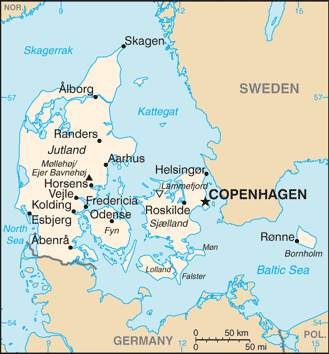
Map image could not be loaded. Open source image.
ⓘ
CIA World Factbook map, February 2021 media edition. Identity reviewed; current boundaries have not been audited. visual contact sheet or original identity check; does not verify current boundaries Boundaries, place names and designations may be dated or disputed; original annotations retained. SHA-256: 1f5d9d94c12634f3df006ba5feb2582faf067e8440de9c2b94bffa49a89729b9. Provenance and inspection record.ⓘ
World Bank directory coordinates; approximate location, not a country center. Coordinate reference date is not supplied by the directory. Natural Earth 1:110m land (2022 source); simplified coastline, no political borders. Map source. Land SVG SHA-256: CF26056A39DC0A5B02F65704E279DFA86E77539A8387D0B2C92F907A67739E5E.Introduction
Background:1
Once the seat of Viking raiders and later a major north European power, Denmark has evolved into a modern, prosperous nation that is part of the general political and economic integration of Europe. It joined NATO in 1949 and the EEC (now the EU) in 1973. The country has opted out of certain elements of the EU's Maastricht Treaty, including the European Economic and Monetary Union and justice and home affairs issues. a 2022 referendum resulted in the removal of Denmark's 30-year opt-out on defense issues, now allowing Denmark to participate fully in the EU's Common Security and Defense Policy.
Geography
Location:2
Northern Europe, bordering the Baltic Sea and the North Sea, on a peninsula north of Germany (Jutland); also includes several major islands (Sjaelland, Fyn, and Bornholm)
Geographic coordinates:3
56 00 N, 10 00 E
Map references:4
Europe
Area:5
Surface area: 42,920 square kilometers (2024)
Area - comparative:7
slightly less than twice the size of Massachusetts; about two-thirds the size of West Virginia
Land boundaries:8
Coastline:9
7,314 km
Maritime claims:10
Climate:11
temperate; humid and overcast; mild, windy winters and cool summers
Terrain:12
low and flat to gently rolling plains
Elevation:13
Natural resources:14
petroleum, natural gas, fish, arable land, salt, limestone, chalk, stone, gravel and sand
Land use:15
Irrigated land:16
2,420 sq km (2022)
Population distribution:17
population centers tend to be along coastal areas, particularly in Copenhagen and the eastern side of the country's mainland
Natural hazards:18
flooding is a threat in some areas of the country (e.g., parts of Jutland, along the southern coast of the island of Lolland) that are protected from the sea by a system of dikes
Geography - note:19
composed of the Jutland Peninsula and a group of more than 400 islands (Danish Archipelago); controls Danish Straits (Skagerrak and Kattegat) linking Baltic and North Seas; about one-quarter of the population lives in greater Copenhagen
People and Society
Population:20
Population: 6,009,169 people (2025)
Nationality:22
Ethnic groups:23
Danish (includes Greenlandic (who are predominantly Inuit) and Faroese) 84.2%, Turkish 1.1%, other 14.7% (largest groups are Polish, Romanian, Syrian, Ukrainian, German, and Iraqi) (2023 est.)
Languages:24
Danish, Faroese, Greenlandic (an Inuit dialect), German (small minority); note - English is the predominant second language
Religions:25
Evangelical Lutheran (official) 71.4%, Muslim 4.3%, other/none/unspecified (denominations include Roman Catholic, Jehovah's Witness, Serbian Orthodox Christian, Jewish, Baptist, Buddhist, Church of Jesus Christ, Pentecostal, and nondenominational Christian) 24.3% (2024 est.)
Age structure:26
Dependency ratios:27
Median age:28
Population growth rate:29
Population growth rate: 0.54 % annually (2025)
0.44% (2024 est.)
Birth rate:31
Crude birth rate: 9.5 births per 1,000 people (2024)
11.3 births/1,000 population (2024 est.)
Death rate:33
Crude death rate: 9.5 deaths per 1,000 people (2024)
9.6 deaths/1,000 population (2024 est.)
Net migration rate:35
2.7 migrant(s)/1,000 population (2024 est.)
Population distribution:36
population centers tend to be along coastal areas, particularly in Copenhagen and the eastern side of the country's mainland
Urbanization:37
Urban population: 88.85 % of population (2025)
Major urban areas - population:39
1.381 million COPENHAGEN (capital) (2023)
Sex ratio:40
Mother's mean age at first birth:41
29.8 years (2020 est.)
Maternal mortality ratio:42
Maternal mortality ratio: 4 deaths per 100,000 live births (2023)
4 deaths/100,000 live births (2023 est.)
Infant mortality rate:44
Infant mortality rate: 3.5 deaths per 1,000 live births (2024)
Life expectancy at birth:46
Life expectancy at birth: 82.25 years (2024)
Total fertility rate:48
Total fertility rate: 1.47 births per woman (2024)
1.77 children born/woman (2024 est.)
Gross reproduction rate:50
0.86 (2024 est.)
Drinking water source:51
At least basic drinking water services: 100 % of population (2024)
Health expenditure:53
Current health expenditure: 9.39 % of GDP (2024)
Physician density:55
Physicians: 4.5 per 1,000 people (2021)
7.24 physicians/1,000 population (2021)
Hospital bed density:57
2.5 beds/1,000 population (2021 est.)
Sanitation facility access:58
At least basic sanitation services: 99.6 % of population (2024)
Obesity - adult prevalence rate:60
19.7% (2016)
Alcohol consumption per capita:61
Tobacco use:62
Currently married women (ages 15-49):63
59.6% (2023 est.)
Child marriage:64
Education expenditure:65
Government education expenditure: 6.36 % of GDP (2022)
School life expectancy (primary to tertiary education):67
Environment
Environmental issues:68
air pollution, principally from vehicle and power-plant emissions; nitrogen and phosphorus pollution of the North Sea; water pollution from animal wastes and pesticides
International environmental agreements:69
Climate:70
temperate; humid and overcast; mild, windy winters and cool summers
Land use:71
Urbanization:72
Carbon dioxide emissions:73
Particulate matter emissions:74
10.1 micrograms per cubic meter (2019 est.)
Methane emissions:75
Waste and recycling:76
Total water withdrawal:77
Total renewable water resources:78
6 billion cubic meters (2022 est.)
Geoparks:79
Government
Country name:80
Government type:81
parliamentary constitutional monarchy
Capital:82
Administrative divisions:83
metropolitan Denmark - 5 regions ( regioner , singular - region ); Hovedstaden (Capital), Midtjylland (Central Jutland), Nordjylland (North Jutland), Sjaelland (Zealand), Syddanmark (Southern Denmark)
Legal system:84
civil law; judicial review of legislative acts
Constitution:85
International law organization participation:86
accepts compulsory ICJ jurisdiction with reservations; accepts ICCt jurisdiction
Citizenship:87
Suffrage:88
18 years of age; universal
Executive branch:89
Legislative branch:90
Judicial branch:91
Political parties:92
The Alternative or AP
Conservative People's Party or DKF or C
Danish People's Party or DF or O
Denmark Democrats or E
Green Left or SF or F (formerly Socialist People's Party or SF or F)
Liberal Alliance or LA or I
Liberal Party (Venstre) or V
Moderates or M
New Right Party or NB or D
Red-Green Alliance (Unity List) or EL
Social Democrats or SDP or A
Social Liberal Party or SLP or B
Diplomatic representation in the US:93
Diplomatic representation from the US:94
International organization participation:95
ADB (nonregional member), AfDB (nonregional member), Arctic Council, Australia Group, BIS, CBSS, CD, CE, CERN, EAPC, EBRD, ECB, EIB, EITI (implementing country), ESA, EU, FAO, FATF, G-9, IADB, IAEA, IBRD, ICAO, ICC (national committees), ICCt, ICRM, IDA, IEA, IFAD, IFC, IFRCS, IGAD (partners), IHO, ILO, IMF, IMO, IMSO, Interpol, IOC, IOM, IPU, ISO, ITSO, ITU, ITUC (NGOs), MIGA, NATO, NC, NEA, NIB, NSG, OAS (observer), OECD, OPCW, OSCE, Paris Club, PCA, Schengen Convention, UN, UNCTAD, UNESCO, UNHCR, UNIDO, UNMIL, UNMISS, UNOOSA, UNRWA, UNTSO, UPU, Wassenaar Arrangement, WCO, WHO, WIPO, WMO, WTO, ZC
Independence:96
ca. 965 (unified and Christianized under Harald I GORMSSON); 5 June 1849 (became a parliamentary constitutional monarchy)
National holiday:97
Constitution Day, 5 June (1849)
Flag:98
National symbol(s):99
lion, mute swan
National color(s):100
red, white
National coat of arms:101
Denmark’s King Frederick VI adopted the national coat of arms in 1819; the crown of King Christian V, who ruled Denmark and Norway from 1670 to 1699, sits atop the shield, symbolizing royal and national authority; the three lions represent a strong and powerful country, with red lily pads in the shape of hearts that stand for strength, valor, and joy
National anthem(s):102
National heritage:103
Economy
Economic overview:104
high-income, EU-member, trade-oriented Nordic economy; growth driven by pharmaceuticals, energy, and services; large share of employment in public sector; fixed exchange rate pegged to euro; strong fiscal position and declining public debt; tight labor market mitigated by migrant workers and higher retirement age
Real GDP (purchasing power parity):105
$440.558 billion (2024 est.)
$424.937 billion (2023 est.)
$414.592 billion (2022 est.)
Real GDP growth rate:106
3.7% (2024 est.)
2.5% (2023 est.)
1.5% (2022 est.)
Real GDP per capita:107
GDP (official exchange rate):108
GDP: 462,526,660,468.39 current US dollars (2025)
$429.457 billion (2024 est.)
Inflation rate (consumer prices):110
GDP - composition, by sector of origin:111
GDP - composition, by end use:112
Agricultural products:113
milk, wheat, potatoes, barley, sugar beets, pork, rapeseed, rye, oats, chicken (2023)
Industries:114
wind turbines, pharmaceuticals, medical equipment, shipbuilding and refurbishment, iron, steel, nonferrous metals, chemicals, food processing, machinery and transportation equipment, textiles and clothing, electronics, construction, furniture and other wood products
Industrial production growth rate:115
12% (2024 est.)
Labor force:116
3.21 million (2024 est.)
Unemployment rate:117
Youth unemployment rate (ages 15-24):118
Population below poverty line:119
12.4% (2021 est.)
Gini Index coefficient - distribution of family income:120
29.3 (2022 est.)
Average household expenditures:121
Household income or consumption by percentage share:122
Remittances:123
0.4% of GDP (2024 est.)
0.4% of GDP (2023 est.)
0.3% of GDP (2022 est.)
Budget:124
Public debt:125
35.3% of GDP (2017 est.)
Taxes and other revenues:126
31.4% (of GDP) (2023 est.)
Current account balance:127
$55.901 billion (2024 est.)
$40.061 billion (2023 est.)
$46.488 billion (2022 est.)
Exports:128
$299.405 billion (2024 est.)
$276.646 billion (2023 est.)
$283.37 billion (2022 est.)
Exports - partners:129
Germany 13%, USA 10%, Sweden 9%, Netherlands 7%, China 5% (2023)
Exports - commodities:130
packaged medicine, fish, vaccines, refined petroleum, pork (2023)
Imports:131
$252.954 billion (2024 est.)
$243.478 billion (2023 est.)
$245.07 billion (2022 est.)
Imports - partners:132
Germany 18%, Sweden 11%, Norway 10%, Netherlands 9%, China 7% (2023)
Imports - commodities:133
natural gas, cars, garments, packaged medicine, refined petroleum (2023)
Reserves of foreign exchange and gold:134
$108.405 billion (2024 est.)
$109.371 billion (2023 est.)
$96.073 billion (2022 est.)
Exchange rates:135
6.894 (2024 est.)
6.89 (2023 est.)
7.076 (2022 est.)
6.287 (2021 est.)
6.542 (2020 est.)
Energy
Electricity access:136
Electricity:137
Electricity generation sources:138
Coal:139
Petroleum:140
Natural gas:141
Energy consumption per capita:142
Communications
Telephones - fixed lines:143
Telephones - mobile cellular:144
Broadcast media:145
strong public-sector TV presence, with Danmarks Radio (DR) operating 6 channels and TV2 operating roughly a half-dozen channels; private stations are available via satellite and cable feed; DR operates 4 FM radio stations, 10 digital audio stations, and 14 web-based radio stations; 140 commercial and 187 community (non-commercial) radio stations (2019)
Internet country code:146
.dk
Internet users:147
Broadband - fixed subscriptions:148
Transportation
Civil aircraft registration country code prefix:149
OY
Airports:150
102 (2025)
Heliports:151
29 (2025)
Railways:152
Merchant marine:153
Ports:154
Military and Security
Military and security forces:155
Danish Armed Forces (Forsvaret): Royal Danish Army, Royal Danish Navy, Royal Danish Air Force (2025)
Military expenditures:156
3.2% of GDP (2025 est.)
2.3% of GDP (2024 est.)
2% of GDP (2023 est.)
1.4% of GDP (2022 est.)
1.3% of GDP (2021 est.)
Military and security service personnel strengths:157
approximately 17,000 active-duty military personnel (2025)
Military equipment inventories and acquisitions:158
the Danish military inventory is comprised of modern European, US, and domestically produced weapons and equipment; the Danish defense industry is active in the production of naval vessels, defense electronics, and subcomponents of larger weapons systems, such as the US F-35 fighter aircraft; the major warships of the Royal Danish Navy were all produced domestically (2024)
Military service age and obligation:159
18 years of age for compulsory and voluntary military service for men and women; conscripts serve 11 months, including five months of basic training, followed by six months in an operational unit (2025)
note 2: women have been able serve in all military occupations, including combat arms, since 1988; as of 2022, they made up about 9% of the military's full-time personnel; military conscription was extended to women in June 2025
Military deployments:160
approximately 800 Latvia (NATO); Denmark contributes small numbers of air, ground, and naval forces to a variety of other NATO and international missions (2024)
Military - note:161
the Danish Armed Forces (Forsvaret) have a variety of missions, including enforcing the country’s sovereignty, monitoring Danish waters and airspace, search and rescue, environmental protection, host nation support for alliance partners, international peacekeeping, fulfilling Denmark’s commitments to NATO, and providing assistance to the police for border control, guard tasks, air surveillance, and during national disasters and other emergencies
NATO has been a cornerstone of Danish security and defense police since it joined in 1949 as one of the organization’s original members under the North Atlantic Treaty (also known as the Washington Treaty); the Forsvaret regularly exercises with NATO allies and participates in a number of NATO missions, including its Enhanced Forward Presence in Eastern Europe, air policing in the Baltics, naval operations in the Baltic Sea and North Atlantic, and an advisory mission in Iraq; the Forsvaret leads NATO’s Multinational Division – North (inaugurated 2019), a headquarters based in Latvia that supports the defense planning of Estonia, Latvia, and Lithuania, and the coordination of regional military activities, including NATO’s forward deployed forces; it also takes part in other international missions for Europe and the UN ranging from peacekeeping in Africa to protecting Europe's external borders by patrolling the Mediterranean Sea in support of the European Border and Coast Guard Agency; Denmark is a member of the EU and voted to join the EU’s Common Defense and Security Policy in a 2022 referendum; the Forsvaret cooperates closely with the militaries of other Nordic countries through the Nordic Defense Cooperation (NORDEFCO; established 2009), which consists of Denmark, Finland, Iceland, Norway, and Sweden in such areas as armaments, training and exercises, and operations; it also has a joint composite special operations command with Belgium and the Netherlands
the Forsvaret has an Arctic Command to protect the sovereignty of Denmark in the Arctic region, including the Faroe Islands and Greenland, and conducts maritime pollution prevention, environmental monitoring, fishery inspections, search and rescue, and hydrographical surveys, plus support to governmental science missions; there is also a joint service Special Operations Command (SOKOM), which includes the Sirius Dog Sled Patrol, an elite unit that patrols the most remote parts of northeast Greenland (2025)
Terrorism
Terrorist group(s):162
Islamic State of Iraq and ash-Sham (ISIS); Islamic Revolutionary Guard Corps (IRGC)/Qods Force
Transnational Issues
Refugees and internally displaced persons:163
Additional observations
- Real GDP growth164
- 2.93 % annual change (2025)
- Consumer price inflation165
- 1.89 % annual change (2025)
- Unemployment (modeled ILO estimate)166
- 5.53 % of labor force (2025)
- Access to electricity167
- 100 % of population (2024)
- Renewable energy share of total final energy consumption168
- 39.5 % (2021)
- Individuals using the internet169
- 99.77 % of population (2024)
Notes & sources
- Background. Reference edition; observation: dates as stated in text. Field last updated: not supplied; profile fallback: 2025-11-24 14:32:10 -0500 (not a field revision date); needs review. Reference source. Edition last checked 2026-10-29 (retrieval only). ↩
- Location. Reference edition; observation: dates as stated in text. Field last updated: not supplied; profile fallback: 2025-11-24 14:32:10 -0500 (not a field revision date); needs review. Reference source. Edition last checked 2026-10-29 (retrieval only). ↩
- Geographic coordinates. Reference edition; observation: dates as stated in text. Field last updated: not supplied; profile fallback: 2025-11-24 14:32:10 -0500 (not a field revision date); needs review. Reference source. Edition last checked 2026-10-29 (retrieval only). ↩
- Map references. Reference edition; observation: dates as stated in text. Field last updated: not supplied; profile fallback: 2025-11-24 14:32:10 -0500 (not a field revision date); needs review. Reference source. Edition last checked 2026-10-29 (retrieval only). ↩
- Area. Reference edition; observation: dates as stated in text. Field last updated: not supplied; profile fallback: 2025-11-24 14:32:10 -0500 (not a field revision date); needs review. Reference source. The archived total area has no reference year and territorial coverage may differ from World Bank surface area. World Bank: 42,920 square kilometers (2024). Reference: 43,094 square kilometers. Edition last checked 2026-10-29 (retrieval only). ↩
- Surface area. Surface area: observation 2024; checked 2026-10-29; single source. World Bank World Development Indicators. The archived total area has no reference year and territorial coverage may differ from World Bank surface area. World Bank: 42,920 square kilometers (2024). Reference: 43,094 square kilometers. ↩
- Area - comparative. Reference edition; observation: dates as stated in text. Field last updated: not supplied; profile fallback: 2025-11-24 14:32:10 -0500 (not a field revision date); needs review. Reference source. Edition last checked 2026-10-29 (retrieval only). ↩
- Land boundaries. Reference edition; observation: dates as stated in text. Field last updated: not supplied; profile fallback: 2025-11-24 14:32:10 -0500 (not a field revision date); needs review. Reference source. Edition last checked 2026-10-29 (retrieval only). ↩
- Coastline. Reference edition; observation: dates as stated in text. Field last updated: not supplied; profile fallback: 2025-11-24 14:32:10 -0500 (not a field revision date); needs review. Reference source. Edition last checked 2026-10-29 (retrieval only). ↩
- Maritime claims. Reference edition; observation: dates as stated in text. Field last updated: not supplied; profile fallback: 2025-11-24 14:32:10 -0500 (not a field revision date); needs review. Reference source. Edition last checked 2026-10-29 (retrieval only). ↩
- Climate. Reference edition; observation: dates as stated in text. Field last updated: not supplied; profile fallback: 2025-11-24 14:32:10 -0500 (not a field revision date); needs review. Reference source. Edition last checked 2026-10-29 (retrieval only). ↩
- Terrain. Reference edition; observation: dates as stated in text. Field last updated: not supplied; profile fallback: 2025-11-24 14:32:10 -0500 (not a field revision date); needs review. Reference source. Edition last checked 2026-10-29 (retrieval only). ↩
- Elevation. Reference edition; observation: dates as stated in text. Field last updated: not supplied; profile fallback: 2025-11-24 14:32:10 -0500 (not a field revision date); needs review. Reference source. Edition last checked 2026-10-29 (retrieval only). ↩
- Natural resources. Reference edition; observation: dates as stated in text. Field last updated: not supplied; profile fallback: 2025-11-24 14:32:10 -0500 (not a field revision date); needs review. Reference source. Edition last checked 2026-10-29 (retrieval only). ↩
- Land use. Reference edition; observation: dates as stated in text. Field last updated: not supplied; profile fallback: 2025-11-24 14:32:10 -0500 (not a field revision date); needs review. Reference source. Edition last checked 2026-10-29 (retrieval only). ↩
- Irrigated land. Reference edition; observation: 2022. Field last updated: not supplied; profile fallback: 2025-11-24 14:32:10 -0500 (not a field revision date); needs review. Reference source. Edition last checked 2026-10-29 (retrieval only). ↩
- Population distribution. Reference edition; observation: dates as stated in text. Field last updated: not supplied; profile fallback: 2025-11-24 14:32:10 -0500 (not a field revision date); needs review. Reference source. Edition last checked 2026-10-29 (retrieval only). ↩
- Natural hazards. Reference edition; observation: dates as stated in text. Field last updated: not supplied; profile fallback: 2025-11-24 14:32:10 -0500 (not a field revision date); needs review. Reference source. Edition last checked 2026-10-29 (retrieval only). ↩
- Geography - note. Reference edition; observation: dates as stated in text. Field last updated: not supplied; profile fallback: 2025-11-24 14:32:10 -0500 (not a field revision date); needs review. Reference source. Edition last checked 2026-10-29 (retrieval only). ↩
- Population. Reference edition; observation: dates as stated in text. Field last updated: not supplied; profile fallback: 2025-11-24 14:32:10 -0500 (not a field revision date); needs review. Reference source. Different reference years; no numerical agreement is asserted. World Bank: 6,009,169 people (2025). Reference: 5,973,136 people (2024). Edition last checked 2026-10-29 (retrieval only). ↩
- Population. Population: observation 2025; checked 2026-10-29; single source. World Bank World Development Indicators. Different reference years; no numerical agreement is asserted. World Bank: 6,009,169 people (2025). Reference: 5,973,136 people (2024). ↩
- Nationality. Reference edition; observation: dates as stated in text. Field last updated: not supplied; profile fallback: 2025-11-24 14:32:10 -0500 (not a field revision date); needs review. Reference source. Edition last checked 2026-10-29 (retrieval only). ↩
- Ethnic groups. Reference edition; observation: 2023 est.. Field last updated: not supplied; profile fallback: 2025-11-24 14:32:10 -0500 (not a field revision date); needs review. Reference source. Edition last checked 2026-10-29 (retrieval only). ↩
- Languages. Reference edition; observation: dates as stated in text. Field last updated: not supplied; profile fallback: 2025-11-24 14:32:10 -0500 (not a field revision date); needs review. Reference source. Edition last checked 2026-10-29 (retrieval only). ↩
- Religions. Reference edition; observation: 2024 est.. Field last updated: not supplied; profile fallback: 2025-11-24 14:32:10 -0500 (not a field revision date); needs review. Reference source. Edition last checked 2026-10-29 (retrieval only). ↩
- Age structure. Reference edition; observation: dates as stated in text. Field last updated: not supplied; profile fallback: 2025-11-24 14:32:10 -0500 (not a field revision date); needs review. Reference source. Edition last checked 2026-10-29 (retrieval only). ↩
- Dependency ratios. Reference edition; observation: dates as stated in text. Field last updated: not supplied; profile fallback: 2025-11-24 14:32:10 -0500 (not a field revision date); needs review. Reference source. Edition last checked 2026-10-29 (retrieval only). ↩
- Median age. Reference edition; observation: dates as stated in text. Field last updated: not supplied; profile fallback: 2025-11-24 14:32:10 -0500 (not a field revision date); needs review. Reference source. Edition last checked 2026-10-29 (retrieval only). ↩
- Population growth rate. Reference edition; observation: 2024. Field last updated: not supplied; profile fallback: 2025-11-24 14:32:10 -0500 (not a field revision date); needs review. Reference source. Edition last checked 2026-10-29 (retrieval only). ↩
- Population growth rate. Population growth rate: observation 2025; checked 2026-10-29; single source. World Bank World Development Indicators. Latest available World Bank series in 2020–2026; reference year is not retrieval year. May be modeled or revised; differing definitions and geography require review. No independent crosscheck; do not silently replace archived Factbook. ↩
- Birth rate. Reference edition; observation: 2024. Field last updated: not supplied; profile fallback: 2025-11-24 14:32:10 -0500 (not a field revision date); needs review. Reference source. Edition last checked 2026-10-29 (retrieval only). ↩
- Crude birth rate. Crude birth rate: observation 2024; checked 2026-10-29; single source. World Bank World Development Indicators. Latest available World Bank series in 2020–2026; reference year is not retrieval year. May be modeled or revised; differing definitions and geography require review. No independent crosscheck; do not silently replace archived Factbook. ↩
- Death rate. Reference edition; observation: 2024. Field last updated: not supplied; profile fallback: 2025-11-24 14:32:10 -0500 (not a field revision date); needs review. Reference source. Edition last checked 2026-10-29 (retrieval only). ↩
- Crude death rate. Crude death rate: observation 2024; checked 2026-10-29; single source. World Bank World Development Indicators. Latest available World Bank series in 2020–2026; reference year is not retrieval year. May be modeled or revised; differing definitions and geography require review. No independent crosscheck; do not silently replace archived Factbook. ↩
- Net migration rate. Reference edition; observation: 2024. Field last updated: not supplied; profile fallback: 2025-11-24 14:32:10 -0500 (not a field revision date); needs review. Reference source. Edition last checked 2026-10-29 (retrieval only). ↩
- Population distribution. Reference edition; observation: dates as stated in text. Field last updated: not supplied; profile fallback: 2025-11-24 14:32:10 -0500 (not a field revision date); needs review. Reference source. Edition last checked 2026-10-29 (retrieval only). ↩
- Urbanization. Reference edition; observation: dates as stated in text. Field last updated: not supplied; profile fallback: 2025-11-24 14:32:10 -0500 (not a field revision date); needs review. Reference source. Edition last checked 2026-10-29 (retrieval only). ↩
- Urban population. Urban population: observation 2025; checked 2026-10-29; single source. World Bank World Development Indicators. Latest available World Bank series in 2020–2026; reference year is not retrieval year. May be modeled or revised; differing definitions and geography require review. No independent crosscheck; do not silently replace archived Factbook. ↩
- Major urban areas - population. Reference edition; observation: 2023. Field last updated: not supplied; profile fallback: 2025-11-24 14:32:10 -0500 (not a field revision date); needs review. Reference source. Edition last checked 2026-10-29 (retrieval only). ↩
- Sex ratio. Reference edition; observation: dates as stated in text. Field last updated: not supplied; profile fallback: 2025-11-24 14:32:10 -0500 (not a field revision date); needs review. Reference source. Edition last checked 2026-10-29 (retrieval only). ↩
- Mother's mean age at first birth. Reference edition; observation: 2020. Field last updated: not supplied; profile fallback: 2025-11-24 14:32:10 -0500 (not a field revision date); needs review. Reference source. Edition last checked 2026-10-29 (retrieval only). ↩
- Maternal mortality ratio. Reference edition; observation: 2023. Field last updated: not supplied; profile fallback: 2025-11-24 14:32:10 -0500 (not a field revision date); needs review. Reference source. Edition last checked 2026-10-29 (retrieval only). ↩
- Maternal mortality ratio. Maternal mortality ratio: observation 2023; checked 2026-10-29; single source. World Bank World Development Indicators. Latest available World Bank series in 2020–2026; reference year is not retrieval year. May be modeled or revised; differing definitions and geography require review. No independent crosscheck; do not silently replace archived Factbook. ↩
- Infant mortality rate. Reference edition; observation: dates as stated in text. Field last updated: not supplied; profile fallback: 2025-11-24 14:32:10 -0500 (not a field revision date); needs review. Reference source. Edition last checked 2026-10-29 (retrieval only). ↩
- Infant mortality rate. Infant mortality rate: observation 2024; checked 2026-10-29; single source. World Bank World Development Indicators. Latest available World Bank series in 2020–2026; reference year is not retrieval year. May be modeled or revised; differing definitions and geography require review. No independent crosscheck; do not silently replace archived Factbook. ↩
- Life expectancy at birth. Reference edition; observation: dates as stated in text. Field last updated: not supplied; profile fallback: 2025-11-24 14:32:10 -0500 (not a field revision date); needs review. Reference source. Edition last checked 2026-10-29 (retrieval only). ↩
- Life expectancy at birth. Life expectancy at birth: observation 2024; checked 2026-10-29; single source. World Bank World Development Indicators. Latest available World Bank series in 2020–2026; reference year is not retrieval year. May be modeled or revised; differing definitions and geography require review. No independent crosscheck; do not silently replace archived Factbook. ↩
- Total fertility rate. Reference edition; observation: 2024. Field last updated: not supplied; profile fallback: 2025-11-24 14:32:10 -0500 (not a field revision date); needs review. Reference source. Edition last checked 2026-10-29 (retrieval only). ↩
- Total fertility rate. Total fertility rate: observation 2024; checked 2026-10-29; single source. World Bank World Development Indicators. Latest available World Bank series in 2020–2026; reference year is not retrieval year. May be modeled or revised; differing definitions and geography require review. No independent crosscheck; do not silently replace archived Factbook. ↩
- Gross reproduction rate. Reference edition; observation: 2024. Field last updated: not supplied; profile fallback: 2025-11-24 14:32:10 -0500 (not a field revision date); needs review. Reference source. Edition last checked 2026-10-29 (retrieval only). ↩
- Drinking water source. Reference edition; observation: dates as stated in text. Field last updated: not supplied; profile fallback: 2025-11-24 14:32:10 -0500 (not a field revision date); needs review. Reference source. Edition last checked 2026-10-29 (retrieval only). ↩
- At least basic drinking water services. At least basic drinking water services: observation 2024; checked 2026-10-29; single source. World Bank World Development Indicators. Latest available World Bank series in 2020–2026; reference year is not retrieval year. May be modeled or revised; differing definitions and geography require review. No independent crosscheck; do not silently replace archived Factbook. This separately sourced basic-service observation is shown alongside the reference edition’s improved/unimproved categories. It does not replace those category totals. ↩
- Health expenditure. Reference edition; observation: dates as stated in text. Field last updated: not supplied; profile fallback: 2025-11-24 14:32:10 -0500 (not a field revision date); needs review. Reference source. Edition last checked 2026-10-29 (retrieval only). ↩
- Current health expenditure. Current health expenditure: observation 2024; checked 2026-10-29; single source. World Bank World Development Indicators. Latest available World Bank series in 2020–2026; reference year is not retrieval year. May be modeled or revised; differing definitions and geography require review. No independent crosscheck; do not silently replace archived Factbook. ↩
- Physician density. Reference edition; observation: 2021. Field last updated: not supplied; profile fallback: 2025-11-24 14:32:10 -0500 (not a field revision date); needs review. Reference source. Edition last checked 2026-10-29 (retrieval only). ↩
- Physicians. Physicians: observation 2021; checked 2026-10-29; single source. World Bank World Development Indicators. Latest available World Bank series in 2020–2026; reference year is not retrieval year. May be modeled or revised; differing definitions and geography require review. No independent crosscheck; do not silently replace archived Factbook. ↩
- Hospital bed density. Reference edition; observation: 2021. Field last updated: not supplied; profile fallback: 2025-11-24 14:32:10 -0500 (not a field revision date); needs review. Reference source. Edition last checked 2026-10-29 (retrieval only). ↩
- Sanitation facility access. Reference edition; observation: dates as stated in text. Field last updated: not supplied; profile fallback: 2025-11-24 14:32:10 -0500 (not a field revision date); needs review. Reference source. Edition last checked 2026-10-29 (retrieval only). ↩
- At least basic sanitation services. At least basic sanitation services: observation 2024; checked 2026-10-29; single source. World Bank World Development Indicators. Latest available World Bank series in 2020–2026; reference year is not retrieval year. May be modeled or revised; differing definitions and geography require review. No independent crosscheck; do not silently replace archived Factbook. This separately sourced basic-service observation is shown alongside the reference edition’s improved/unimproved categories. It does not replace those category totals. ↩
- Obesity - adult prevalence rate. Reference edition; observation: 2016. Field last updated: not supplied; profile fallback: 2025-11-24 14:32:10 -0500 (not a field revision date); needs review. Reference source. Edition last checked 2026-10-29 (retrieval only). ↩
- Alcohol consumption per capita. Reference edition; observation: dates as stated in text. Field last updated: not supplied; profile fallback: 2025-11-24 14:32:10 -0500 (not a field revision date); needs review. Reference source. Edition last checked 2026-10-29 (retrieval only). ↩
- Tobacco use. Reference edition; observation: dates as stated in text. Field last updated: not supplied; profile fallback: 2025-11-24 14:32:10 -0500 (not a field revision date); needs review. Reference source. Edition last checked 2026-10-29 (retrieval only). ↩
- Currently married women (ages 15-49). Reference edition; observation: 2023. Field last updated: not supplied; profile fallback: 2025-11-24 14:32:10 -0500 (not a field revision date); needs review. Reference source. Edition last checked 2026-10-29 (retrieval only). ↩
- Child marriage. Reference edition; observation: dates as stated in text. Field last updated: not supplied; profile fallback: 2025-11-24 14:32:10 -0500 (not a field revision date); needs review. Reference source. Edition last checked 2026-10-29 (retrieval only). ↩
- Education expenditure. Reference edition; observation: dates as stated in text. Field last updated: not supplied; profile fallback: 2025-11-24 14:32:10 -0500 (not a field revision date); needs review. Reference source. Edition last checked 2026-10-29 (retrieval only). ↩
- Government education expenditure. Government education expenditure: observation 2022; checked 2026-10-29; single source. World Bank World Development Indicators. Latest available World Bank series in 2020–2026; reference year is not retrieval year. May be modeled or revised; differing definitions and geography require review. No independent crosscheck; do not silently replace archived Factbook. ↩
- School life expectancy (primary to tertiary education). Reference edition; observation: dates as stated in text. Field last updated: not supplied; profile fallback: 2025-11-24 14:32:10 -0500 (not a field revision date); needs review. Reference source. Edition last checked 2026-10-29 (retrieval only). ↩
- Environmental issues. Reference edition; observation: dates as stated in text. Field last updated: not supplied; profile fallback: 2025-11-24 14:32:10 -0500 (not a field revision date); needs review. Reference source. Edition last checked 2026-10-29 (retrieval only). ↩
- International environmental agreements. Reference edition; observation: dates as stated in text. Field last updated: not supplied; profile fallback: 2025-11-24 14:32:10 -0500 (not a field revision date); needs review. Reference source. Edition last checked 2026-10-29 (retrieval only). ↩
- Climate. Reference edition; observation: dates as stated in text. Field last updated: not supplied; profile fallback: 2025-11-24 14:32:10 -0500 (not a field revision date); needs review. Reference source. Edition last checked 2026-10-29 (retrieval only). ↩
- Land use. Reference edition; observation: dates as stated in text. Field last updated: not supplied; profile fallback: 2025-11-24 14:32:10 -0500 (not a field revision date); needs review. Reference source. Edition last checked 2026-10-29 (retrieval only). ↩
- Urbanization. Reference edition; observation: dates as stated in text. Field last updated: not supplied; profile fallback: 2025-11-24 14:32:10 -0500 (not a field revision date); needs review. Reference source. Edition last checked 2026-10-29 (retrieval only). ↩
- Carbon dioxide emissions. Reference edition; observation: dates as stated in text. Field last updated: not supplied; profile fallback: 2025-11-24 14:32:10 -0500 (not a field revision date); needs review. Reference source. Edition last checked 2026-10-29 (retrieval only). ↩
- Particulate matter emissions. Reference edition; observation: 2019. Field last updated: not supplied; profile fallback: 2025-11-24 14:32:10 -0500 (not a field revision date); needs review. Reference source. Edition last checked 2026-10-29 (retrieval only). ↩
- Methane emissions. Reference edition; observation: dates as stated in text. Field last updated: not supplied; profile fallback: 2025-11-24 14:32:10 -0500 (not a field revision date); needs review. Reference source. Edition last checked 2026-10-29 (retrieval only). ↩
- Waste and recycling. Reference edition; observation: dates as stated in text. Field last updated: not supplied; profile fallback: 2025-11-24 14:32:10 -0500 (not a field revision date); needs review. Reference source. Edition last checked 2026-10-29 (retrieval only). ↩
- Total water withdrawal. Reference edition; observation: dates as stated in text. Field last updated: not supplied; profile fallback: 2025-11-24 14:32:10 -0500 (not a field revision date); needs review. Reference source. Edition last checked 2026-10-29 (retrieval only). ↩
- Total renewable water resources. Reference edition; observation: 2022. Field last updated: not supplied; profile fallback: 2025-11-24 14:32:10 -0500 (not a field revision date); needs review. Reference source. Edition last checked 2026-10-29 (retrieval only). ↩
- Geoparks. Reference edition; observation: dates as stated in text. Field last updated: not supplied; profile fallback: 2025-11-24 14:32:10 -0500 (not a field revision date); needs review. Reference source. Edition last checked 2026-10-29 (retrieval only). ↩
- Country name. Reference edition; observation: dates as stated in text. Field last updated: not supplied; profile fallback: 2025-11-24 14:32:10 -0500 (not a field revision date); needs review. Reference source. Edition last checked 2026-10-29 (retrieval only). ↩
- Government type. Reference edition; observation: dates as stated in text. Field last updated: not supplied; profile fallback: 2025-11-24 14:32:10 -0500 (not a field revision date); needs review. Reference source. Edition last checked 2026-10-29 (retrieval only). ↩
- Capital. Reference edition; observation: dates as stated in text. Field last updated: not supplied; profile fallback: 2025-11-24 14:32:10 -0500 (not a field revision date); needs review. Reference source. Edition last checked 2026-10-29 (retrieval only). ↩
- Administrative divisions. Reference edition; observation: dates as stated in text. Field last updated: not supplied; profile fallback: 2025-11-24 14:32:10 -0500 (not a field revision date); needs review. Reference source. Edition last checked 2026-10-29 (retrieval only). ↩
- Legal system. Reference edition; observation: dates as stated in text. Field last updated: not supplied; profile fallback: 2025-11-24 14:32:10 -0500 (not a field revision date); needs review. Reference source. Edition last checked 2026-10-29 (retrieval only). ↩
- Constitution. Reference edition; observation: dates as stated in text. Field last updated: not supplied; profile fallback: 2025-11-24 14:32:10 -0500 (not a field revision date); needs review. Reference source. Edition last checked 2026-10-29 (retrieval only). ↩
- International law organization participation. Reference edition; observation: dates as stated in text. Field last updated: not supplied; profile fallback: 2025-11-24 14:32:10 -0500 (not a field revision date); needs review. Reference source. Edition last checked 2026-10-29 (retrieval only). ↩
- Citizenship. Reference edition; observation: dates as stated in text. Field last updated: not supplied; profile fallback: 2025-11-24 14:32:10 -0500 (not a field revision date); needs review. Reference source. Edition last checked 2026-10-29 (retrieval only). ↩
- Suffrage. Reference edition; observation: dates as stated in text. Field last updated: not supplied; profile fallback: 2025-11-24 14:32:10 -0500 (not a field revision date); needs review. Reference source. Edition last checked 2026-10-29 (retrieval only). ↩
- Executive branch. Reference edition; observation: dates as stated in text. Field last updated: not supplied; profile fallback: 2025-11-24 14:32:10 -0500 (not a field revision date); needs review. Reference source. Edition last checked 2026-10-29 (retrieval only). ↩
- Legislative branch. Reference edition; observation: dates as stated in text. Field last updated: not supplied; profile fallback: 2025-11-24 14:32:10 -0500 (not a field revision date); needs review. Reference source. Edition last checked 2026-10-29 (retrieval only). ↩
- Judicial branch. Reference edition; observation: dates as stated in text. Field last updated: not supplied; profile fallback: 2025-11-24 14:32:10 -0500 (not a field revision date); needs review. Reference source. Edition last checked 2026-10-29 (retrieval only). ↩
- Political parties. Reference edition; observation: dates as stated in text. Field last updated: not supplied; profile fallback: 2025-11-24 14:32:10 -0500 (not a field revision date); needs review. Reference source. Edition last checked 2026-10-29 (retrieval only). ↩
- Diplomatic representation in the US. Reference edition; observation: dates as stated in text. Field last updated: not supplied; profile fallback: 2025-11-24 14:32:10 -0500 (not a field revision date); needs review. Reference source. Edition last checked 2026-10-29 (retrieval only). ↩
- Diplomatic representation from the US. Reference edition; observation: dates as stated in text. Field last updated: not supplied; profile fallback: 2025-11-24 14:32:10 -0500 (not a field revision date); needs review. Reference source. Edition last checked 2026-10-29 (retrieval only). ↩
- International organization participation. Reference edition; observation: dates as stated in text. Field last updated: not supplied; profile fallback: 2025-11-24 14:32:10 -0500 (not a field revision date); needs review. Reference source. Edition last checked 2026-10-29 (retrieval only). ↩
- Independence. Reference edition; observation: dates as stated in text. Field last updated: not supplied; profile fallback: 2025-11-24 14:32:10 -0500 (not a field revision date); needs review. Reference source. Edition last checked 2026-10-29 (retrieval only). ↩
- National holiday. Reference edition; observation: dates as stated in text. Field last updated: not supplied; profile fallback: 2025-11-24 14:32:10 -0500 (not a field revision date); needs review. Reference source. Edition last checked 2026-10-29 (retrieval only). ↩
- Flag. Reference edition; observation: dates as stated in text. Field last updated: not supplied; profile fallback: 2025-11-24 14:32:10 -0500 (not a field revision date); needs review. Reference source. Edition last checked 2026-10-29 (retrieval only). ↩
- National symbol(s). Reference edition; observation: dates as stated in text. Field last updated: not supplied; profile fallback: 2025-11-24 14:32:10 -0500 (not a field revision date); needs review. Reference source. Edition last checked 2026-10-29 (retrieval only). ↩
- National color(s). Reference edition; observation: dates as stated in text. Field last updated: not supplied; profile fallback: 2025-11-24 14:32:10 -0500 (not a field revision date); needs review. Reference source. Edition last checked 2026-10-29 (retrieval only). ↩
- National coat of arms. Reference edition; observation: dates as stated in text. Field last updated: not supplied; profile fallback: 2025-11-24 14:32:10 -0500 (not a field revision date); needs review. Reference source. Edition last checked 2026-10-29 (retrieval only). ↩
- National anthem(s). Reference edition; observation: dates as stated in text. Field last updated: not supplied; profile fallback: 2025-11-24 14:32:10 -0500 (not a field revision date); needs review. Reference source. Edition last checked 2026-10-29 (retrieval only). ↩
- National heritage. Reference edition; observation: dates as stated in text. Field last updated: not supplied; profile fallback: 2025-11-24 14:32:10 -0500 (not a field revision date); needs review. Reference source. Edition last checked 2026-10-29 (retrieval only). ↩
- Economic overview. Reference edition; observation: dates as stated in text. Field last updated: not supplied; profile fallback: 2025-11-24 14:32:10 -0500 (not a field revision date); needs review. Reference source. Edition last checked 2026-10-29 (retrieval only). ↩
- Real GDP (purchasing power parity). Reference edition; observation: dates as stated in text. Field last updated: not supplied; profile fallback: 2025-11-24 14:32:10 -0500 (not a field revision date); needs review. Reference source. Edition last checked 2026-10-29 (retrieval only). ↩
- Real GDP growth rate. Reference edition; observation: dates as stated in text. Field last updated: not supplied; profile fallback: 2025-11-24 14:32:10 -0500 (not a field revision date); needs review. Reference source. Edition last checked 2026-10-29 (retrieval only). ↩
- Real GDP per capita. Reference edition; observation: dates as stated in text. Field last updated: not supplied; profile fallback: 2025-11-24 14:32:10 -0500 (not a field revision date); needs review. Reference source. Edition last checked 2026-10-29 (retrieval only). ↩
- GDP (official exchange rate). Reference edition; observation: 2024. Field last updated: not supplied; profile fallback: 2025-11-24 14:32:10 -0500 (not a field revision date); needs review. Reference source. Different reference years; no numerical agreement is asserted. World Bank: 462,526,660,468.39 current US dollars (2025). Reference: 429,457,000,000 current US dollars (2024). Edition last checked 2026-10-29 (retrieval only). ↩
- GDP. GDP: observation 2025; checked 2026-10-29; single source. World Bank World Development Indicators. Different reference years; no numerical agreement is asserted. World Bank: 462,526,660,468.39 current US dollars (2025). Reference: 429,457,000,000 current US dollars (2024). ↩
- Inflation rate (consumer prices). Reference edition; observation: dates as stated in text. Field last updated: not supplied; profile fallback: 2025-11-24 14:32:10 -0500 (not a field revision date); needs review. Reference source. Edition last checked 2026-10-29 (retrieval only). ↩
- GDP - composition, by sector of origin. Reference edition; observation: dates as stated in text. Field last updated: not supplied; profile fallback: 2025-11-24 14:32:10 -0500 (not a field revision date); needs review. Reference source. Edition last checked 2026-10-29 (retrieval only). ↩
- GDP - composition, by end use. Reference edition; observation: dates as stated in text. Field last updated: not supplied; profile fallback: 2025-11-24 14:32:10 -0500 (not a field revision date); needs review. Reference source. Edition last checked 2026-10-29 (retrieval only). ↩
- Agricultural products. Reference edition; observation: 2023. Field last updated: not supplied; profile fallback: 2025-11-24 14:32:10 -0500 (not a field revision date); needs review. Reference source. Edition last checked 2026-10-29 (retrieval only). ↩
- Industries. Reference edition; observation: dates as stated in text. Field last updated: not supplied; profile fallback: 2025-11-24 14:32:10 -0500 (not a field revision date); needs review. Reference source. Edition last checked 2026-10-29 (retrieval only). ↩
- Industrial production growth rate. Reference edition; observation: 2024. Field last updated: not supplied; profile fallback: 2025-11-24 14:32:10 -0500 (not a field revision date); needs review. Reference source. Edition last checked 2026-10-29 (retrieval only). ↩
- Labor force. Reference edition; observation: 2024. Field last updated: not supplied; profile fallback: 2025-11-24 14:32:10 -0500 (not a field revision date); needs review. Reference source. Edition last checked 2026-10-29 (retrieval only). ↩
- Unemployment rate. Reference edition; observation: dates as stated in text. Field last updated: not supplied; profile fallback: 2025-11-24 14:32:10 -0500 (not a field revision date); needs review. Reference source. Edition last checked 2026-10-29 (retrieval only). ↩
- Youth unemployment rate (ages 15-24). Reference edition; observation: dates as stated in text. Field last updated: not supplied; profile fallback: 2025-11-24 14:32:10 -0500 (not a field revision date); needs review. Reference source. Edition last checked 2026-10-29 (retrieval only). ↩
- Population below poverty line. Reference edition; observation: 2021. Field last updated: not supplied; profile fallback: 2025-11-24 14:32:10 -0500 (not a field revision date); needs review. Reference source. Edition last checked 2026-10-29 (retrieval only). ↩
- Gini Index coefficient - distribution of family income. Reference edition; observation: dates as stated in text. Field last updated: not supplied; profile fallback: 2025-11-24 14:32:10 -0500 (not a field revision date); needs review. Reference source. Edition last checked 2026-10-29 (retrieval only). ↩
- Average household expenditures. Reference edition; observation: dates as stated in text. Field last updated: not supplied; profile fallback: 2025-11-24 14:32:10 -0500 (not a field revision date); needs review. Reference source. Edition last checked 2026-10-29 (retrieval only). ↩
- Household income or consumption by percentage share. Reference edition; observation: dates as stated in text. Field last updated: not supplied; profile fallback: 2025-11-24 14:32:10 -0500 (not a field revision date); needs review. Reference source. Edition last checked 2026-10-29 (retrieval only). ↩
- Remittances. Reference edition; observation: dates as stated in text. Field last updated: not supplied; profile fallback: 2025-11-24 14:32:10 -0500 (not a field revision date); needs review. Reference source. Edition last checked 2026-10-29 (retrieval only). ↩
- Budget. Reference edition; observation: dates as stated in text. Field last updated: not supplied; profile fallback: 2025-11-24 14:32:10 -0500 (not a field revision date); needs review. Reference source. Edition last checked 2026-10-29 (retrieval only). ↩
- Public debt. Reference edition; observation: dates as stated in text. Field last updated: not supplied; profile fallback: 2025-11-24 14:32:10 -0500 (not a field revision date); needs review. Reference source. Edition last checked 2026-10-29 (retrieval only). ↩
- Taxes and other revenues. Reference edition; observation: 2023. Field last updated: not supplied; profile fallback: 2025-11-24 14:32:10 -0500 (not a field revision date); needs review. Reference source. Edition last checked 2026-10-29 (retrieval only). ↩
- Current account balance. Reference edition; observation: dates as stated in text. Field last updated: not supplied; profile fallback: 2025-11-24 14:32:10 -0500 (not a field revision date); needs review. Reference source. Edition last checked 2026-10-29 (retrieval only). ↩
- Exports. Reference edition; observation: dates as stated in text. Field last updated: not supplied; profile fallback: 2025-11-24 14:32:10 -0500 (not a field revision date); needs review. Reference source. Edition last checked 2026-10-29 (retrieval only). ↩
- Exports - partners. Reference edition; observation: 2023. Field last updated: not supplied; profile fallback: 2025-11-24 14:32:10 -0500 (not a field revision date); needs review. Reference source. Edition last checked 2026-10-29 (retrieval only). ↩
- Exports - commodities. Reference edition; observation: 2023. Field last updated: not supplied; profile fallback: 2025-11-24 14:32:10 -0500 (not a field revision date); needs review. Reference source. Edition last checked 2026-10-29 (retrieval only). ↩
- Imports. Reference edition; observation: dates as stated in text. Field last updated: not supplied; profile fallback: 2025-11-24 14:32:10 -0500 (not a field revision date); needs review. Reference source. Edition last checked 2026-10-29 (retrieval only). ↩
- Imports - partners. Reference edition; observation: 2023. Field last updated: not supplied; profile fallback: 2025-11-24 14:32:10 -0500 (not a field revision date); needs review. Reference source. Edition last checked 2026-10-29 (retrieval only). ↩
- Imports - commodities. Reference edition; observation: 2023. Field last updated: not supplied; profile fallback: 2025-11-24 14:32:10 -0500 (not a field revision date); needs review. Reference source. Edition last checked 2026-10-29 (retrieval only). ↩
- Reserves of foreign exchange and gold. Reference edition; observation: dates as stated in text. Field last updated: not supplied; profile fallback: 2025-11-24 14:32:10 -0500 (not a field revision date); needs review. Reference source. Edition last checked 2026-10-29 (retrieval only). ↩
- Exchange rates. Reference edition; observation: dates as stated in text. Field last updated: not supplied; profile fallback: 2025-11-24 14:32:10 -0500 (not a field revision date); needs review. Reference source. Edition last checked 2026-10-29 (retrieval only). ↩
- Electricity access. Reference edition; observation: dates as stated in text. Field last updated: not supplied; profile fallback: 2025-11-24 14:32:10 -0500 (not a field revision date); needs review. Reference source. Edition last checked 2026-10-29 (retrieval only). ↩
- Electricity. Reference edition; observation: dates as stated in text. Field last updated: not supplied; profile fallback: 2025-11-24 14:32:10 -0500 (not a field revision date); needs review. Reference source. Edition last checked 2026-10-29 (retrieval only). ↩
- Electricity generation sources. Reference edition; observation: dates as stated in text. Field last updated: not supplied; profile fallback: 2025-11-24 14:32:10 -0500 (not a field revision date); needs review. Reference source. Edition last checked 2026-10-29 (retrieval only). ↩
- Coal. Reference edition; observation: dates as stated in text. Field last updated: not supplied; profile fallback: 2025-11-24 14:32:10 -0500 (not a field revision date); needs review. Reference source. Edition last checked 2026-10-29 (retrieval only). ↩
- Petroleum. Reference edition; observation: dates as stated in text. Field last updated: not supplied; profile fallback: 2025-11-24 14:32:10 -0500 (not a field revision date); needs review. Reference source. Edition last checked 2026-10-29 (retrieval only). ↩
- Natural gas. Reference edition; observation: dates as stated in text. Field last updated: not supplied; profile fallback: 2025-11-24 14:32:10 -0500 (not a field revision date); needs review. Reference source. Edition last checked 2026-10-29 (retrieval only). ↩
- Energy consumption per capita. Reference edition; observation: dates as stated in text. Field last updated: not supplied; profile fallback: 2025-11-24 14:32:10 -0500 (not a field revision date); needs review. Reference source. Edition last checked 2026-10-29 (retrieval only). ↩
- Telephones - fixed lines. Reference edition; observation: dates as stated in text. Field last updated: not supplied; profile fallback: 2025-11-24 14:32:10 -0500 (not a field revision date); needs review. Reference source. Edition last checked 2026-10-29 (retrieval only). ↩
- Telephones - mobile cellular. Reference edition; observation: dates as stated in text. Field last updated: not supplied; profile fallback: 2025-11-24 14:32:10 -0500 (not a field revision date); needs review. Reference source. Edition last checked 2026-10-29 (retrieval only). ↩
- Broadcast media. Reference edition; observation: 2019. Field last updated: not supplied; profile fallback: 2025-11-24 14:32:10 -0500 (not a field revision date); needs review. Reference source. Edition last checked 2026-10-29 (retrieval only). ↩
- Internet country code. Reference edition; observation: dates as stated in text. Field last updated: not supplied; profile fallback: 2025-11-24 14:32:10 -0500 (not a field revision date); needs review. Reference source. Edition last checked 2026-10-29 (retrieval only). ↩
- Internet users. Reference edition; observation: dates as stated in text. Field last updated: not supplied; profile fallback: 2025-11-24 14:32:10 -0500 (not a field revision date); needs review. Reference source. Edition last checked 2026-10-29 (retrieval only). ↩
- Broadband - fixed subscriptions. Reference edition; observation: dates as stated in text. Field last updated: not supplied; profile fallback: 2025-11-24 14:32:10 -0500 (not a field revision date); needs review. Reference source. Edition last checked 2026-10-29 (retrieval only). ↩
- Civil aircraft registration country code prefix. Reference edition; observation: dates as stated in text. Field last updated: not supplied; profile fallback: 2025-11-24 14:32:10 -0500 (not a field revision date); needs review. Reference source. Edition last checked 2026-10-29 (retrieval only). ↩
- Airports. Reference edition; observation: 2025. Field last updated: not supplied; profile fallback: 2025-11-24 14:32:10 -0500 (not a field revision date); needs review. Reference source. Edition last checked 2026-10-29 (retrieval only). ↩
- Heliports. Reference edition; observation: 2025. Field last updated: not supplied; profile fallback: 2025-11-24 14:32:10 -0500 (not a field revision date); needs review. Reference source. Edition last checked 2026-10-29 (retrieval only). ↩
- Railways. Reference edition; observation: dates as stated in text. Field last updated: not supplied; profile fallback: 2025-11-24 14:32:10 -0500 (not a field revision date); needs review. Reference source. Edition last checked 2026-10-29 (retrieval only). ↩
- Merchant marine. Reference edition; observation: dates as stated in text. Field last updated: not supplied; profile fallback: 2025-11-24 14:32:10 -0500 (not a field revision date); needs review. Reference source. Edition last checked 2026-10-29 (retrieval only). ↩
- Ports. Reference edition; observation: dates as stated in text. Field last updated: not supplied; profile fallback: 2025-11-24 14:32:10 -0500 (not a field revision date); needs review. Reference source. Edition last checked 2026-10-29 (retrieval only). ↩
- Military and security forces. Reference edition; observation: 2025. Field last updated: not supplied; profile fallback: 2025-11-24 14:32:10 -0500 (not a field revision date); needs review. Reference source. Edition last checked 2026-10-29 (retrieval only). ↩
- Military expenditures. Reference edition; observation: dates as stated in text. Field last updated: not supplied; profile fallback: 2025-11-24 14:32:10 -0500 (not a field revision date); needs review. Reference source. Edition last checked 2026-10-29 (retrieval only). ↩
- Military and security service personnel strengths. Reference edition; observation: 2025. Field last updated: not supplied; profile fallback: 2025-11-24 14:32:10 -0500 (not a field revision date); needs review. Reference source. Edition last checked 2026-10-29 (retrieval only). ↩
- Military equipment inventories and acquisitions. Reference edition; observation: 2024. Field last updated: not supplied; profile fallback: 2025-11-24 14:32:10 -0500 (not a field revision date); needs review. Reference source. Edition last checked 2026-10-29 (retrieval only). ↩
- Military service age and obligation. Reference edition; observation: 2025. Field last updated: not supplied; profile fallback: 2025-11-24 14:32:10 -0500 (not a field revision date); needs review. Reference source. Edition last checked 2026-10-29 (retrieval only). ↩
- Military deployments. Reference edition; observation: 2024. Field last updated: not supplied; profile fallback: 2025-11-24 14:32:10 -0500 (not a field revision date); needs review. Reference source. Edition last checked 2026-10-29 (retrieval only). ↩
- Military - note. Reference edition; observation: 2025. Field last updated: not supplied; profile fallback: 2025-11-24 14:32:10 -0500 (not a field revision date); needs review. Reference source. Edition last checked 2026-10-29 (retrieval only). ↩
- Terrorist group(s). Reference edition; observation: dates as stated in text. Field last updated: not supplied; profile fallback: 2025-11-24 14:32:10 -0500 (not a field revision date); needs review. Reference source. Edition last checked 2026-10-29 (retrieval only). ↩
- Refugees and internally displaced persons. Reference edition; observation: dates as stated in text. Field last updated: not supplied; profile fallback: 2025-11-24 14:32:10 -0500 (not a field revision date); needs review. Reference source. Edition last checked 2026-10-29 (retrieval only). ↩
- Real GDP growth. Real GDP growth: observation 2025; checked 2026-10-29; single source. World Bank World Development Indicators. Gross domestic product is the total income earned through the production of goods and services in an economic territory during an accounting period. It can be measured in three different ways: using either the expenditure approach, the income approach, or the production approach. This indicator denotes the percentage change over each previous year of the constant price (base year 2015) series in United States dollars. Source metadata: https://api.worldbank.org/v2/indicator/NY.GDP.MKTP.KD.ZG?format=json ↩
- Consumer price inflation. Consumer price inflation: observation 2025; checked 2026-10-29; single source. World Bank World Development Indicators. Inflation as measured by the consumer price index reflects the annual percentage change in the cost to the average consumer of acquiring a basket of goods and services that may be fixed or changed at specified intervals, such as yearly. Source metadata: https://api.worldbank.org/v2/indicator/FP.CPI.TOTL.ZG?format=json ↩
- Unemployment (modeled ILO estimate). Unemployment (modeled ILO estimate): observation 2025; checked 2026-10-29; single source. World Bank World Development Indicators. Unemployment refers to the share of the labor force that is without work but available for and seeking employment. The ILO modeled estimate is not necessarily directly comparable with national unemployment measures. Source metadata: https://api.worldbank.org/v2/indicator/SL.UEM.TOTL.ZS?format=json ↩
- Access to electricity. Access to electricity: observation 2024; checked 2026-10-29; single source. World Bank World Development Indicators. Access to electricity is the percentage of population with access to electricity. Electrification data are collected from industry, national surveys and international sources. Source metadata: https://api.worldbank.org/v2/indicator/EG.ELC.ACCS.ZS?format=json ↩
- Renewable energy share of total final energy consumption. Renewable energy share of total final energy consumption: observation 2021; checked 2026-10-29; single source. World Bank World Development Indicators. Renewable energy consumption is the share of renewable energy in total final energy consumption. Source metadata: https://api.worldbank.org/v2/indicator/EG.FEC.RNEW.ZS?format=json ↩
- Individuals using the internet. Individuals using the internet: observation 2024; checked 2026-10-29; single source. World Bank World Development Indicators. Internet users are individuals who have used the Internet (from any location) in the last 3 months. The Internet can be used via a computer, mobile phone, personal digital assistant, games machine, digital TV etc. Source metadata: https://api.worldbank.org/v2/indicator/IT.NET.USER.ZS?format=json ↩