Oceans / XQ
Arctic Ocean
Last updated: October 29, 2026
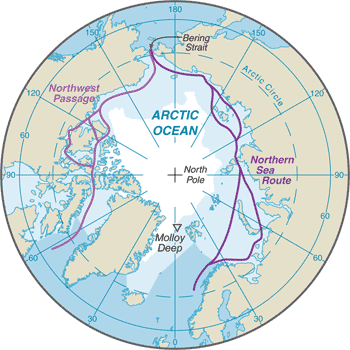
Map image could not be loaded. Open source image.
ⓘ
CIA World Factbook map, February 2021 media edition. Identity reviewed; current boundaries have not been audited. visual contact sheet or original identity check; does not verify current boundaries Boundaries, place names and designations may be dated or disputed; original annotations retained. SHA-256: 5f74cc6d2d96c159d316068c05f5f60a329ae8d1cfd416a9523443c9fb93d536. Provenance and inspection record.Introduction
Background:1
The Arctic Ocean is the smallest of the world's five ocean basins (after the Pacific Ocean, Atlantic Ocean, Indian Ocean, and the Southern Ocean). The Northwest Passage (US and Canada) and Northern Sea Route (Norway and Russia) are two important seasonal waterways. In recent years, the polar ice pack has receded in the summer allowing for increased navigation and raising the possibility of future sovereignty and shipping disputes among the Arctic coastal states affected (Canada, Denmark (Greenland), Iceland, Norway, Russia, US).
Geography
Location:2
body of water between Europe, Asia, and North America, mostly north of the Arctic Circle
Geographic coordinates:3
90 00 N, 0 00 E
Map references:4
Arctic Region
Area:5
Area - comparative:6
slightly less than 1.5 times the size of the US
Coastline:7
45,389 km
Climate:8
polar climate characterized by persistent cold and relatively narrow annual temperature range; winters characterized by continuous darkness, cold and stable weather conditions, and clear skies; summers characterized by continuous daylight, damp and foggy weather, and weak cyclones with rain or snow
Ocean volume:9
Major ocean currents:10
two major, slow-moving, wind-driven currents (drift streams) dominate: a clockwise drift pattern in the Beaufort Gyre in the western part of the Arctic Ocean and a nearly straight line Transpolar Drift Stream that moves eastward across the ocean from the New Siberian Islands (Russia) to the Fram Strait (between Greenland and Svalbard); sea ice that lies close to the center of the gyre can complete a 360 degree circle in about 2 years, while ice on the gyre periphery will complete the same circle in about 7-8 years; sea ice in the Transpolar Drift crosses the ocean in about 3 years
Bathymetry:11
Elevation:12
Natural resources:13
sand and gravel aggregates, placer deposits, polymetallic nodules, oil and gas fields, fish, marine mammals (seals and whales)
Natural hazards:14
ice islands occasionally break away from northern Ellesmere Island; icebergs calved from glaciers in western Greenland and extreme northeastern Canada; permafrost in islands; virtually ice locked from October to June; ships subject to superstructure icing from October to May
Geography - note:15
major chokepoint is the southern Chukchi Sea (northern access to the Pacific Ocean via the Bering Strait); strategic location between North America and Russia; shortest marine link between the extremes of eastern and western Russia; floating research stations operated by the US and Russia; maximum snow cover in March or April about 20 to 50 centimeters over the frozen ocean; snow cover lasts about 10 months
Environment
Environmental issues:16
changes in biodiversity and temperature; water pollution from use of toxic chemicals; endangered marine species; ecosystem slow to recover from disruptions or damage; thinning polar icepack
Climate:17
polar climate characterized by persistent cold and relatively narrow annual temperature range; winters characterized by continuous darkness, cold and stable weather conditions, and clear skies; summers characterized by continuous daylight, damp and foggy weather, and weak cyclones with rain or snow
Marine fisheries:18
the Arctic fishery region (Region 18) is the smallest in the world with a catch of only 708 mt in 2019, although the Food and Agriculture Organization assesses that some Arctic catches are reported in adjacent regions; Russia and Canada were historically the major producers; in 2017, Canada, Denmark (Greenland), Iceland, Norway, Russia, and the US, along with the People’s Republic of China, the European Union, Japan, and the Republic of Korea, agreed to a 16-year ban on fishing in the Central Arctic Ocean to allow for time to study the ecological system of these waters
Government
Country name:19
Transportation
Transportation - note:20
sparse network of air, ocean, river, and land routes; the Northwest Passage (North America) and Northern Sea Route (Eurasia) are important seasonal waterways
Notes & sources
- Background. Reference edition; observation: dates as stated in text. Field last updated: not supplied; profile fallback: 2025-09-25 14:42:29 -0400 (not a field revision date); needs review. Reference source. Edition last checked 2026-10-29 (retrieval only). ↩
- Location. Reference edition; observation: dates as stated in text. Field last updated: not supplied; profile fallback: 2025-09-25 14:42:29 -0400 (not a field revision date); needs review. Reference source. Edition last checked 2026-10-29 (retrieval only). ↩
- Geographic coordinates. Reference edition; observation: dates as stated in text. Field last updated: not supplied; profile fallback: 2025-09-25 14:42:29 -0400 (not a field revision date); needs review. Reference source. Edition last checked 2026-10-29 (retrieval only). ↩
- Map references. Reference edition; observation: dates as stated in text. Field last updated: not supplied; profile fallback: 2025-09-25 14:42:29 -0400 (not a field revision date); needs review. Reference source. Edition last checked 2026-10-29 (retrieval only). ↩
- Area. Reference edition; observation: dates as stated in text. Field last updated: not supplied; profile fallback: 2025-09-25 14:42:29 -0400 (not a field revision date); needs review. Reference source. Edition last checked 2026-10-29 (retrieval only). ↩
- Area - comparative. Reference edition; observation: dates as stated in text. Field last updated: not supplied; profile fallback: 2025-09-25 14:42:29 -0400 (not a field revision date); needs review. Reference source. Edition last checked 2026-10-29 (retrieval only). ↩
- Coastline. Reference edition; observation: dates as stated in text. Field last updated: not supplied; profile fallback: 2025-09-25 14:42:29 -0400 (not a field revision date); needs review. Reference source. Edition last checked 2026-10-29 (retrieval only). ↩
- Climate. Reference edition; observation: dates as stated in text. Field last updated: not supplied; profile fallback: 2025-09-25 14:42:29 -0400 (not a field revision date); needs review. Reference source. Edition last checked 2026-10-29 (retrieval only). ↩
- Ocean volume. Reference edition; observation: dates as stated in text. Field last updated: not supplied; profile fallback: 2025-09-25 14:42:29 -0400 (not a field revision date); needs review. Reference source. Edition last checked 2026-10-29 (retrieval only). ↩
- Major ocean currents. Reference edition; observation: dates as stated in text. Field last updated: not supplied; profile fallback: 2025-09-25 14:42:29 -0400 (not a field revision date); needs review. Reference source. Edition last checked 2026-10-29 (retrieval only). ↩
- Bathymetry. Reference edition; observation: dates as stated in text. Field last updated: not supplied; profile fallback: 2025-09-25 14:42:29 -0400 (not a field revision date); needs review. Reference source. Edition last checked 2026-10-29 (retrieval only). ↩
- Elevation. Reference edition; observation: dates as stated in text. Field last updated: not supplied; profile fallback: 2025-09-25 14:42:29 -0400 (not a field revision date); needs review. Reference source. Edition last checked 2026-10-29 (retrieval only). ↩
- Natural resources. Reference edition; observation: dates as stated in text. Field last updated: not supplied; profile fallback: 2025-09-25 14:42:29 -0400 (not a field revision date); needs review. Reference source. Edition last checked 2026-10-29 (retrieval only). ↩
- Natural hazards. Reference edition; observation: dates as stated in text. Field last updated: not supplied; profile fallback: 2025-09-25 14:42:29 -0400 (not a field revision date); needs review. Reference source. Edition last checked 2026-10-29 (retrieval only). ↩
- Geography - note. Reference edition; observation: dates as stated in text. Field last updated: not supplied; profile fallback: 2025-09-25 14:42:29 -0400 (not a field revision date); needs review. Reference source. Edition last checked 2026-10-29 (retrieval only). ↩
- Environmental issues. Reference edition; observation: dates as stated in text. Field last updated: not supplied; profile fallback: 2025-09-25 14:42:29 -0400 (not a field revision date); needs review. Reference source. Edition last checked 2026-10-29 (retrieval only). ↩
- Climate. Reference edition; observation: dates as stated in text. Field last updated: not supplied; profile fallback: 2025-09-25 14:42:29 -0400 (not a field revision date); needs review. Reference source. Edition last checked 2026-10-29 (retrieval only). ↩
- Marine fisheries. Reference edition; observation: dates as stated in text. Field last updated: not supplied; profile fallback: 2025-09-25 14:42:29 -0400 (not a field revision date); needs review. Reference source. Edition last checked 2026-10-29 (retrieval only). ↩
- Country name. Reference edition; observation: dates as stated in text. Field last updated: not supplied; profile fallback: 2025-09-25 14:42:29 -0400 (not a field revision date); needs review. Reference source. Edition last checked 2026-10-29 (retrieval only). ↩
- Transportation - note. Reference edition; observation: dates as stated in text. Field last updated: not supplied; profile fallback: 2025-09-25 14:42:29 -0400 (not a field revision date); needs review. Reference source. Edition last checked 2026-10-29 (retrieval only). ↩