South Asia / BGD
Bangladesh

ⓘ
2021 Factbook flag mirror; image identity has not been individually audited. Source.
Last updated: October 29, 2026
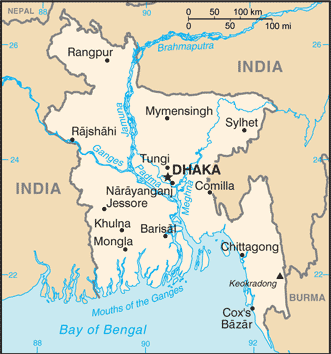
Map image could not be loaded. Open source image.
ⓘ
CIA World Factbook map, February 2021 media edition. Identity reviewed; current boundaries have not been audited. visual contact sheet or original identity check; does not verify current boundaries Boundaries, place names and designations may be dated or disputed; original annotations retained. SHA-256: 914a451cfa8b0441d40a87131750254de4049c5238e6ce1a9414f3e0b422275f. Provenance and inspection record.ⓘ
World Bank directory coordinates; approximate location, not a country center. Coordinate reference date is not supplied by the directory. Natural Earth 1:110m land (2022 source); simplified coastline, no political borders. Map source. Land SVG SHA-256: CF26056A39DC0A5B02F65704E279DFA86E77539A8387D0B2C92F907A67739E5E.Introduction
Background:1
The huge delta region at the confluence of the Ganges and Brahmaputra River systems -- now referred to as Bangladesh -- was a loosely incorporated outpost of various empires for much of the first millennium A.D. Muslim conversions and settlement in the region began in the 10th century, primarily from Arab and Persian traders and preachers. Europeans established trading posts in the area in the 16th century. Eventually the area known as Bengal, which is primarily Hindu in the western section and mostly Muslim in the eastern half, became part of British India. After the partition of India in 1947, the Muslim-majority area became East Pakistan. Calls for greater autonomy and animosity between the eastern and western areas of Pakistan led to a Bengali independence movement. That movement, led by the Awami League (AL) and supported by India, won the independence war for Bangladesh in 1971.
The military overthrew the post-independence AL government in 1975, the first of a series of military coups that resulted in a military-backed government and the subsequent creation of the Bangladesh Nationalist Party (BNP) that took power in 1979. That government also ended in a coup in 1981, followed by military-backed rule until democratic elections were held in 1991. The BNP and AL alternated in power from 1991 to 2008, with the exception of a military-backed, emergency caretaker regime in 2007. The country returned to fully democratic rule in 2008 with the election of the AL and Prime Minister Sheikh HASINA. With the help of international development assistance, Bangladesh is on track to graduate from the UN’s Least Developed Countries (LDC) list in 2026.
The economy has grown at an annual average of about 6.25% for the last two decades. Poverty declined from 11.8 percent in 2010 to 5.0 percent in 2022, based on the international poverty line of $2.15 a day (using 2017 Purchasing Power Parity exchange rate). The country made a rapid recovery from the COVID-19 pandemic, but still faces economic challenges.
Geography
Location:2
Southern Asia, bordering the Bay of Bengal, between Burma and India
Geographic coordinates:3
24 00 N, 90 00 E
Map references:4
Asia
Area:5
Surface area: 147,570 square kilometers (2024)
Area - comparative:7
slightly larger than Pennsylvania and New Jersey combined; slightly smaller than Iowa
Land boundaries:8
Coastline:9
580 km
Maritime claims:10
Climate:11
tropical; mild winter (October to March); hot, humid summer (March to June); humid, warm rainy monsoon (June to October)
Terrain:12
mostly flat alluvial plain; hilly in southeast
Elevation:13
Natural resources:14
natural gas, arable land, timber, coal
Land use:15
Irrigated land:16
83,690 sq km (2022)
Major rivers (by length in km):17
Brahmaputra river mouth (shared with China [s] and India) - 3,969 km; Ganges river mouth (shared with India [s]) - 2,704 km
Major watersheds (area sq km):18
Major aquifers:19
Indus-Ganges-Brahmaputra Basin
Natural hazards:20
droughts; cyclones; much of the country routinely inundated during the summer monsoon season
Geography - note:21
most of the country is situated on deltas of large rivers flowing from the Himalayas: the Ganges unites with the Jamuna (main channel of the Brahmaputra) and later joins the Meghna to eventually empty into the Bay of Bengal
People and Society
Population:22
Population: 175,686,899 people (2025)
Nationality:24
Ethnic groups:25
Bengali at least 99%, other indigenous ethnic groups 1% (2022 est.)
Languages:26
Bangla 98.8% (official, also known as Bengali), other 1.2% (2011 est.)
Religions:27
Muslim 91%, Hindu 8%, other 1% (2022 est.)
Age structure:28
Dependency ratios:29
Median age:30
Population growth rate:31
Population growth rate: 1.22 % annually (2025)
0.89% (2024 est.)
Birth rate:33
Crude birth rate: 19.99 births per 1,000 people (2024)
17.3 births/1,000 population (2024 est.)
Death rate:35
Crude death rate: 5.11 deaths per 1,000 people (2024)
5.5 deaths/1,000 population (2024 est.)
Net migration rate:37
-2.9 migrant(s)/1,000 population (2024 est.)
Urbanization:38
Urban population: 33.24 % of population (2025)
Major urban areas - population:40
23.210 million DHAKA (capital), 5.380 million Chittagong, 955,000 Khulna, 962,000 Rajshahi, 964,000 Sylhet, 906,000 Bogra (2023)
Sex ratio:41
Mother's mean age at first birth:42
18.6 years (2017/18 est.)
Maternal mortality ratio:43
Maternal mortality ratio: 115 deaths per 100,000 live births (2023)
115 deaths/100,000 live births (2023 est.)
Infant mortality rate:45
Infant mortality rate: 24.4 deaths per 1,000 live births (2024)
Life expectancy at birth:47
Life expectancy at birth: 74.93 years (2024)
Total fertility rate:49
Total fertility rate: 2.14 births per woman (2024)
2.07 children born/woman (2024 est.)
Gross reproduction rate:51
1.01 (2024 est.)
Drinking water source:52
At least basic drinking water services: 98.78 % of population (2024)
Health expenditure:54
Current health expenditure: 2.17 % of GDP (2023)
Physician density:56
Physicians: 0.72 per 1,000 people (2023)
0.72 physicians/1,000 population (2023)
Hospital bed density:58
0.9 beds/1,000 population (2019 est.)
Sanitation facility access:59
At least basic sanitation services: 67.62 % of population (2024)
Obesity - adult prevalence rate:61
3.6% (2016)
Alcohol consumption per capita:62
Tobacco use:63
Children under the age of 5 years underweight:64
21.7% (2022 est.)
Currently married women (ages 15-49):65
80.1% (2023 est.)
Child marriage:66
Education expenditure:67
Government education expenditure: 2.03 % of GDP (2024)
Literacy:69
Adult literacy rate: 79 % of people aged 15 and over (2022)
School life expectancy (primary to tertiary education):71
Environment
Environmental issues:72
flooding; water pollution, especially of fishing areas, from the use of commercial pesticides; groundwater pollution from naturally occurring arsenic; falling water tables in the northern and central parts of the country; soil degradation and erosion; deforestation; destruction of wetlands; severe overpopulation with noise pollution
International environmental agreements:73
Climate:74
tropical; mild winter (October to March); hot, humid summer (March to June); humid, warm rainy monsoon (June to October)
Land use:75
Urbanization:76
Carbon dioxide emissions:77
Particulate matter emissions:78
42.5 micrograms per cubic meter (2019 est.)
Methane emissions:79
Waste and recycling:80
Total water withdrawal:81
Total renewable water resources:82
1.227 trillion cubic meters (2022 est.)
Government
Country name:83
Government type:84
parliamentary republic
Capital:85
Administrative divisions:86
8 divisions; Barishal, Chattogram, Dhaka, Khulna, Mymensingh, Rajshahi, Rangpur, Sylhet
Legal system:87
common law, incorporating elements of English common law; since independence, statutory law has been the primary form of legislation; Islamic law applies to Muslims in family and inheritance laws, with Hindu personal law applying to Hindus and Buddhists
Constitution:88
International law organization participation:89
has not submitted an ICJ jurisdiction declaration; accepts ICCt jurisdiction
Citizenship:90
Suffrage:91
18 years of age; universal
Executive branch:92
Legislative branch:93
Judicial branch:94
Political parties:95
Awami League or AL
Bangladesh Jamaat-i-Islami or JIB
Bangladesh Nationalist Party or BNP
Islami Andolan Bangladesh
Jatiya Party or JP (Ershad faction)
Jatiya Party or JP (Manju faction)
National Socialist Party (Jatiya Samajtantrik Dal) or JSD
Workers Party or WP
Diplomatic representation in the US:96
Diplomatic representation from the US:97
International organization participation:98
ADB, ARF, BIMSTEC, C, CD, CICA (observer), CP, D-8, FAO, G-77, IAEA, IBRD, ICAO, ICC (national committees), ICRM, IDA, IDB, IFAD, IFC, IFRCS, IHO, ILO, IMF, IMO, IMSO, Interpol, IOC, IOM, IPU, ISO, ITSO, ITU, ITUC (NGOs), MIGA, MINURSO, MINUSCA, MONUSCO, NAM, OIC, OPCW, PCA, SAARC, SACEP, UN, UNAMID, UNCTAD, UNESCO, UNHCR, UNIDO, UNISFA, UNIFIL, UNMISS, UNOOSA, UNWTO, UPU, WCO, WFTU (NGOs), WHO, WIPO, WMO, WTO
Independence:99
16 December 1971 (from Pakistan)
National holiday:100
Independence Day, 26 March (1971); Victory Day, 16 December (1971)
Flag:101
National symbol(s):102
Bengal tiger, water lily
National color(s):103
green, red
National coat of arms:104
the water lily is the national flower and symbolizes promise, aesthetics, and elegance; the water under the lily, the rice sheaves on the sides, and the jute leaves at the top represent the Bangladeshi landscape and economy; the four stars represent the aims and ambition of the nation
National anthem(s):105
National heritage:106
Economy
Economic overview:107
one of the fastest growing emerging market economies; strong economic rebound following COVID-19; significant poverty reduction; exports dominated by textile industry; weakened exports and remittances resulted in declining foreign exchange reserves and 2022 IMF loan request
Real GDP (purchasing power parity):108
$1.473 trillion (2024 est.)
$1.413 trillion (2023 est.)
$1.336 trillion (2022 est.)
Real GDP growth rate:109
4.2% (2024 est.)
5.8% (2023 est.)
7.1% (2022 est.)
Real GDP per capita:110
GDP (official exchange rate):111
GDP: 456,319,229,255.58 current US dollars (2025)
$450.119 billion (2024 est.)
Inflation rate (consumer prices):113
GDP - composition, by sector of origin:114
GDP - composition, by end use:115
Agricultural products:116
rice, milk, potatoes, maize, sugarcane, onions, jute, vegetables, mangoes/guavas, tropical fruits (2023)
Industries:117
cotton, textiles and clothing, jute, tea, paper, cement, fertilizer, sugar, light engineering
Industrial production growth rate:118
3.5% (2024 est.)
Labor force:119
77.355 million (2024 est.)
Unemployment rate:120
Youth unemployment rate (ages 15-24):121
Population below poverty line:122
18.7% (2022 est.)
Gini Index coefficient - distribution of family income:123
33.4 (2022 est.)
Average household expenditures:124
Household income or consumption by percentage share:125
Remittances:126
6% of GDP (2024 est.)
5.1% of GDP (2023 est.)
4.7% of GDP (2022 est.)
Budget:127
Public debt:128
33.3% of GDP (2016 est.)
Taxes and other revenues:129
7.6% (of GDP) (2021 est.)
Current account balance:130
$1.87 billion (2024 est.)
$4.388 billion (2023 est.)
-$14.438 billion (2022 est.)
Exports:131
$53.848 billion (2024 est.)
$58.885 billion (2023 est.)
$60.066 billion (2022 est.)
Exports - partners:132
USA 16%, Germany 15%, UK 8%, Spain 7%, Poland 6% (2023)
Exports - commodities:133
garments, footwear, fabric, textiles, trunks and cases (2023)
Imports:134
$74.96 billion (2024 est.)
$73.172 billion (2023 est.)
$93.635 billion (2022 est.)
Imports - partners:135
China 34%, India 17%, Indonesia 5%, Singapore 5%, Malaysia 4% (2023)
Imports - commodities:136
refined petroleum, cotton fabric, natural gas, cotton, fabric (2023)
Reserves of foreign exchange and gold:137
$21.395 billion (2024 est.)
$21.86 billion (2023 est.)
$33.747 billion (2022 est.)
Debt - external:138
$58.02 billion (2023 est.)
Exchange rates:139
115.604 (2024 est.)
106.309 (2023 est.)
91.745 (2022 est.)
85.084 (2021 est.)
84.871 (2020 est.)
Energy
Electricity access:140
Electricity:141
Electricity generation sources:142
Nuclear energy:143
Coal:144
Petroleum:145
Natural gas:146
Energy consumption per capita:147
Communications
Telephones - fixed lines:148
Telephones - mobile cellular:149
Broadcast media:150
state-owned Bangladesh Television (BTV) broadcasts nationally; some channels operate via satellite; the government also owns a medium-wave radio channel and some private FM radio news channels; of the 41 approved TV stations, 26 are currently being used to broadcast, and 23 operate under private management via cable distribution
Internet country code:151
.bd
Internet users:152
Broadband - fixed subscriptions:153
Transportation
Civil aircraft registration country code prefix:154
S2
Airports:155
17 (2025)
Heliports:156
36 (2025)
Railways:157
Merchant marine:158
Ports:159
Military and Security
Military and security forces:160
Armed Forces of Bangladesh (aka Bangladesh Defense Force): Bangladesh Army, Bangladesh Navy, Bangladesh Air Force
Ministry of Home Affairs: Bangladesh Police, Border Guard Bangladesh (BGB), Bangladesh Coast Guard, Rapid Action Battalion (RAB), Ansars, Village Defense Party (VDP) (2025)
Military expenditures:161
0.9% of GDP (2024 est.)
1% of GDP (2023 est.)
1.1% of GDP (2022 est.)
1.2% of GDP (2021 est.)
1.3% of GDP (2020 est.)
Military and security service personnel strengths:162
information varies; approximately 170,000 active Armed Forces (2025)
Military equipment inventories and acquisitions:163
much of the military's inventory is comprised of Chinese- and Russian-origin equipment; in recent years, China has been the leading provider of arms to Bangladesh (2024)
Military service age and obligation:164
generally 17-21 for voluntary military service; length of service varies by military service (2024)
Military deployments:165
approximately 1,400 Central African Republic (MINUSCA); 1,650 Democratic Republic of the Congo (MONUSCO; plus about 200 police); 120 Lebanon (UNIFIL); 100 Mali (MINUSMA; plus about 150 police); 1,600 South Sudan (UNMISS); 500 Sudan (UNISFA) (2024)
Military - note:166
the military’s primary responsibility is external defense but it also has a domestic security role; following widespread domestic protests in September 2024, the Army was given law enforcement powers, including making arrests, conducting searches, and dispersing unlawful assemblies; the military has traditionally been a significant player in the country's politics and has commercial business interests in such areas as banking, food, hotels, manufacturing, real estate, and shipbuilding, and manages government infrastructure and construction projects
the military has a long history of participating in UN peacekeeping missions, which has provided operational experience and a source of funding; it runs an international institute for the training of peacekeepers; the military also conducts multinational and bilateral exercises with foreign partners, particularly India (2025)
Space
Space agency/agencies:167
Bangladesh Space Research and Remote Sensing Organization (SPARRSO; established as a statutory body in 1991 and designated as the country's national focal point for space-related activities in 1995) (2025)
Space program overview:168
has a modest space program focused on designing, building, and operating satellites, particularly those with remote sensing (RS) capabilities; SPARSSO's mandate is to use space and RS technology in areas such as agriculture, education, environmental studies, fisheries, forestry, geology, land use, mapping, meteorology, and oceanography; has a government-owned company for acquiring and operating satellites (Bangladesh Satellite Company Limited, established in 2017); works with several foreign space agencies and commercial entities, including those of France, Japan, Russia, and the US; member of several international space organizations, such as the Asia-Pacific Space Cooperation Organization (2025)
Key space-program milestones:169
2017 - first educational/scientific nanosatellite (BRAC-Onnesha) acquired from Japan and launched by US
2018 - first communications satellite (Bangabandhu-1) built by a French company and launched by US
2025 - signed US-led Artemis Accords for the safe and responsible exploration of space
Terrorism
Terrorist group(s):170
Harakat ul-Jihad-i-Islami/Bangladesh (HUJI-B); Islamic State of Iraq and ash-Sham (ISIS) in Bangladesh (ISB); al-Qa'ida; al-Qa'ida in the Indian Subcontinent (AQIS)
Transnational Issues
Refugees and internally displaced persons:171
Additional observations
- Real GDP growth172
- 3.49 % annual change (2025)
- Consumer price inflation173
- 8.77 % annual change (2025)
- Unemployment (modeled ILO estimate)174
- 3.78 % of labor force (2025)
- Access to electricity175
- 99.5 % of population (2024)
- Renewable energy share of total final energy consumption176
- 25 % (2021)
- Individuals using the internet177
- 53.42 % of population (2024)
Notes & sources
- Background. Reference edition; observation: dates as stated in text. Field last updated: not supplied; profile fallback: 2025-12-04 13:07:31 -0500 (not a field revision date); needs review. Reference source. Edition last checked 2026-10-29 (retrieval only). ↩
- Location. Reference edition; observation: dates as stated in text. Field last updated: not supplied; profile fallback: 2025-12-04 13:07:31 -0500 (not a field revision date); needs review. Reference source. Edition last checked 2026-10-29 (retrieval only). ↩
- Geographic coordinates. Reference edition; observation: dates as stated in text. Field last updated: not supplied; profile fallback: 2025-12-04 13:07:31 -0500 (not a field revision date); needs review. Reference source. Edition last checked 2026-10-29 (retrieval only). ↩
- Map references. Reference edition; observation: dates as stated in text. Field last updated: not supplied; profile fallback: 2025-12-04 13:07:31 -0500 (not a field revision date); needs review. Reference source. Edition last checked 2026-10-29 (retrieval only). ↩
- Area. Reference edition; observation: dates as stated in text. Field last updated: not supplied; profile fallback: 2025-12-04 13:07:31 -0500 (not a field revision date); needs review. Reference source. The archived total area has no reference year and territorial coverage may differ from World Bank surface area. World Bank: 147,570 square kilometers (2024). Reference: 148,460 square kilometers. Edition last checked 2026-10-29 (retrieval only). ↩
- Surface area. Surface area: observation 2024; checked 2026-10-29; single source. World Bank World Development Indicators. The archived total area has no reference year and territorial coverage may differ from World Bank surface area. World Bank: 147,570 square kilometers (2024). Reference: 148,460 square kilometers. ↩
- Area - comparative. Reference edition; observation: dates as stated in text. Field last updated: not supplied; profile fallback: 2025-12-04 13:07:31 -0500 (not a field revision date); needs review. Reference source. Edition last checked 2026-10-29 (retrieval only). ↩
- Land boundaries. Reference edition; observation: dates as stated in text. Field last updated: not supplied; profile fallback: 2025-12-04 13:07:31 -0500 (not a field revision date); needs review. Reference source. Edition last checked 2026-10-29 (retrieval only). ↩
- Coastline. Reference edition; observation: dates as stated in text. Field last updated: not supplied; profile fallback: 2025-12-04 13:07:31 -0500 (not a field revision date); needs review. Reference source. Edition last checked 2026-10-29 (retrieval only). ↩
- Maritime claims. Reference edition; observation: dates as stated in text. Field last updated: not supplied; profile fallback: 2025-12-04 13:07:31 -0500 (not a field revision date); needs review. Reference source. Edition last checked 2026-10-29 (retrieval only). ↩
- Climate. Reference edition; observation: dates as stated in text. Field last updated: not supplied; profile fallback: 2025-12-04 13:07:31 -0500 (not a field revision date); needs review. Reference source. Edition last checked 2026-10-29 (retrieval only). ↩
- Terrain. Reference edition; observation: dates as stated in text. Field last updated: not supplied; profile fallback: 2025-12-04 13:07:31 -0500 (not a field revision date); needs review. Reference source. Edition last checked 2026-10-29 (retrieval only). ↩
- Elevation. Reference edition; observation: dates as stated in text. Field last updated: not supplied; profile fallback: 2025-12-04 13:07:31 -0500 (not a field revision date); needs review. Reference source. Edition last checked 2026-10-29 (retrieval only). ↩
- Natural resources. Reference edition; observation: dates as stated in text. Field last updated: not supplied; profile fallback: 2025-12-04 13:07:31 -0500 (not a field revision date); needs review. Reference source. Edition last checked 2026-10-29 (retrieval only). ↩
- Land use. Reference edition; observation: dates as stated in text. Field last updated: not supplied; profile fallback: 2025-12-04 13:07:31 -0500 (not a field revision date); needs review. Reference source. Edition last checked 2026-10-29 (retrieval only). ↩
- Irrigated land. Reference edition; observation: 2022. Field last updated: not supplied; profile fallback: 2025-12-04 13:07:31 -0500 (not a field revision date); needs review. Reference source. Edition last checked 2026-10-29 (retrieval only). ↩
- Major rivers (by length in km). Reference edition; observation: dates as stated in text. Field last updated: not supplied; profile fallback: 2025-12-04 13:07:31 -0500 (not a field revision date); needs review. Reference source. Edition last checked 2026-10-29 (retrieval only). ↩
- Major watersheds (area sq km). Reference edition; observation: dates as stated in text. Field last updated: not supplied; profile fallback: 2025-12-04 13:07:31 -0500 (not a field revision date); needs review. Reference source. Edition last checked 2026-10-29 (retrieval only). ↩
- Major aquifers. Reference edition; observation: dates as stated in text. Field last updated: not supplied; profile fallback: 2025-12-04 13:07:31 -0500 (not a field revision date); needs review. Reference source. Edition last checked 2026-10-29 (retrieval only). ↩
- Natural hazards. Reference edition; observation: dates as stated in text. Field last updated: not supplied; profile fallback: 2025-12-04 13:07:31 -0500 (not a field revision date); needs review. Reference source. Edition last checked 2026-10-29 (retrieval only). ↩
- Geography - note. Reference edition; observation: dates as stated in text. Field last updated: not supplied; profile fallback: 2025-12-04 13:07:31 -0500 (not a field revision date); needs review. Reference source. Edition last checked 2026-10-29 (retrieval only). ↩
- Population. Reference edition; observation: dates as stated in text. Field last updated: not supplied; profile fallback: 2025-12-04 13:07:31 -0500 (not a field revision date); needs review. Reference source. Different reference years; no numerical agreement is asserted. World Bank: 175,686,899 people (2025). Reference: 168,697,184 people (2024). Edition last checked 2026-10-29 (retrieval only). ↩
- Population. Population: observation 2025; checked 2026-10-29; single source. World Bank World Development Indicators. Different reference years; no numerical agreement is asserted. World Bank: 175,686,899 people (2025). Reference: 168,697,184 people (2024). ↩
- Nationality. Reference edition; observation: dates as stated in text. Field last updated: not supplied; profile fallback: 2025-12-04 13:07:31 -0500 (not a field revision date); needs review. Reference source. Edition last checked 2026-10-29 (retrieval only). ↩
- Ethnic groups. Reference edition; observation: 2022 est.. Field last updated: not supplied; profile fallback: 2025-12-04 13:07:31 -0500 (not a field revision date); needs review. Reference source. Edition last checked 2026-10-29 (retrieval only). ↩
- Languages. Reference edition; observation: dates as stated in text. Field last updated: not supplied; profile fallback: 2025-12-04 13:07:31 -0500 (not a field revision date); needs review. Reference source. Edition last checked 2026-10-29 (retrieval only). ↩
- Religions. Reference edition; observation: 2022 est.. Field last updated: not supplied; profile fallback: 2025-12-04 13:07:31 -0500 (not a field revision date); needs review. Reference source. Edition last checked 2026-10-29 (retrieval only). ↩
- Age structure. Reference edition; observation: dates as stated in text. Field last updated: not supplied; profile fallback: 2025-12-04 13:07:31 -0500 (not a field revision date); needs review. Reference source. Edition last checked 2026-10-29 (retrieval only). ↩
- Dependency ratios. Reference edition; observation: dates as stated in text. Field last updated: not supplied; profile fallback: 2025-12-04 13:07:31 -0500 (not a field revision date); needs review. Reference source. Edition last checked 2026-10-29 (retrieval only). ↩
- Median age. Reference edition; observation: dates as stated in text. Field last updated: not supplied; profile fallback: 2025-12-04 13:07:31 -0500 (not a field revision date); needs review. Reference source. Edition last checked 2026-10-29 (retrieval only). ↩
- Population growth rate. Reference edition; observation: 2024. Field last updated: not supplied; profile fallback: 2025-12-04 13:07:31 -0500 (not a field revision date); needs review. Reference source. Edition last checked 2026-10-29 (retrieval only). ↩
- Population growth rate. Population growth rate: observation 2025; checked 2026-10-29; single source. World Bank World Development Indicators. Latest available World Bank series in 2020–2026; reference year is not retrieval year. May be modeled or revised; differing definitions and geography require review. No independent crosscheck; do not silently replace archived Factbook. ↩
- Birth rate. Reference edition; observation: 2024. Field last updated: not supplied; profile fallback: 2025-12-04 13:07:31 -0500 (not a field revision date); needs review. Reference source. Edition last checked 2026-10-29 (retrieval only). ↩
- Crude birth rate. Crude birth rate: observation 2024; checked 2026-10-29; single source. World Bank World Development Indicators. Latest available World Bank series in 2020–2026; reference year is not retrieval year. May be modeled or revised; differing definitions and geography require review. No independent crosscheck; do not silently replace archived Factbook. ↩
- Death rate. Reference edition; observation: 2024. Field last updated: not supplied; profile fallback: 2025-12-04 13:07:31 -0500 (not a field revision date); needs review. Reference source. Edition last checked 2026-10-29 (retrieval only). ↩
- Crude death rate. Crude death rate: observation 2024; checked 2026-10-29; single source. World Bank World Development Indicators. Latest available World Bank series in 2020–2026; reference year is not retrieval year. May be modeled or revised; differing definitions and geography require review. No independent crosscheck; do not silently replace archived Factbook. ↩
- Net migration rate. Reference edition; observation: 2024. Field last updated: not supplied; profile fallback: 2025-12-04 13:07:31 -0500 (not a field revision date); needs review. Reference source. Edition last checked 2026-10-29 (retrieval only). ↩
- Urbanization. Reference edition; observation: dates as stated in text. Field last updated: not supplied; profile fallback: 2025-12-04 13:07:31 -0500 (not a field revision date); needs review. Reference source. Edition last checked 2026-10-29 (retrieval only). ↩
- Urban population. Urban population: observation 2025; checked 2026-10-29; single source. World Bank World Development Indicators. Latest available World Bank series in 2020–2026; reference year is not retrieval year. May be modeled or revised; differing definitions and geography require review. No independent crosscheck; do not silently replace archived Factbook. ↩
- Major urban areas - population. Reference edition; observation: 2023. Field last updated: not supplied; profile fallback: 2025-12-04 13:07:31 -0500 (not a field revision date); needs review. Reference source. Edition last checked 2026-10-29 (retrieval only). ↩
- Sex ratio. Reference edition; observation: dates as stated in text. Field last updated: not supplied; profile fallback: 2025-12-04 13:07:31 -0500 (not a field revision date); needs review. Reference source. Edition last checked 2026-10-29 (retrieval only). ↩
- Mother's mean age at first birth. Reference edition; observation: 2017/18. Field last updated: not supplied; profile fallback: 2025-12-04 13:07:31 -0500 (not a field revision date); needs review. Reference source. Edition last checked 2026-10-29 (retrieval only). ↩
- Maternal mortality ratio. Reference edition; observation: 2023. Field last updated: not supplied; profile fallback: 2025-12-04 13:07:31 -0500 (not a field revision date); needs review. Reference source. Edition last checked 2026-10-29 (retrieval only). ↩
- Maternal mortality ratio. Maternal mortality ratio: observation 2023; checked 2026-10-29; single source. World Bank World Development Indicators. Latest available World Bank series in 2020–2026; reference year is not retrieval year. May be modeled or revised; differing definitions and geography require review. No independent crosscheck; do not silently replace archived Factbook. ↩
- Infant mortality rate. Reference edition; observation: dates as stated in text. Field last updated: not supplied; profile fallback: 2025-12-04 13:07:31 -0500 (not a field revision date); needs review. Reference source. Edition last checked 2026-10-29 (retrieval only). ↩
- Infant mortality rate. Infant mortality rate: observation 2024; checked 2026-10-29; single source. World Bank World Development Indicators. Latest available World Bank series in 2020–2026; reference year is not retrieval year. May be modeled or revised; differing definitions and geography require review. No independent crosscheck; do not silently replace archived Factbook. ↩
- Life expectancy at birth. Reference edition; observation: dates as stated in text. Field last updated: not supplied; profile fallback: 2025-12-04 13:07:31 -0500 (not a field revision date); needs review. Reference source. Edition last checked 2026-10-29 (retrieval only). ↩
- Life expectancy at birth. Life expectancy at birth: observation 2024; checked 2026-10-29; single source. World Bank World Development Indicators. Latest available World Bank series in 2020–2026; reference year is not retrieval year. May be modeled or revised; differing definitions and geography require review. No independent crosscheck; do not silently replace archived Factbook. ↩
- Total fertility rate. Reference edition; observation: 2024. Field last updated: not supplied; profile fallback: 2025-12-04 13:07:31 -0500 (not a field revision date); needs review. Reference source. Edition last checked 2026-10-29 (retrieval only). ↩
- Total fertility rate. Total fertility rate: observation 2024; checked 2026-10-29; single source. World Bank World Development Indicators. Latest available World Bank series in 2020–2026; reference year is not retrieval year. May be modeled or revised; differing definitions and geography require review. No independent crosscheck; do not silently replace archived Factbook. ↩
- Gross reproduction rate. Reference edition; observation: 2024. Field last updated: not supplied; profile fallback: 2025-12-04 13:07:31 -0500 (not a field revision date); needs review. Reference source. Edition last checked 2026-10-29 (retrieval only). ↩
- Drinking water source. Reference edition; observation: dates as stated in text. Field last updated: not supplied; profile fallback: 2025-12-04 13:07:31 -0500 (not a field revision date); needs review. Reference source. Edition last checked 2026-10-29 (retrieval only). ↩
- At least basic drinking water services. At least basic drinking water services: observation 2024; checked 2026-10-29; single source. World Bank World Development Indicators. Latest available World Bank series in 2020–2026; reference year is not retrieval year. May be modeled or revised; differing definitions and geography require review. No independent crosscheck; do not silently replace archived Factbook. This separately sourced basic-service observation is shown alongside the reference edition’s improved/unimproved categories. It does not replace those category totals. ↩
- Health expenditure. Reference edition; observation: dates as stated in text. Field last updated: not supplied; profile fallback: 2025-12-04 13:07:31 -0500 (not a field revision date); needs review. Reference source. Edition last checked 2026-10-29 (retrieval only). ↩
- Current health expenditure. Current health expenditure: observation 2023; checked 2026-10-29; single source. World Bank World Development Indicators. Latest available World Bank series in 2020–2026; reference year is not retrieval year. May be modeled or revised; differing definitions and geography require review. No independent crosscheck; do not silently replace archived Factbook. ↩
- Physician density. Reference edition; observation: 2023. Field last updated: not supplied; profile fallback: 2025-12-04 13:07:31 -0500 (not a field revision date); needs review. Reference source. Edition last checked 2026-10-29 (retrieval only). ↩
- Physicians. Physicians: observation 2023; checked 2026-10-29; single source. World Bank World Development Indicators. Latest available World Bank series in 2020–2026; reference year is not retrieval year. May be modeled or revised; differing definitions and geography require review. No independent crosscheck; do not silently replace archived Factbook. ↩
- Hospital bed density. Reference edition; observation: 2019. Field last updated: not supplied; profile fallback: 2025-12-04 13:07:31 -0500 (not a field revision date); needs review. Reference source. Edition last checked 2026-10-29 (retrieval only). ↩
- Sanitation facility access. Reference edition; observation: dates as stated in text. Field last updated: not supplied; profile fallback: 2025-12-04 13:07:31 -0500 (not a field revision date); needs review. Reference source. Edition last checked 2026-10-29 (retrieval only). ↩
- At least basic sanitation services. At least basic sanitation services: observation 2024; checked 2026-10-29; single source. World Bank World Development Indicators. Latest available World Bank series in 2020–2026; reference year is not retrieval year. May be modeled or revised; differing definitions and geography require review. No independent crosscheck; do not silently replace archived Factbook. This separately sourced basic-service observation is shown alongside the reference edition’s improved/unimproved categories. It does not replace those category totals. ↩
- Obesity - adult prevalence rate. Reference edition; observation: 2016. Field last updated: not supplied; profile fallback: 2025-12-04 13:07:31 -0500 (not a field revision date); needs review. Reference source. Edition last checked 2026-10-29 (retrieval only). ↩
- Alcohol consumption per capita. Reference edition; observation: dates as stated in text. Field last updated: not supplied; profile fallback: 2025-12-04 13:07:31 -0500 (not a field revision date); needs review. Reference source. Edition last checked 2026-10-29 (retrieval only). ↩
- Tobacco use. Reference edition; observation: dates as stated in text. Field last updated: not supplied; profile fallback: 2025-12-04 13:07:31 -0500 (not a field revision date); needs review. Reference source. Edition last checked 2026-10-29 (retrieval only). ↩
- Children under the age of 5 years underweight. Reference edition; observation: 2022. Field last updated: not supplied; profile fallback: 2025-12-04 13:07:31 -0500 (not a field revision date); needs review. Reference source. Edition last checked 2026-10-29 (retrieval only). ↩
- Currently married women (ages 15-49). Reference edition; observation: 2023. Field last updated: not supplied; profile fallback: 2025-12-04 13:07:31 -0500 (not a field revision date); needs review. Reference source. Edition last checked 2026-10-29 (retrieval only). ↩
- Child marriage. Reference edition; observation: dates as stated in text. Field last updated: not supplied; profile fallback: 2025-12-04 13:07:31 -0500 (not a field revision date); needs review. Reference source. Edition last checked 2026-10-29 (retrieval only). ↩
- Education expenditure. Reference edition; observation: dates as stated in text. Field last updated: not supplied; profile fallback: 2025-12-04 13:07:31 -0500 (not a field revision date); needs review. Reference source. Edition last checked 2026-10-29 (retrieval only). ↩
- Government education expenditure. Government education expenditure: observation 2024; checked 2026-10-29; single source. World Bank World Development Indicators. Latest available World Bank series in 2020–2026; reference year is not retrieval year. May be modeled or revised; differing definitions and geography require review. No independent crosscheck; do not silently replace archived Factbook. ↩
- Literacy. Reference edition; observation: dates as stated in text. Field last updated: not supplied; profile fallback: 2025-12-04 13:07:31 -0500 (not a field revision date); needs review. Reference source. Edition last checked 2026-10-29 (retrieval only). ↩
- Adult literacy rate. Adult literacy rate: observation 2022; checked 2026-10-29; single source. World Bank World Development Indicators. Latest available World Bank series in 2020–2026; reference year is not retrieval year. May be modeled or revised; differing definitions and geography require review. No independent crosscheck; do not silently replace archived Factbook. ↩
- School life expectancy (primary to tertiary education). Reference edition; observation: dates as stated in text. Field last updated: not supplied; profile fallback: 2025-12-04 13:07:31 -0500 (not a field revision date); needs review. Reference source. Edition last checked 2026-10-29 (retrieval only). ↩
- Environmental issues. Reference edition; observation: dates as stated in text. Field last updated: not supplied; profile fallback: 2025-12-04 13:07:31 -0500 (not a field revision date); needs review. Reference source. Edition last checked 2026-10-29 (retrieval only). ↩
- International environmental agreements. Reference edition; observation: dates as stated in text. Field last updated: not supplied; profile fallback: 2025-12-04 13:07:31 -0500 (not a field revision date); needs review. Reference source. Edition last checked 2026-10-29 (retrieval only). ↩
- Climate. Reference edition; observation: dates as stated in text. Field last updated: not supplied; profile fallback: 2025-12-04 13:07:31 -0500 (not a field revision date); needs review. Reference source. Edition last checked 2026-10-29 (retrieval only). ↩
- Land use. Reference edition; observation: dates as stated in text. Field last updated: not supplied; profile fallback: 2025-12-04 13:07:31 -0500 (not a field revision date); needs review. Reference source. Edition last checked 2026-10-29 (retrieval only). ↩
- Urbanization. Reference edition; observation: dates as stated in text. Field last updated: not supplied; profile fallback: 2025-12-04 13:07:31 -0500 (not a field revision date); needs review. Reference source. Edition last checked 2026-10-29 (retrieval only). ↩
- Carbon dioxide emissions. Reference edition; observation: dates as stated in text. Field last updated: not supplied; profile fallback: 2025-12-04 13:07:31 -0500 (not a field revision date); needs review. Reference source. Edition last checked 2026-10-29 (retrieval only). ↩
- Particulate matter emissions. Reference edition; observation: 2019. Field last updated: not supplied; profile fallback: 2025-12-04 13:07:31 -0500 (not a field revision date); needs review. Reference source. Edition last checked 2026-10-29 (retrieval only). ↩
- Methane emissions. Reference edition; observation: dates as stated in text. Field last updated: not supplied; profile fallback: 2025-12-04 13:07:31 -0500 (not a field revision date); needs review. Reference source. Edition last checked 2026-10-29 (retrieval only). ↩
- Waste and recycling. Reference edition; observation: dates as stated in text. Field last updated: not supplied; profile fallback: 2025-12-04 13:07:31 -0500 (not a field revision date); needs review. Reference source. Edition last checked 2026-10-29 (retrieval only). ↩
- Total water withdrawal. Reference edition; observation: dates as stated in text. Field last updated: not supplied; profile fallback: 2025-12-04 13:07:31 -0500 (not a field revision date); needs review. Reference source. Edition last checked 2026-10-29 (retrieval only). ↩
- Total renewable water resources. Reference edition; observation: 2022. Field last updated: not supplied; profile fallback: 2025-12-04 13:07:31 -0500 (not a field revision date); needs review. Reference source. Edition last checked 2026-10-29 (retrieval only). ↩
- Country name. Reference edition; observation: dates as stated in text. Field last updated: not supplied; profile fallback: 2025-12-04 13:07:31 -0500 (not a field revision date); needs review. Reference source. Edition last checked 2026-10-29 (retrieval only). ↩
- Government type. Reference edition; observation: dates as stated in text. Field last updated: not supplied; profile fallback: 2025-12-04 13:07:31 -0500 (not a field revision date); needs review. Reference source. Edition last checked 2026-10-29 (retrieval only). ↩
- Capital. Reference edition; observation: dates as stated in text. Field last updated: not supplied; profile fallback: 2025-12-04 13:07:31 -0500 (not a field revision date); needs review. Reference source. Edition last checked 2026-10-29 (retrieval only). ↩
- Administrative divisions. Reference edition; observation: dates as stated in text. Field last updated: not supplied; profile fallback: 2025-12-04 13:07:31 -0500 (not a field revision date); needs review. Reference source. Edition last checked 2026-10-29 (retrieval only). ↩
- Legal system. Reference edition; observation: dates as stated in text. Field last updated: not supplied; profile fallback: 2025-12-04 13:07:31 -0500 (not a field revision date); needs review. Reference source. Edition last checked 2026-10-29 (retrieval only). ↩
- Constitution. Reference edition; observation: dates as stated in text. Field last updated: not supplied; profile fallback: 2025-12-04 13:07:31 -0500 (not a field revision date); needs review. Reference source. Edition last checked 2026-10-29 (retrieval only). ↩
- International law organization participation. Reference edition; observation: dates as stated in text. Field last updated: not supplied; profile fallback: 2025-12-04 13:07:31 -0500 (not a field revision date); needs review. Reference source. Edition last checked 2026-10-29 (retrieval only). ↩
- Citizenship. Reference edition; observation: dates as stated in text. Field last updated: not supplied; profile fallback: 2025-12-04 13:07:31 -0500 (not a field revision date); needs review. Reference source. Edition last checked 2026-10-29 (retrieval only). ↩
- Suffrage. Reference edition; observation: dates as stated in text. Field last updated: not supplied; profile fallback: 2025-12-04 13:07:31 -0500 (not a field revision date); needs review. Reference source. Edition last checked 2026-10-29 (retrieval only). ↩
- Executive branch. Reference edition; observation: dates as stated in text. Field last updated: not supplied; profile fallback: 2025-12-04 13:07:31 -0500 (not a field revision date); needs review. Reference source. Updated head of government; supported as of 2026-06-22; reviewed 2026-10-29T20:18:55.525Z. Term began 2026-02-17. Bangladesh Ministry of Expatriates Welfare. Previous reference claim: Interim Prime Minister Muhammad YUNUS (since 8 August 2024). Edition last checked 2026-10-29 (retrieval only). ↩
- Legislative branch. Reference edition; observation: dates as stated in text. Field last updated: not supplied; profile fallback: 2025-12-04 13:07:31 -0500 (not a field revision date); needs review. Reference source. Edition last checked 2026-10-29 (retrieval only). ↩
- Judicial branch. Reference edition; observation: dates as stated in text. Field last updated: not supplied; profile fallback: 2025-12-04 13:07:31 -0500 (not a field revision date); needs review. Reference source. Edition last checked 2026-10-29 (retrieval only). ↩
- Political parties. Reference edition; observation: dates as stated in text. Field last updated: not supplied; profile fallback: 2025-12-04 13:07:31 -0500 (not a field revision date); needs review. Reference source. Edition last checked 2026-10-29 (retrieval only). ↩
- Diplomatic representation in the US. Reference edition; observation: dates as stated in text. Field last updated: not supplied; profile fallback: 2025-12-04 13:07:31 -0500 (not a field revision date); needs review. Reference source. Edition last checked 2026-10-29 (retrieval only). ↩
- Diplomatic representation from the US. Reference edition; observation: dates as stated in text. Field last updated: not supplied; profile fallback: 2025-12-04 13:07:31 -0500 (not a field revision date); needs review. Reference source. Edition last checked 2026-10-29 (retrieval only). ↩
- International organization participation. Reference edition; observation: dates as stated in text. Field last updated: not supplied; profile fallback: 2025-12-04 13:07:31 -0500 (not a field revision date); needs review. Reference source. Edition last checked 2026-10-29 (retrieval only). ↩
- Independence. Reference edition; observation: dates as stated in text. Field last updated: not supplied; profile fallback: 2025-12-04 13:07:31 -0500 (not a field revision date); needs review. Reference source. Edition last checked 2026-10-29 (retrieval only). ↩
- National holiday. Reference edition; observation: dates as stated in text. Field last updated: not supplied; profile fallback: 2025-12-04 13:07:31 -0500 (not a field revision date); needs review. Reference source. Edition last checked 2026-10-29 (retrieval only). ↩
- Flag. Reference edition; observation: dates as stated in text. Field last updated: not supplied; profile fallback: 2025-12-04 13:07:31 -0500 (not a field revision date); needs review. Reference source. Edition last checked 2026-10-29 (retrieval only). ↩
- National symbol(s). Reference edition; observation: dates as stated in text. Field last updated: not supplied; profile fallback: 2025-12-04 13:07:31 -0500 (not a field revision date); needs review. Reference source. Edition last checked 2026-10-29 (retrieval only). ↩
- National color(s). Reference edition; observation: dates as stated in text. Field last updated: not supplied; profile fallback: 2025-12-04 13:07:31 -0500 (not a field revision date); needs review. Reference source. Edition last checked 2026-10-29 (retrieval only). ↩
- National coat of arms. Reference edition; observation: dates as stated in text. Field last updated: not supplied; profile fallback: 2025-12-04 13:07:31 -0500 (not a field revision date); needs review. Reference source. Edition last checked 2026-10-29 (retrieval only). ↩
- National anthem(s). Reference edition; observation: dates as stated in text. Field last updated: not supplied; profile fallback: 2025-12-04 13:07:31 -0500 (not a field revision date); needs review. Reference source. Edition last checked 2026-10-29 (retrieval only). ↩
- National heritage. Reference edition; observation: dates as stated in text. Field last updated: not supplied; profile fallback: 2025-12-04 13:07:31 -0500 (not a field revision date); needs review. Reference source. Edition last checked 2026-10-29 (retrieval only). ↩
- Economic overview. Reference edition; observation: dates as stated in text. Field last updated: not supplied; profile fallback: 2025-12-04 13:07:31 -0500 (not a field revision date); needs review. Reference source. Edition last checked 2026-10-29 (retrieval only). ↩
- Real GDP (purchasing power parity). Reference edition; observation: dates as stated in text. Field last updated: not supplied; profile fallback: 2025-12-04 13:07:31 -0500 (not a field revision date); needs review. Reference source. Edition last checked 2026-10-29 (retrieval only). ↩
- Real GDP growth rate. Reference edition; observation: dates as stated in text. Field last updated: not supplied; profile fallback: 2025-12-04 13:07:31 -0500 (not a field revision date); needs review. Reference source. Edition last checked 2026-10-29 (retrieval only). ↩
- Real GDP per capita. Reference edition; observation: dates as stated in text. Field last updated: not supplied; profile fallback: 2025-12-04 13:07:31 -0500 (not a field revision date); needs review. Reference source. Edition last checked 2026-10-29 (retrieval only). ↩
- GDP (official exchange rate). Reference edition; observation: 2024. Field last updated: not supplied; profile fallback: 2025-12-04 13:07:31 -0500 (not a field revision date); needs review. Reference source. Different reference years; no numerical agreement is asserted. World Bank: 456,319,229,255.58 current US dollars (2025). Reference: 450,119,000,000 current US dollars (2024). Edition last checked 2026-10-29 (retrieval only). ↩
- GDP. GDP: observation 2025; checked 2026-10-29; single source. World Bank World Development Indicators. Different reference years; no numerical agreement is asserted. World Bank: 456,319,229,255.58 current US dollars (2025). Reference: 450,119,000,000 current US dollars (2024). ↩
- Inflation rate (consumer prices). Reference edition; observation: dates as stated in text. Field last updated: not supplied; profile fallback: 2025-12-04 13:07:31 -0500 (not a field revision date); needs review. Reference source. Edition last checked 2026-10-29 (retrieval only). ↩
- GDP - composition, by sector of origin. Reference edition; observation: dates as stated in text. Field last updated: not supplied; profile fallback: 2025-12-04 13:07:31 -0500 (not a field revision date); needs review. Reference source. Edition last checked 2026-10-29 (retrieval only). ↩
- GDP - composition, by end use. Reference edition; observation: dates as stated in text. Field last updated: not supplied; profile fallback: 2025-12-04 13:07:31 -0500 (not a field revision date); needs review. Reference source. Edition last checked 2026-10-29 (retrieval only). ↩
- Agricultural products. Reference edition; observation: 2023. Field last updated: not supplied; profile fallback: 2025-12-04 13:07:31 -0500 (not a field revision date); needs review. Reference source. Edition last checked 2026-10-29 (retrieval only). ↩
- Industries. Reference edition; observation: dates as stated in text. Field last updated: not supplied; profile fallback: 2025-12-04 13:07:31 -0500 (not a field revision date); needs review. Reference source. Edition last checked 2026-10-29 (retrieval only). ↩
- Industrial production growth rate. Reference edition; observation: 2024. Field last updated: not supplied; profile fallback: 2025-12-04 13:07:31 -0500 (not a field revision date); needs review. Reference source. Edition last checked 2026-10-29 (retrieval only). ↩
- Labor force. Reference edition; observation: 2024. Field last updated: not supplied; profile fallback: 2025-12-04 13:07:31 -0500 (not a field revision date); needs review. Reference source. Edition last checked 2026-10-29 (retrieval only). ↩
- Unemployment rate. Reference edition; observation: dates as stated in text. Field last updated: not supplied; profile fallback: 2025-12-04 13:07:31 -0500 (not a field revision date); needs review. Reference source. Edition last checked 2026-10-29 (retrieval only). ↩
- Youth unemployment rate (ages 15-24). Reference edition; observation: dates as stated in text. Field last updated: not supplied; profile fallback: 2025-12-04 13:07:31 -0500 (not a field revision date); needs review. Reference source. Edition last checked 2026-10-29 (retrieval only). ↩
- Population below poverty line. Reference edition; observation: 2022. Field last updated: not supplied; profile fallback: 2025-12-04 13:07:31 -0500 (not a field revision date); needs review. Reference source. Edition last checked 2026-10-29 (retrieval only). ↩
- Gini Index coefficient - distribution of family income. Reference edition; observation: dates as stated in text. Field last updated: not supplied; profile fallback: 2025-12-04 13:07:31 -0500 (not a field revision date); needs review. Reference source. Edition last checked 2026-10-29 (retrieval only). ↩
- Average household expenditures. Reference edition; observation: dates as stated in text. Field last updated: not supplied; profile fallback: 2025-12-04 13:07:31 -0500 (not a field revision date); needs review. Reference source. Edition last checked 2026-10-29 (retrieval only). ↩
- Household income or consumption by percentage share. Reference edition; observation: dates as stated in text. Field last updated: not supplied; profile fallback: 2025-12-04 13:07:31 -0500 (not a field revision date); needs review. Reference source. Edition last checked 2026-10-29 (retrieval only). ↩
- Remittances. Reference edition; observation: dates as stated in text. Field last updated: not supplied; profile fallback: 2025-12-04 13:07:31 -0500 (not a field revision date); needs review. Reference source. Edition last checked 2026-10-29 (retrieval only). ↩
- Budget. Reference edition; observation: dates as stated in text. Field last updated: not supplied; profile fallback: 2025-12-04 13:07:31 -0500 (not a field revision date); needs review. Reference source. Edition last checked 2026-10-29 (retrieval only). ↩
- Public debt. Reference edition; observation: dates as stated in text. Field last updated: not supplied; profile fallback: 2025-12-04 13:07:31 -0500 (not a field revision date); needs review. Reference source. Edition last checked 2026-10-29 (retrieval only). ↩
- Taxes and other revenues. Reference edition; observation: 2021. Field last updated: not supplied; profile fallback: 2025-12-04 13:07:31 -0500 (not a field revision date); needs review. Reference source. Edition last checked 2026-10-29 (retrieval only). ↩
- Current account balance. Reference edition; observation: dates as stated in text. Field last updated: not supplied; profile fallback: 2025-12-04 13:07:31 -0500 (not a field revision date); needs review. Reference source. Edition last checked 2026-10-29 (retrieval only). ↩
- Exports. Reference edition; observation: dates as stated in text. Field last updated: not supplied; profile fallback: 2025-12-04 13:07:31 -0500 (not a field revision date); needs review. Reference source. Edition last checked 2026-10-29 (retrieval only). ↩
- Exports - partners. Reference edition; observation: 2023. Field last updated: not supplied; profile fallback: 2025-12-04 13:07:31 -0500 (not a field revision date); needs review. Reference source. Edition last checked 2026-10-29 (retrieval only). ↩
- Exports - commodities. Reference edition; observation: 2023. Field last updated: not supplied; profile fallback: 2025-12-04 13:07:31 -0500 (not a field revision date); needs review. Reference source. Edition last checked 2026-10-29 (retrieval only). ↩
- Imports. Reference edition; observation: dates as stated in text. Field last updated: not supplied; profile fallback: 2025-12-04 13:07:31 -0500 (not a field revision date); needs review. Reference source. Edition last checked 2026-10-29 (retrieval only). ↩
- Imports - partners. Reference edition; observation: 2023. Field last updated: not supplied; profile fallback: 2025-12-04 13:07:31 -0500 (not a field revision date); needs review. Reference source. Edition last checked 2026-10-29 (retrieval only). ↩
- Imports - commodities. Reference edition; observation: 2023. Field last updated: not supplied; profile fallback: 2025-12-04 13:07:31 -0500 (not a field revision date); needs review. Reference source. Edition last checked 2026-10-29 (retrieval only). ↩
- Reserves of foreign exchange and gold. Reference edition; observation: dates as stated in text. Field last updated: not supplied; profile fallback: 2025-12-04 13:07:31 -0500 (not a field revision date); needs review. Reference source. Edition last checked 2026-10-29 (retrieval only). ↩
- Debt - external. Reference edition; observation: dates as stated in text. Field last updated: not supplied; profile fallback: 2025-12-04 13:07:31 -0500 (not a field revision date); needs review. Reference source. Edition last checked 2026-10-29 (retrieval only). ↩
- Exchange rates. Reference edition; observation: dates as stated in text. Field last updated: not supplied; profile fallback: 2025-12-04 13:07:31 -0500 (not a field revision date); needs review. Reference source. Edition last checked 2026-10-29 (retrieval only). ↩
- Electricity access. Reference edition; observation: dates as stated in text. Field last updated: not supplied; profile fallback: 2025-12-04 13:07:31 -0500 (not a field revision date); needs review. Reference source. Edition last checked 2026-10-29 (retrieval only). ↩
- Electricity. Reference edition; observation: dates as stated in text. Field last updated: not supplied; profile fallback: 2025-12-04 13:07:31 -0500 (not a field revision date); needs review. Reference source. Edition last checked 2026-10-29 (retrieval only). ↩
- Electricity generation sources. Reference edition; observation: dates as stated in text. Field last updated: not supplied; profile fallback: 2025-12-04 13:07:31 -0500 (not a field revision date); needs review. Reference source. Edition last checked 2026-10-29 (retrieval only). ↩
- Nuclear energy. Reference edition; observation: dates as stated in text. Field last updated: not supplied; profile fallback: 2025-12-04 13:07:31 -0500 (not a field revision date); needs review. Reference source. Edition last checked 2026-10-29 (retrieval only). ↩
- Coal. Reference edition; observation: dates as stated in text. Field last updated: not supplied; profile fallback: 2025-12-04 13:07:31 -0500 (not a field revision date); needs review. Reference source. Edition last checked 2026-10-29 (retrieval only). ↩
- Petroleum. Reference edition; observation: dates as stated in text. Field last updated: not supplied; profile fallback: 2025-12-04 13:07:31 -0500 (not a field revision date); needs review. Reference source. Edition last checked 2026-10-29 (retrieval only). ↩
- Natural gas. Reference edition; observation: dates as stated in text. Field last updated: not supplied; profile fallback: 2025-12-04 13:07:31 -0500 (not a field revision date); needs review. Reference source. Edition last checked 2026-10-29 (retrieval only). ↩
- Energy consumption per capita. Reference edition; observation: dates as stated in text. Field last updated: not supplied; profile fallback: 2025-12-04 13:07:31 -0500 (not a field revision date); needs review. Reference source. Edition last checked 2026-10-29 (retrieval only). ↩
- Telephones - fixed lines. Reference edition; observation: dates as stated in text. Field last updated: not supplied; profile fallback: 2025-12-04 13:07:31 -0500 (not a field revision date); needs review. Reference source. Edition last checked 2026-10-29 (retrieval only). ↩
- Telephones - mobile cellular. Reference edition; observation: dates as stated in text. Field last updated: not supplied; profile fallback: 2025-12-04 13:07:31 -0500 (not a field revision date); needs review. Reference source. Edition last checked 2026-10-29 (retrieval only). ↩
- Broadcast media. Reference edition; observation: dates as stated in text. Field last updated: not supplied; profile fallback: 2025-12-04 13:07:31 -0500 (not a field revision date); needs review. Reference source. Edition last checked 2026-10-29 (retrieval only). ↩
- Internet country code. Reference edition; observation: dates as stated in text. Field last updated: not supplied; profile fallback: 2025-12-04 13:07:31 -0500 (not a field revision date); needs review. Reference source. Edition last checked 2026-10-29 (retrieval only). ↩
- Internet users. Reference edition; observation: dates as stated in text. Field last updated: not supplied; profile fallback: 2025-12-04 13:07:31 -0500 (not a field revision date); needs review. Reference source. Edition last checked 2026-10-29 (retrieval only). ↩
- Broadband - fixed subscriptions. Reference edition; observation: dates as stated in text. Field last updated: not supplied; profile fallback: 2025-12-04 13:07:31 -0500 (not a field revision date); needs review. Reference source. Edition last checked 2026-10-29 (retrieval only). ↩
- Civil aircraft registration country code prefix. Reference edition; observation: dates as stated in text. Field last updated: not supplied; profile fallback: 2025-12-04 13:07:31 -0500 (not a field revision date); needs review. Reference source. Edition last checked 2026-10-29 (retrieval only). ↩
- Airports. Reference edition; observation: 2025. Field last updated: not supplied; profile fallback: 2025-12-04 13:07:31 -0500 (not a field revision date); needs review. Reference source. Edition last checked 2026-10-29 (retrieval only). ↩
- Heliports. Reference edition; observation: 2025. Field last updated: not supplied; profile fallback: 2025-12-04 13:07:31 -0500 (not a field revision date); needs review. Reference source. Edition last checked 2026-10-29 (retrieval only). ↩
- Railways. Reference edition; observation: dates as stated in text. Field last updated: not supplied; profile fallback: 2025-12-04 13:07:31 -0500 (not a field revision date); needs review. Reference source. Edition last checked 2026-10-29 (retrieval only). ↩
- Merchant marine. Reference edition; observation: dates as stated in text. Field last updated: not supplied; profile fallback: 2025-12-04 13:07:31 -0500 (not a field revision date); needs review. Reference source. Edition last checked 2026-10-29 (retrieval only). ↩
- Ports. Reference edition; observation: dates as stated in text. Field last updated: not supplied; profile fallback: 2025-12-04 13:07:31 -0500 (not a field revision date); needs review. Reference source. Edition last checked 2026-10-29 (retrieval only). ↩
- Military and security forces. Reference edition; observation: 2025. Field last updated: not supplied; profile fallback: 2025-12-04 13:07:31 -0500 (not a field revision date); needs review. Reference source. Edition last checked 2026-10-29 (retrieval only). ↩
- Military expenditures. Reference edition; observation: dates as stated in text. Field last updated: not supplied; profile fallback: 2025-12-04 13:07:31 -0500 (not a field revision date); needs review. Reference source. Edition last checked 2026-10-29 (retrieval only). ↩
- Military and security service personnel strengths. Reference edition; observation: 2025. Field last updated: not supplied; profile fallback: 2025-12-04 13:07:31 -0500 (not a field revision date); needs review. Reference source. Edition last checked 2026-10-29 (retrieval only). ↩
- Military equipment inventories and acquisitions. Reference edition; observation: 2024. Field last updated: not supplied; profile fallback: 2025-12-04 13:07:31 -0500 (not a field revision date); needs review. Reference source. Edition last checked 2026-10-29 (retrieval only). ↩
- Military service age and obligation. Reference edition; observation: 2024. Field last updated: not supplied; profile fallback: 2025-12-04 13:07:31 -0500 (not a field revision date); needs review. Reference source. Edition last checked 2026-10-29 (retrieval only). ↩
- Military deployments. Reference edition; observation: 2024. Field last updated: not supplied; profile fallback: 2025-12-04 13:07:31 -0500 (not a field revision date); needs review. Reference source. Edition last checked 2026-10-29 (retrieval only). ↩
- Military - note. Reference edition; observation: 2025. Field last updated: not supplied; profile fallback: 2025-12-04 13:07:31 -0500 (not a field revision date); needs review. Reference source. Edition last checked 2026-10-29 (retrieval only). ↩
- Space agency/agencies. Reference edition; observation: 2025. Field last updated: not supplied; profile fallback: 2025-12-04 13:07:31 -0500 (not a field revision date); needs review. Reference source. Edition last checked 2026-10-29 (retrieval only). ↩
- Space program overview. Reference edition; observation: 2025. Field last updated: not supplied; profile fallback: 2025-12-04 13:07:31 -0500 (not a field revision date); needs review. Reference source. Edition last checked 2026-10-29 (retrieval only). ↩
- Key space-program milestones. Reference edition; observation: dates as stated in text. Field last updated: not supplied; profile fallback: 2025-12-04 13:07:31 -0500 (not a field revision date); needs review. Reference source. Edition last checked 2026-10-29 (retrieval only). ↩
- Terrorist group(s). Reference edition; observation: dates as stated in text. Field last updated: not supplied; profile fallback: 2025-12-04 13:07:31 -0500 (not a field revision date); needs review. Reference source. Edition last checked 2026-10-29 (retrieval only). ↩
- Refugees and internally displaced persons. Reference edition; observation: dates as stated in text. Field last updated: not supplied; profile fallback: 2025-12-04 13:07:31 -0500 (not a field revision date); needs review. Reference source. Edition last checked 2026-10-29 (retrieval only). ↩
- Real GDP growth. Real GDP growth: observation 2025; checked 2026-10-29; single source. World Bank World Development Indicators. Gross domestic product is the total income earned through the production of goods and services in an economic territory during an accounting period. It can be measured in three different ways: using either the expenditure approach, the income approach, or the production approach. This indicator denotes the percentage change over each previous year of the constant price (base year 2015) series in United States dollars. Source metadata: https://api.worldbank.org/v2/indicator/NY.GDP.MKTP.KD.ZG?format=json ↩
- Consumer price inflation. Consumer price inflation: observation 2025; checked 2026-10-29; single source. World Bank World Development Indicators. Inflation as measured by the consumer price index reflects the annual percentage change in the cost to the average consumer of acquiring a basket of goods and services that may be fixed or changed at specified intervals, such as yearly. Source metadata: https://api.worldbank.org/v2/indicator/FP.CPI.TOTL.ZG?format=json ↩
- Unemployment (modeled ILO estimate). Unemployment (modeled ILO estimate): observation 2025; checked 2026-10-29; single source. World Bank World Development Indicators. Unemployment refers to the share of the labor force that is without work but available for and seeking employment. The ILO modeled estimate is not necessarily directly comparable with national unemployment measures. Source metadata: https://api.worldbank.org/v2/indicator/SL.UEM.TOTL.ZS?format=json ↩
- Access to electricity. Access to electricity: observation 2024; checked 2026-10-29; single source. World Bank World Development Indicators. Access to electricity is the percentage of population with access to electricity. Electrification data are collected from industry, national surveys and international sources. Source metadata: https://api.worldbank.org/v2/indicator/EG.ELC.ACCS.ZS?format=json ↩
- Renewable energy share of total final energy consumption. Renewable energy share of total final energy consumption: observation 2021; checked 2026-10-29; single source. World Bank World Development Indicators. Renewable energy consumption is the share of renewable energy in total final energy consumption. Source metadata: https://api.worldbank.org/v2/indicator/EG.FEC.RNEW.ZS?format=json ↩
- Individuals using the internet. Individuals using the internet: observation 2024; checked 2026-10-29; single source. World Bank World Development Indicators. Internet users are individuals who have used the Internet (from any location) in the last 3 months. The Internet can be used via a computer, mobile phone, personal digital assistant, games machine, digital TV etc. Source metadata: https://api.worldbank.org/v2/indicator/IT.NET.USER.ZS?format=json ↩