Latin America & Caribbean / ARG
Argentina

ⓘ
2021 Factbook flag mirror; image identity has not been individually audited. Source.
Last updated: October 29, 2026
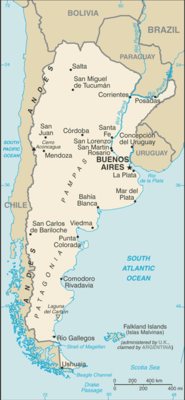
Map image could not be loaded. Open source image.
ⓘ
CIA World Factbook map, February 2021 media edition. Identity reviewed; current boundaries have not been audited. visual contact sheet or original identity check; does not verify current boundaries Boundaries, place names and designations may be dated or disputed; original annotations retained. SHA-256: ae4196563bc412ffb34ac7f8b3a4c0f9b6bd2afab7f747d1ce342b10e4631c7a. Provenance and inspection record.ⓘ
World Bank directory coordinates; approximate location, not a country center. Coordinate reference date is not supplied by the directory. Natural Earth 1:110m land (2022 source); simplified coastline, no political borders. Map source. Land SVG SHA-256: CF26056A39DC0A5B02F65704E279DFA86E77539A8387D0B2C92F907A67739E5E.Introduction
Background:1
In 1816, the United Provinces of the Río de la Plata declared their independence from Spain. After Bolivia, Paraguay, and Uruguay went their separate ways, the area that remained became Argentina. European immigrants heavily shaped the country's population and culture, with Italy and Spain providing the largest percentage of newcomers from 1860 to 1930. Until about the mid-20th century, much of Argentina's history was dominated by periods of internal political unrest and conflict between civilian and military factions.
After World War II, former President Juan Domingo PERÓN -- the founder of the Peronist political movement -- introduced an era of populism, serving three non-consecutive terms in office until his death in 1974. Direct and indirect military interference in government throughout the PERÓN years led to a military junta taking power in 1976. In 1982, the junta failed in its bid to seize the Falkland Islands (Islas Malvinas) by force from the United Kingdom. Democracy was reinstated in 1983 and has persisted despite numerous challenges, the most formidable of which was a severe economic crisis in 2001-02 that led to violent public protests and the successive resignations of several presidents. The years 2003-15 saw Peronist rule by Néstor KIRCHNER (2003-07) and his spouse Cristina FERNÁNDEZ DE KIRCHNER (2007-15), who oversaw several years of strong economic growth (2003-11) followed by a gradual deterioration in the government’s fiscal situation and eventual economic stagnation and isolation. Argentina underwent a brief period of economic reform and international reintegration under Mauricio MACRI (2015-19), but a recession in 2018-19 and frustration with MACRI’s economic policies ushered in a new Peronist government in 2019 led by President Alberto FERNÁNDEZ and Vice President Cristina FERNÁNDEZ DE KIRCHNER. Argentina's high public debts, its pandemic-related inflationary pressures, and systemic monetary woes served as the catalyst for the 2023 elections, culminating with President Javier MILEI's electoral success. Argentina has since eliminated half of its government agencies and is seeking shock therapy to amend taxation and monetary policies.
Geography
Location:2
Southern South America, bordering the South Atlantic Ocean, between Chile and Uruguay
Geographic coordinates:3
34 00 S, 64 00 W
Map references:4
South America
Area:5
Surface area: 2,780,400 square kilometers (2024)
Area - comparative:7
slightly less than three-tenths the size of the US
Land boundaries:8
Coastline:9
4,989 km
Maritime claims:10
Climate:11
mostly temperate; arid in southeast; subantarctic in southwest
Terrain:12
rich plains of the Pampas in northern half, flat to rolling plateau of Patagonia in south, rugged Andes along western border
Elevation:13
Natural resources:14
fertile plains of the pampas, lead, zinc, tin, copper, iron ore, manganese, petroleum, uranium, arable land
Land use:15
Irrigated land:16
13,910 sq km (2018)
Major lakes (area sq km):17
Major rivers (by length in km):18
Río de la Plata/Paraná river mouth (shared with Brazil [s], Paraguay, and Uruguay) - 4,880 km; Paraguay (shared with Brazil [s], and Paraguay [m]) - 2,549 km; Uruguay (shared with Brazil [s] and Uruguay [m]) - 1,610 km
Major watersheds (area sq km):19
Major aquifers:20
Guaraní Aquifer System
Population distribution:21
one third of the population lives in Buenos Aires; pockets of agglomeration occur throughout the northern and central parts of the country; Patagonia to the south remains sparsely populated
Natural hazards:22
San Miguel de Tucumán and Mendoza areas in the Andes subject to earthquakes; pamperos are violent windstorms that can strike the pampas and northeast; heavy flooding in some areas
Geography - note:23
second-largest country in South America (after Brazil); strategic location relative to sea lanes between the South Atlantic and the South Pacific Oceans (Strait of Magellan, Beagle Channel, Drake Passage); diverse geophysical landscapes range from tropical climates in the north to tundra in the far south; Cerro Aconcagua is the Western Hemisphere's tallest mountain, while Laguna del Carbón is the lowest point in the Western Hemisphere; shares Iguazú Falls, the world's largest waterfalls system, with Brazil
People and Society
Population:24
Population: 45,851,378 people (2025)
Nationality:26
Ethnic groups:27
European (mostly Spanish and Italian descent) and Mestizo (mixed European and Indigenous ancestry) 97.2%, Indigenous 2.4%, African descent 0.4% (2010 est.)
Languages:28
Spanish (official), Italian, English, German, French, indigenous (Quechua, Guarani, Mapudungun)
Religions:29
Roman Catholic 62.9%, Evangelical 15.3% (Pentecostal 13%, other Evangelical 2.3%), Jehovah's Witness and Church of Jesus Christ 1.4%, other 1.2% (includes Muslim, Jewish), none 18.9% (includes agnostic and atheist), unspecified 0.3% (2019 est.)
Age structure:30
Dependency ratios:31
Median age:32
Population growth rate:33
Population growth rate: 0.34 % annually (2025)
0.79% (2024 est.)
Birth rate:35
Crude birth rate: 11.09 births per 1,000 people (2024)
15.2 births/1,000 population (2024 est.)
Death rate:37
Crude death rate: 7.73 deaths per 1,000 people (2024)
7.3 deaths/1,000 population (2024 est.)
Net migration rate:39
-0.1 migrant(s)/1,000 population (2024 est.)
Population distribution:40
one third of the population lives in Buenos Aires; pockets of agglomeration occur throughout the northern and central parts of the country; Patagonia to the south remains sparsely populated
Urbanization:41
Urban population: 92.35 % of population (2025)
Major urban areas - population:43
15.490 million BUENOS AIRES (capital), 1.612 million Córdoba, 1.594 million Rosario, 1.226 million Mendoza, 1.027 million San Miguel de Tucumán, 914,000 La Plata (2023)
Sex ratio:44
Maternal mortality ratio:45
Maternal mortality ratio: 33 deaths per 100,000 live births (2023)
33 deaths/100,000 live births (2023 est.)
Infant mortality rate:47
Infant mortality rate: 8 deaths per 1,000 live births (2024)
Life expectancy at birth:49
Life expectancy at birth: 77.54 years (2024)
Total fertility rate:51
Total fertility rate: 1.5 births per woman (2024)
2.15 children born/woman (2024 est.)
Gross reproduction rate:53
1.04 (2024 est.)
Drinking water source:54
Health expenditure:55
Current health expenditure: 10.27 % of GDP (2023)
Physician density:57
Physicians: 5.11 per 1,000 people (2023)
5.11 physicians/1,000 population (2023)
Hospital bed density:59
3.3 beds/1,000 population (2021 est.)
Sanitation facility access:60
Obesity - adult prevalence rate:61
28.3% (2016)
Alcohol consumption per capita:62
Tobacco use:63
Children under the age of 5 years underweight:64
2% (2018 est.)
Currently married women (ages 15-49):65
48.9% (2023 est.)
Child marriage:66
Education expenditure:67
Government education expenditure: 5 % of GDP (2023)
Literacy:69
Adult literacy rate: 99.14 % of people aged 15 and over (2020)
School life expectancy (primary to tertiary education):71
Environment
Environmental issues:72
deforestation; soil degradation (erosion, salinization); desertification; air pollution; water pollution
International environmental agreements:73
Climate:74
mostly temperate; arid in southeast; subantarctic in southwest
Land use:75
Urbanization:76
Carbon dioxide emissions:77
Particulate matter emissions:78
12 micrograms per cubic meter (2019 est.)
Methane emissions:79
Waste and recycling:80
Total water withdrawal:81
Total renewable water resources:82
876.24 billion cubic meters (2022 est.)
Government
Country name:83
Government type:84
presidential republic
Capital:85
Administrative divisions:86
23 provinces ( provincias , singular - provincia ) and 1 autonomous city*; Buenos Aires, Catamarca, Chaco, Chubut, Ciudad Autonoma de Buenos Aires*, Cordoba, Corrientes, Entre Rios, Formosa, Jujuy, La Pampa, La Rioja, Mendoza, Misiones, Neuquen, Rio Negro, Salta, San Juan, San Luis, Santa Cruz, Santa Fe, Santiago del Estero, Tierra del Fuego - Antartida e Islas del Atlántico Sur (Tierra del Fuego - Antarctica and the South Atlantic Islands), Tucuman
Legal system:87
civil law system based on Western European legal systems
Constitution:88
International law organization participation:89
has not submitted an ICJ jurisdiction declaration; accepts ICCt jurisdiction
Citizenship:90
Suffrage:91
18-70 years of age; universal and compulsory; 16-17 years of age: optional for national elections
Executive branch:92
Legislative branch:93
Legislative branch - lower chamber:94
Legislative branch - upper chamber:95
Judicial branch:96
Political parties:97
Avanza Libertad or AL
Civic Coalition ARI or CC-ARI
Consenso Federal (Federal Consensus) or CF
Frente Cívico por Santiago (Civic Front for Santiago)
Frente de Izquierda y de los Trabajadores – Unidad (Workers' Left Front) or FIT-U (coalition of leftist parties in lower house; includes PTS, PO, and MST)
Frente de la Concordia Misionero (Front for the Renewal of Social Concord) or FRCS
Frente Renovador (Renewal Front) or FR
Generación por un Encuentro Nacional (Generation for a National Encounter) or GEN
Hacemos por Córdoba (We do for Cordoba) or HC
Hacemos por Nuestro Pais (We Do For Our Country) or NHP
Juntos por el Cambio (Together for Change) or JxC (includes CC-ARI, PRO, and UCR); note - primary opposition coalition since 2019
Juntos Somos Río Negro (Together We Are Rio Negro) or JSRN
Partido Justicialista (Justicialist Party) or PJ
La Cámpora
La Libertad Avanza (The Liberty Advances) or LLA
Movimiento Popular Neuquino (Neuquén People's Movement) or MPN
Movimiento Socialista de los Trabajadores (Workers' Socialist Movement) or MST
Partido de los Trabajadores Socialistas (Socialist Workers' Party) or PTS
Partido Demócrata (Democratic Party) or PDN
Partido Libertario (Libertarian Party) or PL; note - party is also a founding member of the coalition La Libertad Avanza
Partido Obrero (Workers' Party) or PO
Partido Socialista or PS
Propuesta Republicana (Republican Proposal) or PRO
Unidad Federal (coalition of provencial parties in the lower house; includes FRCS and JSRN)
Unión Cívica Radical (Radical Civic Union) or UCR
Unión por la Patria (Union for the Homeland) or UP (formerly Frente de Todos (Everyone's Front) or FdT) (includes FR, La Cámpora, and PJ); note - ruling coalition since 2019; includes several national and provincial Peronist political parties
Vamos con Vos (Let's Go with You) or VcV
Diplomatic representation in the US:98
Diplomatic representation from the US:99
International organization participation:100
AfDB (nonregional member), Australia Group, BCIE, BIS, CAN (associate), CD, CABEI, CELAC, FAO, FATF, G-15, G-20, G-24, G-77, IADB, IAEA, IBRD, ICAO, ICC (national committees), ICCt, ICRM, IDA, IFAD, IFC, IFRCS, IHO, ILO, IMF, IMO, IMSO, Interpol, IOC, IOM, IPU, ISO, ITSO, ITU, ITUC (NGOs), LAES, LAIA, Mercosur, MIGA, MINURSO, MINUSTAH, NAM (observer), NSG, OAS, OPANAL, OPCW, Paris Club (associate), PCA, PROSUR, SICA (observer), UN, UNASUR, UNCTAD, UNDOF, UNESCO, UNFICYP, UNHCR, UNHRC, UNIDO, Union Latina (observer), UNOOSA, UNTSO, UNWTO, UPU, Wassenaar Arrangement, WCO, WFTU (NGOs), WHO, WIPO, WMO, WTO, ZC
Independence:101
9 July 1816 (from Spain)
National holiday:102
Revolution Day (May Revolution Day), 25 May (1810)
Flag:103
National symbol(s):104
Sun of May (a sun-with-face symbol)
National color(s):105
sky blue, white
National anthem(s):106
National heritage:107
Economy
Economic overview:108
large diversified economy; financial risks from debt obligations, rapid inflation, and reduced investor appetites; resource-rich, export-led growth model; increasing trade relations with China; G20 and OAS leader; tendency to nationalize businesses and under-report inflation
Real GDP (purchasing power parity):109
$1.213 trillion (2024 est.)
$1.234 trillion (2023 est.)
$1.255 trillion (2022 est.)
Real GDP growth rate:110
-1.7% (2024 est.)
-1.6% (2023 est.)
5.3% (2022 est.)
Real GDP per capita:111
GDP (official exchange rate):112
GDP: 683,097,891,618.6 current US dollars (2025)
$633.267 billion (2024 est.)
Inflation rate (consumer prices):114
GDP - composition, by sector of origin:115
GDP - composition, by end use:116
Agricultural products:117
maize, soybeans, sugarcane, wheat, milk, sunflower seeds, barley, beef, potatoes, chicken (2023)
Industries:118
food processing, motor vehicles, consumer durables, textiles, chemicals and petrochemicals, printing, metallurgy, steel
Industrial production growth rate:119
-7.2% (2024 est.)
Labor force:120
22.286 million (2024 est.)
Unemployment rate:121
Youth unemployment rate (ages 15-24):122
Population below poverty line:123
41.7% (2023 est.)
Gini Index coefficient - distribution of family income:124
42.4 (2023 est.)
Average household expenditures:125
Household income or consumption by percentage share:126
Remittances:127
0.2% of GDP (2024 est.)
0.2% of GDP (2023 est.)
0.2% of GDP (2022 est.)
Budget:128
Public debt:129
55% of GDP (2016 est.)
Taxes and other revenues:130
10% (of GDP) (2023 est.)
Current account balance:131
$6.285 billion (2024 est.)
-$20.956 billion (2023 est.)
-$4.055 billion (2022 est.)
Exports:132
$96.899 billion (2024 est.)
$82.947 billion (2023 est.)
$102.928 billion (2022 est.)
Exports - partners:133
Brazil 18%, USA 9%, Chile 8%, China 8%, India 4% (2023)
Exports - commodities:134
soybean meal, corn, trucks, soybean oil, crude petroleum (2023)
Imports:135
$79.999 billion (2024 est.)
$92.3 billion (2023 est.)
$97.399 billion (2022 est.)
Imports - partners:136
Brazil 23%, China 20%, USA 12%, Paraguay 5%, Germany 4% (2023)
Imports - commodities:137
soybeans, vehicle parts/accessories, refined petroleum, natural gas, cars (2023)
Reserves of foreign exchange and gold:138
$29.56 billion (2024 est.)
$23.081 billion (2023 est.)
$44.795 billion (2022 est.)
Debt - external:139
$74.362 billion (2023 est.)
Exchange rates:140
914.695 (2024 est.)
296.258 (2023 est.)
130.617 (2022 est.)
94.991 (2021 est.)
70.539 (2020 est.)
Energy
Electricity access:141
Electricity:142
Electricity generation sources:143
Nuclear energy:144
Coal:145
Petroleum:146
Natural gas:147
Energy consumption per capita:148
Communications
Telephones - fixed lines:149
Telephones - mobile cellular:150
Broadcast media:151
one of South America's biggest media markets; dozens of TV networks, hundreds of radio stations, and more than 150 daily newspapers (2023)
Internet country code:152
.ar
Internet users:153
Broadband - fixed subscriptions:154
Transportation
Civil aircraft registration country code prefix:155
LV
Airports:156
764 (2025)
Heliports:157
148 (2025)
Railways:158
Merchant marine:159
Ports:160
Military and Security
Military and security forces:161
Armed Forces of the Argentine Republic (Fuerzas Armadas de la República Argentina): Argentine Army (Ejercito Argentino, EA), Navy of the Argentine Republic (Armada Republica, ARA; includes naval aviation and naval infantry), Argentine Air Force (Fuerza Aerea Argentina, FAA)
Ministry of Security: Gendarmería Nacional Argentina (National Gendarmerie), Coast Guard (Prefectura Naval) (2025)
Military expenditures:162
0.6% of GDP (2024 est.)
0.5% of GDP (2023 est.)
0.6% of GDP (2022 est.)
0.8% of GDP (2021 est.)
0.8% of GDP (2020 est.)
Military and security service personnel strengths:163
approximately 75,000 active-duty Armed Forces (45,000 Army; 15,000 Navy, including about 3,500 marines; 15,000 Air Force) (2025)
Military equipment inventories and acquisitions:164
the inventory of Argentina's armed forces is a mix of domestically-produced and mostly older imported weapons, largely from Europe and the US; in recent years, France and the US have been the leading suppliers of equipment; Argentina has an indigenous defense industry that produces air, land, and naval systems (2024)
Military service age and obligation:165
18-24 years of age for voluntary military service for men and women; conscription suspended in 1995; citizens can still be drafted in times of crisis, national emergency, or war, or if the Defense Ministry is unable to fill all vacancies to keep the military functional (2024)
Military deployments:166
325 Cyprus (UNFICYP) (2024)
Military - note:167
the Argentine military’s primary responsibilities are territorial defense and protecting the country’s sovereignty; duties also include border security, countering narcotics trafficking, and other internal missions, such as disaster response and infrastructure development; it conducts support operations and has bases in Antarctica to promote an active presence in areas of national territory that are sparsely populated; the military also participates in both bilateral and multinational training exercises and supports UN peacekeeping operations
Argentina participates in the Tripartite Command, an interagency security mechanism created by Argentina, Brazil, and Paraguay to exchange information and combat transnational threats, such as crime and terrorism, in the Tri-Border Area; in addition, Argentina and Chile have a joint peacekeeping force known as the Combined Southern Cross Peacekeeping Force, designed to be made available to the UN; Argentina has Major Non-NATO Ally (MNNA) status with the US, a designation under US law that provides foreign partners with certain benefits in the areas of defense trade and security cooperation
the Army and Navy were both created in 1810 during the Argentine War of Independence, while the Air Force was established in 1945; the military conducted coups d'état in 1930, 1943, 1955, 1962, 1966, and 1976; the 1976 coup, aka the "National Reorganization Process," marked the beginning of the so-called "Dirty War," a period of state-sponsored terrorism that saw the deaths or disappearances of thousands of Argentinians; the defeat in the 1982 Falklands War led to the downfall of the military junta (2025)
Space
Space agency/agencies:168
Argentina National Space Activities Commission (Comision Nacional de Actividades Espaciales, CONAE; formed in 1991) (2025)
Space launch site(s):169
Manuel Belgrano Space Center (Buenos Aires province); Punta Indio Space Center (Buenos Aires province); Teofilo Tabanera Space Center (CETT; Cordoba Province; testing/mission control) (2025)
Space program overview:170
has a national space program and a history in the development of space-related capabilities, including rockets and satellites; develops, builds, and operates communications, remote sensing (RS), and scientific satellites, often in partnership with other countries; developing additional satellites with more advanced payloads; contracts with commercial and other government space agencies for launches, but has a domestic rocket program and is developing space launch vehicle (SLV) capabilities; cooperates with a broad range of space agencies and industries, including those of Brazil, China, the European Space Agency and its member states (particularly France, Italy), and the US; also has a commercial space industry (2025)
Key space-program milestones:171
1961-1967 - launched first rocket (Alfa Centauro) and was first country in Latin America to send an animal into space
1997 - first domestically built communications satellite (Nahuel-1A) launched on European satellite launch vehicle (SLV)
2007 - launch of first sub-orbital test rocket for domestic SLV (Tronador) project
2018 - first domestically built, synthetic-aperture-radar remote sensing satellite (SAOCOM 1A) launched by US
2020-2021 - worked with Mexico to create the Latin American and Caribbean Space Agency (ALCE)
2023 - signed US-led Artemis Accords outlining best practices for space exploration
2025 - continued development of two-stage Tronador SLV
Terrorism
Terrorist group(s):172
Hizballah
Transnational Issues
Refugees and internally displaced persons:173
Additional observations
- Real GDP growth174
- 4.37 % annual change (2025)
- Consumer price inflation175
- 219.88 % annual change (2024)
- Unemployment (modeled ILO estimate)176
- 7.15 % of labor force (2025)
- Access to electricity177
- 98.4 % of population (2024)
- Renewable energy share of total final energy consumption178
- 9.2 % (2021)
- Individuals using the internet179
- 89.67 % of population (2024)
- At least basic sanitation services180
- 94.82 % of population (2016)
- At least basic drinking water services181
- 99.04 % of population (2016)
Notes & sources
- Background. Reference edition; observation: dates as stated in text. Field last updated: not supplied; profile fallback: 2025-12-05 06:51:32 -0500 (not a field revision date); needs review. Reference source. Edition last checked 2026-10-29 (retrieval only). ↩
- Location. Reference edition; observation: dates as stated in text. Field last updated: not supplied; profile fallback: 2025-12-05 06:51:32 -0500 (not a field revision date); needs review. Reference source. Edition last checked 2026-10-29 (retrieval only). ↩
- Geographic coordinates. Reference edition; observation: dates as stated in text. Field last updated: not supplied; profile fallback: 2025-12-05 06:51:32 -0500 (not a field revision date); needs review. Reference source. Edition last checked 2026-10-29 (retrieval only). ↩
- Map references. Reference edition; observation: dates as stated in text. Field last updated: not supplied; profile fallback: 2025-12-05 06:51:32 -0500 (not a field revision date); needs review. Reference source. Edition last checked 2026-10-29 (retrieval only). ↩
- Area. Reference edition; observation: dates as stated in text. Field last updated: not supplied; profile fallback: 2025-12-05 06:51:32 -0500 (not a field revision date); needs review. Reference source. The archived total area has no reference year and territorial coverage may differ from World Bank surface area. World Bank: 2,780,400 square kilometers (2024). Reference: 2,780,400 square kilometers. Edition last checked 2026-10-29 (retrieval only). ↩
- Surface area. Surface area: observation 2024; checked 2026-10-29; single source. World Bank World Development Indicators. The archived total area has no reference year and territorial coverage may differ from World Bank surface area. World Bank: 2,780,400 square kilometers (2024). Reference: 2,780,400 square kilometers. ↩
- Area - comparative. Reference edition; observation: dates as stated in text. Field last updated: not supplied; profile fallback: 2025-12-05 06:51:32 -0500 (not a field revision date); needs review. Reference source. Edition last checked 2026-10-29 (retrieval only). ↩
- Land boundaries. Reference edition; observation: dates as stated in text. Field last updated: not supplied; profile fallback: 2025-12-05 06:51:32 -0500 (not a field revision date); needs review. Reference source. Edition last checked 2026-10-29 (retrieval only). ↩
- Coastline. Reference edition; observation: dates as stated in text. Field last updated: not supplied; profile fallback: 2025-12-05 06:51:32 -0500 (not a field revision date); needs review. Reference source. Edition last checked 2026-10-29 (retrieval only). ↩
- Maritime claims. Reference edition; observation: dates as stated in text. Field last updated: not supplied; profile fallback: 2025-12-05 06:51:32 -0500 (not a field revision date); needs review. Reference source. Edition last checked 2026-10-29 (retrieval only). ↩
- Climate. Reference edition; observation: dates as stated in text. Field last updated: not supplied; profile fallback: 2025-12-05 06:51:32 -0500 (not a field revision date); needs review. Reference source. Edition last checked 2026-10-29 (retrieval only). ↩
- Terrain. Reference edition; observation: dates as stated in text. Field last updated: not supplied; profile fallback: 2025-12-05 06:51:32 -0500 (not a field revision date); needs review. Reference source. Edition last checked 2026-10-29 (retrieval only). ↩
- Elevation. Reference edition; observation: dates as stated in text. Field last updated: not supplied; profile fallback: 2025-12-05 06:51:32 -0500 (not a field revision date); needs review. Reference source. Edition last checked 2026-10-29 (retrieval only). ↩
- Natural resources. Reference edition; observation: dates as stated in text. Field last updated: not supplied; profile fallback: 2025-12-05 06:51:32 -0500 (not a field revision date); needs review. Reference source. Edition last checked 2026-10-29 (retrieval only). ↩
- Land use. Reference edition; observation: dates as stated in text. Field last updated: not supplied; profile fallback: 2025-12-05 06:51:32 -0500 (not a field revision date); needs review. Reference source. Edition last checked 2026-10-29 (retrieval only). ↩
- Irrigated land. Reference edition; observation: 2018. Field last updated: not supplied; profile fallback: 2025-12-05 06:51:32 -0500 (not a field revision date); needs review. Reference source. Edition last checked 2026-10-29 (retrieval only). ↩
- Major lakes (area sq km). Reference edition; observation: dates as stated in text. Field last updated: not supplied; profile fallback: 2025-12-05 06:51:32 -0500 (not a field revision date); needs review. Reference source. Edition last checked 2026-10-29 (retrieval only). ↩
- Major rivers (by length in km). Reference edition; observation: dates as stated in text. Field last updated: not supplied; profile fallback: 2025-12-05 06:51:32 -0500 (not a field revision date); needs review. Reference source. Edition last checked 2026-10-29 (retrieval only). ↩
- Major watersheds (area sq km). Reference edition; observation: dates as stated in text. Field last updated: not supplied; profile fallback: 2025-12-05 06:51:32 -0500 (not a field revision date); needs review. Reference source. Edition last checked 2026-10-29 (retrieval only). ↩
- Major aquifers. Reference edition; observation: dates as stated in text. Field last updated: not supplied; profile fallback: 2025-12-05 06:51:32 -0500 (not a field revision date); needs review. Reference source. Edition last checked 2026-10-29 (retrieval only). ↩
- Population distribution. Reference edition; observation: dates as stated in text. Field last updated: not supplied; profile fallback: 2025-12-05 06:51:32 -0500 (not a field revision date); needs review. Reference source. Edition last checked 2026-10-29 (retrieval only). ↩
- Natural hazards. Reference edition; observation: dates as stated in text. Field last updated: not supplied; profile fallback: 2025-12-05 06:51:32 -0500 (not a field revision date); needs review. Reference source. Edition last checked 2026-10-29 (retrieval only). ↩
- Geography - note. Reference edition; observation: dates as stated in text. Field last updated: not supplied; profile fallback: 2025-12-05 06:51:32 -0500 (not a field revision date); needs review. Reference source. Edition last checked 2026-10-29 (retrieval only). ↩
- Population. Reference edition; observation: dates as stated in text. Field last updated: not supplied; profile fallback: 2025-12-05 06:51:32 -0500 (not a field revision date); needs review. Reference source. Different reference years; no numerical agreement is asserted. World Bank: 45,851,378 people (2025). Reference: 46,994,384 people (2024). Edition last checked 2026-10-29 (retrieval only). ↩
- Population. Population: observation 2025; checked 2026-10-29; single source. World Bank World Development Indicators. Different reference years; no numerical agreement is asserted. World Bank: 45,851,378 people (2025). Reference: 46,994,384 people (2024). ↩
- Nationality. Reference edition; observation: dates as stated in text. Field last updated: not supplied; profile fallback: 2025-12-05 06:51:32 -0500 (not a field revision date); needs review. Reference source. Edition last checked 2026-10-29 (retrieval only). ↩
- Ethnic groups. Reference edition; observation: 2010 est.. Field last updated: not supplied; profile fallback: 2025-12-05 06:51:32 -0500 (not a field revision date); needs review. Reference source. Edition last checked 2026-10-29 (retrieval only). ↩
- Languages. Reference edition; observation: dates as stated in text. Field last updated: not supplied; profile fallback: 2025-12-05 06:51:32 -0500 (not a field revision date); needs review. Reference source. Edition last checked 2026-10-29 (retrieval only). ↩
- Religions. Reference edition; observation: 2019 est.. Field last updated: not supplied; profile fallback: 2025-12-05 06:51:32 -0500 (not a field revision date); needs review. Reference source. Edition last checked 2026-10-29 (retrieval only). ↩
- Age structure. Reference edition; observation: dates as stated in text. Field last updated: not supplied; profile fallback: 2025-12-05 06:51:32 -0500 (not a field revision date); needs review. Reference source. Edition last checked 2026-10-29 (retrieval only). ↩
- Dependency ratios. Reference edition; observation: dates as stated in text. Field last updated: not supplied; profile fallback: 2025-12-05 06:51:32 -0500 (not a field revision date); needs review. Reference source. Edition last checked 2026-10-29 (retrieval only). ↩
- Median age. Reference edition; observation: dates as stated in text. Field last updated: not supplied; profile fallback: 2025-12-05 06:51:32 -0500 (not a field revision date); needs review. Reference source. Edition last checked 2026-10-29 (retrieval only). ↩
- Population growth rate. Reference edition; observation: 2024. Field last updated: not supplied; profile fallback: 2025-12-05 06:51:32 -0500 (not a field revision date); needs review. Reference source. Edition last checked 2026-10-29 (retrieval only). ↩
- Population growth rate. Population growth rate: observation 2025; checked 2026-10-29; single source. World Bank World Development Indicators. Latest available World Bank series in 2020–2026; reference year is not retrieval year. May be modeled or revised; differing definitions and geography require review. No independent crosscheck; do not silently replace archived Factbook. ↩
- Birth rate. Reference edition; observation: 2024. Field last updated: not supplied; profile fallback: 2025-12-05 06:51:32 -0500 (not a field revision date); needs review. Reference source. Edition last checked 2026-10-29 (retrieval only). ↩
- Crude birth rate. Crude birth rate: observation 2024; checked 2026-10-29; single source. World Bank World Development Indicators. Latest available World Bank series in 2020–2026; reference year is not retrieval year. May be modeled or revised; differing definitions and geography require review. No independent crosscheck; do not silently replace archived Factbook. ↩
- Death rate. Reference edition; observation: 2024. Field last updated: not supplied; profile fallback: 2025-12-05 06:51:32 -0500 (not a field revision date); needs review. Reference source. Edition last checked 2026-10-29 (retrieval only). ↩
- Crude death rate. Crude death rate: observation 2024; checked 2026-10-29; single source. World Bank World Development Indicators. Latest available World Bank series in 2020–2026; reference year is not retrieval year. May be modeled or revised; differing definitions and geography require review. No independent crosscheck; do not silently replace archived Factbook. ↩
- Net migration rate. Reference edition; observation: 2024. Field last updated: not supplied; profile fallback: 2025-12-05 06:51:32 -0500 (not a field revision date); needs review. Reference source. Edition last checked 2026-10-29 (retrieval only). ↩
- Population distribution. Reference edition; observation: dates as stated in text. Field last updated: not supplied; profile fallback: 2025-12-05 06:51:32 -0500 (not a field revision date); needs review. Reference source. Edition last checked 2026-10-29 (retrieval only). ↩
- Urbanization. Reference edition; observation: dates as stated in text. Field last updated: not supplied; profile fallback: 2025-12-05 06:51:32 -0500 (not a field revision date); needs review. Reference source. Edition last checked 2026-10-29 (retrieval only). ↩
- Urban population. Urban population: observation 2025; checked 2026-10-29; single source. World Bank World Development Indicators. Latest available World Bank series in 2020–2026; reference year is not retrieval year. May be modeled or revised; differing definitions and geography require review. No independent crosscheck; do not silently replace archived Factbook. ↩
- Major urban areas - population. Reference edition; observation: 2023. Field last updated: not supplied; profile fallback: 2025-12-05 06:51:32 -0500 (not a field revision date); needs review. Reference source. Edition last checked 2026-10-29 (retrieval only). ↩
- Sex ratio. Reference edition; observation: dates as stated in text. Field last updated: not supplied; profile fallback: 2025-12-05 06:51:32 -0500 (not a field revision date); needs review. Reference source. Edition last checked 2026-10-29 (retrieval only). ↩
- Maternal mortality ratio. Reference edition; observation: 2023. Field last updated: not supplied; profile fallback: 2025-12-05 06:51:32 -0500 (not a field revision date); needs review. Reference source. Edition last checked 2026-10-29 (retrieval only). ↩
- Maternal mortality ratio. Maternal mortality ratio: observation 2023; checked 2026-10-29; single source. World Bank World Development Indicators. Latest available World Bank series in 2020–2026; reference year is not retrieval year. May be modeled or revised; differing definitions and geography require review. No independent crosscheck; do not silently replace archived Factbook. ↩
- Infant mortality rate. Reference edition; observation: dates as stated in text. Field last updated: not supplied; profile fallback: 2025-12-05 06:51:32 -0500 (not a field revision date); needs review. Reference source. Edition last checked 2026-10-29 (retrieval only). ↩
- Infant mortality rate. Infant mortality rate: observation 2024; checked 2026-10-29; single source. World Bank World Development Indicators. Latest available World Bank series in 2020–2026; reference year is not retrieval year. May be modeled or revised; differing definitions and geography require review. No independent crosscheck; do not silently replace archived Factbook. ↩
- Life expectancy at birth. Reference edition; observation: dates as stated in text. Field last updated: not supplied; profile fallback: 2025-12-05 06:51:32 -0500 (not a field revision date); needs review. Reference source. Edition last checked 2026-10-29 (retrieval only). ↩
- Life expectancy at birth. Life expectancy at birth: observation 2024; checked 2026-10-29; single source. World Bank World Development Indicators. Latest available World Bank series in 2020–2026; reference year is not retrieval year. May be modeled or revised; differing definitions and geography require review. No independent crosscheck; do not silently replace archived Factbook. ↩
- Total fertility rate. Reference edition; observation: 2024. Field last updated: not supplied; profile fallback: 2025-12-05 06:51:32 -0500 (not a field revision date); needs review. Reference source. Edition last checked 2026-10-29 (retrieval only). ↩
- Total fertility rate. Total fertility rate: observation 2024; checked 2026-10-29; single source. World Bank World Development Indicators. Latest available World Bank series in 2020–2026; reference year is not retrieval year. May be modeled or revised; differing definitions and geography require review. No independent crosscheck; do not silently replace archived Factbook. ↩
- Gross reproduction rate. Reference edition; observation: 2024. Field last updated: not supplied; profile fallback: 2025-12-05 06:51:32 -0500 (not a field revision date); needs review. Reference source. Edition last checked 2026-10-29 (retrieval only). ↩
- Drinking water source. Reference edition; observation: dates as stated in text. Field last updated: not supplied; profile fallback: 2025-12-05 06:51:32 -0500 (not a field revision date); needs review. Reference source. Edition last checked 2026-10-29 (retrieval only). ↩
- Health expenditure. Reference edition; observation: dates as stated in text. Field last updated: not supplied; profile fallback: 2025-12-05 06:51:32 -0500 (not a field revision date); needs review. Reference source. Edition last checked 2026-10-29 (retrieval only). ↩
- Current health expenditure. Current health expenditure: observation 2023; checked 2026-10-29; single source. World Bank World Development Indicators. Latest available World Bank series in 2020–2026; reference year is not retrieval year. May be modeled or revised; differing definitions and geography require review. No independent crosscheck; do not silently replace archived Factbook. ↩
- Physician density. Reference edition; observation: 2023. Field last updated: not supplied; profile fallback: 2025-12-05 06:51:32 -0500 (not a field revision date); needs review. Reference source. Edition last checked 2026-10-29 (retrieval only). ↩
- Physicians. Physicians: observation 2023; checked 2026-10-29; single source. World Bank World Development Indicators. Latest available World Bank series in 2020–2026; reference year is not retrieval year. May be modeled or revised; differing definitions and geography require review. No independent crosscheck; do not silently replace archived Factbook. ↩
- Hospital bed density. Reference edition; observation: 2021. Field last updated: not supplied; profile fallback: 2025-12-05 06:51:32 -0500 (not a field revision date); needs review. Reference source. Edition last checked 2026-10-29 (retrieval only). ↩
- Sanitation facility access. Reference edition; observation: dates as stated in text. Field last updated: not supplied; profile fallback: 2025-12-05 06:51:32 -0500 (not a field revision date); needs review. Reference source. Edition last checked 2026-10-29 (retrieval only). ↩
- Obesity - adult prevalence rate. Reference edition; observation: 2016. Field last updated: not supplied; profile fallback: 2025-12-05 06:51:32 -0500 (not a field revision date); needs review. Reference source. Edition last checked 2026-10-29 (retrieval only). ↩
- Alcohol consumption per capita. Reference edition; observation: dates as stated in text. Field last updated: not supplied; profile fallback: 2025-12-05 06:51:32 -0500 (not a field revision date); needs review. Reference source. Edition last checked 2026-10-29 (retrieval only). ↩
- Tobacco use. Reference edition; observation: dates as stated in text. Field last updated: not supplied; profile fallback: 2025-12-05 06:51:32 -0500 (not a field revision date); needs review. Reference source. Edition last checked 2026-10-29 (retrieval only). ↩
- Children under the age of 5 years underweight. Reference edition; observation: 2018. Field last updated: not supplied; profile fallback: 2025-12-05 06:51:32 -0500 (not a field revision date); needs review. Reference source. Edition last checked 2026-10-29 (retrieval only). ↩
- Currently married women (ages 15-49). Reference edition; observation: 2023. Field last updated: not supplied; profile fallback: 2025-12-05 06:51:32 -0500 (not a field revision date); needs review. Reference source. Edition last checked 2026-10-29 (retrieval only). ↩
- Child marriage. Reference edition; observation: dates as stated in text. Field last updated: not supplied; profile fallback: 2025-12-05 06:51:32 -0500 (not a field revision date); needs review. Reference source. Edition last checked 2026-10-29 (retrieval only). ↩
- Education expenditure. Reference edition; observation: dates as stated in text. Field last updated: not supplied; profile fallback: 2025-12-05 06:51:32 -0500 (not a field revision date); needs review. Reference source. Edition last checked 2026-10-29 (retrieval only). ↩
- Government education expenditure. Government education expenditure: observation 2023; checked 2026-10-29; single source. World Bank World Development Indicators. Latest available World Bank series in 2020–2026; reference year is not retrieval year. May be modeled or revised; differing definitions and geography require review. No independent crosscheck; do not silently replace archived Factbook. ↩
- Literacy. Reference edition; observation: dates as stated in text. Field last updated: not supplied; profile fallback: 2025-12-05 06:51:32 -0500 (not a field revision date); needs review. Reference source. Edition last checked 2026-10-29 (retrieval only). ↩
- Adult literacy rate. Adult literacy rate: observation 2020; checked 2026-10-29; single source. World Bank World Development Indicators. Latest available World Bank series in 2020–2026; reference year is not retrieval year. May be modeled or revised; differing definitions and geography require review. No independent crosscheck; do not silently replace archived Factbook. ↩
- School life expectancy (primary to tertiary education). Reference edition; observation: dates as stated in text. Field last updated: not supplied; profile fallback: 2025-12-05 06:51:32 -0500 (not a field revision date); needs review. Reference source. Edition last checked 2026-10-29 (retrieval only). ↩
- Environmental issues. Reference edition; observation: dates as stated in text. Field last updated: not supplied; profile fallback: 2025-12-05 06:51:32 -0500 (not a field revision date); needs review. Reference source. Edition last checked 2026-10-29 (retrieval only). ↩
- International environmental agreements. Reference edition; observation: dates as stated in text. Field last updated: not supplied; profile fallback: 2025-12-05 06:51:32 -0500 (not a field revision date); needs review. Reference source. Edition last checked 2026-10-29 (retrieval only). ↩
- Climate. Reference edition; observation: dates as stated in text. Field last updated: not supplied; profile fallback: 2025-12-05 06:51:32 -0500 (not a field revision date); needs review. Reference source. Edition last checked 2026-10-29 (retrieval only). ↩
- Land use. Reference edition; observation: dates as stated in text. Field last updated: not supplied; profile fallback: 2025-12-05 06:51:32 -0500 (not a field revision date); needs review. Reference source. Edition last checked 2026-10-29 (retrieval only). ↩
- Urbanization. Reference edition; observation: dates as stated in text. Field last updated: not supplied; profile fallback: 2025-12-05 06:51:32 -0500 (not a field revision date); needs review. Reference source. Edition last checked 2026-10-29 (retrieval only). ↩
- Carbon dioxide emissions. Reference edition; observation: dates as stated in text. Field last updated: not supplied; profile fallback: 2025-12-05 06:51:32 -0500 (not a field revision date); needs review. Reference source. Edition last checked 2026-10-29 (retrieval only). ↩
- Particulate matter emissions. Reference edition; observation: 2019. Field last updated: not supplied; profile fallback: 2025-12-05 06:51:32 -0500 (not a field revision date); needs review. Reference source. Edition last checked 2026-10-29 (retrieval only). ↩
- Methane emissions. Reference edition; observation: dates as stated in text. Field last updated: not supplied; profile fallback: 2025-12-05 06:51:32 -0500 (not a field revision date); needs review. Reference source. Edition last checked 2026-10-29 (retrieval only). ↩
- Waste and recycling. Reference edition; observation: dates as stated in text. Field last updated: not supplied; profile fallback: 2025-12-05 06:51:32 -0500 (not a field revision date); needs review. Reference source. Edition last checked 2026-10-29 (retrieval only). ↩
- Total water withdrawal. Reference edition; observation: dates as stated in text. Field last updated: not supplied; profile fallback: 2025-12-05 06:51:32 -0500 (not a field revision date); needs review. Reference source. Edition last checked 2026-10-29 (retrieval only). ↩
- Total renewable water resources. Reference edition; observation: 2022. Field last updated: not supplied; profile fallback: 2025-12-05 06:51:32 -0500 (not a field revision date); needs review. Reference source. Edition last checked 2026-10-29 (retrieval only). ↩
- Country name. Reference edition; observation: dates as stated in text. Field last updated: not supplied; profile fallback: 2025-12-05 06:51:32 -0500 (not a field revision date); needs review. Reference source. Edition last checked 2026-10-29 (retrieval only). ↩
- Government type. Reference edition; observation: dates as stated in text. Field last updated: not supplied; profile fallback: 2025-12-05 06:51:32 -0500 (not a field revision date); needs review. Reference source. Edition last checked 2026-10-29 (retrieval only). ↩
- Capital. Reference edition; observation: dates as stated in text. Field last updated: not supplied; profile fallback: 2025-12-05 06:51:32 -0500 (not a field revision date); needs review. Reference source. Edition last checked 2026-10-29 (retrieval only). ↩
- Administrative divisions. Reference edition; observation: dates as stated in text. Field last updated: not supplied; profile fallback: 2025-12-05 06:51:32 -0500 (not a field revision date); needs review. Reference source. Edition last checked 2026-10-29 (retrieval only). ↩
- Legal system. Reference edition; observation: dates as stated in text. Field last updated: not supplied; profile fallback: 2025-12-05 06:51:32 -0500 (not a field revision date); needs review. Reference source. Edition last checked 2026-10-29 (retrieval only). ↩
- Constitution. Reference edition; observation: dates as stated in text. Field last updated: not supplied; profile fallback: 2025-12-05 06:51:32 -0500 (not a field revision date); needs review. Reference source. Edition last checked 2026-10-29 (retrieval only). ↩
- International law organization participation. Reference edition; observation: dates as stated in text. Field last updated: not supplied; profile fallback: 2025-12-05 06:51:32 -0500 (not a field revision date); needs review. Reference source. Edition last checked 2026-10-29 (retrieval only). ↩
- Citizenship. Reference edition; observation: dates as stated in text. Field last updated: not supplied; profile fallback: 2025-12-05 06:51:32 -0500 (not a field revision date); needs review. Reference source. Edition last checked 2026-10-29 (retrieval only). ↩
- Suffrage. Reference edition; observation: dates as stated in text. Field last updated: not supplied; profile fallback: 2025-12-05 06:51:32 -0500 (not a field revision date); needs review. Reference source. Edition last checked 2026-10-29 (retrieval only). ↩
- Executive branch. Reference edition; observation: dates as stated in text. Field last updated: not supplied; profile fallback: 2025-12-05 06:51:32 -0500 (not a field revision date); needs review. Reference source. Edition last checked 2026-10-29 (retrieval only). ↩
- Legislative branch. Reference edition; observation: dates as stated in text. Field last updated: not supplied; profile fallback: 2025-12-05 06:51:32 -0500 (not a field revision date); needs review. Reference source. Edition last checked 2026-10-29 (retrieval only). ↩
- Legislative branch - lower chamber. Reference edition; observation: dates as stated in text. Field last updated: not supplied; profile fallback: 2025-12-05 06:51:32 -0500 (not a field revision date); needs review. Reference source. Edition last checked 2026-10-29 (retrieval only). ↩
- Legislative branch - upper chamber. Reference edition; observation: dates as stated in text. Field last updated: not supplied; profile fallback: 2025-12-05 06:51:32 -0500 (not a field revision date); needs review. Reference source. Edition last checked 2026-10-29 (retrieval only). ↩
- Judicial branch. Reference edition; observation: dates as stated in text. Field last updated: not supplied; profile fallback: 2025-12-05 06:51:32 -0500 (not a field revision date); needs review. Reference source. Edition last checked 2026-10-29 (retrieval only). ↩
- Political parties. Reference edition; observation: dates as stated in text. Field last updated: not supplied; profile fallback: 2025-12-05 06:51:32 -0500 (not a field revision date); needs review. Reference source. Edition last checked 2026-10-29 (retrieval only). ↩
- Diplomatic representation in the US. Reference edition; observation: dates as stated in text. Field last updated: not supplied; profile fallback: 2025-12-05 06:51:32 -0500 (not a field revision date); needs review. Reference source. Edition last checked 2026-10-29 (retrieval only). ↩
- Diplomatic representation from the US. Reference edition; observation: dates as stated in text. Field last updated: not supplied; profile fallback: 2025-12-05 06:51:32 -0500 (not a field revision date); needs review. Reference source. Edition last checked 2026-10-29 (retrieval only). ↩
- International organization participation. Reference edition; observation: dates as stated in text. Field last updated: not supplied; profile fallback: 2025-12-05 06:51:32 -0500 (not a field revision date); needs review. Reference source. Edition last checked 2026-10-29 (retrieval only). ↩
- Independence. Reference edition; observation: dates as stated in text. Field last updated: not supplied; profile fallback: 2025-12-05 06:51:32 -0500 (not a field revision date); needs review. Reference source. Edition last checked 2026-10-29 (retrieval only). ↩
- National holiday. Reference edition; observation: dates as stated in text. Field last updated: not supplied; profile fallback: 2025-12-05 06:51:32 -0500 (not a field revision date); needs review. Reference source. Edition last checked 2026-10-29 (retrieval only). ↩
- Flag. Reference edition; observation: dates as stated in text. Field last updated: not supplied; profile fallback: 2025-12-05 06:51:32 -0500 (not a field revision date); needs review. Reference source. Edition last checked 2026-10-29 (retrieval only). ↩
- National symbol(s). Reference edition; observation: dates as stated in text. Field last updated: not supplied; profile fallback: 2025-12-05 06:51:32 -0500 (not a field revision date); needs review. Reference source. Edition last checked 2026-10-29 (retrieval only). ↩
- National color(s). Reference edition; observation: dates as stated in text. Field last updated: not supplied; profile fallback: 2025-12-05 06:51:32 -0500 (not a field revision date); needs review. Reference source. Edition last checked 2026-10-29 (retrieval only). ↩
- National anthem(s). Reference edition; observation: dates as stated in text. Field last updated: not supplied; profile fallback: 2025-12-05 06:51:32 -0500 (not a field revision date); needs review. Reference source. Edition last checked 2026-10-29 (retrieval only). ↩
- National heritage. Reference edition; observation: dates as stated in text. Field last updated: not supplied; profile fallback: 2025-12-05 06:51:32 -0500 (not a field revision date); needs review. Reference source. Edition last checked 2026-10-29 (retrieval only). ↩
- Economic overview. Reference edition; observation: dates as stated in text. Field last updated: not supplied; profile fallback: 2025-12-05 06:51:32 -0500 (not a field revision date); needs review. Reference source. Edition last checked 2026-10-29 (retrieval only). ↩
- Real GDP (purchasing power parity). Reference edition; observation: dates as stated in text. Field last updated: not supplied; profile fallback: 2025-12-05 06:51:32 -0500 (not a field revision date); needs review. Reference source. Edition last checked 2026-10-29 (retrieval only). ↩
- Real GDP growth rate. Reference edition; observation: dates as stated in text. Field last updated: not supplied; profile fallback: 2025-12-05 06:51:32 -0500 (not a field revision date); needs review. Reference source. Edition last checked 2026-10-29 (retrieval only). ↩
- Real GDP per capita. Reference edition; observation: dates as stated in text. Field last updated: not supplied; profile fallback: 2025-12-05 06:51:32 -0500 (not a field revision date); needs review. Reference source. Edition last checked 2026-10-29 (retrieval only). ↩
- GDP (official exchange rate). Reference edition; observation: 2024. Field last updated: not supplied; profile fallback: 2025-12-05 06:51:32 -0500 (not a field revision date); needs review. Reference source. Different reference years; no numerical agreement is asserted. World Bank: 683,097,891,618.6 current US dollars (2025). Reference: 633,267,000,000 current US dollars (2024). Edition last checked 2026-10-29 (retrieval only). ↩
- GDP. GDP: observation 2025; checked 2026-10-29; single source. World Bank World Development Indicators. Different reference years; no numerical agreement is asserted. World Bank: 683,097,891,618.6 current US dollars (2025). Reference: 633,267,000,000 current US dollars (2024). ↩
- Inflation rate (consumer prices). Reference edition; observation: dates as stated in text. Field last updated: not supplied; profile fallback: 2025-12-05 06:51:32 -0500 (not a field revision date); needs review. Reference source. Edition last checked 2026-10-29 (retrieval only). ↩
- GDP - composition, by sector of origin. Reference edition; observation: dates as stated in text. Field last updated: not supplied; profile fallback: 2025-12-05 06:51:32 -0500 (not a field revision date); needs review. Reference source. Edition last checked 2026-10-29 (retrieval only). ↩
- GDP - composition, by end use. Reference edition; observation: dates as stated in text. Field last updated: not supplied; profile fallback: 2025-12-05 06:51:32 -0500 (not a field revision date); needs review. Reference source. Edition last checked 2026-10-29 (retrieval only). ↩
- Agricultural products. Reference edition; observation: 2023. Field last updated: not supplied; profile fallback: 2025-12-05 06:51:32 -0500 (not a field revision date); needs review. Reference source. Edition last checked 2026-10-29 (retrieval only). ↩
- Industries. Reference edition; observation: dates as stated in text. Field last updated: not supplied; profile fallback: 2025-12-05 06:51:32 -0500 (not a field revision date); needs review. Reference source. Edition last checked 2026-10-29 (retrieval only). ↩
- Industrial production growth rate. Reference edition; observation: 2024. Field last updated: not supplied; profile fallback: 2025-12-05 06:51:32 -0500 (not a field revision date); needs review. Reference source. Edition last checked 2026-10-29 (retrieval only). ↩
- Labor force. Reference edition; observation: 2024. Field last updated: not supplied; profile fallback: 2025-12-05 06:51:32 -0500 (not a field revision date); needs review. Reference source. Edition last checked 2026-10-29 (retrieval only). ↩
- Unemployment rate. Reference edition; observation: dates as stated in text. Field last updated: not supplied; profile fallback: 2025-12-05 06:51:32 -0500 (not a field revision date); needs review. Reference source. Edition last checked 2026-10-29 (retrieval only). ↩
- Youth unemployment rate (ages 15-24). Reference edition; observation: dates as stated in text. Field last updated: not supplied; profile fallback: 2025-12-05 06:51:32 -0500 (not a field revision date); needs review. Reference source. Edition last checked 2026-10-29 (retrieval only). ↩
- Population below poverty line. Reference edition; observation: 2023. Field last updated: not supplied; profile fallback: 2025-12-05 06:51:32 -0500 (not a field revision date); needs review. Reference source. Edition last checked 2026-10-29 (retrieval only). ↩
- Gini Index coefficient - distribution of family income. Reference edition; observation: dates as stated in text. Field last updated: not supplied; profile fallback: 2025-12-05 06:51:32 -0500 (not a field revision date); needs review. Reference source. Edition last checked 2026-10-29 (retrieval only). ↩
- Average household expenditures. Reference edition; observation: dates as stated in text. Field last updated: not supplied; profile fallback: 2025-12-05 06:51:32 -0500 (not a field revision date); needs review. Reference source. Edition last checked 2026-10-29 (retrieval only). ↩
- Household income or consumption by percentage share. Reference edition; observation: dates as stated in text. Field last updated: not supplied; profile fallback: 2025-12-05 06:51:32 -0500 (not a field revision date); needs review. Reference source. Edition last checked 2026-10-29 (retrieval only). ↩
- Remittances. Reference edition; observation: dates as stated in text. Field last updated: not supplied; profile fallback: 2025-12-05 06:51:32 -0500 (not a field revision date); needs review. Reference source. Edition last checked 2026-10-29 (retrieval only). ↩
- Budget. Reference edition; observation: dates as stated in text. Field last updated: not supplied; profile fallback: 2025-12-05 06:51:32 -0500 (not a field revision date); needs review. Reference source. Edition last checked 2026-10-29 (retrieval only). ↩
- Public debt. Reference edition; observation: dates as stated in text. Field last updated: not supplied; profile fallback: 2025-12-05 06:51:32 -0500 (not a field revision date); needs review. Reference source. Edition last checked 2026-10-29 (retrieval only). ↩
- Taxes and other revenues. Reference edition; observation: 2023. Field last updated: not supplied; profile fallback: 2025-12-05 06:51:32 -0500 (not a field revision date); needs review. Reference source. Edition last checked 2026-10-29 (retrieval only). ↩
- Current account balance. Reference edition; observation: dates as stated in text. Field last updated: not supplied; profile fallback: 2025-12-05 06:51:32 -0500 (not a field revision date); needs review. Reference source. Edition last checked 2026-10-29 (retrieval only). ↩
- Exports. Reference edition; observation: dates as stated in text. Field last updated: not supplied; profile fallback: 2025-12-05 06:51:32 -0500 (not a field revision date); needs review. Reference source. Edition last checked 2026-10-29 (retrieval only). ↩
- Exports - partners. Reference edition; observation: 2023. Field last updated: not supplied; profile fallback: 2025-12-05 06:51:32 -0500 (not a field revision date); needs review. Reference source. Edition last checked 2026-10-29 (retrieval only). ↩
- Exports - commodities. Reference edition; observation: 2023. Field last updated: not supplied; profile fallback: 2025-12-05 06:51:32 -0500 (not a field revision date); needs review. Reference source. Edition last checked 2026-10-29 (retrieval only). ↩
- Imports. Reference edition; observation: dates as stated in text. Field last updated: not supplied; profile fallback: 2025-12-05 06:51:32 -0500 (not a field revision date); needs review. Reference source. Edition last checked 2026-10-29 (retrieval only). ↩
- Imports - partners. Reference edition; observation: 2023. Field last updated: not supplied; profile fallback: 2025-12-05 06:51:32 -0500 (not a field revision date); needs review. Reference source. Edition last checked 2026-10-29 (retrieval only). ↩
- Imports - commodities. Reference edition; observation: 2023. Field last updated: not supplied; profile fallback: 2025-12-05 06:51:32 -0500 (not a field revision date); needs review. Reference source. Edition last checked 2026-10-29 (retrieval only). ↩
- Reserves of foreign exchange and gold. Reference edition; observation: dates as stated in text. Field last updated: not supplied; profile fallback: 2025-12-05 06:51:32 -0500 (not a field revision date); needs review. Reference source. Edition last checked 2026-10-29 (retrieval only). ↩
- Debt - external. Reference edition; observation: dates as stated in text. Field last updated: not supplied; profile fallback: 2025-12-05 06:51:32 -0500 (not a field revision date); needs review. Reference source. Edition last checked 2026-10-29 (retrieval only). ↩
- Exchange rates. Reference edition; observation: dates as stated in text. Field last updated: not supplied; profile fallback: 2025-12-05 06:51:32 -0500 (not a field revision date); needs review. Reference source. Edition last checked 2026-10-29 (retrieval only). ↩
- Electricity access. Reference edition; observation: dates as stated in text. Field last updated: not supplied; profile fallback: 2025-12-05 06:51:32 -0500 (not a field revision date); needs review. Reference source. Edition last checked 2026-10-29 (retrieval only). ↩
- Electricity. Reference edition; observation: dates as stated in text. Field last updated: not supplied; profile fallback: 2025-12-05 06:51:32 -0500 (not a field revision date); needs review. Reference source. Edition last checked 2026-10-29 (retrieval only). ↩
- Electricity generation sources. Reference edition; observation: dates as stated in text. Field last updated: not supplied; profile fallback: 2025-12-05 06:51:32 -0500 (not a field revision date); needs review. Reference source. Edition last checked 2026-10-29 (retrieval only). ↩
- Nuclear energy. Reference edition; observation: dates as stated in text. Field last updated: not supplied; profile fallback: 2025-12-05 06:51:32 -0500 (not a field revision date); needs review. Reference source. Edition last checked 2026-10-29 (retrieval only). ↩
- Coal. Reference edition; observation: dates as stated in text. Field last updated: not supplied; profile fallback: 2025-12-05 06:51:32 -0500 (not a field revision date); needs review. Reference source. Edition last checked 2026-10-29 (retrieval only). ↩
- Petroleum. Reference edition; observation: dates as stated in text. Field last updated: not supplied; profile fallback: 2025-12-05 06:51:32 -0500 (not a field revision date); needs review. Reference source. Edition last checked 2026-10-29 (retrieval only). ↩
- Natural gas. Reference edition; observation: dates as stated in text. Field last updated: not supplied; profile fallback: 2025-12-05 06:51:32 -0500 (not a field revision date); needs review. Reference source. Edition last checked 2026-10-29 (retrieval only). ↩
- Energy consumption per capita. Reference edition; observation: dates as stated in text. Field last updated: not supplied; profile fallback: 2025-12-05 06:51:32 -0500 (not a field revision date); needs review. Reference source. Edition last checked 2026-10-29 (retrieval only). ↩
- Telephones - fixed lines. Reference edition; observation: dates as stated in text. Field last updated: not supplied; profile fallback: 2025-12-05 06:51:32 -0500 (not a field revision date); needs review. Reference source. Edition last checked 2026-10-29 (retrieval only). ↩
- Telephones - mobile cellular. Reference edition; observation: dates as stated in text. Field last updated: not supplied; profile fallback: 2025-12-05 06:51:32 -0500 (not a field revision date); needs review. Reference source. Edition last checked 2026-10-29 (retrieval only). ↩
- Broadcast media. Reference edition; observation: 2023. Field last updated: not supplied; profile fallback: 2025-12-05 06:51:32 -0500 (not a field revision date); needs review. Reference source. Edition last checked 2026-10-29 (retrieval only). ↩
- Internet country code. Reference edition; observation: dates as stated in text. Field last updated: not supplied; profile fallback: 2025-12-05 06:51:32 -0500 (not a field revision date); needs review. Reference source. Edition last checked 2026-10-29 (retrieval only). ↩
- Internet users. Reference edition; observation: dates as stated in text. Field last updated: not supplied; profile fallback: 2025-12-05 06:51:32 -0500 (not a field revision date); needs review. Reference source. Edition last checked 2026-10-29 (retrieval only). ↩
- Broadband - fixed subscriptions. Reference edition; observation: dates as stated in text. Field last updated: not supplied; profile fallback: 2025-12-05 06:51:32 -0500 (not a field revision date); needs review. Reference source. Edition last checked 2026-10-29 (retrieval only). ↩
- Civil aircraft registration country code prefix. Reference edition; observation: dates as stated in text. Field last updated: not supplied; profile fallback: 2025-12-05 06:51:32 -0500 (not a field revision date); needs review. Reference source. Edition last checked 2026-10-29 (retrieval only). ↩
- Airports. Reference edition; observation: 2025. Field last updated: not supplied; profile fallback: 2025-12-05 06:51:32 -0500 (not a field revision date); needs review. Reference source. Edition last checked 2026-10-29 (retrieval only). ↩
- Heliports. Reference edition; observation: 2025. Field last updated: not supplied; profile fallback: 2025-12-05 06:51:32 -0500 (not a field revision date); needs review. Reference source. Edition last checked 2026-10-29 (retrieval only). ↩
- Railways. Reference edition; observation: dates as stated in text. Field last updated: not supplied; profile fallback: 2025-12-05 06:51:32 -0500 (not a field revision date); needs review. Reference source. Edition last checked 2026-10-29 (retrieval only). ↩
- Merchant marine. Reference edition; observation: dates as stated in text. Field last updated: not supplied; profile fallback: 2025-12-05 06:51:32 -0500 (not a field revision date); needs review. Reference source. Edition last checked 2026-10-29 (retrieval only). ↩
- Ports. Reference edition; observation: dates as stated in text. Field last updated: not supplied; profile fallback: 2025-12-05 06:51:32 -0500 (not a field revision date); needs review. Reference source. Edition last checked 2026-10-29 (retrieval only). ↩
- Military and security forces. Reference edition; observation: 2025. Field last updated: not supplied; profile fallback: 2025-12-05 06:51:32 -0500 (not a field revision date); needs review. Reference source. Edition last checked 2026-10-29 (retrieval only). ↩
- Military expenditures. Reference edition; observation: dates as stated in text. Field last updated: not supplied; profile fallback: 2025-12-05 06:51:32 -0500 (not a field revision date); needs review. Reference source. Edition last checked 2026-10-29 (retrieval only). ↩
- Military and security service personnel strengths. Reference edition; observation: 2025. Field last updated: not supplied; profile fallback: 2025-12-05 06:51:32 -0500 (not a field revision date); needs review. Reference source. Edition last checked 2026-10-29 (retrieval only). ↩
- Military equipment inventories and acquisitions. Reference edition; observation: 2024. Field last updated: not supplied; profile fallback: 2025-12-05 06:51:32 -0500 (not a field revision date); needs review. Reference source. Edition last checked 2026-10-29 (retrieval only). ↩
- Military service age and obligation. Reference edition; observation: 2024. Field last updated: not supplied; profile fallback: 2025-12-05 06:51:32 -0500 (not a field revision date); needs review. Reference source. Edition last checked 2026-10-29 (retrieval only). ↩
- Military deployments. Reference edition; observation: 2024. Field last updated: not supplied; profile fallback: 2025-12-05 06:51:32 -0500 (not a field revision date); needs review. Reference source. Edition last checked 2026-10-29 (retrieval only). ↩
- Military - note. Reference edition; observation: 2025. Field last updated: not supplied; profile fallback: 2025-12-05 06:51:32 -0500 (not a field revision date); needs review. Reference source. Edition last checked 2026-10-29 (retrieval only). ↩
- Space agency/agencies. Reference edition; observation: 2025. Field last updated: not supplied; profile fallback: 2025-12-05 06:51:32 -0500 (not a field revision date); needs review. Reference source. Edition last checked 2026-10-29 (retrieval only). ↩
- Space launch site(s). Reference edition; observation: 2025. Field last updated: not supplied; profile fallback: 2025-12-05 06:51:32 -0500 (not a field revision date); needs review. Reference source. Edition last checked 2026-10-29 (retrieval only). ↩
- Space program overview. Reference edition; observation: 2025. Field last updated: not supplied; profile fallback: 2025-12-05 06:51:32 -0500 (not a field revision date); needs review. Reference source. Edition last checked 2026-10-29 (retrieval only). ↩
- Key space-program milestones. Reference edition; observation: dates as stated in text. Field last updated: not supplied; profile fallback: 2025-12-05 06:51:32 -0500 (not a field revision date); needs review. Reference source. Edition last checked 2026-10-29 (retrieval only). ↩
- Terrorist group(s). Reference edition; observation: dates as stated in text. Field last updated: not supplied; profile fallback: 2025-12-05 06:51:32 -0500 (not a field revision date); needs review. Reference source. Edition last checked 2026-10-29 (retrieval only). ↩
- Refugees and internally displaced persons. Reference edition; observation: dates as stated in text. Field last updated: not supplied; profile fallback: 2025-12-05 06:51:32 -0500 (not a field revision date); needs review. Reference source. Edition last checked 2026-10-29 (retrieval only). ↩
- Real GDP growth. Real GDP growth: observation 2025; checked 2026-10-29; single source. World Bank World Development Indicators. Gross domestic product is the total income earned through the production of goods and services in an economic territory during an accounting period. It can be measured in three different ways: using either the expenditure approach, the income approach, or the production approach. This indicator denotes the percentage change over each previous year of the constant price (base year 2015) series in United States dollars. Source metadata: https://api.worldbank.org/v2/indicator/NY.GDP.MKTP.KD.ZG?format=json ↩
- Consumer price inflation. Consumer price inflation: observation 2024; checked 2026-10-29; single source. World Bank World Development Indicators. Inflation as measured by the consumer price index reflects the annual percentage change in the cost to the average consumer of acquiring a basket of goods and services that may be fixed or changed at specified intervals, such as yearly. Source metadata: https://api.worldbank.org/v2/indicator/FP.CPI.TOTL.ZG?format=json ↩
- Unemployment (modeled ILO estimate). Unemployment (modeled ILO estimate): observation 2025; checked 2026-10-29; single source. World Bank World Development Indicators. Unemployment refers to the share of the labor force that is without work but available for and seeking employment. The ILO modeled estimate is not necessarily directly comparable with national unemployment measures. Source metadata: https://api.worldbank.org/v2/indicator/SL.UEM.TOTL.ZS?format=json ↩
- Access to electricity. Access to electricity: observation 2024; checked 2026-10-29; single source. World Bank World Development Indicators. Access to electricity is the percentage of population with access to electricity. Electrification data are collected from industry, national surveys and international sources. Source metadata: https://api.worldbank.org/v2/indicator/EG.ELC.ACCS.ZS?format=json ↩
- Renewable energy share of total final energy consumption. Renewable energy share of total final energy consumption: observation 2021; checked 2026-10-29; single source. World Bank World Development Indicators. Renewable energy consumption is the share of renewable energy in total final energy consumption. Source metadata: https://api.worldbank.org/v2/indicator/EG.FEC.RNEW.ZS?format=json ↩
- Individuals using the internet. Individuals using the internet: observation 2024; checked 2026-10-29; single source. World Bank World Development Indicators. Internet users are individuals who have used the Internet (from any location) in the last 3 months. The Internet can be used via a computer, mobile phone, personal digital assistant, games machine, digital TV etc. Source metadata: https://api.worldbank.org/v2/indicator/IT.NET.USER.ZS?format=json ↩
- At least basic sanitation services. At least basic sanitation services: observation 2016; checked 2026-10-29; primary source checked. World Bank World Development Indicators. Primary source checked 2026-10-29T19:32:15.212Z. provider release 2026-10-08. source organization WHO/UNICEF Joint Monitoring Programme (JMP) for Water Supply, Sanitation and Hygiene, World Health Organization (WHO), uri: washdata.org, publisher: WHO/UNICEF Joint Monitoring Programme (JMP) for Water Supply, Sanitation and Hygiene (washdata.org), date accessed: 2025-09-30, date published: 2025-08-25; UN Children's Fund (UNICEF), uri: washdata.org, note: WHO/UNICEF Joint Monitoring Programme (JMP) for Water Supply, Sanitation and Hygiene. definition People using at least basic sanitation services (% of population). Original provider-reported country/economy series; unchanged historical boundaries are not asserted. Checked original WDI publication and metadata, not independent corroboration. ↩
- At least basic drinking water services. At least basic drinking water services: observation 2016; checked 2026-10-29; primary source checked. World Bank World Development Indicators. Primary source checked 2026-10-29T19:32:07.460Z. provider release 2026-10-08. source organization WHO/UNICEF Joint Monitoring Programme (JMP) for Water Supply, Sanitation and Hygiene, World Health Organization (WHO), uri: washdata.org, publisher: WHO/UNICEF Joint Monitoring Programme (JMP) for Water Supply, Sanitation and Hygiene (washdata.org), date accessed: 2025-09-30, date published: 2025-08-25; UN Children's Fund (UNICEF), uri: washdata.org, note: WHO/UNICEF Joint Monitoring Programme (JMP) for Water Supply, Sanitation and Hygiene. definition People using at least basic drinking water services (% of population). Original provider-reported country/economy series; unchanged historical boundaries are not asserted. Checked original WDI publication and metadata, not independent corroboration. ↩